Search This Blog

Showing posts with label Truss. Show all posts

Friday, May 29, 2026

Early 20th Century Station Road Businesses Part One

NOTE: numbers given here are the numbers as they were then.


Post by Charlotte...


Right Hand Side (St Peter Street side) 

The Marlow Directory And Almanack of 1907 gives the first occupier on this side of the Street as C.H Carter, baker. That is Charles Henry Carter but his was the large corner premises on the Station Road and Causeway corner and these would be more usually considered to be in the Causeway (as that's where the main door was) so we will pass by him for now.

The first proper shop entrance you would come across was instead that of Miss Lydia Heal dressmaker. She'd first asked permission to fit a shop window into the property front in 1899 but she had already been plying her craft as a dressmaker in Marlow for 11 years by then. Many such businesswomen did not have shops, though to do so would be their ultimate ambition if possible. Even though she may not have had a proper shop window in which to display her goods from the start of her career she certainly lived in the exact same Station Road premises and met her clients there by 1891. A 1903 advert in the South Bucks Standard thanked the "nobility and gentry" for their previous business and said that she would now be continuing "the business" on her own account. So it seems that earlier she was in a business partnership with someone else, even though only she is named in the application for the shop front alterations. The advert promises a good fit and moderate prices. Lydia tells us that she sells fancy drapery, millinery, underwear, corsetry, gloves, lace and ribbon as well as operating as a dressmaker. In 1910 lace was advertised as a speciality of her shop. In the same year winter suits are mentioned as being on display there.

We know Lydia still sold ready made underwear in 1906 as a woman pretending to live in nearby Station Villas took some away with her on approval to show an alleged sister but never brought the items back or paid for them, neither did the alleged sister materialize to do so. The same woman defrauded another Marlow clothes retailer around the same time using the same ruse. It might seem remarkably, even foolishly, trusting to allow a stranger to take valuable items from your shop on trust without paying for them but the practice of having clothing items on approval was not uncommon at the time. In order to qualify you would have to appear "respectably" dressed however. 

Passing the residential property of dairy farmer Augustus Creswell at no 9 (who kept some of his cows out back not to the best pleasure of the sanitary inspectors) we next come to James Faulkner the bootmaker at number 11.

A man whose premises seem to move about on this side of the road was photographer Ernest A. Hewett. He was certainly on this side of the street in all scenarios, and in most was given as being at no 17 so we'll slot him in our list here.

Cycle maker, coach builder and wheelwright H. H Mathews lived (at least for a time) at 21 Station Road but operated his business further along at number 35. He was apparently Henry Harold but was often known just by his middle name. There is also a reference to a Horace Mathews cycle agent in the same premises though that may be a mistake. H.H Mathews certainly operated alongside Harold Haine, motor engineer and cycle maker who eventually entirely took over the business at some point between 1915 and 1920. Harold Haine was a Raleigh cycle agent, amongst other things. He came from Egham Surrey originally. In 1907 an Albert Barnes worked for a H Mathews at no 35.

Between the home of H Mathews and his business premises was (by 1903) Mrs Ann Cockayne who let apartments at her home "St Clare", Woodham's Dairy, Walter Lovegrove the auctioneer (who met a tragic end see his biography post here ), a grocery shop at nos 27-29 run firstly by H W Britnell and then by Raymond G Ford and his wife Lily, and Smewings the tobacconist-come- newsagents.

Mrs Cockayne the landlady was in business at St Clare (sometimes given as St Claire) by 1899. She was then in her late 60s and by 1911 had retired and moved out. In the early 1890s there had been 4 apartment proprietors at the town end of Station Road as well a boarding house and two further apartment rental buildings at the station end of the road, all with a residential owner. The private lodgings trade in Station Road had clearly dropped off a lot by the second decade of the 1900s though some of that loss was due to similar properties springing up in Glade Road and elsewhere in the town rather than for a lack of desire for furnished apartments. Ann Cockayne herself became a lodger with a family in nearby South Place.

Annie Smewing ran the tobacconist come newsagents at number 31, with her husband Henry assisting her and being the name above the door but mainly being a gardener and groom employed elsewhere at The Lawn. Henry was one of the committee members at Marlow Football Club and one of Marlow's volunteer firefighters in the Edwardian age. In the 1930s this was Morris tobacconist and newsagent.

Also near to these shops was another dairy in 1907, Hornsby's. Presumably this was connected to the Hornsby's who kept a small dairy herd at Wood Barn Farm, Little Marlow. See here for more on them. Be warned - that post contains mention of serious animal cruelty.

Next along in terms of commercial premises in the mid 1910s was tobacconist C.O Mathews which probably became by 1920 the tobacco and confectionery shop of Mrs Annie Truss (who was definitely at no 37). She was still there in 1924 when she served hot drinks too. Probably she remained in business until her death in 1931. Annie, formerly Bailey, was the wife of Albert Truss, a man jailed at least four times prior to his 1916 marriage to Annie for failing to maintain his illegitimate children by Fanny Louisa Penfold. When jailed he frequently laughed in court. By trade Albert was a boatman though apparently reluctant to work. Prior to his marriage he was "kept" by his brother who was landlord of the Two Brewer's pub in St Peter Street. 

At 39 was the tiny premises of George Gardner AKA George Gardiner the greengrocer and fruiterer by 1920. George did not spend many years in the shop here. He was the grandson of Clara and William Gardner /Gardiner /Gardener of the Nags Head pub in Dean Street, see here.

Our next Station Road businesspeople on this side of the road were the Ways. Robert was a cabinet maker and shopkeeper early in the 1900s and adjoining his premises was the tiny Wheatsheaf pub. This was run by Thomas Way senior until his retirement in 1905 in favour of his son Thomas junior. Thomas junior remained landlord until at least 1921 but was gone by 1939. More on the Way family of the Wheatsheaf, including both Thomas Ways in my biographical post here. 

Finally on this side of the road in terms of commercial property we come to the Railway Hotel across from the station. For a history of this pub / hotel including the early 1900s landlords of these premises see this post.

The other side of the road will be featured in another post in the future along with businesses which we cannot firmly place to one side or the other.

Written and researched by Charlotte Day 

©Marlow Ancestors. You are very welcome to use my research for family or local history purposes with credit to this blog.

Selected Sources:

Marlow Directory and Almanack 1907 and 1915 editions, Marlow Printing Company. Marlow Directory 1891, Marlow Publishing Company.

"England and Wales, Marriage Registration Index, 1837-2005," , FamilySearch (https://familysearch.org/ark:/61903/1:1:26FV-PWY : 13 December 2014), Albert Truss and null, 1916; from "England & Wales Marriages, 1837-2005," database, findmypast (http://www.findmypast.com : 2012); citing 1916, quarter 4, vol. 3A, p. 1914, Wycombe, Buckinghamshire, England, General Register Office, Southport, England.

South Bucks Standard May 6th 1899, April 3rd 1903 and 10th August 1906 British Library Archives via the BNA.

Kelly's Post Office Directory of Bucks etc 1911, 1915 and 1920 editions. Kelly's Directories Limited.


Sunday, May 18, 2025

Edwardian St Peter Street / St Peter's Street


 Marlow St Peter /St Peter's Street residents in the Edwardian era (taking the popular definition for the era as extending 1901-1914). Some earlier and later incidents in the lives of those mentioned are also given to give a rounder picture.

EDWARDIAN PROPERTY NUMBERS (used here) ARE NOT NECESSARILY THE SAME AS THOSE OF TODAY. Some of these properties no longer exist. A few people may be missing here, we will work to get them added. 

Odd numbered properties=

The Old Parsonage - Mrs Fanny Havell  Morgan, a widow with her unmarried adult children Alice and William James. William was the manager of the Morgan family draper's shop in the High Street / Market Square. More on this long standing business and William here . By 1915 Mr H L Slocock was the resident.

The Deanery - Heneage Legge, a retired unmarried army colonel from 1907 to 1911. Steward of the Chiltern Hundreds 1906+ and former Conservative M.P for St George's Hanover Square constituency in London. One of the many Vice-Presidents of Marlow Regatta. He gave a speech to the local schoolchildren as part of the Empire Day celebrations in 1909 in which he told them that within the British Empire there lived a total population 90 thousand times greater than that of Marlow. All of the children present should work for the Empire and pray for the King he said. He then warned the little boy's amongst them that they might have to fight to defend the Empire one day and they should be prepared to die as a result. Way to go top of the list of people not to invite to a children's party, Heneage. You can see a photo of him on the National Portrait Gallery website here. Heneage died November 1911. The Deanery seems to have been empty for a little while afterwards.

Catholic Church. Exterior restored in 1904. Interior redecorated 1910.

Catholic Mixed School (infants) This was considered upon official inspection in 1910 to be poorly lit and with too few toilets. Grace Crowther of the Convent School (see below) also supervised this school which had around 90 pupils. Unlike the Convent  School this was not a private school.

No 7 Catholic Rectory  Canon Bernard Smith until his death in 1903 (full biography of him on the blog here ) then Father Squirrell, then from 1909 Father Arthur Tillet (bn c 1875-76). Arthur was the priest at Marlow for many years. He had been a student at St Mary's Roman Catholic College, Erdington, Warwickshire though he was of Norfolk origin. In 1912 he held a mass for those who died in the Titanic disaster.

Convent School (the Catholic Upper School) - supervised by Miss Grace Crowther who also lived on the premises. This school on this site was formerly ran by nuns hence the popular name but they left in the early 1880s. Back then it has been a mixed school for children of all classes but in Edwardian times it had been transformed into a school for girls. Grace had been the head since at least 1886. In 1889 money was stolen from her desk in a robbery by a hungry and homeless Henry Lacey, a boy whose father routinely locked him and his siblings out of their home and refused to let them back in. He wanted to buy himself some food. He was jailed for 2 weeks for the offence but no one seemed to do anything to punish the father, the real cause of the problem. The Convent upper school of the Edwardian era was described as a prestigious if small school for the children of rich Catholics. Four of her pupils aged between 12 and 18 boarded with Grace at the time of the 1901 census and she had two live in domestic servants. She later described herself as working for Buckinghamshire County Council as a teacher, at the Catholic mixed school above. Grace originated from Todmorden. Her date of birth wanders all about in the census but it would appear that it was correctly 1856 and that her parents Crossley and Mary and her siblings emigrated to the USA in 1873 on the Royal Mail Steamship the SS Algeria. Grace was already living away from home in 1871. Nevertheless to be willingly left behind in Britain without her parents or siblings at the age of just 17 must have been quite something. It certainly suggests a spirit of independence. 

Unplaced property somewhere around this point in the street later Victorian times to early 1900s - The boarding house of William and Mary Ann Betts (nee Hawks). Mary was the main head of the business and was assisted by her niece Sarah Godfrey who lived in. The Betts had previously operated the Queen public house in Quoiting Square. Following the death of her husband Mary took her niece and moved away from this street. Her "boarding house" seems to have consisted of two rooms rented out as one piece of accommodation. For many years  Charles Gibbons a commercial traveller for the wine and spirits trade had taken the rooms. He had once had a brewery in St Peter Street but the business collapsed. Though he moved to Maidenhead in around 1876/77 he kept up his friendship with Mary Ann and visited her whenever his business brought him to Marlow. Sadly in 1880 Charles was found dead with horrific injuries on the train line between Marlow and Maidenhead. It was supposed four different trains had gone over him while he lay on the track. Earlier in the day he had been visiting the Betts. Mary Ann Betts gave evidence at the inquest into his death, saying that both she and her niece had spoken to Charles and though he had some new money troubles he did not seem to be in low spirits. An open verdict was recorded.

The Nook - W Gibson then Charles Berry who remained into the 1920s. Not to be confused with Glade Nook in Glade Road.

River Cottage  mysterious. Seems to have been empty or non existent for most of the era but just afterwards in 1915 the home of Mrs Zuccani.

No. 13 William John Hutchins / Hutchings, sometimes known simply by his middle name and his wife Florence. Their ancient cottage consisted of just two rooms. William had worked as a boilersmith for Great Western Railways as well as formerly being the lock keeper at Temple Lock. Florence informally provided food for some of those who camped at the lock or passed through it in a boat. The campers, most of whom were from privileged backgrounds, often rented a spot on the lock island for the whole season and left their tents up whether they were there or not. Back in 1896 a teenage boy presented himself to Florence at the Lock Keeper's cottage and said he had been sent by one of the absent campers to keep an eye on his tent and he was to be kept and fed by her, bills to be sent to the camper at home in London. The boy disappeared after 3 days. Investigations revealed the camper had never seen him before in his life!

No. 15 Mary Butler born circa 1871, a self-employed needlewoman. Her niece Ethel Butler a teacher lived with her. She was appointed to the Infant School in St Peter Street in 1902. Their home was a very old cottage.  Ethel has retired and was still living at no 15 in the late 1930s.

No 17 a very old cottage of just three rooms at this point. Mrs Kezia(h) Corby, a widow, and her sister Caroline Smith. Earlier in the Edwardian era Kezia's children Charlie (bn circa 1873 a hotel barman) and Kate (bn circa 1886 an embroiderer) lived at home too. When Keziah died Caroline continued to live there alone. Both of these women were embroiderers too. Keziah had lived in St Peter's Street for some years with her husband Henry before his death.

No 19 Mrs Sparks early in the era. 

Fishermens Retreat former pub now small hotel ran by Mrs Elizabeth Hoddinott assisted by her daughter also called Elizabeth. Catered for boating and fishing parties. Was seen as a "high class" place of accommodation. More info here

Buckinghamshire Chair Company (behind)- detailed history of this business here.

Weir House let out as apartments 1903 by John Clark(e) Truss (see below). Had been split into apartments for at least 12 years at this point. Members of the Truss family were still hiring out apartments there in the late 1930s. In 1911 Eliza and Hugh Sutcliffe (a bookmaker) seem to have let the whole premises and sublet one or more rooms to a man described as their lodger, Stanley Smith. Jack Langley who was later a very successful bookmaker on his own account worked for him and became a St Peter Street resident himself when he bought Bridge House in 1913. See below. A Miss Lupton by the end of the Edwardian era was also a tenant of Weir House.

The Two Brewers pub Emily Sophia Truss then John Clarke Truss and his wife Henrietta. Like many pubs of the Edwardian era this one had a Slate Club. Pub was popular with early motoring visitors as it had a lock up garage.

Even numbered properties=

The Public Hall / Cinema combined. Both under the management of Horace Lacey of Station Road. A detailed post about the silent era film shows in the building is already on the blog here.

6-8 National School, Girls (built 1871) and Infants School (built 1868) front part of the site had  two houses for the head teachers. National School (Girls) =Miss Elizabeth Hunt head in 1907, previously head of the Infant's school on the same premises. She retired due to ill health in 1909 after 40 years of service to education at the school. In a presentation upon her leaving Elizabeth was given a gift of £35 collected by well wishers. A little more about Elizabeth can be found in this post. The girls' school had been expanded with two new classrooms and additional cloakrooms during the Edwardian era but was still considered cramped. After Elizabeth left she was replaced as head teacher by Mrs Mary Collins. As Mary lived with her husband Henry /Harry in Chapel Street the live in accommodation due to her within the school premises (numbered no 6 St Peter Street) was  instead let out to William and Annie (nee Jesty) Alloway. William was a house painter. / Infants School (built 1868) whose head was Victor Kibblewhite in 1907. In 1905 he became the Secretary of the Marlow Literary and Scientific Institute. He was also a member of the Rifle and Cricket clubs in the town. Victor was later a town councillor. The school heads usually resided on the premises in St Peter Street and Victor, his wife Ella and their children were no different (their living portion was officially no 8 St Peter Street).  When the new Boys' C of E school opened in Trinity Road he transferred there and the family made a new home at St Ronans Claremont Gardens. During the First World War Victor served on the town Food Control Committee. 

Dial House- Mrs Winter and Selina White, at end of era Mrs Ward. I have a post on the blog already about the Winter family of Dial House see here.

Dial Cottage - ?

The Old Malt House Mrs Emma Hoare of next door Bridge House bought this property in 1897 for £1600 from the executors of Mrs Greenwood. It was used as a summer home by some of her children. Rear Admiral Sir Sydney Marow Eardley Wilmot (bn 1847) made the property his home from circa 1909 and remained there till at least the early 1920s with his wife Grace nee Hoare daughter of Emma Hoare above. The property may have in fact been Grace's inheritance from her mother. Sydney was a twice published novelist and the author of two naval history books. One of his novels The Battle Of The North Sea was written during the time he was officially a resident of Marlow however he and Grace often travelled abroad so I can't guarantee that he actually sat down and wrote any pages in Marlow. He was knighted in 1909 for his Naval services. In an accidental explosion during a training exercise he had lost one of his hands.

Bridge House - Mrs Emma Hoare, widow of Thomas Rolls Hoare who had died in 1892. House put up for sale by auction in 1909 following her death aged 86 at her London house. Bridge House was described then as a Jacobean style home with 15 bedrooms, 3 reception rooms, a boat house, summer house and tennis court. Emma had apparently lived in Hastings and London jointly prior to moving to Marlow but she had visited the town as a regular summer guest before the move. She bought Bridge House in 1898 and if she was away on her summer holidays let out it out to tourists for the river season. She found the garden prone to flooding and her home to have drainage issues so soon after moving in asked the council to improve the drainage and provide a curbed pavement for St Peter Street down both sides. She offered to demolish the part of her stables that jutted 8 feet into the road to enable this. The council accepted her offer but did not end up kerbing the whole street as she had asked. The was the cause of an inordinate amount of discussion and trouble. 

After Mrs Hoare, Mrs Stephenson Smith briefly kept Bridge House as her summer holiday home. She was robbed while the house was shut up. The teenage thief got away with her fur lined coat, a pearl cross, an ornamental dagger and various other items. Not all those pieces of property were successfully recovered.

In 1913 Bridge House was bought by John "Jack" Langley, the chairman of Marlow Urban District Council. See here for a biography of John and Jack Langley. See above also. 


Sources=

Regatta Programme 1911.

Marlow Directory and Almanack 1891,  1907 and 1915 editions by Marlow Printing Company.

Kelly's Post Office Directory of Bucks etc 1895, 1911, 1915 editions.

1901 census of England and Wales, transcribed from microfilm, National Archives by Charlotte Day or Jane Pullinger except 1901 Erdington Warwickshire which was https://www.rootspoint.com/search/?CollectionKey=UK1901&FirstName=Arthur&MiddleName=&LastName=&BirthPlace=&LivedIn=Warwickshire+erdington+court&BirthYear=&MatchType=defaultex&submit=Search

South Bucks Standard June 1909 and 11th March 1898 from the British Library Archives, accessed via the BNA.

Maidenhead Advertiser clipping March 18th 1914.

Maidenhead Advertiser 12th June 1889, via Baylis Media Archives online.

Wikipedia article on Eardley-Wilmot https://en.m.wikipedia.org/wiki/Sydney_Eardley-Wilmot

Advertising literature, personal letters.

 G.R.O death registrations from the G.R.O online except m of William Alloway which was 

"England and Wales, Marriage Registration Index, 1837-2005," database, FamilySearch (https://familysearch.org/ark:/61903/1:1:2D6G-DLL : 13 December 2014), William Thomas Alloway, 1909; from "England & Wales Marriages, 1837-2005," database, findmypast (http://www.findmypast.com : 2012); citing 1909, quarter 4, vol. 3A, p. 1554, Wycombe, Buckinghamshire, England, General Register Office, Southport, England. 


Saturday, June 17, 2023

WILL OF ANN FULLER

Ann Fuller of Great Marlow, singlewoman. Will written 1851 and proved 1852.

Margaret Hickman has kindly offered to be her executor so she is appointed as such.

Just debts, funeral and costs for proving the will are to be paid first.

1 guinea each to:

Sarah Truss, widow.

Elizabeth Piggott, widow.

The wife of Edward Edwards.

The wife of Benjamin Marcham.

Elizabeth ?Mayor? 

The wife of Thomas Robinson of Harleyford.

To the wife of Joseph Austin her fire irons, fender, and sheets.

To Hannah Austin her best ....ing.

Tea caddy to ....Hickman.

Chest of drawers to Margaret Hickman.

From the rest of the furniture and clothing Martha Atkins, Susan Cleobury, Ann B.... and Caroline ?Dark? can choose something to remember her by.

Rest of her possessions: half to the said Mrs Austin and half to be divided between the children of Mrs Austin.

Witnessed by Ann Fry and William Fry both of Marlow.

The will was proved by Margaret Hickman wife of George Hickman.

Notes:

Ann lived with an elderly William Hickman, a surgeon, in West Street Marlow at the time of the 1841 census. I am unsure if she was related to him as the 1841 census did not record household relationships. William died aged 94 in 1850. George Hickman was his son and also a surgeon. Margaret Hickman was nee Aitchinson.

Benjamin Marcham and his wife lived in Oxford Road.

The wife of Thomas Robinson of Harleyford was named Mary. He was a Chelsea Pensioner.

Elizabeth Piggott was a laundress in Chapel Street Marlow.

Sarah Truss was an elderly laundress of Spittal Street.

William Fry was a servant (live out) who lived in West Street. It is uncertain whom he worked for. He had a daughter called Ann but she would have been only in her mid teens in 1851 which seems young for a will witness, though not unprecedented. The grave of William and his wife Phebe / Phoebe can be seen on the blog here, and their home here

More Marlow will summaries indexed here.

All mentions of any individual on this blog can be found by looking at the A-Z Person Index.

©Marlow Ancestors.

Will is held at the National Archives Kew. Transcribed by me and then summarised here.

Friday, September 9, 2022

A Triangle Used In Anger - Life In Eton Place, Marlow


While Eton Place survives as a place name in Marlow, unlike it's "twin" Cambridge Place, the old buildings are all long gone. As we have often been contacted by those with ancestors living in this busy little place in the Victorian and Edwardian era, this post will hopefully bring the old street back to life. 


Most of the housing was occupied by working class families, but it did not have the reputation for real poverty that some of the other nearby streets and rows did. This is not to say there were not some individuals there who were really badly off however. It's worth noting that Eton Place is in the general area known as Marefield and many people give that as their address as opposed to anything more specific well into the 1920s. Sometimes they may also describe their address as "Eton Place, Marefield(s). 


It's proximity to the very many public houses in Dean Street did mean a certain amount of drunk and disorderly behaviour spilling over there, not necessarily actually involving any of the residents! It's amusing how often those slightly worse for wear seem to end up wandering down Eton Place when it was not exactly part of their route home.  However there was one nasty brawl that did involve a resident, 37 year old bricklayer William Stacey, in April 1882. The victim was John Neighbour of Marefield and the weapon a rather unusual one...


A Triangle Wielded In Anger


Constable Birch was on routine patrol around midnight in Cambridge Road, just behind Eton Place. He heard a tremendous row going on so hot footed it to the scene. As he approached he heard John Neighbour call out several times that he had been hit, and what he took to be the sound of a bottle falling to the floor.  It was dark in the place but eventually he saw John leaning up against a wall with blood pouring down his face. It transpired that William Stacey had struck John on the head not with a bottle but a "triangle" which was in fact an iron cornice mould. Amusingly William had been using it as a triangle in the musical sense as part of an impromptu band celebrating a local wedding, I think in one of the Dean Street pubs. (Concertina, spoons..) He was returning home to Eton Place with his wife in what might be called a jolly state. It was at the corner of the Place and Queens Road that he met brothers John and William Neighbour also on the way home from an evening drinking. William Neighbour made a comment that it was time Stacey went home to bed, and especially his wife Elizabeth should do the same. Stacey took that as an insult, insinuating that Mrs Stacey was the sort of woman to stay out late, with the connotation of immoral character. He asked the Neighbours if they wanted to "start something" at which John Neighbour turned and asked him just what he meant by that. The end is not hard to predict and Stacey hit John on the head above his eye, knocking him unconscious briefly with the results we've seen. He was taken to Mr Atterbury, assistant to surgeon Shone, and then PC Birch returned and arrested Stacey who admitted the action. The doctor said the cut to Neighbour went to the bone and narrowly avoided destroying his eye. 


The background to this seemingly petty squabble is a little complicated. The Neighbour brothers were something of a terrible twosome, getting into no end of minor scrapes and brushes with the law.** They seem inseparable and rarely does a case involving one not involve the other. But they were not serious offenders, mostly troubling police with drunken and disorderly behaviour and silly nuisance offences such as kicking a door and then running away. It was for one of the last offences in February 1882 that saw Mrs Stacey testify that she had seen William Neighbour kick the door of William Smith in Queens Road, an action that resulted in him receiving a fine. It was insinuated that Elizabeth had lied about this as another man there "Potter" confessed to the action and yet another witness said it was in fact brother John who was guilty. It seems in the melee it was probably difficult to see what was going on. So there was bad blood between the Neighbours and the Staceys who also trouble the courts fairly often with drink related bad behaviour. The court found against Stacey noting that you could not be under the illusion that hitting someone with such an implement could do anything other than a nasty injury. But they also decided he had acted under provocation and counted the fact the weapon was not carried with the intention to do any harm. So a sentence of 4 months detention with hard labour came Stacey's way.* 


Most crime associated with Eton Place was minor thefts such as the loss of  George Rockell's ferret, lifted from his back garden. It was thankfully recovered alive and well! 


A Stranger Appears...

Although the number of people living in Eton Place was relatively dense, it's certain they all knew each other well and a stranger wandering about would attract attention, especially if he was discovered to be foreign. In 1902 one such person visited the Boddy family home. Ellen Boddy opened the door to a loud knock and found a well dressed man unknown to her standing there. He said (in a heavy foreign accent) that he had lodged with a Mrs Boddy in Station Rd about 5 years previously and wished to call on her. Young Ellen was clearly not this person so she took him to see her mother in law who had indeed lived previously at Station Rd but she did not recognize him either. Whether he himself thought Mrs Boddy senior was his former landlady is not clear. Regardless he left, having asked for no assistance or favour of any kind. A day later he was found floating face down in the river off the end of St Peters Street. He was spotted by Charles Woodley, who alerted the landlord of the adjacent Two Brewers, John Clark Truss. Truss recovered the body but the victim was not immediately identified. I do believe his identity was eventually established as a Frenchman who had been living in London but the circumstances of his trip to Marlow were a mystery. 


Tragedy for No.14

In 1939, resident of no 14 Eton Place, chauffeur Henry Samuel Batt, was killed on the sinking of the Dutch liner Simon Bolivar. This sank after coming in contact with a German mine. Henry was traveling aboard with his employer Sydney Preece of Maidenhead and the latters 3 year old daughter Elizabeth. He helped to put little Elizabeth in a wooden box to act as a sort of life raft for her, an action that undoubtedly saved her life. Preece managed to keep Elizabeth afloat and push her in front of him as he kept afloat in turn but he became separated from Henry. Henry is buried in Maidenhead cemetery. The horror for the Preece family was that Sydney Preece's wife and parents had all died in a car accident recently and so father and daughter had been travelling to visit her other grandparents who would be taking care of little Elizabeth for a while. 


Eton Place Gossip

Other events an Eton Place ancestor would have remembered and talked about were the scarlet fever outbreak amongst children in 1882. There were thankfully no fatalities. The Sanitary authorities ordered that the landlords of the affected properties should have them thoroughly cleaned out and disinfected. Predictably some landlords were less than forthcoming with work and at least one was fined for delaying the necessary actions. (He claimed he did not think the children really had scarlet fever and the house was already clean.)


Then there was the great stink of March 1887. A cart carrying barrels of waste from cess pits in neighbouring cottages was left standing by Eton Place for more than an hour, causing a sickening odour and obstructing the road. A brave soul ventured past the cart and summoned a constable to investigate. The cart was driven by William Burt but the case presented against him was dropped as he was only following orders of employer farmer William Creswell. 


I hope this gives you an idea of the events that impacted on the lives of our Eton Place residents of days gone by. There's many more we could mention..but if you are looking for a specific person or family, look for them in the A-Z person index in the top drop down menu or the Biographies of Families menu here


William Stacey's wife Elizabeth or Lizzie was nee Sadler and her little sister Ellen was the "Sleeping girl of Turville" - see here


To find other posts on specific streets see the menu here


Other posts about everyday life in old Marlow here


Written and researched by Kathryn Day. 


© MarlowAncestors. 


* Also present at the infamous Triangle fight was labourer George Jones of Marefield. 


**The Neighbour brothers were aged 23 (John) and 19 (William). Their sister Matilda features in a post to follow shortly.  The boys grandfather, a convict transported to Australia will also feature soon. 


Thursday, April 14, 2022

Interesting Occupations Of Marlow People 1891

 Trawling through my transcriptions of the 1891 census from microfilm I found some people with slightly more unusual occupations than the usual agricultural labourers, seamstresses and paper makers.

Roughton Henry Whall A native of Gloucestershire, Roughton was an organist and professor of music according to the census. He had the role of organist at the parish church in Marlow. He was also, though not at Marlow, a clarinet teacher. His older brother William Boulter Whall was a mariner who published an important book on English sea shanties in 1910. Roughton contributed the musical settings for the book while their niece Veronica illustrated the work. In 1891 Roughton aged 29 and his wife Flora (nee Adames, married Chichester 1887) lived along with a servant in the High Street. Roughton had lived in Marlow for about 4 years at that point. The Whalls were still there in the High Street in 1892 but seem to have moved away quite soon afterwards. The couple settled finally in Stroud, Gloucestershire where Roughton acted as the church organist for over 20 years. He died in 1937 leaving an estate worth just over £3,500. Flora passed away the next year with an estate worth a little under £9,000.

Charles Campton A watercress grower living Henley Road. Aged 34. The local watercress industry never garners much attention but it encompassed sites at Marlow (along the Henley Road), Little Marlow, Bourne End, Wooburn Moor and Medmenham. It was up in Chesham that the Bucks industry was centered however. There a Henry Dell grew 100 tons of the crop in 1881 alone. Half a bushel of watercress wholesale in 1885 was worth 1 shilling. It was a popular food in the Victorian era. Though it was made into soups and purees, it was thought to be most beneficial when eaten raw such as in a salad or sandwich. Charles Campton may have had streams flowing from the Thames to feed his watercress beds however running water was not necessary to grow the plant, a plentiful supply of near enough water from a well which could be used to wet the soil regularly was enough. Fellow Marlow Ancestors blogger Kathryn has grown watercress in her Marlow garden in the modern day nowhere near a stream. The water of course must be clean. During the 1890s there was a panic when the public began to realise that some growers were using water from streams into which Wycombe Sewage Works discharged their effluent, as well as water from potentially contaminated wells. The victims in all this were mostly Londoners who ended eating up he majority of Marlow area cress. Charles Campton is not known to have been involved in selling dodgy cress! 

Jeffery Truss A bill poster aged 77 living West Street with his wife Ann, as they had done for years. Being the town Bill Poster was an official position with public announcements being posted up for the public by the man given that job. Though he does not say so on the census, Jeffrey had also been the town crier since at least 1866. He had earlier in life been a cordwainer. In 1894 poor Jeffrey was rendered bed ridden with paralysis and suffered the loss of his wife. He died himself the next year and was buried in St Peters Roman Catholic churchyard. Perhaps he was a late convert to Catholicism as he was for decades one of the bellringers of the C of E parish church. He was in fact one of the team that first rang the bells when the (current) new church was built back in the 1830s. Jeffrey also played the hand bells in local musical concerts.

A biography of his successor as Bill Poster for Marlow, Edward Hatton, has been published on the blog here. 

Ellen Venables A draper's cashier visiting Clara and William Langston at no 12 High Street. It is quite unusual to see shop assistants specifically referred to as cashiers. This implies she most probably worked somewhere sufficiently large or busy for it to be someone's job to just take payment rather than to be a general assistant. More about the Langston's here

See:

Wikipedia article on W. B Whall, brother of Roughton.

Obituary Jeffrey Truss South Bucks Standard 14th June 1895.

Thursday, April 7, 2022

1700s West Street Residents

Updated March 2023.

 I glean every possible will and property record to gather the names of those who lived in West Street in the 1700s. The date next to each name is the date I find reference to them there but they may have been present earlier and later. This post is for the OCCUPIERS not owners of property. In most cases in the 1700s the two are not the same thing. The precise buildings cannot usually be identified but I am working on it!

Multiple people in the same family can bear the same name so don't automatically presume that a "John Smith" here is your particular "Joe Smith"!

Alice and Robert Beckford. He was a hoop shaver and owned their West Street home, though they only occupied part of it. This was described in his will written 1730 and proved 1731.

David Beckford 1751. Occupied part of the house formerly occupied by Alice and Robert Beckford above, which had been inherited by the Beckford's daughter.

John Biggs. Tenant of a cottage 1733. This was probably on the North side, close to Potlands.

Abel Bird. "The youngest Abel Bird" Shoemaker resident 1754. There were multiple Abel Birds about, the Bird family owned several West Street properties as well as some elsewhere in Marlow such as in Chapel Street.

William Bradshaw, market gardener, tenant of lands. 1709-26. Now part of Borlase playing fields.

Samuel Bradshaw, market gardener, tenant of lands off West Street South side 1735. 

Thomas Cook. Tenant of house and land 1784-91. This appears to be on the way out of town. Owned by William Bishop who farmed at Winter Hill.

John Cox in 1751 occupied part of the same house (divided into two) that David Beckford also occupied.

J Dalmes Esquire. Tenant of Remnantz 1787.

Elizabeth Davis. Albion House. Running a school 1785. Same property as used by Sophia Tylecote, below.

Ann Gray - occupier 1792. North side. Likely widow of Benjamin Gray, bricklayer, who died 1791.

Thomas Gray - Bricklayer (and possibly carpenter) 1754.

Parmenus Grey. Labourer. Tenant of a North side cottage 1722.

William Glanville. Tenant 1729.

John Goldsmith. Tenant of a cottage West End (so on way out of town) 1767.

Anne and Thomas Handley. 1758. He owned the house that they lived in. He died in 1760 and left this and some land in Oxford Road to Anne for her lifetime.

James Harding. Tenant of a cottage West End (West Street from about Borlase onwards going out of town) 1767.

Mathew Hawes. Surgeon resident 1798.

Ann Hobbs, Mrs. 1774 to death 1787. More on her with a photo of the premises here 

Thomas Hussey, of the Ship Inn. Tenant 1792. All landlords for this pub here

William Johnson. Tenant 1733.

John Lane. 1787+ (probably 1785+) Running an ironmonger's shop. Took over from Ann Hobbs above. More, including a photo of the premises as they are today here

Ann Lockwood, widow. Occupier and owner of a cottage North Side 1726. She had bought the cottage in 1707 from her relatives Richard and Ann Lockwood who lived nearby in West Street but did not immediately occupy it herself.

Richard and Ann Lockwood. Owner occupiers of a North side cottage 1709. Relatives of the Ann Lockwood above, whose home they had also once owned.

Robert Moore. A baker. Owned and lived in a house 1795. Left it to his sister Susan.

Edward Neighbour. Landlord of the Coach and Horses 1783 till death 1787. Wife Lydia who inherited all his liquors and other possessions. Landlord listing for this pub here

Thomas Ollis. Ran the Three Tuns. 1798 to after 1800. Will 1808 summarized here.

William Phillips. Owner and occupier. Will 1749.

Thomas Pither. Occupier cottage North side 1709.

James and Sarah Puddifant. Late 1700s. He was a pawnbroker, biographical post about them here.

George Rackshaw. Tenant of a cottage, South side 1726. Neighbour of John Smith.

Thomas Redding. Tenant of cottage and land 1791. Seems Henley Road end.

Stephen Remnant. Owner and sometimes occupier Remnantz. 1753 -1787. After that owner only. Also later 1700s had some land on the other side of the street. Biography post here

Cornelius Richardson, hatter. Occupier 1754. Unknown if owner.

John Smith. Occupier 1726. South Side. Neighbour of George Rackshaw.

William Smith, cordwainer in West Street 1779-98. North side. The Smiths were still boot making in West Street, albeit on the other side of the road well into the 1800s.

Richard Truss. Tenant 1762. North Side.

Sophia Tylecote. Running school from and living Albion House 1795 to post 1700s. Apparently tenant at first but the house was owned by 1809 by her husband Jeffrey, a banker. Read more here

William White. Occupied part of a house in West Street 1730, owned by Robert Beckford above.

Elizabeth Wright. Landlady Duke's Head pub. 1761.


Related Posts:

To find every mention of an individual here, use the A-Z person index in the top drop down menu. As of April 2022 there are more than 4,000 individuals listed there. 


For an index of posts related to West Street in general see the listing here

Everyday life in old Great Marlow:

here

Post listing for West Street pubs, ale houses etc here

Recreated 1700s trade directory here

Residents of 1700s Spittal Street here


©Marlow Ancestors. You are very welcome to use this research for family or local history purposes with credit to this blog.

Sunday, October 10, 2021

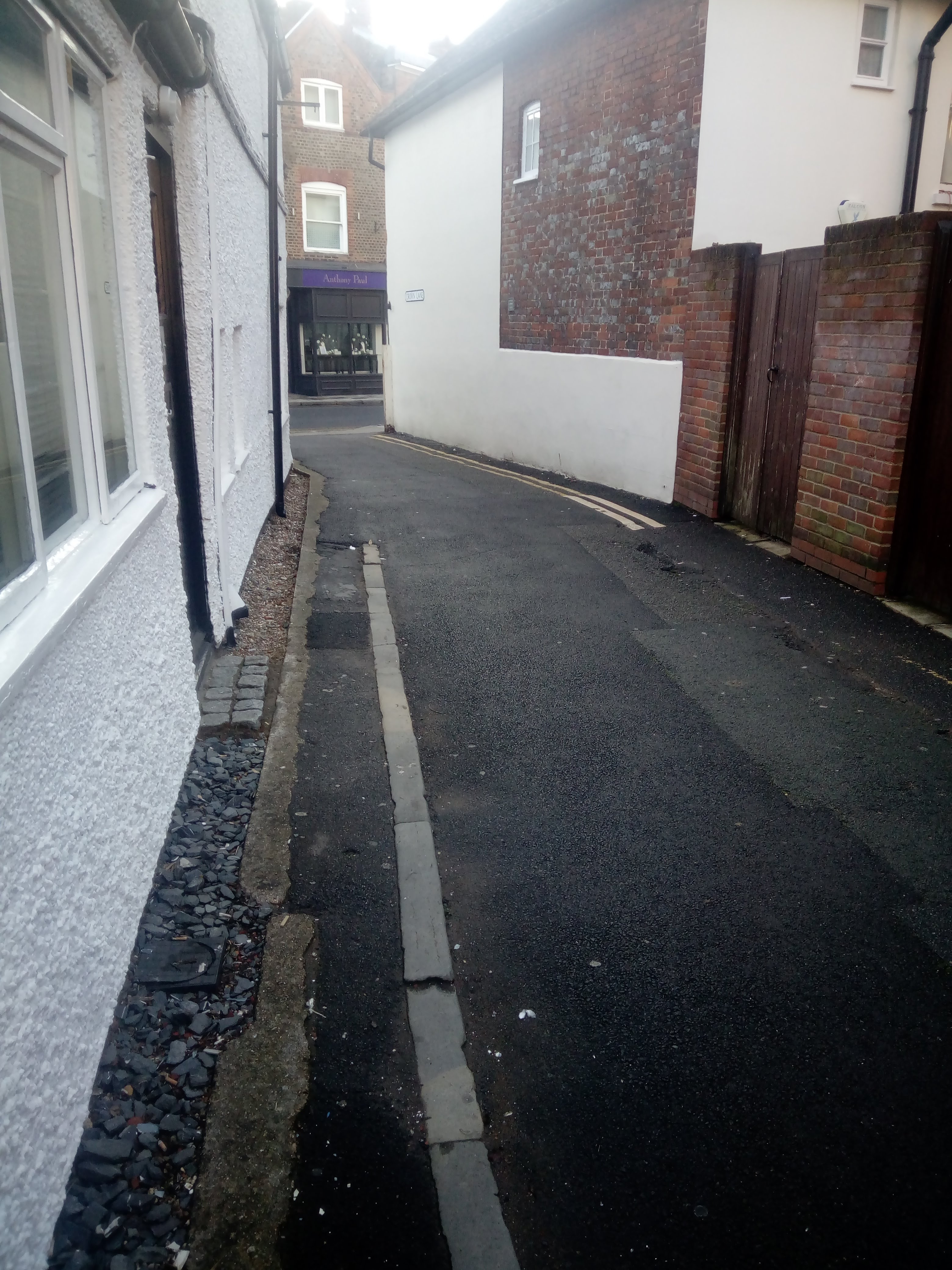
Miss Perfect and Some Tragedy In Crown Lane


Most people who have lived in this lane in Marlow have done so from the early 1890s onwards. Before that the lane existed as a way around to a few buildings but was only ever home to a couple of families at a time. It was sometimes early on called Spittal Lane as it comes off Spittal Street. (For a potential candidate date for the origin of Crown Lane, see the Crown timeline post here - under date 1650. )

On the 1861 census the White and Davis families had homes there. Anthony Davis was a labourer at the paper mills near the river while his wife Elizabeth was a housewife. Thomas White was a sawyer and his wife Mary Ann was a laundress.
Sadly two different residents of Crown Lane were found drowned in the Thames at Marlow- Thomas Holford in 1902 and Arthur Bristow in 1916. In neither case were there any witnesses so the respective juries at the resulting inquests returned verdicts simply of "Found Drowned".
Arthur Bristow aged 43 suffered from "locomotor ataxy". He believed his condition to be worsening and expected to soon lose the use of his legs. As a result he was very depressed and the implication from the evidence of those who knew him at the inquest was that suicide was a probability.  But no one saw him go into the water hence the "Found Drowned" verdict. The jury in his case donated their fees to the Red Cross. Such donations of fees tended to occur when the case heard had been particularly tragic, typically a suicide of an adult or the death of a small child. Both inquests took place at the Two Brewer's pub in St Peter's Street near the river. Local man Albert Truss helped to recover the body.

On the theme of losing the use of legs in 1900 resident "Frank" Tapping took out an ad in the South Bucks Standard thanking all those in the town who had donated money to him after he had to had his right leg amputated. This was in fact Harry Frank Tapping who would have been only 17 at the time. He was the son of Police Constable George Tapping and Mary. Frank appears on the 1901 census as a hairdresser and barber living with his parents and siblings in Crown Lane so the amputation didn't hold him back from starting a career. 
The family had moved there at some point in the 1890s. George was the constable for Lane End from at least 1889 to at least 1892. Prior to that he was stationed at Amersham.
He and Mary married in 1876. Her maiden name was Perfect hence this blog post title. I hadn't heard of this last name before and I had to check it twice to be sure!

The year of Frank's amputation 1900 was also a tragic year for another Crown Lane family when Elizabeth Tubb aged just 40 and a mother with half a dozen children still at home, died. Her husband William, then a labourer, had already had a very troubled life. His father had died at Medmenham when he was only a few months old. His mother brought him back to live with her parents in Dean Street Marlow. He became a shoemaker but found it hard to stay out of trouble. In 1868 he was prosecuted for stealing oats, in 1875 for not paying his lighting rates, in 1880 for rioting when the local Liberal candidate lost the election [more on this in future. Many local working people felt cheated and dispirited by this loss], in 1889 for stealing a piece of leather from Mrs Dewey's Chapel Street shop, and numerous times for failing to pay other local taxes. Poverty looks to be the main factor in these cases. When he stole the leather he said he was a father of ten who had no work for a week after his job with "Messrs Burrows" finished and he was now desperate. The case is a stark reminder of the fact that many families then could afford to make no savings and a single week without pay pushed them to the brink. William received 14 days in jail for that theft. This the court said was a mercy because of his hard pleading of his dire circumstances. The Messrs Burrows had a boot and shoe manufacturing workshop in Marefield, Marlow. 

He still lived in Crown Lane in 1910 when he was summoned for the last time I could find - this time for using bad language.

There was a laundry in Crown Lane in 1929 and an ice cream supplies business at the "Farm House" in the 1950s. When (or if) that house was a farm house I am unsure, it is on my very long "to do" list of further research! It was apparently a school in the early 1830s.

Sculptors Doreen and George Dereford had a studio in Crown Lane in the 1960s.
 
For histories of other Marlow streets or buildings see the "Specific Shops, Streets etc" option on the menu. All mentions of an individual on the blog can be found on the Person Index on the top drop down menu. 

Photographed Summer 2020.
Post written and researched by Charlotte Day. Photos by Kathryn Day.

Sources:
South Bucks Standard 16th November 1900 and 9th December 1910, Reading Mercury 1st February 1902, Bucks Herald 25th July 1868, 14th September 1889 and 19th August 1916. Newspaper copies all from the British Library Archives and accessed via the BNA March 2021.

GRO Marriage Index and Death Index online from their website.

1891 and 1901 census transcribed from microfilm by Jane Pullinger. Thanks Jane.

1881 census from Familysearch website, ran by the LDS [Intellectual Reserve Inc]. Accessed March 2021.

©Marlow Ancestors. You are very welcome to use these images or research for family history purposes if you credit this blog and link here so that our sources remain credited for the information they provided. Thanks!

Thursday, July 29, 2021

List Of Landlords Of The Two Brewers, and Fishermen's Retreat Hotel, St Peters Street. *Updated*

Updated August 2025

THE TWO BREWERS


This building is still in existence and still trading as a pub.

1755 claimed start date for the pub 

1770 - John Ireland landlord

1772 - used for an auction

1776 - Passing mention in the Oxford Journal, it is hosting an auction. 

 1795 - William Carter or Widow  Carter. Building has arched cellar, walled garden, and spacious stabling. Premises up for sale in this year. It's "extremely commanding and advantageous situation" at the foot of Marlow Bridge is emphasized. Owner was the late deceased maltster Henry Smith who had had a malt house in the High Street.

 1823 - G. Hawkins. Other source say John.

 1824 - John and Mary Hawkins. 

 1826 - John Hawkins who died of  Smallpox that year.

1831 - Mary Hawkins, John's widow (nee Hewett).

1833 - Richard Bye. Marries Mary Hawkins who is widowed. Widow of John Hawkins. More on this couple in a post here.

1837 - William Bavin. Previously a chairmaker. Went to first incarnation of Carpenters Arms c1843. See also The Clayton Arms.

1839 - Samuel Hobbs  See his grave here In the 1833 Parish Assessment a Samuel Hobbs is listed as an occupier of a cottage elsewhere in St Peters Street. Samuel seems to have come from High Wycombe originally.

 1844 - Samuel Hobbs "Duck Lane"

 1851- Elizabeth Hobbs. Widow of Samuel above.  See her grave here

 1853 - Elizabeth Hobbs.

 1854 - William Truss (also a sexton).

 1862 - bottle of gin and 10s stolen from till while Mrs Truss away from it. 

 1869 - William Truss.

 1871 - John C Truss.

 1883 - John Clark Truss.

 1894 - John Clark Truss.

 1896 - J C Truss 2. William Truss.

 1899 - E. S. Truss.

 1902-1910 - final stop for many  motoring clubs on their regular  "runs". 

 1903 - Emily Sophia Truss. At this point John Clarke Truss (below) was letting apartments at neighbouring Weir House.

 1907 -  John Clark Truss - bellringer too.

 1911 - John Clark Truss (Junior)

1914 - John Clark Truss is also a boat proprietor.

 1915 - John Clark Truss. In this year severe floods mean the pub can for a while only be accessed via a raised plank walkway. 

 1918 - "late J C Truss"

1925 ? - John C Truss. Died 1939 at Weir Cottage after retiring from the Two Brewers just over a decade before. After retirement he became a traveller for the Wethered's Brewery.  

c1926 Thomas Alfred Neate takes over. 

1939 - Thomas Alfred Neate

1952 - Thomas Alfred Neate retires, but stays in Marlow. He died 1959. 

1958 - H.H Gummer


The Two Brewers, above, on right.

To see a small sample of the historic graffiti carved into a wall at the Two Brewers, see here

THE FISHERMAN'S RETREAT HOTEL /FISHERMENS RETREAT (the latter rendering of the name was on the front but the other was often used too).


This was opened by William Spark(e)s in 1873 after his former premises The Barge Pole in Church Passage became due for demolition. Originally described as a "first class boarding house". It was converted from a house. William also spent time in charge of the Black Boy in Church Passage. (You can read a post about the Spark(e)s family here ) Referred to as Fisherman's Arms in the 1877 Post Office Directory. Housing is now on the site. It was very close to the Two Brewers. Some evidence points to the fact that it was commonly if not officially known as The Barge Pole for the first couple of years. It was also frequently recorded as The FishermEns Retreat, a name which appeared above the door but FishermAns Retreat is the form which almost invariably appears in advertising and at licensing hearings. The owners probably gave up correcting this! Despite becoming increasingly up market, it was still used as a "local" drinking hole by working class residents in the first 15 years or so. This is pointed to by the names and occupations of people drinking there who are mentioned in passing during court hearings, news reports, inquests etc. They include labourers and others who also lived in St Peters Street for example. (E.g "jobbing man" of St Peters Street John Lloyd in 1880) 

1873 - William Sparkes (Read a detailed post on him here)

1875 - William Sparkes dies, widow Maria takes over. See his grave here

1877 - Maria Sparkes, widow. In this year the retreat hosts the inquest relating to death of young labourer Timothy Young at Marlow Place. He was killed when the 10ft high brick and flint garden wall he was employed to help demolish collapses upon him. He was trapped from running away by some shrubs planted nearby. Other workers were also injured. This is during improvement works at Marlow Place when it is converted back to a house after spending much time as a school. 

1878 - described by The Field as an economic and comfortable place to stay, especially for anglers. 

1879 - "As cosy a retreat from the cares of the world as a man may desire" - Bells Life in London and Sporting Chronicle. 

1880 - Albert D Symes.  Still described as a "public house" during court case this year. Transfer to John "Hodenot" - see below

1881 - John Hoddinott (Born Balcombe, Somerset) John is a keen angler himself. 

1882 - John is assaulted by John Neighbour and Walter Bowles who are reluctant to pay for the beer, mineral water and cigars that they have consumed. Neighbour is convicted of pushing John and spitting in his face while Bowles breaks a window at the Retreat. Both are fined with the threat of 14 days imprisonment if the fine is unpaid. After the window is broken, the police are called and Neighbour and Bowles decide to pay but the damage has been done. 

1885 - John and Elizabeth Hoddinott cater for 40 guests each day at breakfast during a busy August weekend. 

1887 - hosts Fire Brigade dinner, one of many such events. 

1880's - frequently used as retreat after racing for regatta crews as well as visiting societies and clubs on their annual river outings. 

1891 - John Hoddinott ( John died in the 1890's Flu pandemic. For more on the outbreak, see my post Here ) Described as one of the most comfortable hostelry on the river (Evening News, May 1891)

1895 - Has collection box on the premises for Marlow Cottage Hospital. Both the Hoddinotts were frequent in their own financial and practical donations to the hospital. "Fishermen's Retreat Hotel"

1903 - Mrs Elizabeth Hoddinott, John's widow. 

1907 - Mrs Elizabeth Hodinott qv


1911 - Elizabeth Hoddinott

1915 - Recommended for closure without compensation as fully licensed premises, by Renewal Authorities of County Licensing Committee, continues as hotel however.

1920 - the Misses Hoddinott

1927 - described as "residential hotel". Does also take short term guests however. 

1932 - up for sale. It then comprises 8 bedrooms, one good bathroom, a office-reception, lounge, dining room, sitting room, kitchen and 3 servants bedrooms. Outside there is a barn, garage and stabling. 

1933 - substantially altered, updated and extended, with new entrance door (the one currently for Duck Lane House). It was discovered the existing Retreat was in a bad state  of repair. New supplies of hot and cold water, new sanitary fittings and electric lighting were all put in.  Architect for this work was G Berkley Wills of Marlow, with local builder R H Harris & Co as the principal contractor. We are told the finished property was decorated throughout with a colour scheme centered on "dove grey", the 1930s equivalent of Magnolia. The other two entrances were added later, when the property was extended again. 

1939 - Mrs Dorothy Herbert. Private Hotel. 


Researched by Charlotte Day and Kathryn Day.


This post is updated as new information emerges. All listings are as noted in original sources, including alternative spellings. Where multiple sources list an individual's name, only the first and last mention are listed here unless there is any alteration in how they are recorded, for example when an additional occupation is noted. Note that some listings may in fact refer to fathers and sons sharing the same given name so be sure to double check this. 

Many Marlow landlords changed premises and there can be other family members running other establishments. Some places changed how they described themselves - or how they were viewed - and so licensed premises listings here take in not just beer houses, pubs and inns but common lodging houses and hotels too. We mainly focus on pre WW1 listings but sometimes list later names if it ties in with research we are helping with. To find every mention of an individual here, use the A-Z Person Index in the top drop down menu. There's 3,000 people listed there currently! 


SOURCES -

1853 Mussons and Cravens Commercial Directory, (compiled 1852).

Kelly's Post Office Directory- 1859,1864,1869,1877,1899,1903, 1907,1911,1915,1920. Published by Kelly's Directories Limited.

Dickens Dictionary of the Thames from Oxford to the Nore (1880 Edition, issue 2)

Census 1881,1891. Transcribed from microfilm by Jane Pullinger.

Historic newspapers, held at the British Library and accessed via the BNA March 2021:

Bucks Herald - 13 May 1837, 9 Jan 1915, as above. 

Reading Mercury - 6 & 20 July 1795, as above. 

Oxford Journal - 24th June 1826, as above

Maidenhead Advertiser 14 April 1877, 26 August 1885,  as above

Robson's Directory 1839, 1844. Via University of Leicester Archives.

South Bucks Standard 7 June 1895, as above

Sunday Mirror 26 June 1927. 

Morning Post 18 June 1909

Pigots Directory 1823

Weekly Dispatch London 26 June 1927. 

©Marlow Ancestors. 


Tuesday, July 6, 2021

The Loss Of Old Marlow Church *UPDATED*


The chancel date of 1875 commemorated. 


If a visitor was to stand and look at our current delightful All Saints Church, it's hard to imagine that many would describe it as "a pile of deformity", hideously ugly or unfit for viewing up close. But these are all descriptions chosen by contemporary visitors in the years after the new church opened in 1835. The building as it stood then did however look very different to the current one! A lot of work has gone into changing it's appearance. This post is about some of the reasons why and is also a tribute to the old church it replaced. 


The old Marlow church. 

The "ancient" structure our current church replaced was regarded by many as handsome, and full of historic memorials. In 1801 it's interior was described as "plain and decent" with an ancient stone screen , handsome carved oak altar and a large hand organ in the front gallery dating from 1775.  But those who had to work within it felt the building was showing it's age, with a leaky roof, damp and frequent inundations by flood water making the situation worse. In 1730 the church is described as a long low building consisting of the tower, 3 aisles, two chancels and "on the south west part was a chantry chapel in honour of St Mary". (The chantry was dissolved in 1547 and was still standing in 1730 according to some but then used as a "timber warehouse". More on that will follow.) 


 The wooden spire dating from 1627 needed periodic repainting - it was white in colour - and suffered weather damage fairly often. A workman, 20 year old carpenter William Gray of Cookham Dean, was engaged in doing some of this repainting of the spire in 1791. The pulley he was standing on gave way taking some scaffolding with it and causing him to fall 75ft. He escaped with relatively minor injuries, and no broken bones. This story got embellished a little in later retelling, with some saying he did not receive any injury at all. But poor William did suffer severe bruising of his back and loins and a lacerated right hand and it was originally thought he might have suffered an internal rupture. But 8 days later he was able to walk home from Marlow to Cookham Dean. A black line was painted on the steeple to show the place William fell from and to commemorate his death defying plunge. He was lucky enough to receive an allowance of 7s a week from Lady Le Despencer until such time as he could resume his work.  Another feature of the steeple was the new weather cock erected in 1745. 


Various dates have been given for the steeple and parts of the tower below collapsing, but on going back to the original sources it's clear the two incidents happened separately. The tower had "for some time past been dismantled of its curious steeple" in September 1829, according to a press article complaining about the very slow progress being made with a projected repair (after weather damage). This date is seconded by a separate newspaper which bemoaned the fact the tower had been without it's steeple for 2 weeks in August 1829. The tower had also been "despoiled of its coating" and looked like an emblem of "majesty in distress". Not much progress had been made in December so the church wardens promised to do something to protect the bells over winter. The Reading Mercury thought the tower had been ruined by bad building work and thought it would take an architect of "superior intellect" to sort it all out. A separate storm did more damage in 1830. A cap was put on the tower which was dismissively described as looking like a cucumber frame but yet more poor weather bought this crashing to the ground along with parts of the tower, and the last remains of the steeple framework, in December 1831. Some graves were broken by this fall. 


In decay

In 1826 the church was described as in a state of general decay. The rector and the Dean and Chapter of Gloucester was supposed to maintain the chancel of the church, but they leased out the right to collect the grand tithes and with it the responsibility of doing the repairs. And so little funds were actually given to the church to do any maintenance with. Repairing the church became an election issue with various candidates promising to fix it along with the bridge but no progress was made. 


In 1829, not only was the steeple down, but work was ongoing to build the new Marlow Bridge adjacent. This was a difficult project for all kinds of reasons, which has been covered by a different post which you can read  here.  As part of the work to provide foundations for the bridge, a "chasm" had been opened up beneath the church tower and poor weather saw it fill with water. Some speculated that this pit was damaging the foundations of the church tower. There were sarcastic comments about how much deeper the pit would be made, and the great expense that seemed to be involved in digging it. 


A decision was made that it would be better value for money to knock down all of the old church and build a fine new one that would make a fine companion to the new suspension bridge. There were a lot of arguements about how the new build was to be paid for. Some individuals did make donations towards it's cost and a loan of £7,000 was to be secured on the church rates. But in the end an extra church rate was going to be levied for the next 40 years payable by those also liable for the poor rate whether they attended the church or not. This caused outrage in some quarters. Why couldn't the Dean and Chapter dip into their own coffers for once it was asked. 


Foundations probed

A church committee selected Charles Frederick Inwood as the architect for their new building. A vote was held to consider whether to position it on exactly the same site of the old, or whether to move it a (very) little closer to the High Street. The new site was selected on a 6-5 majority, with the latter option winning. This was not without controversy as it was considered to add needlessly to the cost by some. A couple of thatched "wretched looking hovels" which were located  "in the churchyard"  and a small beer house nearby had to be removed but the Act allowing for the rebuilding of the church had not made provision for the compulsory purchase of these. So the owner held out for a good price. Some asked whether it would be (or should be) lawful for a beer house to be so close to a church. It does seem they were eventually cleared away though. The new site also meant some graves had to be carefully moved, which upset others. 


In October 1831 the site was more or less fixed and tenders were sought for it's construction. William Bond of Marlow won. Later in the month the workmen were probing for a good foundation and in November they began to demolish the old place. The congregation could not continue to worship in a church due for demolition so they met instead at the former workshop of Washbourne's satin stitch manufactory off Quoiting Square/Oxford Road, a place later used for the first Salvation Army Headquarters in the town. They would stay there until June 1835. 


Marlow church is falling down..or is it? 

The problem the old church had with flooding was definite, and a new slightly higher site did improve things even if it was not the means to totally avoid such problems. 


As for the other issues, the demolition of the old church gave plenty of food for thought for those who believed that the church authorities had much exaggerated the supposed dilapidated state of the old building. They were amused by the difficulties involved in demolishing a church that was supposed to be just about ready to fall down of it's own accord. The old "clunch" (hard chalk) building blocks proved hard work to break apart - "it appeared strange that so much apprehension of it's security had been excited". [A group of Marlow residents had petitioned Parliament not to pass the act allowing demolition of the church, at least not until they had closely looked into the buildings reported bad condition and the causes of it - "examine into the Condition of the Said Church, which the petitioners conceive to have been unnecessarily pulled to pieces" It was unsuccessful.] Later rumours were that those involved in the demolition had resorted to the use of gunpowder to complete the work! 


If the church was not so fragile the critics said, there was no reason to begin the building work before funds had been raised to pay for it without resorting to a church rate. But it was too late to complain. Demolition completed, the first stone of the new church was laid by parish clerk Samuel Barnes of St Peter's Street in January 1833. 


As the building progressed, some began to question it's appearance. Architect Inwood had exhibited his plans for the new church at the Royal Academy in 1832 and obviously those originally commissioning the building were happy with them. But it was said that "officious simpletons"  had made adjustments to the original design that ruined it's original beauty. This opinion was given by the Bucks Gazette -  who was very against the Church of England not funding church building from it's own funds. However others stated that Inwood had altered his plans in order to reduce the building cost, which no doubt would have won the approval of many. 


Upset of another kind was caused when the "tackling" used to haul a 15cwt piece of iron to the top of the steeple gave way and the entire load plummeted to the ground, making a hole 6 foot deep in the earth below. It narrowly missed two workman which must have seemed a miracle indeed. The scaffold recieved a good shaking but no injuries resulted. 


The vibrating steeple


Shortly after the church was finished it was noted that the steeple vibrated a great deal "especially when the bells were rung". (See note below.) It was considered that removing the weather vane on top at least temporarily would improve things. So a steeple jack was sent up to remove it watched by a vast crowd. In 1891 it was still noted that the cross on top could be "distinctly seen to rock" when the bells were rung. 


This was only one of many problems recorded. Twelve years after it's construction two glaring issues were raised in the Ecclesiologist magazine. First there was no chancel, despite provision in the Act of Parliament for building the church that it should be maintained at the expense of the rector as before. The other problem was the font was apparently hidden away in a side room in an "unconsecrated" part of the church. They complained the font was not visible from anywhere inside during a service as the door to the room was kept always shut. 


In 1862 more improvements were planned despite the fact the building was only 30 or so years old. It was said that the interior design was full of blunders that made the everyday life of the church difficult. The choir had made frequent complaints that the site allocated to them was not right and hampered how they sounded. So that would be moved and more space would be allowed.  The organ was in the wrong place too and would be put now in the former baptistry. With the pulpit also planned to shift position, it's hard to think of an interior part of the church that everyone was happy with.  


A pile of deformity

But it was the overall appearance of the church that upset many. There were some who were ready to praise it's modern look, even while others decried it's "weak imitation" of 15thc style.  But for the majority of guidebooks and surviving descriptions, the church was ugly, bald of ornament and/or had ruined the once pretty view. Temple Bar magazine, called it "atrociously ugly" in 1862 for example. And those who were responsible for taking down the old church were labelled "ruthless destroyers" by the Bucks Herald. 


One little part of the old church fabric was left in 1862. A hefty stone window was said to be on display in builder Thomas Corby's High Street premises. It's possible some of the other less obviously ecclesiastical materials were recycled and incorporated into other buildings where they may be sitting anonymously today. Alfred Heneage Cocks (the Victorian Marlow gentleman historian, menagerie keeper and bell ringer) was also reported to possess some of the remains of a window.  He had in addition one of two models of the old Church known to exist at that time. Cocks himself reported to the Bucks Archaeological Society of whom he was an active member, that he had recovered numerous bits of moulded stone and marble from the old church. He had them at Thames Bank during his residence there, and on leaving it for Poynetts in 1899, he offered the remains to the churchwardens. This was on condition they were incorporated into the interior of the west end of the church. The churchwardens declined this offer, so Cocks gave them to his aunt Charlotte Cocks who was living at The Glade. He said they were used as a part of a fernery there. Whether they survived is hard to say. There had been complaints that the process of disposing of the old church materials had not been at all transparent with materials sold at low prices to a selected few. 


The church is dilapidated - again

In 1872, the building cost was paid off at last. The Reverend Snaith had bad news to deliver though. He said the church had been neglected for generations (surely a slight exaggeration given it was 40 years old) and now it was in a "dreadful state of dilapidation". The state of the walls and windows was "ruinous" he said. When it rained, the roof leaked so badly that the clergy had to dodge about in order not to get soaked. He said the issues must be dealt with soon and that doing patchwork repairs and improvements would involve much more expense in the end. So a committee was started to raise subscriptions. As well as repairs, a new chancel was at last planned, and much later the wide nave would be divided with arches into 2 aisles. On the 9th September 1875 the foundation stone was laid for the chancel and it was opened on 1 September 1876, with the work costing £1924 and completed by Thomas Corby to the design of John Oldred Scott. 


Other works carried on at various times include bricking up the door that formerly faced the High Street, removing the galleries and box pews, adding new stained glass windows and replacing the flat roof with a pitched design of hand made tiles of "special tint".  And then there was the damage done by the terrible storm of 1897 - a separate post on this is here. Selling off the old pews and gas fittings in 1890 raised £7 for church funds. Even in 1889, when the church was opened after works that included the new roof and new flooring, the bitterness relating to the old church's demise could still be felt. The Bishop of Oxford, preaching on the occasion of this re opening, probably unwittingly touched a still raw nerve in his sermon. He referred to how the old church at Marlow was probably a "strong, large and ancient building which if the possessors of it had taken care in time, would have lasted until now." He added it must therefore have been demolished as it had fallen behind the times as regards convenience. 


The money spent on putting the church right was a large sum and whether it was worth it divided opinion. The book The Royal River in 1885 thought no. Despite Rev Snaith's description of the ruinous state of the church the author thought the apparent sturdy state of the fabric of the building  meant that as no emergency repairs were needed, no further funds should be wasted on it. "It is a question whether it would not have been better to have accepted its ugliness and employed the very large sums which must be expended before the work can be completed to other and more directly useful purposes." Ouch. On the other hand, the South Bucks Standard in 1900 thought that while the church of 1835 had originally been both costly and ugly, the work spent on putting it right was well spent even if had cost a very large amount in it's own right. In 1889 the paper had thought that with the new roof and old pews gone, all the church needed now was to have all of its windows replaced "in a more suitable style", the outer walls refaced in stone and flint, and the west front and steeple recast. Not much work then! 

All Saints is a beautiful church to our modern eyes, both inside and out so if you have not yet visited it, it will repay your time! 


Notes:


 The new bells were rung in the new church in February 1835, some months after the church had re opened. These first bell ringers were honoured on the 60th anniversary of the occasion with a special bell peel in their honour. The ringers were William Truss (later landlord of the Two Brewers), William Smith (tailor of the High Street),  town crier Jeffrey Truss, John Smith (cabinet maker of High Street), Thomas Coster (carpenter and lock keeper), Thomas Rosewell, (fisherman), George Creswell, (Swan landlord, farmer, timber merchant and barge owner)  and Richard Davis (pork butcher and parish constable). 


The Chapel that gave Chapel Street it's name is of uncertain location.  But a possible discovery of part of it was at least previously visible under a house in Spittal Street in the first half of the 20thc. A mention is made of a "crypt" with vaulted ceiling under this house but much pre-dating it, in a passing comment by former Marlow antique dealer Jane Toller in her book "Discovering Antiques". Jane and husband Charles lived at the Old Vicarage in the High Street in the 1930s. The "crypt" was under a front room of the Spittal Street property. It may be (if from the right period at all) associated with the hospital of St Thomas that gave Spittal Street it's name. Another even more likely hint of the chapel remains were seen at the Rookery. It was here in 1877 it was reported that workman digging foundations for the new range of stables had discovered numerous interesting items which were believed to have come from the Hermitage / Chapel. These included some 11th century silver coins, a silver seal, a stone "mantelpiece" and parts of several stone columns.


Written and researched by Kathryn Day. 


Related posts: 

The Angry roaring mist of 1897 here

List of grave images at All Saints and other Marlow area sites here

For more posts like this see Church Related on the menu here

General posts about everyday life in old Marlow here

To find all mentions of an individual here use the A-Z person index in the top drop down. (There are 4,300 people listed there as of July 2022 and new posts are added daily)


SOURCES


Britton, John; Brayley, Edward Westlake et al - Beauties Of England and Wales or, Delineations topographical, historical and descriptive, of each county - (1801)

Cook, William Bernard -  The Thames or graphic illustrations of seats, villas, public institutions" Vol 1. (1827)

Cox, A H - The Church Bells of Buckinghamshire (Jarrold, 1897)

Dugdale, Thomas - Curiosities of Great Britain, England and Wales Delineated (1854)

Hogg, Alexander. The New Ladies Magazine 1791 vol 6. 

Langley, Thomas - The History and Antiquities of the Hundred of Desborough ( Faulkner ? & B&J Clark. 1797)

Rimmer, Alfred Belgravia Magazine, Vol 14, 1881

Sheahan, James Joseph - A History of Buckinghamshire, 1862. 

Guide to Marlow 1891 - South Bucks Standard - with thanks to Michael Eagleton. 

Willis, Browne Notitia Parliamentaria or a history of the counties, cities and borough of England and Wales. Vol 1. (Robert Gosling. 1730)

1833 Parish Assessment, transcribed  by Charlotte from the original notebook owned by our family 

The Royal River - The Thames from Source to Sea (Cassell 1885)

Law Journal 1832 (E B Ince 1837)

The Ecclesiologist Vol 6 (1847)

Temple Bar Magazine For Town and Country Readers Vol 15 Ward & Locke 1865. 

South Bucks Standard 12 June 1895, 2 July 1897 

Reading Mercury 21 September & 7 December 1829, 8 October 1832

Northampton Mercury 13 August 1791 via the BNA

The Building News and Engineers Journal,  17 February 1882

Notes on the old Parish Church at Great Marlow, by Alfred Heneage Cocks, 1900 as read to the Bucks Archaeological Society on their annual outing. [Undated typed report, and as per Records of Buckinghamshire - Bucks Archaeological Society, 1905 digitised by Google and supplied by InternetArchive.org ]

'House of Lords Journal Volume 63: 28 March 1831', in Journal of the House of Lords: Volume 63, 1830-1831 (London, [n.d.]), pp. 383-390. British History Online http://www.british-history.ac.uk/lords-jrnl/vol63/pp383-390 [accessed 7 February 2020]

The Builder September 25th 1875. Vol 33. 

Windsor and Eton Express, 01 November 1834. 


©Marlow Ancestors


PHOTO ID ANYONE?

 Can anyone help a fellow family history researcher Linda identify where this staff photo may have been taken in Marlow? Underneath are some...