Search This Blog

Showing posts with label Morgan. Show all posts

Sunday, May 18, 2025

Edwardian St Peter Street / St Peter's Street


 Marlow St Peter /St Peter's Street residents in the Edwardian era (taking the popular definition for the era as extending 1901-1914). Some earlier and later incidents in the lives of those mentioned are also given to give a rounder picture.

EDWARDIAN PROPERTY NUMBERS (used here) ARE NOT NECESSARILY THE SAME AS THOSE OF TODAY. Some of these properties no longer exist. A few people may be missing here, we will work to get them added. 

Odd numbered properties=

The Old Parsonage - Mrs Fanny Havell  Morgan, a widow with her unmarried adult children Alice and William James. William was the manager of the Morgan family draper's shop in the High Street / Market Square. More on this long standing business and William here . By 1915 Mr H L Slocock was the resident.

The Deanery - Heneage Legge, a retired unmarried army colonel from 1907 to 1911. Steward of the Chiltern Hundreds 1906+ and former Conservative M.P for St George's Hanover Square constituency in London. One of the many Vice-Presidents of Marlow Regatta. He gave a speech to the local schoolchildren as part of the Empire Day celebrations in 1909 in which he told them that within the British Empire there lived a total population 90 thousand times greater than that of Marlow. All of the children present should work for the Empire and pray for the King he said. He then warned the little boy's amongst them that they might have to fight to defend the Empire one day and they should be prepared to die as a result. Way to go top of the list of people not to invite to a children's party, Heneage. You can see a photo of him on the National Portrait Gallery website here. Heneage died November 1911. The Deanery seems to have been empty for a little while afterwards.

Catholic Church. Exterior restored in 1904. Interior redecorated 1910.

Catholic Mixed School (infants) This was considered upon official inspection in 1910 to be poorly lit and with too few toilets. Grace Crowther of the Convent School (see below) also supervised this school which had around 90 pupils. Unlike the Convent  School this was not a private school.

No 7 Catholic Rectory  Canon Bernard Smith until his death in 1903 (full biography of him on the blog here ) then Father Squirrell, then from 1909 Father Arthur Tillet (bn c 1875-76). Arthur was the priest at Marlow for many years. He had been a student at St Mary's Roman Catholic College, Erdington, Warwickshire though he was of Norfolk origin. In 1912 he held a mass for those who died in the Titanic disaster.

Convent School (the Catholic Upper School) - supervised by Miss Grace Crowther who also lived on the premises. This school on this site was formerly ran by nuns hence the popular name but they left in the early 1880s. Back then it has been a mixed school for children of all classes but in Edwardian times it had been transformed into a school for girls. Grace had been the head since at least 1886. In 1889 money was stolen from her desk in a robbery by a hungry and homeless Henry Lacey, a boy whose father routinely locked him and his siblings out of their home and refused to let them back in. He wanted to buy himself some food. He was jailed for 2 weeks for the offence but no one seemed to do anything to punish the father, the real cause of the problem. The Convent upper school of the Edwardian era was described as a prestigious if small school for the children of rich Catholics. Four of her pupils aged between 12 and 18 boarded with Grace at the time of the 1901 census and she had two live in domestic servants. She later described herself as working for Buckinghamshire County Council as a teacher, at the Catholic mixed school above. Grace originated from Todmorden. Her date of birth wanders all about in the census but it would appear that it was correctly 1856 and that her parents Crossley and Mary and her siblings emigrated to the USA in 1873 on the Royal Mail Steamship the SS Algeria. Grace was already living away from home in 1871. Nevertheless to be willingly left behind in Britain without her parents or siblings at the age of just 17 must have been quite something. It certainly suggests a spirit of independence. 

Unplaced property somewhere around this point in the street later Victorian times to early 1900s - The boarding house of William and Mary Ann Betts (nee Hawks). Mary was the main head of the business and was assisted by her niece Sarah Godfrey who lived in. The Betts had previously operated the Queen public house in Quoiting Square. Following the death of her husband Mary took her niece and moved away from this street. Her "boarding house" seems to have consisted of two rooms rented out as one piece of accommodation. For many years  Charles Gibbons a commercial traveller for the wine and spirits trade had taken the rooms. He had once had a brewery in St Peter Street but the business collapsed. Though he moved to Maidenhead in around 1876/77 he kept up his friendship with Mary Ann and visited her whenever his business brought him to Marlow. Sadly in 1880 Charles was found dead with horrific injuries on the train line between Marlow and Maidenhead. It was supposed four different trains had gone over him while he lay on the track. Earlier in the day he had been visiting the Betts. Mary Ann Betts gave evidence at the inquest into his death, saying that both she and her niece had spoken to Charles and though he had some new money troubles he did not seem to be in low spirits. An open verdict was recorded.

The Nook - W Gibson then Charles Berry who remained into the 1920s. Not to be confused with Glade Nook in Glade Road.

River Cottage  mysterious. Seems to have been empty or non existent for most of the era but just afterwards in 1915 the home of Mrs Zuccani.

No. 13 William John Hutchins / Hutchings, sometimes known simply by his middle name and his wife Florence. Their ancient cottage consisted of just two rooms. William had worked as a boilersmith for Great Western Railways as well as formerly being the lock keeper at Temple Lock. Florence informally provided food for some of those who camped at the lock or passed through it in a boat. The campers, most of whom were from privileged backgrounds, often rented a spot on the lock island for the whole season and left their tents up whether they were there or not. Back in 1896 a teenage boy presented himself to Florence at the Lock Keeper's cottage and said he had been sent by one of the absent campers to keep an eye on his tent and he was to be kept and fed by her, bills to be sent to the camper at home in London. The boy disappeared after 3 days. Investigations revealed the camper had never seen him before in his life!

No. 15 Mary Butler born circa 1871, a self-employed needlewoman. Her niece Ethel Butler a teacher lived with her. She was appointed to the Infant School in St Peter Street in 1902. Their home was a very old cottage.  Ethel has retired and was still living at no 15 in the late 1930s.

No 17 a very old cottage of just three rooms at this point. Mrs Kezia(h) Corby, a widow, and her sister Caroline Smith. Earlier in the Edwardian era Kezia's children Charlie (bn circa 1873 a hotel barman) and Kate (bn circa 1886 an embroiderer) lived at home too. When Keziah died Caroline continued to live there alone. Both of these women were embroiderers too. Keziah had lived in St Peter's Street for some years with her husband Henry before his death.

No 19 Mrs Sparks early in the era. 

Fishermens Retreat former pub now small hotel ran by Mrs Elizabeth Hoddinott assisted by her daughter also called Elizabeth. Catered for boating and fishing parties. Was seen as a "high class" place of accommodation. More info here

Buckinghamshire Chair Company (behind)- detailed history of this business here.

Weir House let out as apartments 1903 by John Clark(e) Truss (see below). Had been split into apartments for at least 12 years at this point. Members of the Truss family were still hiring out apartments there in the late 1930s. In 1911 Eliza and Hugh Sutcliffe (a bookmaker) seem to have let the whole premises and sublet one or more rooms to a man described as their lodger, Stanley Smith. Jack Langley who was later a very successful bookmaker on his own account worked for him and became a St Peter Street resident himself when he bought Bridge House in 1913. See below. A Miss Lupton by the end of the Edwardian era was also a tenant of Weir House.

The Two Brewers pub Emily Sophia Truss then John Clarke Truss and his wife Henrietta. Like many pubs of the Edwardian era this one had a Slate Club. Pub was popular with early motoring visitors as it had a lock up garage.

Even numbered properties=

The Public Hall / Cinema combined. Both under the management of Horace Lacey of Station Road. A detailed post about the silent era film shows in the building is already on the blog here.

6-8 National School, Girls (built 1871) and Infants School (built 1868) front part of the site had  two houses for the head teachers. National School (Girls) =Miss Elizabeth Hunt head in 1907, previously head of the Infant's school on the same premises. She retired due to ill health in 1909 after 40 years of service to education at the school. In a presentation upon her leaving Elizabeth was given a gift of £35 collected by well wishers. A little more about Elizabeth can be found in this post. The girls' school had been expanded with two new classrooms and additional cloakrooms during the Edwardian era but was still considered cramped. After Elizabeth left she was replaced as head teacher by Mrs Mary Collins. As Mary lived with her husband Henry /Harry in Chapel Street the live in accommodation due to her within the school premises (numbered no 6 St Peter Street) was  instead let out to William and Annie (nee Jesty) Alloway. William was a house painter. / Infants School (built 1868) whose head was Victor Kibblewhite in 1907. In 1905 he became the Secretary of the Marlow Literary and Scientific Institute. He was also a member of the Rifle and Cricket clubs in the town. Victor was later a town councillor. The school heads usually resided on the premises in St Peter Street and Victor, his wife Ella and their children were no different (their living portion was officially no 8 St Peter Street).  When the new Boys' C of E school opened in Trinity Road he transferred there and the family made a new home at St Ronans Claremont Gardens. During the First World War Victor served on the town Food Control Committee. 

Dial House- Mrs Winter and Selina White, at end of era Mrs Ward. I have a post on the blog already about the Winter family of Dial House see here.

Dial Cottage - ?

The Old Malt House Mrs Emma Hoare of next door Bridge House bought this property in 1897 for £1600 from the executors of Mrs Greenwood. It was used as a summer home by some of her children. Rear Admiral Sir Sydney Marow Eardley Wilmot (bn 1847) made the property his home from circa 1909 and remained there till at least the early 1920s with his wife Grace nee Hoare daughter of Emma Hoare above. The property may have in fact been Grace's inheritance from her mother. Sydney was a twice published novelist and the author of two naval history books. One of his novels The Battle Of The North Sea was written during the time he was officially a resident of Marlow however he and Grace often travelled abroad so I can't guarantee that he actually sat down and wrote any pages in Marlow. He was knighted in 1909 for his Naval services. In an accidental explosion during a training exercise he had lost one of his hands.

Bridge House - Mrs Emma Hoare, widow of Thomas Rolls Hoare who had died in 1892. House put up for sale by auction in 1909 following her death aged 86 at her London house. Bridge House was described then as a Jacobean style home with 15 bedrooms, 3 reception rooms, a boat house, summer house and tennis court. Emma had apparently lived in Hastings and London jointly prior to moving to Marlow but she had visited the town as a regular summer guest before the move. She bought Bridge House in 1898 and if she was away on her summer holidays let out it out to tourists for the river season. She found the garden prone to flooding and her home to have drainage issues so soon after moving in asked the council to improve the drainage and provide a curbed pavement for St Peter Street down both sides. She offered to demolish the part of her stables that jutted 8 feet into the road to enable this. The council accepted her offer but did not end up kerbing the whole street as she had asked. The was the cause of an inordinate amount of discussion and trouble. 

After Mrs Hoare, Mrs Stephenson Smith briefly kept Bridge House as her summer holiday home. She was robbed while the house was shut up. The teenage thief got away with her fur lined coat, a pearl cross, an ornamental dagger and various other items. Not all those pieces of property were successfully recovered.

In 1913 Bridge House was bought by John "Jack" Langley, the chairman of Marlow Urban District Council. See here for a biography of John and Jack Langley. See above also. 


Sources=

Regatta Programme 1911.

Marlow Directory and Almanack 1891,  1907 and 1915 editions by Marlow Printing Company.

Kelly's Post Office Directory of Bucks etc 1895, 1911, 1915 editions.

1901 census of England and Wales, transcribed from microfilm, National Archives by Charlotte Day or Jane Pullinger except 1901 Erdington Warwickshire which was https://www.rootspoint.com/search/?CollectionKey=UK1901&FirstName=Arthur&MiddleName=&LastName=&BirthPlace=&LivedIn=Warwickshire+erdington+court&BirthYear=&MatchType=defaultex&submit=Search

South Bucks Standard June 1909 and 11th March 1898 from the British Library Archives, accessed via the BNA.

Maidenhead Advertiser clipping March 18th 1914.

Maidenhead Advertiser 12th June 1889, via Baylis Media Archives online.

Wikipedia article on Eardley-Wilmot https://en.m.wikipedia.org/wiki/Sydney_Eardley-Wilmot

Advertising literature, personal letters.

 G.R.O death registrations from the G.R.O online except m of William Alloway which was 

"England and Wales, Marriage Registration Index, 1837-2005," database, FamilySearch (https://familysearch.org/ark:/61903/1:1:2D6G-DLL : 13 December 2014), William Thomas Alloway, 1909; from "England & Wales Marriages, 1837-2005," database, findmypast (http://www.findmypast.com : 2012); citing 1909, quarter 4, vol. 3A, p. 1554, Wycombe, Buckinghamshire, England, General Register Office, Southport, England. 


Tuesday, April 9, 2024

Will of James Fish, Brewer

James Fish, brewer of Great Marlow. Will written and proved 1704.

Says he feels that he is growing weak of body but is of sound and disposing mind.

Bequeaths soul to God.

Asks to be buried in the chancel of Marlow church in a decent manner.

Any debts and funeral expenses to be taken care of first then £5 to son James.

The house where son James lives in Great Marlow to testator's dear and loving wife Elizabeth.

To son Benjamin the two properties adjoining the above. Like the above these two were recently purchased from Christopher Morgan. The two houses left to Benjamin were dwelt in by Richard Harding and William ....ing at the time the will was written. Also to Benjamin 6.5 acres of arable land in the Great Common Field of Marlow  which testator had bought from John ...st and Mary his wife.

The will's executor was to take the profit of all those properties left to Benjamin until Benjamin reached 21 or finished an apprenticeship whichever came soonest.

Also to Benjamin one silver....cup , two silver salts and three silver spoons.

To daughters Elizabeth, Ann and Katherine Fish his messuage with appurtenances and a close of land belonging to it called Bonners Close which he bought from Henry Cane and Elizeus Fletcher and the outhouse [seemingly a brewhouse] adjoining this property. Also a close of land which he purchased from William Elliott, butcher, deceased which is in the tenure of Mr Prosser.

Also to daughters all his household goods except the copper and utensils for brewing which go to wife Elizabeth.

To each grandchild 12p [not individually named].

Rest of personal estate to wife Elizabeth who is appointed executor.

Will witnessed by Charles Blewitt, [barber surgeon] John ..at and Richard Goddard.


Notes: Elizeus Fletcher was the brother in law of Henry Cane. Cane was the son of innkeeper and yeoman Matthew Cane.

The Fish family were related to the Moore family also Marlow brewers.

You can obtain your own copy of this PCC will from the National Archives, Kew.

Transcription and summary by Charlotte Day.


Other wills on this blog can be found ton the Wills option on the menu.

©Marlow Ancestors. You are very welcome to use this content for family or local history purposes with credit to this blog.


Monday, February 5, 2024

Marlow's Extraordinary Victorian Gardeners

 This is a tribute to our Victorian Marlovians who took their gardening so seriously that a particularly choice apple could attract crowds when displayed in a grocers window. Horticultural shows could raise strong passions and petty squabbles, mostly amongst those organising them. The shows nevertheless were visited by the local gentry who might bring a party of "fashionable persons" to peruse the magnificent carrots and sweet little nosegays gathered by local children. We have featured biographies of some of the local head gardeners and nurserymen before but this post deals mostly with our talented amateur growers. (See below for a link to a history of Marlow allotments.)

First up we have Henry Allnutt, best remembered as a solicitor. In 1868 he published a book called "A System For Cropping A Kitchen Garden" resulting from his careful horticulture experiments. More particularly he based the book on some "ancient" notes kept by his grandfather who took the same scientific approach to his gardening. Henry aimed his book not at those who could afford a team of gardeners but those with more modest gardens who were most in need of maximizing their returns from the space at their disposal. The magic system uses crop rotation, successional sowing and inter-cropping and as such still contains very relevant tips and advice. Perhaps not quite so exciting is one of Henry's other main publications, aimed at farmers  - The Wheat Diagram. This was a large pull out diagram mounted on rollers that could show you the average price of wheat from 1641 to the present. It was an "interesting and valuable read" so they say. 


As mentioned above, growing a large vegetable could cause someone to become quite the local celebrity. Prize specimens can be found on display at pubs and grocers. John Price's 36lb marrow was on show somewhere in the High Street in 1890. It was noted that his success was remarkable as his Cambridge Rd garden was only small.  The fact that Wildsmith Badger had pulled a carrot in his garden 4 and a half feet long was considered entertainment enough to grace the pages of newspapers nationwide in 1806. And Mr Janes, of Valley View, Little Marlow Rd had an apple weighing around 1lb on display at the Greyhound Inn in 1900. If size did not impress you how about a 29 year old marrow, as preserved by Jeremiah Harding of Trinity Cottages? This, along with a 23 year old example was displayed somewhere in the town in 1893. 


In 1905 journalists were visiting Harleyford this time to see a bunch of bananas 60lbs in weight when cut, as grown by James Sharpe. A picture of this crop appeared in the Morning Leader. For many years banana plants were offered for sale from the estate but how many purchasers had success with growing them is hard to say. 


The Horticultural Journal visited W J Morgans in the High Street in 1892, not to admire their magnificent drapery and millinery, but to see the junior deputy of the business "Mr Morgan" who had a secret Eden at the rear of the premises. He was an orchid grower who produced blooms to astonish the professionals. This was especially so considering the limited space and lack of professional help at his finger tips. The London journalists were followed by those from local papers. Those specimens that Mr Morgan could allow out of his tender care sometimes graced the stage of the Music room during concerts and other events. 


The first Marlow Horticultural Society started in 1846 with a show in "Mr Hewett's meadow" - it's usual venue up to the 1850s. We are told that it was "very numerously and respectably attended." There were classes for gentleman's gardeners, as well as amateurs. Unfortunately it was held on a Tuesday, so the majority of working men and women could not attend. Over the next few days the event grew bigger and there is some indication that some businesses declared a half day holiday. The church bells were allowed to give a merry peel to indicate the start of the show while various bands entertained the guests. The main tent in 1850 was said to be some 300ft long with a second 60ft in length. With prizes totalling £40-50 it is no wonder that many locals entered a class or two. It was as the Bucks Advertiser out it "a useful exhibition of nature's sweetest gift." While almost everyone agreed the shows were a great success, unnamed individuals involved in their organisation fell out and the wealthy patrons lost interest. So the shows came to stop in the 1850s before the Horticultural Society was resurrected in 1861 with the first show in 1862.  Court Garden was the usual venue at this period, the host F W Berger extolling the virtues of a society to "encourage friendship and good feeling amongst the labouring classes" by promoting healthy competition. It's a shame the same mutual good will did not exist amongst it's promoters as apparently more ill feeling (and lack of funds) ended the society again in 1867. A Cottagers Horticultural Society was active for a while in the 1870s with shows in Spinfield park, before it too disappeared. A few shows popped up again in the late 1880s and early 1890s but in 1894 we are told there is no Horticultural Society at present due to "petty jealousies" and "bad management". The following year there was a horticulture show at Gyldernscroft which attracted 500 entries for yet another incarnation of the Horticultural Society. The aim was similar to before - to "encourage healthful and honest industry." After a few years this was more often held in Alder Meadow as part of the Marlow Week celebrations leading up to the Marlow Regatta. If looking at tasteful dinner table flower arrangements or champion cabbages began to pall, there was the companion event on the same day to entertain you - the bicycle gymkhana aka the bicycle fete and dancing until late. This society finally flourished, also organising chrysanthemum shows and rose ones (latter / from 1908 usually at either the cricket ground or Gyldernscroft)


Written and researched by Kathryn Day. 

Related Posts:

History of Marlow allotments here

List of head gardeners at the "big houses" in and around Marlow with links to biographies if available - here

General posts about Marlow History - here

To find every mention of a family or individual here, use the A-Z Person Index in the top drop down menu. 


Sources:

A System For Cropping A Kitchen Garden - Henry Allnutt (Estates Gazette 1868)

Journal of Horticulture and Practical Gardening - Vol 9

Journal of Horticulture and Cottage Garden - 1892 collected edition. 

The Gardeners Chronicle And Agricultural Gazette, January 1849

Bucks Advertiser and Aylesbury News  - 27 June 1846 & 6 July 1850

Bucks Herald 6 July 1850

South Bucks Standard 12 September 1890, 21st July 1893, 31st August 1894 & 23rd August 1895. 

Allotment history research by Kathryn. 

1905 Marlow Guide

Morning Leader March 1905 digitised by Archive.org

Slough and Eton Observer Match 25th 1905  (Slough Borough Libraries)

The Amateur Garden Guide - Messrs Elliott & Co, Great Marlow 1882. 

 Bath Chronicle and Weekly Gazette - 07 August 1806 (British Library Archives)

The Garden: an illustrated journal of gardening in all its branches. 1903. 

Royal Horticultural Journal - July 1909. 


© MarlowAncestors


Tuesday, September 19, 2023

War Dead Congregational Church

The Imperial War Museum has transcribed the memorial to the members of the Congregational Church (as it was then called) in Quoiting Square Marlow who fought in the First World War.  The transcribed names are listed below and I have added some research into those young men.

Bartlett, Gilbert

Batting, Horace

Grove, William B

Keates, Ronald

Loaring, William J

Peddle, Alfred 

Plumridge, Albert E

Robinson, William

Smith, Henry J


Research:

Gilbert Bartlett. Son of Mrs and Noah Bartlett. Born 1891. His dad ran a grocer's shop in West Street overlooking Quoiting Square. I believe Gilbert is also memorialised in the WW 1 memorial in Sir William Borlase School, which he certainly attended. He had emigrated to South Africa by the time the war started and was thus serving in the South African infantry when he died in 1916. More about his parents in this post where you can find a picture of their premises as they are today.

Horace Batting. Born Horace John Batting 1897 to Charlotte and John Batting. Dad was a gardener. He himself was a grocer's assistant. Lived York Road as a small child. As a 13 year old Herbert was soloist in the Congregational Church's choir. Lance Corporal in the Royal Fusiliers. Died 29th April 1917. On the war memorial at Arras. Parents had previously suffered the loss of their 3 year old daughter Gertrude.

William B Grove. Born 1897 to George and Emma Grove. Lived 1901 Cambridge Place, Cambridge Road. Died 1915. Kings Royal Rife Corps. Featured on the Menin Gate memorial. Dad George worked on the river as a boat building labourer, waterman and a steam launch driver as well as being an amateur rower.

Ronald Keates. In full Ronald Sidney Keates. Born 1895 to Anne and James. Grew up West Street Marlow. Age 10 won a prize in Marlow Horticultural Show 1905 for a bunch of wildflowers he had picked. I know it is a minor thing to mention but the image of the child Ronald wandering peacefully in the fields enjoying the flowers struck a chord with me when I read it considering what he would later live through. Private in the Oxford and Bucks Light Infantry. Before the war he was a clerk. His father James was a builder's foreman, elected parish constable and town councillor.

William J Loaring. Private in the Royal Fusiliers 13th Battalion. Killed 4th August 1917 by a sniper. Included on the Menin Gate Memorial, Ypres. Employed at Morgan's the drapers in the High Street before the war. The Morgans were also Congregational Church members. To see an historic photo of the premises where William worked or to read more about the Morgan family see my post here

Alfred Peddle. Born 1894 to Alfred and Helen Peddle.


Above, grave of Alfred Harry Peddle. Killed In Action in France March 2nd 1917 age 22. Of the King's Own Yorkshire Light Infantry.  Grave is in Marlow Cemetery. He is buried with his parents who lived in York Road at the time of his death. He was a plumber.

Albert E Plumridge. Albert Ernest. Born 1881 in Bisham. Did not die until some years after the war. It may have been considered that his military service caused his death nevertheless. He was badly gassed in 1917 and was sent home to hospital in Stourbridge England. Albert was a worker at Temple Mills before becoming a motor launch driver on the river. He lived at Bisham with his wife Edith (née Finch) at first before moving to West End Gardens Marlow. These houses still exist but are not now known under that name. They are in Henley Road Marlow. Albert had been a regular player for Bisham football team as a teen / young adult, sometimes serving as the Vice Captain. I think he may also have been a rower.

William Robinson. Possibly born 1885 to Alice and William Robinson.

Henry J Smith. The town's main war memorial gives the name H.W Smith which was Henry William, who may be a relative. Henry J was a Private in the Buck's Battalion.

Researched and written by Charlotte Day.

For detailed posts on Marlow in WW1 see Kathryn's Posts 1914  1915  1916  1917  1918 and 1919

For more church related content see the Church Related option on the menu. There are also A-Z Person Indexes, Graves  and Wills options on the menu.

Sources Include:

Transcription of the memorial is ©WMR-8379. Imperial War Museum. Available on a Creative Commons BY-NC licence. 

Commonwealth War Graves Commission. Details of memorials on the continent and dates of death.

Bucks Herald 25th August 1917. Copy held at the British Library archives. Accessed March 2021 via the BNA.

South Bucks Standard 23rd December 1910. As above.

Reading Mercury 25th August 1917.

1891 and 1901 Census transcribed from microfilm images by me.

World War One Service Records 1914-20 database online. https://familysearch.org/ark:/61903/1:1:QVBG-1V55 WO 363. National Archives, Kew.

War Memorial All Saints Church, Marlow (commemorates all denominations).

Written and researched by Charlotte Day. 

©Marlow Ancestors. You are very welcome to reuse our research if you link here so that the sources listed above remain credited for the information they provided.

Friday, July 14, 2023

Victorian Postmen Plumridge

 The Plumridges of Marlow would have been well known to our Great Marlow ancestors as builders, bricklayers, beer-sellers and brewers. But today's subjects are two of those comparatively rare few to have followed a different occupation, at least some of the time!  Both had connections to the Post Office. First up is Daniel Plumridge who was a postman in Victorian Marlow. 


There have been a large number of Plumridges in the Great Marlow Parish area from the Tudor era, if not long before. Daniel was one of those born just outside Marlow itself c1839, in Cadmore End. (Usually rendered as "Cadmer End" or "Cadmor End", Fingest Parish in the earlier days). His parents Thomas and Rebecca worked in what must be some of the most typical occupations in this area at the time. Thomas spent his working life largely as an agricultural labourer and chair maker, while mum Rebecca was a lacemaker. Cadmer End was the more populous part of Fingest Parish at this time, but it was and still is a beautiful rural area. It formerly had a number of brickworks ..bricks and Plumridges are never far apart! Daniel however began to work from a young man as a postman in Cadmer End. Despite all the travelling involved in a rural route, in the Victorian imagination the role of a rural postman stereotypically went to someone lame or not perhaps as mobile as they had once been who could not keep up as an agricultural labourer. How many of these limping postman were actually about is hard to say, but young Daniel certainly did not fit that image. Whether he filled that other stereotype of taking a good while to complete his round by stopping at each cottage door for a gossip we don't know. But as a letter was the primary means by which the inhabitants recieved personal news from afar, both good and bad, he must often have been a longed for sight hoving into view in his uniform. It was noted that into the 1890s few Marlow homes had letterboxes within their front doors, which greatly slowed down the delivery of letters, as the postman had to wait at each house for the door to be opened so he could hand over the mail. An appeal was made to install them, and not to delay the workers in their rounds too much with chit chat. But who knows if anyone took any notice! 


Although postman were usually called letter-carriers in the early days in general, I have noticed that locally "post man" was in popular use much earlier. Postman was adopted nationally as it better reflected the work of the men when they began to carry packages too. 


In 1864 Daniel married Elizabeth Hannah Davis. Elizabeth was the daughter of the Bovingdon Green beer sellers William and Hannah Davis of The Jolly Cricketers. The couple set up home in Queens Road and Cambridge Place, Marlow. Other Plumridges filled several of the homes in this area, and had indeed built some of them. The pub in the road, The Duke Of Cambridge, also had a Plumridge at the helm and indeed had been built by them. At this point Daniel was working as..a bricklayer. Was it for one of his Plumridge relatives? Very likely. Later, Daniel is referred to as chairmaker.  In any case Daniel must have liked his work for the postal service as a few years later, he is back in the role of postman, this time in Marlow. Elizabeth's paid work was as a dressmaker, and the couple also took in lodgers. 


Daniel remained a post man into the early years of the 20th century, living in and around Queens Rd for some 30 years. (At the time of his daughter Rosa's marriage in late 1901, he had moved a few minutes away to Quoiting Square.) It must have been interesting for him to see how the town expanded with new developments, especially at the hands of various Plumridge builders. Marlow's Victorian residents could enjoy more than one post delivery a day (3 in 1880) except Sundays when there was one. In the same way the boxes were emptied more than once. The exact schedule varied over time, except on Sundays. Usually the longer distance items came by train from Maidenhead and by mail cart before that. When Marlow got her own station, the post arrived in town sooner and so deliveries were moved back too. At the time that Daniel started his work in Marlow, the last letters left here on the 4.15pm train, but this was eventually moved back to just after 8pm. Deliveries were even made on Christmas Day itself (although just one usually). 


In 1891, the Plumridge's 14 year old son George Henry was working for the Post Office, as a telegraph messenger. This role was usually given to younger men, but it was regarded as a responsible one and a good start. Messages received at the telegraph office naturally had to be taken to the recipient and this was the messengers responsibility. 


The community had to rely on the honesty of their letter carriers, an issue in the public eye here in 1885 after Marlow man James Morgan spent a year in prison for stealing postal orders entrusted to him as a postman in Bedford. He was taking on a temporary cover role in that town - otherwise he was a chimney sweep. In total he stole 3 postal orders over two weeks. Nothing of a similar kind seems to have troubled those recieving mail within Marlow itself. Morgan received a reduced sentence because he was only a temporary relief postman so it was considered a less severe  betrayal of trust. He had not lived in Marlow long before his apprehension.**


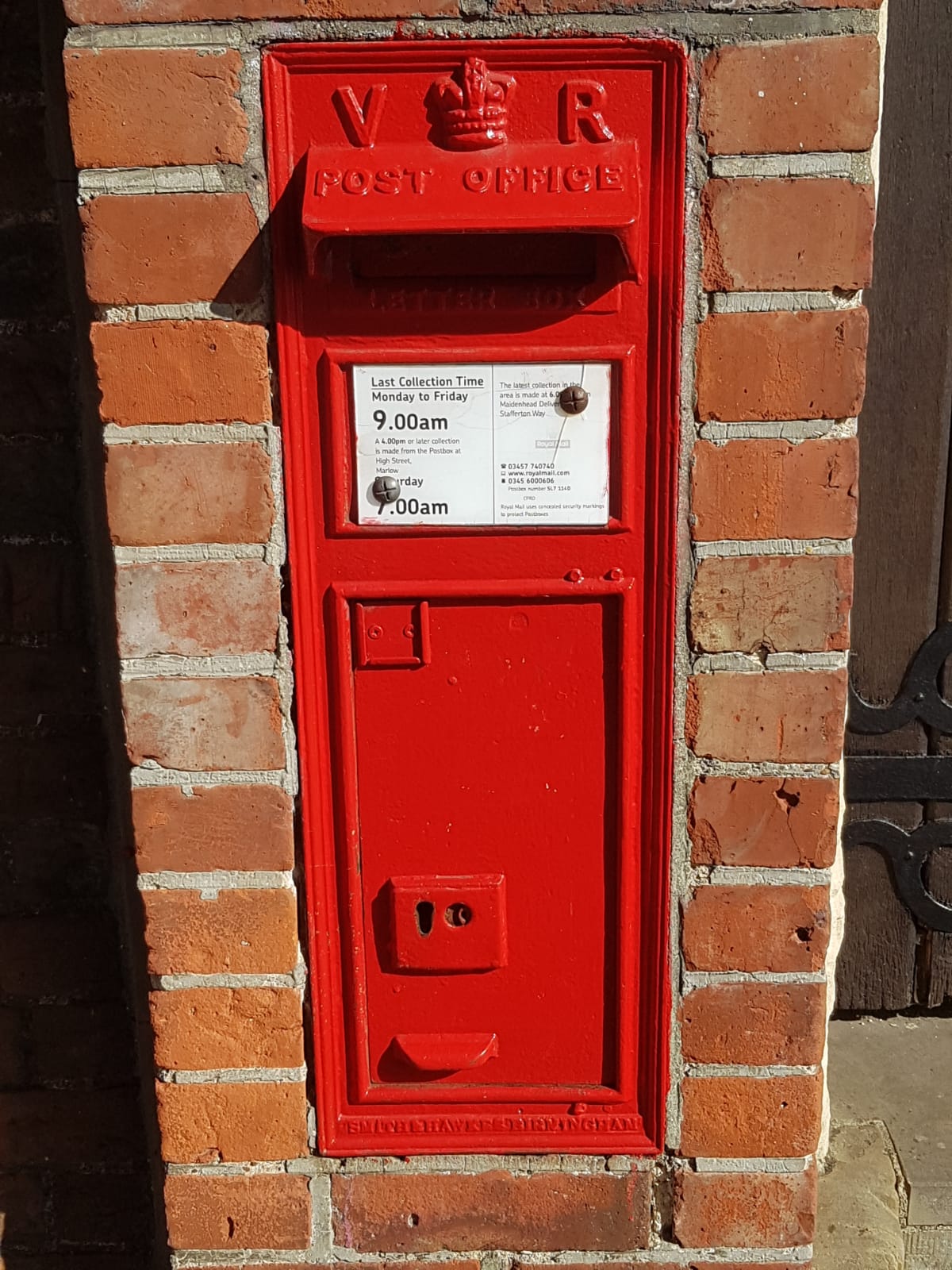
If the postal staff had opportunities for mischief so did members of the public. Daniel sometimes arrived at post box to find that a miscreant had broken off the enamel tablets fastened to the pillar boxes. These gave the details of the the collection times. An appeal was made by the postal authorities locally in 1891 to plead with people to leave this essential information alone! 


Another annoyance for Daniel was the "cribbed, cabined and confined" conditions in the main post office in West Street, especially in terms of the space available for recieving packages. It had occupied two different sites there at various times but neither one had been designed to deal with the explosion in popularity of the post. In 1894 it was finally decided to go ahead with long debated plans to move the post office. Institute Road was the first considered site but the town was not happy with this. In the end the grand and attractive Cromwell House in the centre of the High Street was secured, although not until 1897, opening early the following year. It was converted from a house*. (Even this did not please some of the residents of West Street who lamented having a slightly longer journey to reach the main branch now it was no longer in their road. Plans were made for a sub post office there for their convenience! You could also find another sub post office within a couple of minutes of the High Street, in the grocers on the corner of Station Rd and Mill Lane as it was then. In 1897 Mr Yeoman was in charge there. See pic below.)


William Plumridge of Lane End 

Our second Plumridge connected to the post service is non conformist William Plumridge, of Lane End, son of James and Esther. William worked as a chairmaker and later as a baker, grocer and sub post master at Lane End throughout the late Victorian period. He was assisted by wife Mary nee Ellis and sons Thomas and William at times. William junior's work delivering bread for the family business made him a witness in the Moor End Common murder case which you can read about here

 William senior was obviously a hardworking individual but on his death as an elderly man in 1904 he had a number of debts. His estate could not cover these, to the embarrassment of his family. There is nothing especially unusual about this but the unexpected resolution of the issue was.  Three years after his death William made headlines around the country. An anonymous well wisher paid all of his debts off in full, long after his creditors had resigned themselves to writing them off.  He or she did so as a "token of esteem" for William and his family. The identity of the benefactor(s) was not seemingly revealed, at least not publicly. Perhaps they had spent the years between the death and pay off saving the necessary funds (£167) or perhaps they had been away and unaware of the problem until 1907. Either way, it was a nice thing to do. William junior succeeded his father as sub post master and grocer, also acting as a house agent. Multi tasking obviously ran in the family! There were Plumridges fulfilling the roles of sub postmasters and bakers in Lane End for long after the period our blog covers. 


Written and researched by Kathryn Day. 

Further information:

*History of Cromwell House can be found here

**James Morgans wife applied for parish relief for herself and her 4 children while her husband was awaiting trial at the Bedford Assizes. The Board of Guardians rule was that no "outdoor" parish relief could be given to the family of those in prison, including those waiting trial. (That is no assistance other than a ticket for admission to the workhouse could be offered.) However Marlow's Walter Lovegrove, one of the Guardians  spoke on the behalf of Mrs Morgan, and pleaded for compassion. He was seconded by Marlow's vicar and fellow board member Rev Arthur Fearon who reminded everyone the principal of innocent until proven guilty. In the end a vote to give the family 3s a week plus three loaves of bread was carried unanimously despite grumblings from 3 members about the rule bending. It was one of many examples of Walter Lovegrove speaking out firmly in the interests of Marlow's poor and unfortunate. The relief stopped when James was convicted. 

To find every mention of an individual here, use the A-Z person index in the top drop down menu. There's over 6,000 people listed there. Great Marlow itself is the focus of this blog but for other posts relating to Lane End, Cadmore End and around that we do have, see the index here

If you are interested in some of the other families who quite literally built our town, see the Men Who Built Marlow posts Lovell here Bond here   Corby here

SOURCES: 

Kelly's Directory for Buckinghamshire 1852, 1883, 1905, 1911,1920,1939. (Kelly's Directories Ltd) 

Notice - Changes to Postal Delivery - 1874, 1875, 1877. Thanks to James Purdsey for a view of these. 

Census, 1841-91 - Transcript from the microfilm made by Jane Pullinger. 

Oxford Journal 29 May 1847. 

South Bucks Free Press 5 May 1860

Chesham Examiner 21 January 1891. 

Boston Guardian 7 December 1907, and South Bucks Standard August 1894 - these two copies via the BNA. 

Slough, Windsor and Eton Express Oct 31 1885 - Slough Libraries. 

© MarlowAncestors


Sunday, February 13, 2022

Marlborough Arms Hurley

Marlborough Arms, Hurley Bottom.

Frequently used for auctions. Originally sometimes given as the Duke of Marlborough's Arms. 

Historic landlord listing and history timeline. 

1775- Earliest date I know that it existed. William Glover possibly landlord.

1791- coaching inn. Stop between Wallingford and London.

1797-1800 ran by James Morgan. Used for Turnpike Trust meeting 1797. James was probably the "J Morgan" who had the Hurley tollgate in 1792. James died and in his will proved 1800 left his ale house business (but does not seem to own the actual building) to his wife Ann for her life then to their son William. There were other children too.

1815= landlord George Burden

1841 up to let with land attached. 

1843-47 James Cowley landlord. He moved to the East Arms Hurley by 1851 q.v


Compiled from censuses my transcription, will of James Morgan at National Archives my transcription, licensing information Berkshire Record Office, court cases, adverts, directories- Kellys Post Office Directory 1847,  newspapers if quoted above, etc. 


More Hurley pub history and landlord listings in the future. We have a large number of similar posts for pubs in Marlow, Little Marlow, Medmenham and Lane End (all Buckinghamshire) plus a few for the Hurley pubs we have already featured. These are all listed here.

 Our main focus is Marlow on this blog but we do cover places like Hurley because of frequent connection between them and Marlow. For a list of Hurley, Harleyford and Temple related posts see here

Researched and written by Charlotte Day.

©Marlow Ancestors. You are very welcome to use this content for family and local history purposes if you credit this blog and link here.


Thursday, February 3, 2022

The Switzerland Of England - Spring Celebrations


In May 1849 the Crown (Crown Hotel / Upper Crown) in Marlow hosted a special Easter Ball. It wasn't the first but was one of the last held for that occasion. The room was decorated with a profusion of flowers, and the ladies attending also wore seasonal blooms. An appreciation of the natural beauty of the spring season is a recurring theme. 


The Switzerland of England

The blooming of the wild primroses was enthusiastically welcomed. The Winchbottom Lane area was one abundant in these pretty flowers and some families made it an annual springtime tradition to picnic there to enjoy them. In town, Holy Trinity Church yard was famously carpeted with flowers. 


The most popular outing was however to the sumptuous cherry orchards of Cookham Dean, which the South Bucks Standard thought was "rightly described as the Switzerland of England in all it's spring tide glory". (1906) It's hard for us to visualise the number of trees, and how resplendent the blossom would have been. But people travelled from all around the region to visit the trees, even coming from London to do so. 


Easter finery

Easter saw the churches decorated, traditionally with predominantly white flowers such as arum lillies. The gardeners at the "big houses" prided themselves in producing a selection of forced flowers for the ladies of the congregation to work their wonders with. Wildflowers were also gathered. At All Saints the font, screen, alter and pulpit were smothered in greenery, and Holy Trinity and St Peters had their own floral displays. The latter was also the scene of Canon Bernard Smith's annual famous donkey ride into the church interior - you can read more about this, and Bernard in a dedicated post here


Easter was also the time of the vestry meeting to choose new churchwardens. And Saturday of Easter week was the deadline for hopeful candidates for entry into the Blue Coat School (Borlase) to have got a "ticket" of application signed by the treasurer and committee members - boys only at this time.


The Primitive Methodist Chapel (now Liston Hall) usually had a Good Friday public tea in the Sunday school room followed by an entertainment with singing and music. The chapel choir provided the former and the chapel's piano and famous harmonium the latter. In 1900 the celebrations included a parade lead by the chapel band. All the proceeds went to the chapel building fund, a very long standing debt the Primitive Methodists suffered under. 


The Salvation Army had outdoor services, and marches including a "monster" (contemporary description) Easter parade in 1895. Other sounds of Easter came courtesy of the Marlow Town band who are mentioned as performing across town at Easter 1884 and the "usual" Easter morning peal of bells from All Saints. 


You could buy hot cross buns from the towns bakers such as West Streets Death and Sons who thought they had the very best in town. Deaths sounds a tasty place to visit in any season with mince pies another speciality. 


Football fun

The Easter Bank Holiday Monday was a traditional time for a football match, with Marlow playing at Crown Meadow, and the more minor teams  fitting in where they could (such as a meadow by the station and Gossmore). In 1896, Marlow saw the final of the Berks and Bucks Cup between Maidenhead and Wolverton on Easter Monday. The roads into town were said to be bustling with supporters making their way into town by horse, bicycle and on foot. Just under 3,500 fans were in attendance, and the club were delighted to collect more than £100 in gate money. 


A match of a different kind was played at Crown Meadow at Easter 1897 before a crowd of 500. A High Street v Rest of Marlow football match with all players playing in fancy dress. At least 3 of the men were dressed as ladies!* Not quite the image we sometimes have of staid Victorians! F W Burton captained the High Street and Geoffrey Hide the rest of Marlow.  The High Street lost 5-3. Costumes included cowboys, butchers, crusaders, and a Turkish soldier.  Funds raised were for the cottage hospital. 


Outside of football supporters, Easter saw a huge influx of visitors, especially by train. In good weather the numbers were reported to be sometimes large enough to cause lengthy delays on the railway because of the extra time taken to get everyone on and off the trains. Great Western Railway offered special cheap third class excursion tickets to Marlow from Paddington over Easter, with services running on Easter Sunday as well. In May 1890, all the hotels, inns and lodging houses in Marlow were said to be full, leading to many people heading back to Bourne End to try and find a room there. The main hotels and inns decorated themselves with flags and bunting to add to the holiday atmosphere - the Fishermen's Retreat, Compleat Angler, Crown Hotel, Greyhound, Two Brewers and the George and Dragon were all mentioned as joining in in 1884. 


May Day Celebrations

We immediately think of May poles when we think of May Day. But the "old tradition" of carrying flower garlands about town seems more long lasting in Marlow. This was the spring equivalent of "penny for the guy" of Guy Fawkes day. By the Victorian era, these garlands were made by children and then paraded around the streets in the hope the charmed adults would recognise the children's efforts with a treat or coin or two. In 1886, the May Garland tradition was mentioned as a lingering tradition in Marlow that had faded more rapidly elsewhere. But the traditional pagan figure of Jack In The Green had not put in an appearance for several years. Canny children knew that visiting Highfields, off Henley Rd, home to Mr Borgnis was essential. He was an enthusiastic supporters of the tradition and it was said no child ever went away empty handed from his property. He certainly had an open purse because several hundred children were said to make a stop at his home. Mr Borgnis chose May Day as the date of his annual "levee" or entertainment for friends, and no doubt the arrival of the flower carrying children provided a pleasant addition to the day. 


The most startling mention of a May Pole is from 1842, when 3 May poles were erected, but not for use by dancers. Instead a figure representing an unnamed person was hung from each then set alight.  (It was believed to represent a politician and/or those responsible for encouraging a prosecution against brewer and ropemaker Richard Gibbons for wilfully giving false evidence to a parlimentary committee investigating electoral fraud in the 1842 election. He was arrested by the Sergeant at Arms and sent to Newgate prison. He was later sent home with a severe reprimand from the Speaker for his "disgraceful conduct". Richard said he had become confused about being asked about both the Povey and Pusey votes and had not deliberately mislead anyone. The town as a whole seems to have believed him. A petition for his release was made by numerous inhabitants stressing his integrity and industry. His nephew Charles Gibbons vote was also contested on suspicion of bribery, but was held to be good in the end. He had voted for Clayton. The result of the Electoral Committee was Clayton's victory was over turned and his seat was given to previous runner up Renn Hampden)


The old May Fair, a partner to the longer lasting October Marlow Fair, had ceased by the Victorian era and the "rustic sports" at Bovingdon Green had lapsed by the end of the 19th century. Another lost tradition was a greasy pole climbling competition in the High Street. 


Spring tonic

If the sight of blossom and flowers was not enough, High Street chemist William Baxter could offer flagging spirits his "health giving saline"  spring tonic. It was aimed at children too, and cost 1/6 a bottle in 1897. 


The changing of the seasons also prompted certain shops to promote their new stock or to suggest you could refresh your wardrobe with the latest Paris or London fashions, if you were lucky enough to be able to afford to do so. James Morgan advertised that Spring 1897 would see every department of his drapers  stocked "replete with the latest novelties". Sounds delightful! 


* The "ladies" were F Langley, F Langley junior (in a bathing costume!) and P Chapman (the last dressed as a lady of fashion with a yellow dress and hat trimmed with an abundance of flowers)


Written by Kathryn Day. 


Related posts:

More about the Povey vote scandal here

Victorian Christmas in Marlow part 1 here and part 2 here

New Year traditions here

Bonfire night in Victorian Marlow here

A listing of other posts about every day life in old Marlow  here


SOURCES


©Marlow Ancestors


Saturday, January 15, 2022

Marlow's Chair Makers - Buckinghamshire Chair Co. *UPDATED Nov 2024*

 High Wycombe near Marlow is justly famous for it's chair making. But Marlow also had a chair making factory for 40 years and the employment it offered provided the reason for many families move to Marlow so it deserves a post of its own. 


Marlow's business was called the Buckinghamshire Chair Co Ltd, and many Marlow people were involved in it in one way or another - as workers, managers, shareholders and directors. Initially based in the riverside building usually referred to as the Tithe Barn by the bridge, then in St. Peters Street, it finished up off Victoria Rd with an entrance in Dedmere Rd (after 1907).


But back to the beginning. The year 1872 was a difficult year in the chair industry in nearby Wycombe. There was a bitter dispute about wages and employment conditions ongoing with strikes and lockouts featuring. A trade union was formed and it negotiated the pay settlement. In this environment, a group of investors in Marlow decided to set up a chair making concern here. This was not an uncontentious decision to all. Many thought the Marlow company was exploiting the labour dispute to gain contracts and skilled workers "idle" in Wycombe. Others thought a rival employer would encourage competitive wages, although considering the number of furniture factories already existing in Wycombe, this seems optimistic. The Marlow manufactory was opened in 1872 and it specialised in Windsor backed and rush seated chairs, although it did make many others as well as other furniture. The advertisements for workers follows convention and asks at first for men to complete particular tasks such as turning the legs or finishing the seats. In the early years some of these men may have been outworkers, completing their work at home from materials supplied to them, but later it is clear the chairs were both made and assembled in the workshops of the Chair Co. The works were steam powered by then, which needed more room. The Victoria Rd site was also advertised as a steam saw mill, a role it would still fulfill under different owners after the demise of the Chair Co.


Chair seat caning is associated with a role that women workers often filled elsewhere, at least earlier on. However the frequent adverts for workers to complete this task in Marlow always say it is suitable for "steady" men.  Perhaps because the ads often also say that they wanted the workers to ideally perform other roles at the works. These "extra" duties may have been regarded as more suitable for male staff at the time. I do have reports of some women working in the workshop however. And in 1912 the chair co was fined under the Factory Act for employing youths under 18 for longer than permitted hours. They plead a misunderstanding of the rules. 


Troubled Beginnings

The start of the company was a little shaky. Many local people bought shares and many expressed hope the company would bring prosperity from a new direction into Marlow. But some also expressed doubts the company would thrive in such competitive conditions, and some also said Marlow did not "want" chair makers. Their reasons are not usually elaborated on but chair making men were sometimes blamed for all kinds of bad behaviour or disorder - perhaps because they were often politically active - for example the Marlow election riots of 1880 were said to be largely the work of Wycombe chair makers at the time. 


Rumours about the financial health of the company dogged it's first few months. After less than a year 4 of the directors resigned without warning or explanation - James Morgan, Reuben Nereus Smith, Lawrence Smith and James Roberts. Some sections of the press seem to take this personally and heap insults on the four for committing an act of cowardice, and endangering the companies future without good reason. ("Cave in at the slightest approach of danger...feint of heart...deserted their post...ill-considered in the extreme" etc etc.) They said such men were not wanted in business. However at the meeting objections to the resignations were only voiced by one shareholder who said that the directors had, by attaching their respectable names to the business, induced people to buy shares in a company they had no real confidence in. It was suggested the other shareholders were philosophical as they had had a chance to examine the books and were satisfied enough with the balance sheet. Later the directors would be elected and retire by rotation. It should also be said that the resigning directors did not sell their shares either and the Smiths continued to be closely involved, acting as managing directors again later.   

The first manager, Mr Hughes came from North's chair manufactory in West Wycombe where he had been 20 years. 


At the Tithe Barn

The very first workshop for the chair co was adapted in September 1872 from what was almost always referred to at the time as the Tithe Barn, on the bank of the Thames, immediately next to the suspension bridge. An ancient building, it was nevertheless considered ideal for conversion into a workshop, polishing shop and stove room. To admit light, the old bricked up windows were opened up. Fifteen men were reported to be working on fitting the equipment and benches there in that September. It was intended as a temporary solution, until more spacious facilities were adapted and fitted out in St Peters Street. (The former Gibbons Brewery site, purchased 1873, possibly also including the barn behind the Two Brewers.) However it looks as though the company continued to use the barn in some capacity until close to it's sad demolition in 1877.  


Chairs for the railways

But despite their inauspicious beginning, the company thrived. In 1874, they were described as making solid progress. In the previous 12 months they had sold £4000 worth of goods and were receiving orders exceeding their capacity to supply them. By 1875 they employed 60 men. In that year these workers, accompanied by their "wives and sweethearts" had a days summer holiday.* A number of horse drawn vehicles pulled up outside the St Peters Street workshops and conveyed the crowd to number of attractions including the ever popular Burnham Beeches and the town of Windsor. The shareholders received comfortable dividends. In 1879 the fact they could get a dividend despite a general commercial depression was credited to careful management and a desire not to over reach themselves ambition wise. The Chair Co was "helping to sustain in some way the prosperity of the town" said the Bucks Herald. 


The chairs were available to buy all over the South East for example at Perrin's in Hastings. The Bucks Chair Co employed travelling salesman to drum up trade orders, from furniture retailers and commercial organizations. Some of these salesman started out as chair makers themselves and were promoted during their employment at the company, for example William Tanner. One of their biggest contracts was to supply chairs for all stations and offices over the First Great Western network, from 1892. They were already supplying chairs to the London and North Western and London and South Western railways. The timber was local, and a number of Marlow landowners sold wood to the factory. 


The Chair Co maintained a cricket team that mostly played against other chair makers such as Glenister's of Wycombe and Cottons of Lane End, or other large works teams such as one from the Brewery in Marlow. But the first match of the season was always the married v single match involving employees all from the Buckinghamshire Chair Co. 


In the 1890s and early 1900s things still looked rosy at least from the outside. The South Bucks Standard tourist guide to Marlow of 1891 even recommended the factory as a worthy local sight if you had half hour to spare - although how welcoming the poor workers would have been had too many visitors taking up this suggestion remains to be seen! The company invested in new steam powered machinery for the Victoria Road site although not all of it was especially popular with the neighbours. In the summer of 1910 the residents of the Glade Road area complained about the loudness and frequency of the steam whistle. The company promised to try and use it a little less.


Filthy Conditions

 A large outlay on machinery did not leave the company perhaps with much funds  for routine maintenance. Even so, the factory was increasingly poorly looked after as time went on. In 1898 reports came to the attention of the local sanitary and building inspectors that the works buildings were in an extremely poor condition. The Inspector of Factories had visited and was shocked by the dilapidated state of some of them. A visit by the council team including the Medical Officer Dr Dickson confirmed this. They concluded that the men working in framing shop no 2 were working in a building that was in a very dangerous condition. Furthermore some of the other buildings were cobbled together and "rudely constructed" with windows that could not be opened for ventilation - although the large number of broken panes probably helped things! The privvy (toilet) was in a "ruinous" and filthy state. The premises as a whole were crowded with rubbish and all the workshops needed whitewashing inside to bring them up to a basically clean and sanitary condition. The factory had no water supply at all which has a serious effect on the ability to keep it clean. Orders were made for repairs, cleaning and whitewashing to be carried out. Perhaps most happily for the men, the toilets were to be rebuilt. 


Ominous signs

In February 1912 the company issued a circular informing their "friends in the trade" that the they were suffering from an increase in costs in every direction, and a higher price for materials in particular. So they would be compelled to increase all prices by 5% from March 1st. Some people praised this action, and hoped some consent would be reached with Wycombe chair makers to raise their prices by a similar amount. It was thought that undercutting each other was endangering commercial viability and preventing any rise in wages for the workers. 


But it was not to be. By September 1912 the company was in liquidation. The freehold of the site including the "modern machinery", all fittings and stock in trade was offered up for sale. There were no takers for the whole concern so in October the freehold was offered separately and in late November the stock including half finished chairs, tables and music stands were auctioned off on the premises. 


Fire! 

 The cleared out site suffered a significant fire a fortnight later. The fact the buildings suffered huge damage at a time they were still insured by the company aroused gossip but no cause for the blaze could be established. The fire started in the deserted site in the early hours of the morning. It began in a series of workshops, mostly made of wood, that ran in a block from the Victoria Road entrance to the engine and boiler house. It took hold quickly and the fire could be seen from a considerable distance. A crowd gathered despite the early hour. The Fire Brigade under Capt H J Smith arrived to find flames already leaping the gap between the the burning block and the next outbuilding. More worrying still, cottages in Duchess Place and Victoria Road were considered to be in danger and the householders began removing furniture from their homes. But the location of hydrants both in Victoria and Dedmere Roads meant a plentiful supply of water and thankfully the high wind of the night before dropped. So the significant damage was limited to the buildings in which the fire had started. Speculation that a spark from an engine at the nearby rail station was the source of ignition was  immediately ruled out because of the distance the spark had to travel. Fireman Sidney Chalk was the only man injured, by a fall of burning timber. It seems his injuries were thankfully not serious.  This was not the first fire at the factory - in 1883 a spark believed to be from a nearby pub chimney caused a fire in the St Peters Street site that endangered nearby homes as well but thanks to dedication of staff and fire crew the damage was mitigated and the factory was able to continue.


Notes. 

Some of the known shareholders in 1872 include Charles Carter, J H Bridges, Charles Miller Footitt, "Mr Sellman" and Alfred Ilsley. And in 1895 - George Meakes, A Davis and A Lawrence. It had two trustees when it formed - Col. Thomas Peers Williams and Thomas Owen Wethered MP. 


* Working at the factory was not always a happy time, even when sanitary repairs had been made. A fight broke out between two men in the  storehouse in 1875, and it seems cordial workplace relations could not always be counted upon in general! In above case Isaac Avery was given a reduced fine for what was considered an "aggravated" assault on fellow chair maker Charles Bird who had called him names during a petty row. 


Written and researched by Kathryn Day. 

Related posts:

Lane End chair makers here

Royal furniture makers the Mealings here

Biography of director Reuben Nereus Smith here

And of Marlow Bucks Chair Co foreman Joseph Benning - here

To find every mention of an individual on the blog use the A-Z Person Index in the top drop down menu, and for other posts about Marlow crafts and trades see both the General History option here and the Specific Shops Streets etc menu. 


©Marlow Ancestors. 2022

NB Mike Dewey uses information from this article in the Bucks Free Press with permission. 

Sources include: 

Furniture Gazette 1892

Timber & Plywood Vol 6 1888 (Middlesex Publishing Co)

Kelly's Berks, Bucks and Oxon directory 1883, 1911 (Kellys Directories Ltd) 

Kelly's Directory of Merchants, Manufacturers, and Suppliers 1907 (Kellys Directories Ltd) 

The Directory of Marlow, and Tourist Guide to Marlow & the Thames 1891, South Bucks Standard.  

Berkshire Chronicle 07 Feb 1888

Newspapers from the British Library Archive and accessed via the BNA: South Bucks Standard 4 November 1891,  Bucks Advertiser 30 November 1912, Bexhill on Sea Observer 18 May 1901, Maidenhead Advertiser September 4th 1872, Bucks Herald 1st Feb 1873 4 December 1912

Report by the Inspector of Factories 1898 (HMSO)

Article by Cyril Chalk,  unknown original publication, 1977. 

South Bucks Free Press 2nd February 1912, Wycombe Library. 


Saturday, September 4, 2021

Marlow Cemetery Pictures And Information

Stone laid by William James Morgan JP (Cemetery Chapel, 4th July 1910) 


A portion of the cemetery was dedicated by the Free Church Council on 8th November 1910, following a service at the Wesleyan Church. The rest was consecrated by the Church of England. In reality burials were not segregated. 


The Chapel building tender was won by Mr Harris. It was designed by C S Vardy of Maidenhead. 


The land for the cemetery came from Mr Henry Layton of the Rookery and had been farmed before so it needed to have crops cleared, and the earth ploughed before use.  


Fencing by Messrs Batting of Marlow. Benches arrived 1913.  (Current benches are replacements of the originals)

Originally the cemetery had small areas of formal planting and flower beds, with plants in the first few years provided by Danesfield head gardener Thomas Blackmore. 


To find images of individual grave markers here, see our index here

To find all mentions of your ancestor here use the A-Z person index in the top drop down menu. As of Feb 1 2022 there are 3,025 people listed there. New posts added daily! 

Monday, July 19, 2021

"That Abominable Den" St Peter's Court

**This post is due for an update. Further, earlier named households in this court are now identified**

St Peter's Court was a small, impoverished court off St Peter's Street, Great Marlow. It was an address with a very bad reputation. 

The first reference to it by name I find is in 1848 but it was clearly not newly laid out at that time. There were in that year 19 homes in the court which between them were home to at least 85 people. A different report gives the numbers of people there as even more - 88 adults and 35 children in the 19 cottages. Cottages as a description is undoubtedly optimistic given that some were later called "hovels" and were likely single room accommodations.

The Court was very close to the river and both sewage from the town was which emptied into the River Thames and the Court's own poorly built cesspool contaminated the wells providing drinking water for the people who lived there. The single privy serving all the homes was persistently overflowing. The whole court was described as "charged with the most offensive effluvia".  At times the resident families literally walked through sewage to get to their tiny homes. Cholera and persistent low fevers plagued them. During the 1849 cholera epidemic in Marlow 3 people in the court died and 8 more became ill. An emergency meeting in the Town Hall saw it organised that the families were removed for the time being to the Old Workhouse in Munday Dean Lane. This had been let to someone who at first refused to allow the parish to take back any of the space but relented. The St Peter's Court houses were to be disinfected. Some may have been demolished as a direct response to the cholera- that plan was mooted at the time and certainly the 19 houses of 1849 had become only 5 in number by 1871. 

In the early 1860s the single cesspit that all the residents shared was replaced by a new one. But still just the one.

In 1867 the Reading Mercury referred to "St Peter's Court" as "that notorious court". The case it was reporting was of James Spark(e)s, convicted of assaulting fellow resident Sarah Stacey. Few other court cases seem to involve the people of the Court. But wretched poverty went hand in hand with a presumption of bad character in the popular imagination of the day.

I found five households in the Court on the 1871 census. There were two households headed by a James Sparks so it isn't possible to be sure which one was the James of the assault case. One James Sparks was a labourer aged 46. He lived with his wife Maria who was a 53 year old laundress and their children George aged 21, James aged 18, Thomas aged 15 and Martha aged 12. Martha was a scholar, her brothers all labourers.

The second head of household James Sparks was aged 60 and a coal porter. He lived with his 50 year old wife Sarah, 21 year old son William a spinner of something I couldn't decipher, 18 year old labouring son Henry, 14 year old labouring son James and 7 year old scholar daughter Mary.

Sarah Stacey was not still in St Peter's Court in 1871 though there was a Stacey family headed by 29 year old bricklayer William and his 24 year old laundress wife Elizabeth (née Sadler, married Marlow 1864). The only named victim of the 1849 cholera epidemic in the Court which I could find was a  Stacey- William aged 40, father to the William above. William senior was described as a person of "most moderate and temperate habits"  and previously in good health. He left a pregnant wife and 6 children, who had no choice but to go to the workhouse. William Stacey the younger could be the one who asked the Board if Guardians for financial help towards the emigration to Canada for himself, his wife and their children in 1873 but was refused. Miss Fowler of Marlow who had helped others migrate was raising money to help the Staceys so it is still possible that they were able to leave England. The cost was estimated at £20.

The other families in the Court in 1871 were the Illsley family headed by James a 57 year old labourer and Elizabeth his 68 year old wife and the Grove family headed by Thomas a 40 year old labourer and Mary his 35 year old wife [Elizabeth Illsley was nee Grove]. On the 1861 census Thomas is more specific and calls himself a wharf labourer. He lived then with Mary in "St Peter's Street". It is possible this was actually St Peter's Court not being given a separate address by the census enumerator. The elder Sparks couple are also censused as living in St Peter's Street 1861. Remember that the Court was already occupied in 1848. Someone had to be living there in 1861.

Thomas Grove was fined for being drunk one evening in St Peter's Street in 1874. He was aghast at the charge insisting he had been more drunk plenty of times when out with "swells" on the river than he had been that evening. This suggests that he was one of the many Marlow men who earned money by taking well-off tourists out on the river and guiding them to the best fishing spots. The fact that his co-accused in the drunkenness incident was William one of the Shaw family, boat proprietors and fishermen, of Marlow supports that. Both men were unusually confident in Court, challenging the witnesses against them when they spoke. Still the charge was a minor one. Nothing to make the Court seem a terrible "den". Thomas had nearly two decades previously spent a month in jail for stealing filbert nuts from a tree belonging to the vicar but this does not relate to his time at St Peter's Court.

James Illsley had a conviction for stealing in his younger days but again not when living at St Peter's Court. His daughter Sarah, a needlewoman, in 1873 and described as of "St Peter's Street" was a witness against Isabella Quelch who had stolen various articles from the well off Morgan family of that street. One of the articles was some calico which Isabella gave to Sarah to work up. For more on this case see this post. There was no blame or suspicion attached to Sarah. 

The poor quality buildings of the Court were seen as an eyesore and embarrassment for the town.

In 1875 it was announced that the Court was to be demolished and more salubrious housing put in place of it. The Bucks Herald reporting this said that everyone would be glad such "an abominable den" would be swept away (the people set to lose the only home which they could afford presumably not included).

The Illsleys moved out to St Peter's Street at first. The cottage they rented there was in 1877 stated as being unfit for human habitation because it was in an insanitary state and in need of substantial repairs. The landlord William Crook blamed the Illsleys for the insanitary condition of the cottage and said he had removed them and was going to do the structural repairs necessary for safety. The Illsleys were camped outside their former home, presumably hoping to be able to go back in once repairs were done or simply having nowhere else to go. It was then in the middle of winter. By 1881 they were in Dean Street where we can only hope they had at last the decent home they deserved. 

The Staceys ended up apparently in Turville (where Elizabeth's family was) and the younger Sparks couple went to Oxford Road. The Groves lived later in Oxford Road too and Station Road, where Mary died in 1892.


Researched and written by Charlotte Day with additional research by Kathryn Day. 


Related Posts:

Poverty in Victoria and Edwardian Marlow here

Life at Great Marlow Workhouse 1775-1843 here


To find all mentions of your ancestor here, use the A-Z Person index in the top drop down menu. For other posts about general Marlow history including other poverty and medical related posts, see the General Marlow History section also in the top drop down menu.  

©Marlow Ancestors. You are welcome to use my research for family or local history purposes with credit to this blog.

Census information always  remains Crown Copyright.


Sources:

The Third Report Of The Commisioners Appointed To Inquire Into The Best Means Of Preventing The Pollution Of Rivers [Royal Commission] 1866. Published by G.E Eyre and W Spottiswoode.

Censuses my transcription from microfilm.

Newspapers, available British Library:

Bucks Herald 11 August 1849, 30th October 1875 and 27th January 1877.

Bucks Chronicle 6 Nov 1848

Reading Mercury 22nd June 1867 and 12th September 1857.

Parish registers, my old transcription.


Wednesday, May 12, 2021

No Rational Dress Allowed


This post is about the entertaining and sometimes bizarre history of the late Victorian and Edwardian Marlow men and women who took to up the cycling craze. It was a time when the cost of bicycles had come down and the comfort had increased thanks to the Safety bicycle with two equal size wheels. It gave new freedoms to the lucky woman able to buy or hire a cycle and must have made travel much easier for many working people. In 1910 even the parish surveyor got an allowance for the maintenance of his bike.


Join the Club

The Bicycle Touring Club (known as the Cyclists Touring Club after 1883) had a local headquarters in the George and Dragon. This was a national organisation that sometimes lead organised group rides as well as producing a magazine and route maps. Touring members could get advice on local roads from the representative, and they got preferential rates when staying at a HQ.  It's members wore a uniform, so they would be hard to miss on their jaunts. But they were not the only cycling club in town. 


Above, an example of an early Edwardian cycling map. One was also produced for Bucks.


In 1895, the Marlow Cycling club came into existence. They would be open not just to those intending to travel on two wheels but tricyclists as well. Tricycles were not so much a novelty in adult use as they seem to us.  Praised for their comfort and safety, they were the subject of a strong trend of their own. 


The first meeting was held in the new Coffee Room of the Chequers. There were important issues to discuss. Would women be allowed to join? Yes. Would these women be allowed to wear Rational Dress on club runs? Definitely not. What the Victorians called Rational Dress, we might call "practical" options. This meant bloomers/pantaloons or culottes for the women - "divided skirts". These were regarded as unfeminine, lacking in grace, and / or immoral by some. The alternative was to wear a skirt. Some woman had special cycling skirts with the hems stiffened with horse hair so as to lessen the risk of material catching in the mechanism of the bike or the pedals before that. Those who supported Rational Dress suggested that the slightly billowing nature of skirts loose enough to allow a woman to mount the bike in the first place could become unintentionally revealing as it floated outwards as the lady pedalled. There was also the argument that dispensing with skirts allowed women to use a wider range of bicycle frame types. But these arguments did not fly in Marlow as far as the Cycle Club was concerned. More on cycle outfits below. 


What everyone in the club would wear was a sort of uniform. No self respecting Victorian cycle club could be without one. Club colours were navy and gold and there would also eventually be a club badge in the form of a shield with scroll (from 1899). Subscription fees were set at 2s 6d a year, with membership open to those over 17. Their regular headquarters were to be at Timberlake's Cycle Depot in the High Street, from where trips would begin. 


Their first club run was to Henley on a fine May evening in 1895. In all 36 members went, led by Club Captain Ilsley and Sub Captain Miss Nellie Creswell. They arrived at the Catherine Wheel and spent time punting and boating, before returning home at 8 with gas cycle lamps lit. They dismounted at Timberlake's and congratulated each other on a successful trip with no punctures to contend with. 


And so they continued organising "gallant spins" to various local spots such as Beaconsfield and Windsor, with something like 30-40 men and women taking part each time on average. The Club also organised social events, even for a while an annual ball in the Crown. Then there was the "At Home" social gatherings in the large club room of Sycamore House, West Street, which was ran as a sort of private lodging house by Jacob and Hannah Ransome.  But after a while membership declined, and in 1902 the question arose as to whether to continue the club as few people attended on a regular basis but the existing members voted for yes. Their headquarters were now in Chapel Street. 


Mine's a "Marlow" model

There was a lot of places in Marlow which were eager to sell you a bicycle (or tricycle). Many of them started out in other guises but expanded into offering cycling "machines" and accessories. Many were actually manufacturing the bikes themselves either on the premises or elsewhere in the town. A lot also expanded into offering motor cycles. I'll mention a few. 


First up is Mr. W H Carter of Market Square who would offer to hire you a bicycle by the day, week, month or season. He also sold them, and now that cycling was ever expanding in popularity, he could be sure of offering a good supply of second hand machines as well. Repairs and replating would be done "at the lowest prices compatible with good workmanship." [1893]


Mr Barnard was advertising his Chapel Street shop as "the Cycle stores" in 1897. He offered lessons - ladies a speciality - with the assurance of his personal attention. He said he had taught many of the neighbourhoods distinguished residents to ride, and would come to you if the thought of taking your first steps in public was too off-putting. (Biography of Barnard available here)


Alternatively you could go to see cycle agent [Horace] Matthews in Station Road (where Hunts is now). A carriage builder as well, he was now specialising in bicycles. He had the distinction of being the official repairer for the Cyclists Touring Club and of course also offered lessons. In 1904 they claimed to be the cheapest shop in Marlow for cycle accessories. Bells would cost you 9d each and acetylene gas lamp 2s 9d. But they did not just offer cheap. They were the Marlow agents for the Coventry Cross Cycles "recognised by experts to be the best in the world."


Timberlake's Cycle depot was mentioned above. Their slogan was "first class goods at popular prices." Thomas Timberlake was a Maidenhead man and life long cycle enthusiast. In his premises in the High Street (no 18 & 19 in old numbering), you could see not only the very latest designs in bicycles but also one or two ancient models that Mr Timberlake himself had used as a young man. One, built in Marlow by Eustace O Jackson, had a 36" front wheel and rear of 24" both with puncture-less tyres made of steel. Next to this you could see the up to the minute 1899 Timberlake Roadster. If your existing bike was looking worse for wear then Timberlake said he could rebuild it for you so it would look as good as new, for 25s including enamelling and nickel plating. Timberlake also specialised in phonographs, a not uncommon pairing with cycles! 


Above, 1907 advert from the Marlow Almanac and Directory, printed by Marlow Printing Co, for Timberlake's Cycle Depot. 


If you wanted the "Marlow" bicycle, it was to C J Bateman "Cycle Expert" in West Street that you needed to go. It would cost you from £4 in 1904 with a 5 year guarantee and was built in the town. By 1910 the bikes were fitted with Thames Tyres, guaranteed for 15 months.  He could offer other machines built to order from £6 10s and up or ones from stock could be bought from £3 15s. [Prices from 1904-1908. Models included Centaur, Hudson, Premier, Swift, and Unity] Part exchange was also available although you may not get a high price for the boneshaker at the back of the shed. NB Bateman's became Baileys Motor and Cycle Engineers c1914. 


George Hitchings of West Street (opposite Quoiting Square) distinguished himself in 1909 as a "practical cycle maker" which sounds much better than an impractical one! He, like Timberlake, also repaired phonographs, and gramophones as well as prams and mail carts. A second hand bike from Hitchings cost 30s and up in 1909. 


Jasper Collins, of the late Victorian bicycle warehouse in Chapel Street claimed his "Star" bicycles were like thoroughbreds with a graceful appearance and easy running. Jasper would also hire you a bicycle and offered bike riding lessons - ladies a speciality. He said he had the largest selection of models in this district. 


You could also buy or hire a bike from Batting and Sons or from Henry Harris saddle and harness maker of Spittal Street amongst others. 


Don't forget your woolies

Above I mentioned the Marlow Cycling Club uniform and their rational dress policy. I have not found any Marlow shops advertising ready made ladies cycling costumes that might have appealed to those not subject to the club rules but of course many ladies would have expected to buy material and make the items up themselves, or have someone else do it for them. One item that you could buy here was the Platinum Anti Corset, available from George Hide in West Street. It was the only type of corset to be considered for athletic pursuits according to George. Morgan and Sons could offer you cycling gloves and W B Langston's had cycling shoes available. These had soles which apparently allowed for more efficient pedalling. 

General outfit advice for would be cyclists stressed the importance of avoiding chills and suggested woollen underwear was by far the safest choice. Mr Jaeger's brand was perfect, and available from Morgans. 

If on the other hand, engaging in outdoor sport had left you dealing with sunburn or gasp, freckles, then High Street chemist William Baxter would recommend a  tube of his exclusive Burnolia ointment. At 6d a time it will cool and soothe your skin. Others recommended rubbing soap into the inside of your socks to avoid blisters on long runs. 


Overall, your cycling outfit should avoid anything "loud or conspicuous" - perhaps not so easy for some cycling club members. Instead it should be characterised by "the quietness that always characterises the dress of a gentleman."


Cycle gymkhanas and the rest

If taking a conventional spin was starting to bore our Marlow ancestors, there was plenty of other cycle based entertainment on offer. Perhaps they would like to take part in the annual cycle gymkhana. (Later called a Cycle Fete.) It occurred over several years as part of "Marlow Week" or "Fete week", a series of entertainments that finished with Marlow Regatta. The gymkhana was organised by the Marlow Cycle Club, and was intended to show off their proficiency. The 1897 show attracted some 300 entries over two days!  It occurred alongside the Fete Week horticultural show, in Alder Meadow (where Marlow Cricket Club is and adjoining field). So what sort of events does a Cycle Gymkhana consist off? 


There was a ladies only mounted egg and spoon race, a tortoise race (slowest rider wins, much harder than it sounds!) and obstacle races. The latter involved weaving in and out of poles stuck in the ground, and pedaling along a plank or two raised off the ground. The gentleman's races involved more weaving between markers as fast as possible. All of this was to the accompaniment of suitable music. There was also a tilting at a ring competition but no cycle jousting as far as I can see! Prizes tend to go to Cycle Club members - Nellie Creswell being the lady to beat in woman's events, and a fair few of the mixed ones. The number of entries some years would suggest the event was open to non members too, with the exception of the first which was more of an exhibition. The gymkhana continued until just before the First World War. 


If gymkhanas did not appeal, there was a bicycle polo team active around 1900 -1912, with S.J Smith as the Captain. Exhibition matches took place as part of the Cycling Gymkhana as well. And in 1903 a bicycle paper chase was held. This started on Marlow bridge with 4 human "hares" setting off down Pound Lane, ahead of the "hunters" and dropping a paper trail as they went. It was presumably not too windy as the "hares" were  successfully tracked across Alder Meadow up to Red Pits hill taking in 4 styles on the way, round by Danesfield and down by Medmenham Ferry. They crossed the Thames using the ferry boat, and finally finished at the East Arms Hotel in Hurley where 30 weary cyclists sat down to tea. Let's hope they all had the more modern bikes for this cross country route. 


Cycling problems

The Cyclists did not have uninterrupted pleasure on the roads. They could attract the ire of other road users when travelling en masse, snazzy Club uniforms not withstanding. Some came to the attention of police for not abiding by lighting up time regulations in 1897. Then there was the issue of poor quality road surfaces. In 1904 Mrs Hall of Bridge House went out for a ride with her husband, the former riding in the lead. While pedalling through Bisham, she considered the road to be in so poor a condition that she decided to retreat to the footpath to continue. An off duty constable saw this and called out for her to stop and give her name and address. She claimed she did not hear him, and on seeing a man jogging along after her and then attempting to bring her to a stop by grabbing at her bike, she pedalled faster. Her husband heard a commotion and turned back. At this point they understood their pursuer was indeed a policeman and surrendered their details. The magistrates remonstrated with the Constable for not clearly identifying himself earlier and risking an accident by trying to seize the ladies bike. So Mrs Hall escaped with a nominal 6d fine and a warning not to trespass again on the footpath. 


Things did not always run smoothly for the cycle sellers either. In 1914, Vincent Aubrey Herbert Timberlake, had gone bankrupt a year after taking over his father's cycle store in Marlow. He had previously managed it for the family who also had a branch in Queen Street, Maidenhead. Vincent's problem was they had got stuck with a stock of older, more expensive machines that no one wanted any longer. And they could not afford to buy or make the more desirable modern models until they had got rid of this old stock. The trend for cheaper models was good for cyclists but the Timberlakes were paying the price for changing fashion. 


One last problem to consider was how much cycling was considered safe, especially for females. While it was generally considered good exercise, within moderation, there were some dangers to avoid other than chills. The Victorian era Idler Magazine, co edited by Jerome K Jerome, offered some advice to female cyclists in 1895. The writer supported rational dress and agreed on the necessity of chill preventing underwear. He added that over fatigue combined with a timid cycling style had been known to cause severe cases of nervous prostration, sometimes long term in nature. You have been warned cyclists! 


Two 1905 ads.


For a post about Victorian/Edwardian gymnastics in Marlow see here 


Sources

Cyclists Touring Club Monthly Gazette, November 1895, Vol 13-14, (Cyclists Touring Club). 

The Idler Magazine, Volume 8, 1895, (Chatto & Windus)

Pemberton, Max 1895, The Season of The Lady Cyclist, as published in The Album July 29 1895. (Ingram Brothers, 1895)

Grace, William G. Outdoor games and recreation: An Encyclopaedia for Boys (Religious Tract Society 1892) 

Post Office Directory 1883, 1891, (Kelly's Directories Ltd.)

The Marlow Guide, 1905. 

South Bucks Standard 24 March 1893,12 May 1895, 21 August 1896,  21 May, 13 August, 9 & 16 September 1897, 19 May, 2 June, 14 July 1899, 12 & 19 January, 08 June, 28 September 1900, 18 April 1902, 7 April 1903, 15 January, 22 April 1904, 2 November 1906, 21 February, 27 March 1908, 25 June, 23 &30 July 1909,10 January 1910 - copies from the British Library Archive and accessed via the BNA September 2020. 

Maidenhead Advertiser 25th July 1910, as above. 

Bucks Herald July 18 1914, as above


For more on the history of the touring club see:

https://www.cyclinguk.org/about/history/ctc-history-timeline 

And cycle outfits:

https://www.cyclemuseum.org.uk/Cycle-Clothing.aspx


©Marlow Ancestors.


PHOTO ID ANYONE?

 Can anyone help a fellow family history researcher Linda identify where this staff photo may have been taken in Marlow? Underneath are some...