Search This Blog

Showing posts with label Marefield. Show all posts

Thursday, September 7, 2023

The Bell Ringing Beer Selling Bargeman

 Today's subject is the multi talented George Creswell (Cresswell), an imposing figure who could be found striding the streets of the town in the regency and Victorian period. If you wandered into the beautifully thatched Swan Inn in the Causeway, you may have heard licenced victualler George bending the ear of his drinkers on the subject of how the river and barging industry had changed. Going to the river itself, you may have seen George accompanying some eager anglers out on the water or perhaps you would spot him and brother William with their barge, also known as the Swan, starting out for London. Or perhaps you can see an particularly tall and well built parish constable guiding a miscreant to the parish lock up? That's George too.  Hear church bells ringing? George again. He's one of the ringers. You get the idea. 


There are many George Creswells to be found in the pages of Marlow history but our subject is the one born in 1808 to William and Ann of the riverside Complete Angler inn as we call it. His parents turned the somewhat ramshackle cottage conversion into an inn with a far ranging reputation for hospitality and fishing facilities. As such it attracted gentleman visitors from London, willing to rough it a little, and business boomed. The couple have their own dedicated entry here


Suffice to say George and his siblings grew up on the banks of the river. As a young man he worked as a fisherman, which in Thames terms of the time, meant someone who guided anglers out to find the best hunting grounds. The most sought after fisherman had their services in such high demand by visitors that their services were hard to acquire. George had the advantage of a steady stream of customers from the family inn. The two brothers would eventually lease extensive fishing rights between Bisham and Cookham Bridge. His father also maintained an interest in timber and coal dealing, and running the barges that carried goods up and down the river. George would also take up this role. 


At some point, he and brother William began to run the Swan barge on the river. Those described as "running a barge" sometimes owned it, often leased it, and sometimes were those captaining it up the river themselves. George and William seem to have combined the latter two roles at the beginning. As time went on, they did less work on the barges themselves, and more was left to employees. Although George was ultimately very successful in the barge industry, he certainly suffered some setbacks. Both his father and brother William were generally regarded as very shrewd businessman and definite misers. (You can read more about that infamous brother William, scourge of all in authority, here ) George it would seem was less one to frantically count his pennies, or perhaps he was unlucky. For in 1829, he found himself banged up in the notorious Whitecross Street debtors prison in London...


Debtors Prison 


Whitecross Street was used solely for the reception of debtors and it had arguably a worse reputation than the others so used. Sarcastically known as the "Cripplegate Coffee-House", it was often described as over crowded. The debtor's were housed in wards rather than individual rooms, men and woman apart. He is described as a fisherman formerly of Marlow at the time of his incarceration - "formerly" does not mean he had moved to London however. He is imprisoned at Whitecross because the action was taken relating to debts owed to someone operating in London or Middlesex who took a civil action against him there. I can't be sure how much he owed, but if a creditor insisted on it even someone owing a relatively small amount could find themselves behind bars at this time. And they were liable to stay there until the debt was paid, which may of course mean an indefinite stay. George's time however does not seem to have been long..perhaps his family stepped in and helped straighten his affairs. 


Happily, 1829 was not an entirely bad year for our subject. The Berkshire Chronicle of April announced the marriage of George Cresswell of Great Marlow to "Miss Bowles" of the same place. (Elizabeth). The Bowles were a very old and widespread Marlow family, one of the few to be present continuously from the Tudor period onwards and very likely before that too. The Bowles and Cresswell families were in charge of a large number of Victorian inns and beer houses at different times. 


By 1833 George and Elizabeth were living in the High Street. Their home was assessed at £10 for tax purposes so it was a reasonable size. Around now, George was one of the bell ringers at the old parish church*. In fact when that building was demolished, and replaced with a new one, George was one of the "first ringers". That is he was one of those who rang the bells for the first time in the new church in February 1835, a little time after it was completed. On the 60th anniversary of that occasion, the bells were rung again in honour of these early ringers all of whom had since passed away.  


The Swan Inn

Sometime between 1834 and 1839, George became the proprietor of the Swan Inn. Now demolished, this was a very old thatched building standing where the vicarage is now. It's proximity to the river means it's presumed to have had many bargeman amongst it's clientele although there were several beer houses on the river front itself around Church Passage and St Peters Street. And bargeman could be found drinking in any of Marlow's very very many houses of refreshment! However despite barge men having a somewhat fearsome reputation (often embellished later it must be said) events at the Swan rarely generated the sort of traffic to the Petty Sessions that many other licenced premises did. Was there a sort of self policing going on? Maybe, but George was regarded as running a respectable establishment in general. He in fact took a turn as parish constable on more than one occasion. Someone associated with crime would not get voted to this role. (You can find more about how parish constables worked in Marlow here


George's address in the 1840s is several times given as Sundial Cottage. It was the neighbouring property to the Swan, famed for the historic sun dial on an adjacent outer wall. Licenced victuallers were required to live in their premises but it seems George was also using the cottage and this was regarded as sufficiently the same. 


In 1845 wife Elizabeth died with such swiftness that expressions of sympathy were forthcoming from all quarters. She was "hale and hearty" one morning but was taken ill in the night. Surgeon Wilkinson attended but declared her life must be despaired of and she never recovered. Inflammation of the throat was considered the cause of death. George, with a young family,  would go on to marry a second time, to widow Charlotte of Bisham. 


George was the last landlord of The Swan. I'm not sure exactly when he chose to leave it but it was sometime between summer 1861 and December 1863 when the premises is described as uninhabited.  The site was ear marked for a new rectory by the Rev Milman who had many church improvement plans in mind. The Rev left the parish before most were realised but he did see the completion of his new home the year before his departure.  So The Swan and all its history was demolished in the 1860s. George and family moved just a short distance away to Brook(s) Street (now Station Rd). 


Farmer George, Timber Merchant

George primarily used his barge for transporting wood as time passed, as he was increasingly focusing on his timber dealing business. This developed into a substantial affair and by 1851 he employed 9 men. Timber lying at a wharf or in a yard was a frequent subject of thefts locally as it was relatively valuable. For example in 1856 20 year old John Stacey was sentenced to 3 months in jail for stealing some wood from George. He plead guilty and a previous conviction for theft increased his sentence. George also owned timber wagons which made the journey between Marlow and High Wycombe, centre of the chair making industry. 


In 1875 a man working for George was drowned in the Thames. James Rockell** had had charge of the horses towing the barge. When it stopped for the night in Staines, the crew went for food and drink in the town. A rowing boat was used to reach the spot where the barge was moored. James returned separately from the others but sadly his rowing boat was over turned in the dark. His fellow crew had already retired for the night and knew nothing of the tragedy. His body was found the following day. At least that is one version of events. Another later story says that the other crew had deliberately set a wonky gang plank up as a practical joke knowing James would use it last. He did and fell to his death. George had ceased to travel on the barge himself in those days. But he must have trusted James a good deal as the latter had worked for him since the age of 15, over 30 years it was said. 


 George knew all about his dangerous the river could be. He served on coroner's juries for the drowned and personally recovered at least one body from the water at Marlow. This was the badly decomposed remains of 73 year old George Joell, a Berkshire farm labourer of "unsound mind" who had been missing for 6 weeks. George collected a 20 shilling reward which had been posted for news of his whereabouts.


 He continued also to work as a coal merchant. He had however always had a farming interest. Even in the 1830s he was leasing farm land at Red Pits. Subsequently he would add to this holding with land at Lower Field farm (formerly part of the Great Marlow Common Fields, some of it purchased freehold by George in 1849 but still subject to common rights), "Merefield Common" (Marefield common field) and at Hill Farm amongst others. The Creswell Row cottages off Queens Road were built on his land. They were known as Cresswell's Cottages at first, although the family later owned many in the nearby area to which this term can also apply.


Goodbye George

George died aged 71 in 1879. He was still working as a farmer and timber merchant to the end. His beloved Swan Inn was fast becoming just a memory and many of the riverside properties around it were also demolished. The working river was increasingly making money out of tourists and houseboats rather than barges transporting goods. His death must have felt like the end of an era to many. 

The second Mrs Creswell, Charlotte lived to the age of 91, dying at the home of her daughter in law in 1898, Swilley Cottage, Little Marlow Road. She was said to have been as "sharp as a tack" in her old age. Her last illness was brief. She suddenly became blind 3 days before her death. She nevertheless apparently retained a healthy appetite to the end and died peacefully at the last. Of the couple's 4 children, only eldest son farmer and dairyman Augustus was still alive. 


Written and researched by Kathryn Day. 


**Sadly the widow of James Rockell would loose her second husband to drowning too - George Picton whose boat overturned while he was working for the Thames Conservancy in the 1890s. Two of the crew members of James' barge both drowned in separate incidents in the months after his death. You can read more about the rest of Mrs Rockell/Picton's sad life in a post here


More information:

Read about George's run in with a character known as Buffer the Hatch  - here

List of publicans at The Swan: here

A tribute to our bargeman - challenging the stereotypes here

Pub index: here

To find every mention of a person or family here use the A-Z Person Index in the top drop down menu. You'll find over 6,000 people listed there.  

Posts about everyday life for your ancestor in old Great Marlow: here


Sources include:

1833 Parish Assessment, transcribed by me from the original held by my family 

Undated letters and workings related to the above c 1834. 

Robson's Directory 1839

Slater's Commercial Directory 1852

Kelly's Directory 1847 & 1869

Dutton's Directory 1863

Bicester Herald 7 March 1879.

Berkshire Chronicle 4 April 1829, May 3 1845. 

Reading Mercury 29 March 1829, 26 May 1855.

Bucks Herald 15 May 1875, 12 Jan 1879. 

Bucks Advertiser 03 March 1849 & 25 January 1879

South Bucks Standard - January 14 1898. 

Great Marlow census returns as transcribed from microfilm by Jane Pullinger. 

Creswell family research by Charlotte. 

© MarlowAncestors. 


Friday, September 9, 2022

A Triangle Used In Anger - Life In Eton Place, Marlow


While Eton Place survives as a place name in Marlow, unlike it's "twin" Cambridge Place, the old buildings are all long gone. As we have often been contacted by those with ancestors living in this busy little place in the Victorian and Edwardian era, this post will hopefully bring the old street back to life. 


Most of the housing was occupied by working class families, but it did not have the reputation for real poverty that some of the other nearby streets and rows did. This is not to say there were not some individuals there who were really badly off however. It's worth noting that Eton Place is in the general area known as Marefield and many people give that as their address as opposed to anything more specific well into the 1920s. Sometimes they may also describe their address as "Eton Place, Marefield(s). 


It's proximity to the very many public houses in Dean Street did mean a certain amount of drunk and disorderly behaviour spilling over there, not necessarily actually involving any of the residents! It's amusing how often those slightly worse for wear seem to end up wandering down Eton Place when it was not exactly part of their route home.  However there was one nasty brawl that did involve a resident, 37 year old bricklayer William Stacey, in April 1882. The victim was John Neighbour of Marefield and the weapon a rather unusual one...


A Triangle Wielded In Anger


Constable Birch was on routine patrol around midnight in Cambridge Road, just behind Eton Place. He heard a tremendous row going on so hot footed it to the scene. As he approached he heard John Neighbour call out several times that he had been hit, and what he took to be the sound of a bottle falling to the floor.  It was dark in the place but eventually he saw John leaning up against a wall with blood pouring down his face. It transpired that William Stacey had struck John on the head not with a bottle but a "triangle" which was in fact an iron cornice mould. Amusingly William had been using it as a triangle in the musical sense as part of an impromptu band celebrating a local wedding, I think in one of the Dean Street pubs. (Concertina, spoons..) He was returning home to Eton Place with his wife in what might be called a jolly state. It was at the corner of the Place and Queens Road that he met brothers John and William Neighbour also on the way home from an evening drinking. William Neighbour made a comment that it was time Stacey went home to bed, and especially his wife Elizabeth should do the same. Stacey took that as an insult, insinuating that Mrs Stacey was the sort of woman to stay out late, with the connotation of immoral character. He asked the Neighbours if they wanted to "start something" at which John Neighbour turned and asked him just what he meant by that. The end is not hard to predict and Stacey hit John on the head above his eye, knocking him unconscious briefly with the results we've seen. He was taken to Mr Atterbury, assistant to surgeon Shone, and then PC Birch returned and arrested Stacey who admitted the action. The doctor said the cut to Neighbour went to the bone and narrowly avoided destroying his eye. 


The background to this seemingly petty squabble is a little complicated. The Neighbour brothers were something of a terrible twosome, getting into no end of minor scrapes and brushes with the law.** They seem inseparable and rarely does a case involving one not involve the other. But they were not serious offenders, mostly troubling police with drunken and disorderly behaviour and silly nuisance offences such as kicking a door and then running away. It was for one of the last offences in February 1882 that saw Mrs Stacey testify that she had seen William Neighbour kick the door of William Smith in Queens Road, an action that resulted in him receiving a fine. It was insinuated that Elizabeth had lied about this as another man there "Potter" confessed to the action and yet another witness said it was in fact brother John who was guilty. It seems in the melee it was probably difficult to see what was going on. So there was bad blood between the Neighbours and the Staceys who also trouble the courts fairly often with drink related bad behaviour. The court found against Stacey noting that you could not be under the illusion that hitting someone with such an implement could do anything other than a nasty injury. But they also decided he had acted under provocation and counted the fact the weapon was not carried with the intention to do any harm. So a sentence of 4 months detention with hard labour came Stacey's way.* 


Most crime associated with Eton Place was minor thefts such as the loss of  George Rockell's ferret, lifted from his back garden. It was thankfully recovered alive and well! 


A Stranger Appears...

Although the number of people living in Eton Place was relatively dense, it's certain they all knew each other well and a stranger wandering about would attract attention, especially if he was discovered to be foreign. In 1902 one such person visited the Boddy family home. Ellen Boddy opened the door to a loud knock and found a well dressed man unknown to her standing there. He said (in a heavy foreign accent) that he had lodged with a Mrs Boddy in Station Rd about 5 years previously and wished to call on her. Young Ellen was clearly not this person so she took him to see her mother in law who had indeed lived previously at Station Rd but she did not recognize him either. Whether he himself thought Mrs Boddy senior was his former landlady is not clear. Regardless he left, having asked for no assistance or favour of any kind. A day later he was found floating face down in the river off the end of St Peters Street. He was spotted by Charles Woodley, who alerted the landlord of the adjacent Two Brewers, John Clark Truss. Truss recovered the body but the victim was not immediately identified. I do believe his identity was eventually established as a Frenchman who had been living in London but the circumstances of his trip to Marlow were a mystery. 


Tragedy for No.14

In 1939, resident of no 14 Eton Place, chauffeur Henry Samuel Batt, was killed on the sinking of the Dutch liner Simon Bolivar. This sank after coming in contact with a German mine. Henry was traveling aboard with his employer Sydney Preece of Maidenhead and the latters 3 year old daughter Elizabeth. He helped to put little Elizabeth in a wooden box to act as a sort of life raft for her, an action that undoubtedly saved her life. Preece managed to keep Elizabeth afloat and push her in front of him as he kept afloat in turn but he became separated from Henry. Henry is buried in Maidenhead cemetery. The horror for the Preece family was that Sydney Preece's wife and parents had all died in a car accident recently and so father and daughter had been travelling to visit her other grandparents who would be taking care of little Elizabeth for a while. 


Eton Place Gossip

Other events an Eton Place ancestor would have remembered and talked about were the scarlet fever outbreak amongst children in 1882. There were thankfully no fatalities. The Sanitary authorities ordered that the landlords of the affected properties should have them thoroughly cleaned out and disinfected. Predictably some landlords were less than forthcoming with work and at least one was fined for delaying the necessary actions. (He claimed he did not think the children really had scarlet fever and the house was already clean.)


Then there was the great stink of March 1887. A cart carrying barrels of waste from cess pits in neighbouring cottages was left standing by Eton Place for more than an hour, causing a sickening odour and obstructing the road. A brave soul ventured past the cart and summoned a constable to investigate. The cart was driven by William Burt but the case presented against him was dropped as he was only following orders of employer farmer William Creswell. 


I hope this gives you an idea of the events that impacted on the lives of our Eton Place residents of days gone by. There's many more we could mention..but if you are looking for a specific person or family, look for them in the A-Z person index in the top drop down menu or the Biographies of Families menu here


William Stacey's wife Elizabeth or Lizzie was nee Sadler and her little sister Ellen was the "Sleeping girl of Turville" - see here


To find other posts on specific streets see the menu here


Other posts about everyday life in old Marlow here


Written and researched by Kathryn Day. 


© MarlowAncestors. 


* Also present at the infamous Triangle fight was labourer George Jones of Marefield. 


**The Neighbour brothers were aged 23 (John) and 19 (William). Their sister Matilda features in a post to follow shortly.  The boys grandfather, a convict transported to Australia will also feature soon. 


Saturday, January 8, 2022

Will Summary Charles Carter of Great Marlow

 Will proved 1723, written 1717.

A plumber.

Weak in body and limbs but of perfect mind and sound memory he says.

Commends soul to God.

To be buried at discretion of his executor.

Dear and loving wife Mary to get all his worldly estate. This includes his messages or tenements in Marlow called P....io plus a half acre of land in Marefield Marlow. Also to her all mortgages, bonds, household goods and chattels he may possess when he dies. She is sole executor of will.

Witnesses:

Thomas Cage, Richard Young, Thomas [Trott?].

Mary proved the will.

I transcribed this will from a copy supplied by the National Archives Kew and then summarized it here.

You are welcome to use this summary for family and local history purposes with credit to this blog.


To find all mentions of an individual or family here on the blog use the A-Z Person Index in the top drop down menu. It currently lists more than 3,000 individuals about whom we have information of some kind in the blog. New content added daily. 

©Marlow Ancestors.

Sunday, October 10, 2021

Miss Perfect and Some Tragedy In Crown Lane


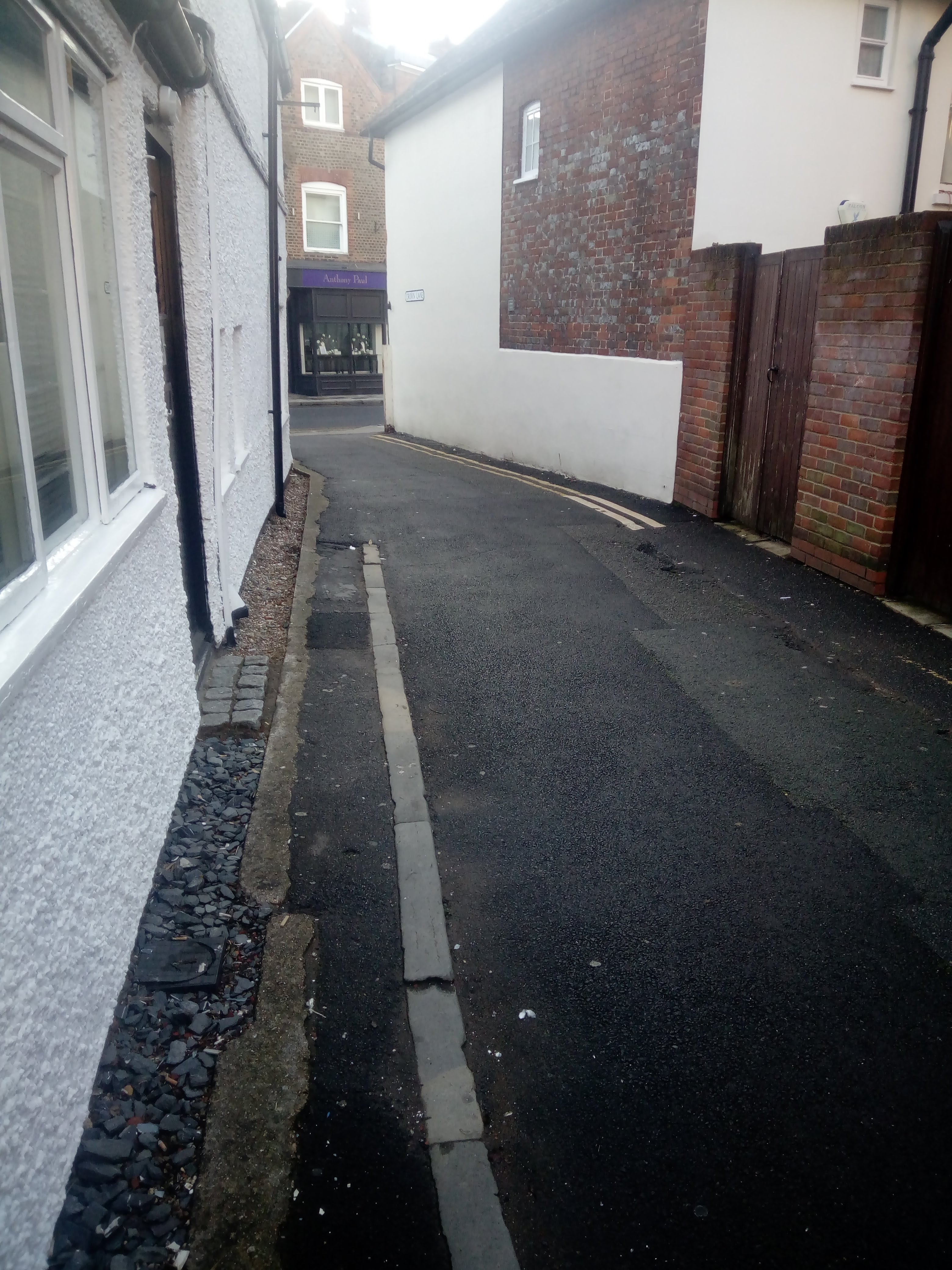
Most people who have lived in this lane in Marlow have done so from the early 1890s onwards. Before that the lane existed as a way around to a few buildings but was only ever home to a couple of families at a time. It was sometimes early on called Spittal Lane as it comes off Spittal Street. (For a potential candidate date for the origin of Crown Lane, see the Crown timeline post here - under date 1650. )

On the 1861 census the White and Davis families had homes there. Anthony Davis was a labourer at the paper mills near the river while his wife Elizabeth was a housewife. Thomas White was a sawyer and his wife Mary Ann was a laundress.
Sadly two different residents of Crown Lane were found drowned in the Thames at Marlow- Thomas Holford in 1902 and Arthur Bristow in 1916. In neither case were there any witnesses so the respective juries at the resulting inquests returned verdicts simply of "Found Drowned".
Arthur Bristow aged 43 suffered from "locomotor ataxy". He believed his condition to be worsening and expected to soon lose the use of his legs. As a result he was very depressed and the implication from the evidence of those who knew him at the inquest was that suicide was a probability.  But no one saw him go into the water hence the "Found Drowned" verdict. The jury in his case donated their fees to the Red Cross. Such donations of fees tended to occur when the case heard had been particularly tragic, typically a suicide of an adult or the death of a small child. Both inquests took place at the Two Brewer's pub in St Peter's Street near the river. Local man Albert Truss helped to recover the body.

On the theme of losing the use of legs in 1900 resident "Frank" Tapping took out an ad in the South Bucks Standard thanking all those in the town who had donated money to him after he had to had his right leg amputated. This was in fact Harry Frank Tapping who would have been only 17 at the time. He was the son of Police Constable George Tapping and Mary. Frank appears on the 1901 census as a hairdresser and barber living with his parents and siblings in Crown Lane so the amputation didn't hold him back from starting a career. 
The family had moved there at some point in the 1890s. George was the constable for Lane End from at least 1889 to at least 1892. Prior to that he was stationed at Amersham.
He and Mary married in 1876. Her maiden name was Perfect hence this blog post title. I hadn't heard of this last name before and I had to check it twice to be sure!

The year of Frank's amputation 1900 was also a tragic year for another Crown Lane family when Elizabeth Tubb aged just 40 and a mother with half a dozen children still at home, died. Her husband William, then a labourer, had already had a very troubled life. His father had died at Medmenham when he was only a few months old. His mother brought him back to live with her parents in Dean Street Marlow. He became a shoemaker but found it hard to stay out of trouble. In 1868 he was prosecuted for stealing oats, in 1875 for not paying his lighting rates, in 1880 for rioting when the local Liberal candidate lost the election [more on this in future. Many local working people felt cheated and dispirited by this loss], in 1889 for stealing a piece of leather from Mrs Dewey's Chapel Street shop, and numerous times for failing to pay other local taxes. Poverty looks to be the main factor in these cases. When he stole the leather he said he was a father of ten who had no work for a week after his job with "Messrs Burrows" finished and he was now desperate. The case is a stark reminder of the fact that many families then could afford to make no savings and a single week without pay pushed them to the brink. William received 14 days in jail for that theft. This the court said was a mercy because of his hard pleading of his dire circumstances. The Messrs Burrows had a boot and shoe manufacturing workshop in Marefield, Marlow. 

He still lived in Crown Lane in 1910 when he was summoned for the last time I could find - this time for using bad language.

There was a laundry in Crown Lane in 1929 and an ice cream supplies business at the "Farm House" in the 1950s. When (or if) that house was a farm house I am unsure, it is on my very long "to do" list of further research! It was apparently a school in the early 1830s.

Sculptors Doreen and George Dereford had a studio in Crown Lane in the 1960s.
 
For histories of other Marlow streets or buildings see the "Specific Shops, Streets etc" option on the menu. All mentions of an individual on the blog can be found on the Person Index on the top drop down menu. 

Photographed Summer 2020.
Post written and researched by Charlotte Day. Photos by Kathryn Day.

Sources:
South Bucks Standard 16th November 1900 and 9th December 1910, Reading Mercury 1st February 1902, Bucks Herald 25th July 1868, 14th September 1889 and 19th August 1916. Newspaper copies all from the British Library Archives and accessed via the BNA March 2021.

GRO Marriage Index and Death Index online from their website.

1891 and 1901 census transcribed from microfilm by Jane Pullinger. Thanks Jane.

1881 census from Familysearch website, ran by the LDS [Intellectual Reserve Inc]. Accessed March 2021.

©Marlow Ancestors. You are very welcome to use these images or research for family history purposes if you credit this blog and link here so that our sources remain credited for the information they provided. Thanks!

Sunday, September 5, 2021

Will Richard Widmore / Widmer 1700

 Richard Widmore (indexed as Widmore but he signs Widmer) Will written 1700. Proved 1705. Tallow chandler of Great Marlow.

Says he is in good health. Burial at discretion of executor.

His messuage in Great Marlow and any rents and profits from it = to loving cousin Susanna Harris wife of George, tallow chandler. She is to pay out of her income from it £8 a year to her sister Rebecca wife of John Field of London. Payments to be given at half yearly intervals.

2 messages or cottages in Great Marlow in occupation of John Williams and George Buck = to John Harris son of George and Susanna above. He is to pay his brother George Harris £20 out of his income from those [see notes below]

6 acres of arable land in the common field called Marefield which was bought from Samuel Lynn gent and citizen of London = to George Harris son of George and Susanna above after Susanna dies.

16.5 acres land in Marlow Common Field bought from Joyce Darvall widow = to Richard Harris son of George and Susanna above after Susanna dies.

6.5 acres land bought from William Elliot in Marlow Common Field = to Thomas Harris son of George and Susanna Harris.

£20 each = to Susanna, Margaret and Elizabeth daughters of George and Susanna Harris above. If any dies before receiving it then her share to be divided between the survivors.  Also £20 to Richard Lane "son of my late cousin John Lane late deceased" at age 21.

All rest of good and personal estate to Susanna Harris his cousin who is sole executor.

Witnessed by John Burridge, John Burridge junior and Thomas Hobbs.

For more wills see Will Transcriptions on the menu. All mentions of someone on the blog can be found under Person Index - both are on top drop down menu. 

PCC will transcribed and summarised by Charlotte Day.

Notes:

The two cottages left to John Harris were in the High Street and had formerly been Harris family property.

The house left to Susanna Harris was, from other sources, also Richard's shop premises. 

Samuel Lynn was a wealthy carpenter of London with quite a lot of Marlow property. 

©Marlow Ancestors. You are welcome to use my transcription and research for family or local history purposes with credit to this blog and a link here.


Tuesday, August 17, 2021

A History Of Marlow Allotments


It's hard to know the date the first allotments in the modern sense arrived in Marlow as all the first ones were privately rather than council owned and they tended to be small scale. Records don't really exist for the establishment of these couple of acre concerns. But one of the first, and the oldest still existing, is the Parish allotments off Munday Dean Lane, aka the Workhouse Field allotments. This is part of land known as "the Berwicks" for hundreds of years, and believed to be part of an historic charitable bequest. 


Although laws had been enacted in the times of George III and William IV to empower churchwardens and overseers of the poor for example to take over parish land for use by the labouring poor, this did not seem to happen in Marlow. The 1882 Allotment Extension act tried to clarify and strengthen the earlier acts, and this was followed by the 1887 Allotments Act that compelled authorities to provide land for allotments were demand was felt. The parish in Marlow just pipped the last act. In 1886 the Vicar and churchwardens hatched a plan to turn the field adjacent to the former workhouse into allotments. In February they went to the 6 acre field to divide it into 41 plots (or 44, depending on who you believe). They made an occasion of it and some of the future allotment holders went along to witness the division. The annual rent would be 6d a pole, with most plots 20 poles in size. This was regarded as an "exceedingly low" rent at the time. The number of applicants had exceeded the number of plots. The Churchwardens were said to be "extremely satisfied" with their effort. Although mention is made later of the Vicar (Rev Fearon) wondering whether any other Parish land could also be turned into allotments, the plan was shelved despite the success of the workhouse field site. Probably this was because there was a big increase in privately owned allotment grounds in the next few years. The tenants of all of these had to be artisans or labourers. The potential gardeners were required to swear to their status, and there was clearly some quibbling about who exactly was a member of that group. In 1901 the agreement was worded to say access to a plot at the Parish allotments was restricted to the "labouring poor." At meeting of parish council that year, the question was raised as to whether the several parish councillors who rented plots there really qualified under that condition. It does seem doubtful that they would have classed themselves as either poor or labourers under other circumstances considering they were business owners. But the parish council said no favouritism had been shown. 

The next large scale allotment that is still with us today was at the area known as Hanging Hill off Prospect Road. (From 1886/7) This was owned by Mr Micklem who must have seen the success of the nearby Parish Allotments, and thought he could put his own large field to profitable use in the same way. He would also charge 6d a pole. He was not wrong about the demand for more plots, as every one was snapped up within days of Mr Micklem announcing his intentions. By 1890, the Board of Agriculture reported the fact there were 217 allotment plots in Marlow across all sites. 

Around this time small areas off Glade Road were also let as allotments. These were on the other side to Foxes Piece and were also run as a business. Some only had 1-2 plots. They quickly earned the reputation for charging high rents for indifferent ground. Foxes Piece allotments, owned by large scale landowner General Owen Williams, started in December 1889. He had previously let the land to a local farmer, but allotment provision were regarded as a better way to earn money. They also undercut the Glade Road neighbours - at first! All of these allotments could be described as "the Glade Road allotment gardens" or the Marlow Fields allotments so it can be hard to split the history of the sites. The stated size of Owen William's Foxes Piece actually let as allotments varied hugely. The "other" site, largely forgotten now, on the east side of Glade Rd belonged for many years to Robert Hammond Chambers, who also owned the long vanished "Marefield Allotments" for a while. The latter was a 4 acre site also described as located "in Dean Street opposite the Bank beerhouse". It was actually just beyond Berwick Close as you head down Berwick Road towards Munday Dean. Other very small sites were located off New Town Road, the largest of which was Mrs Marshall's measuring just over an acre. 


Poor labourer, high rents

Hammond Chambers was a controversial land lord for the allotment holders. He charged 10d a pole which was described as an extremely high price. (1895) He was not the only private owner of allotment land to charge this level of rent however. A letter to the local press signed "a working man" complained at these high charges in Marlow. He had been told that as some plot holders defaulted on their rent, the remaining ones had to be made to pay in order to make the sites profitable. Charitable enterprise they were not. Our letter writer complained that Mr Dorsett had promised to act on the high rents when he was up for election as a councillor but nothing visible had been done. The following month, the Marlow Parish Council tried to address the problem. They wrote to both of the Glade Road allotments owners who were now charging the same "unacceptable" 10d a pole rent. While Owen Williams agreed to reduce the rent back to 6d, the reply recieved from the agents acting on behalf of Hammond Chambers was "unsatisfactory." It was a landlords market it seems. In this year, 54 acres were under cultivation in Marlow as allotments. The cheapest plots were 4d a pole. 


The light fingered and quick fisted

The variety of vegetables and fruit on offer at the allotments proved a tempting sight to some of the lighter fingered Marlow residents. For example, two ladies recieved a 5s fine each for helping themselves to turnip tops at Foxes Piece in 1892. (Turnip tops were often eaten at this time, and were also sold as "spring greens".)

There are reports of rival plot holders coming to blows. Some disputes with petty beginnings ended up in court. In 1900 George Boddy, a labourer from Eton Place and Hanging Hill plot holder, found himself before the magistrates bench for pulling up his allotment neighbours John Dormer's broccoli plants. John had made a path across his plot which other people had also began to use. He turned a blind eye until some of those wandered off the path and trampled his crops. He therefore decided to dig up the path and plant some broccoli where it had been. George said he thought path was a shared one and objected. He was heard to threaten to pull up the new plants so when they were indeed destroyed, he was summoned. As no serious harm was done, George escaped a fine but was made to pay 5s 6d costs. 


The problem with pigs

Pig keeping was a problematic occupation in Marlow. The various parish officers responsible for dealing with nuisances often had to deal with complaints about people erecting a pigsty against a house, not necessarily their own! At the time, pig keeping was allowed at both the Glade Road allotment gardens and at Hanging Hill and Marefield. As Glade Road was increasingly developed for middle class housing, the presence of the pigs became a little contentious. The medical officer of Marlow Urban District Council braved a visit to the sites after an avalanche of complaints in 1897. He went on a warm day in July and could not disagree that the local residents had a just cause for complaint after experiencing the smell from the manure first hand. (He counted an incredible 157 pigs on the Glade Road sites and 73 at Hanging Hill). The poorly constructed styes with no proper bases or drainage were ordered to be improved or taken down. But the problem just sprang up again elsewhere! In the meantime, Glade Road residents hoped for a favourable wind in the opposite direction. 


Chicken and pigeons could also be kept at most of the allotments. The former were a frequent target of thefts. In 1900 several fowls were stolen from the Glade Road allotment of Spittal Street butcher Thomas Carter. Baker Henry Sawyer of Little Marlow was found guilty of this theft along with a similar one in Wycombe Road. His punishment? 14 days imprisonment with hard labour. 


Allotments, a tonic for the working man. 

Allotment gardening was regarded as a wholesome activity that would encourage the poor to be industrious - a well meant if misplaced thought when it concerned manual labourers who already knew the meaning of hard work all too well. Classes for allotment produce were introduced into local horticultural shows with cash prizes on offer. Some classess recieved no entries however and so these particular ones were abandoned. It's hard to know why some classes were not supported, but perhaps the allotment holders could just not afford to pay the entry fee required to submit veg in all the classes they would have liked to. Competing for different allotment prizes clearly bought a lot of fun and pride for others. Another idea to encourage the gardeners was to hold lectures on relevant subjects, sometimes on the allotment grounds themselves. A large number of working men attended lectures organised by the Marlow Technical Education Centre at one of the Glade Road allotments in 1894. They had secured Richard Dean, a fellow of the Royal Horticultural Society to give talks on how to make allotment gardening profitable. He spoke of the striving to produce better and better crops that could be encouraged by some friendly rivalry if the plot holders could organise their own show and horticultural society. They decided to do just that. 


Later history

The 1908 Allotment Act acknowledged that many local authorities had dodged earlier requirements to provide land for allotments where demand existed so it made provisions more explicit and extensive. In Marlow a committee was formed, meeting in the Institute, to look into the issue of whether more allotments needed to be provided. They had received many letters asking for more plots to be made available. They decided to investigate who the people were making these requests and whether "the demand was genuine." Perhaps they thought a landowner hoping to flog some land to the council was writing fake letters? Unfortunately it was up to the Parish Council to police themselves in regard to this vetting and however many letters were sent to them asking for plots, they always decided the need for more allotments was not sufficiently demonstrated. To be fair to the council they said not everyone replied to their letters asking the wanna be allotmenteers to come to a meeting to state their case. The fact this was going to be held on a work day when there was no paid time off probably had something to do with that. However, the Parish Council report on the land then let as allotments is interesting. Hanging Hill, Foxes Piece, Marefield and Glade Rd allotments were all still in operation. Potential future sites were identified off  New Town, Little Marlow and Dedmere roads. 120 people again wrote to the council in 1910 asking for more allotments, and again the request was ignored. No doubt this was partially sparked by Foxes Piece going up for sale. Initially knocked down unsold, it did eventually find a buyer in Marlow Urban District Council chairman John Langley. He paid £1,300 for 23 acres - some of which was not in horticultural use at the time. He did however continue to allow some of the site to remain as allotments. Some of this land would a few years later be donated to the town for the building of Marlow's second Cottage Hospital. 


This blog deals with events up to 1920's but I will just add that in 1939 the Marlow Urban District Council wrote to the  Minister of Health and to the Minister of Agriculture and Fisheries for sanction to acquire some land at Foxes Piece for use as allotments at a cost of £1,300. The following year mention is made of the acquisition of the "playing field known as Foxes Piece" for £800. Part of the motivation for the extended playing field provision was the influx of war time evacuees in Marlow. This part continued in use as playing fields for a while before the building of Foxes Piece First School 1954-56. The allotments remain, not as large as they once were of course.

Related posts

Where your gardener ancestor worked: here

Marlow heroes Bonny & Corby, related to Hanging Hill here

History of Foxes Piece area - here

General Marlow history posts: here


To find all mention of your ancestor here, use the A-Z person index in the top drop down menu. There is currently over 6,000 people in there.  To find other posts about Glade Rd, see the Specific Shops, Streets etc index in the same menu. 


Researched and written by Kathryn Day 

Sources:

Hall, Thomas H. The Law of Allotments - being a treatise on the law relating to the allotment of land for the labouring poor (Longmans, Green and Co, 1886)

Local newspapers including:

Reading Mercury 11 November 1939, Bucks Herald 13 February 1886, 10 February 1933, Maidenhead Advertiser 17 December 1886, South Bucks Standard July 13 & 26 September 1894, 20 March 1913. All copies at British Library. 

Board of Agriculture report into allotment cultivation at Marlow 1890.


©Marlow Ancestors


Monday, July 19, 2021

Transported! William Willis And Wife Emma

 Emma Archer and William Willis married at Lane End near Marlow in 1838. She was born in Marlow in 1821 one of several children born to unmarried mother Ann Archer. Her father was given at marriage as John Sharp, tailor. John witnessed the marriage as did Emma's older married sister Sarah Butler.

William was born in Marlow in 1817 to Henry and Sophia. At the time of his marriage he was a labourer.

As a teenager he had twice been convicted of theft. Firstly he was sentenced to 6 weeks hard labour for stealing brushes from a High Street shop. Then he was convicted of stealing a pewter pot from Mary Sparkes in Marlow. He deceived a sentence this time of 12 months in the house of correction, two of which were to be in solitary confinement.

His marriage might have meant a fresh start for him but William faltered. In 1841 the local tithing man and a constable knocked at Emma's door when her husband was out and asked to search her home. She made no objection, perhaps because she didn't think that there was anything to worry about. 

She was wrong. In a hole under the stairs the searchers found a hoe and confiscated it. 

The hoe was the stolen property of baker John Cresswell. He had given it to blacksmith Mr Shanks, the hoe's maker, to be blacked up ready for spring work. Mr Shanks had done the blacking and left it outside to dry but it disappeared.

William claimed in court he had just picked it up because he found it lying around in someone's yard.

The court did not believe him and his previous convictions told against him. He was sentenced to 14 years transportation.

Later that year at the time of the 1841 census Emma lived in Dean Street with her sister Sarah Butler and Sarah's much older husband Richard who was a Chelsea Pensioner retired from a regiment of foot.

Emma had no occupation listed then but on the 1851 census she was listed as a dressmaker. She was still living with Richard and Sarah, this time in Marefield Marlow. Emma had moved to Chapel Street by 1861 and was living with a different married sister Elizabeth Owen and Elizabeth's husband Thomas. She was still a dressmaker. That was the last time I found her on a census.

William Willis never reappeared. This doesn't mean he didn't want to reunite with Emma. Getting back from Australia after you had served your sentence was near impossible to afford or manage.

The couple had no children before William was taken away.

To read more about Emma's sister Sarah see here

Emma's Archer grandparents Thomas and Hannah ran the White Hart in Chapel Street. More here

To see more posts about people of Dean Street, Marefield or Chapel Street see our street index here.

Sources:

Great Marlow Parish Registers

Lane End Parish Register transcription, via Find My Past Buckinghamshire Marriage Index.

Newspaper copies held at the British Library and accessed via the BNA October 12th 2020: Bucks Herald 21st March 1835, Bucks Gazette 10th April 1841.

Census my transcription from microfilm.

Chelsea Pensioner Records, National Archives Kew.


Sunday, June 20, 2021

More Widows Of The Almshouses

Isabella Mitchell

Isabella after a 10 year wait and at her 12th attempt of trying was successfully elected into an almshouse in 1901. She was at that time living at Cape Town, a virtual shanty town on the edge of Marlow. For more about that place see my post here. As a widow she had survived by working as a servant or charwoman at different times.

Earlier in her life she lived with her husband George in the gardener's lodge at Spinfield House (also called Spinfield Lodge) where George was gardener. 

Isabella married her husband in 1848 at the age of 19. She was born to unmarried mother Ann Holloway. When Isabella was 5 her mother married James Jones, a brewer. On the 1841 Great Marlow census Isabella lived with her stepfather, presumably widowed, and half siblings in a cottage in the Church Yard. That may sound a strange address but there were several homes on the edge of All Saints churchyard and so described in those days. Isabella worked as a satin stitch worker then.

Her husband George is censused as being born in Lambeth. He won numerous prizes in local shows in the Marlow area for flowers and fruit he had grown. He began working at Spinfield circa 1849.


Sarah Butler

Sarah was resident at the Almshouses at the time of her death in 1901 at the age of 83.

She was born to unmarried mother Ann Archer in 1817. When her daughter was 13 Ann married George White and had another child, Elizabeth. George died not long afterwards and Ann married again. It is with that second stepfather Richard Juggins that Sarah lived in 1841 along with her mother, half sister and husband Richard Butler whom she had married at the age of 17. At the time of his marriage Richard Butler himself was around 44. 

Richard and Sarah continued to live in the Dean Street area for many years (Alma Passage and Marefield). Unsurprisingly given the age gap between her and her husband, Sarah had a long widowhood. She worked then as a servant before being elected into the Almshouses in 1889.

To read more about Sarah's sister Emma and her husband who was transported see here. Sarah's grandparents Archer ran the White Hart in Chapel Street. More on them here


Ann Plucknett

Died in her almshouse in January 1892 aged 81 by which time she had been a widow for a few months short of 40 years. Her husband James (born 1810 Marlow to James and Mary) had been a baker and flour dealer of West Street (there by 1839) and after his death Ann continued to run the very small shop for a while. She thereafter lived with her nephew William Cox, Marlow's chief well sinker, before she went to the almshouse.

Post researched and written by Charlotte Day.

This is the second post about the widows of the Almshouses. The first here contains an introduction to the institution. Also see my post here on resident Rebecca Blake who was in her younger days a professional photographer. A post about another resident Sarah Evans is here.

For an index of Oxford Road related posts or of any other Street see here

To find every mention of a person of interest use the Person Index option on the drop down menu.

©Marlow Ancestors. You are very welcome to use this material for family or local history purposes with credit to this blog and a link here.

Sources: 

My census transcriptions.

Newspaper copies in British Library archives, via the BNA:

South Bucks Standard 8th March and 20th December 1901.

Death Cert.

1841 Piggots Royal National and Commercial Directory.

1839 Robson's Directory.

1847 Kelly's Post Office Directory of Bucks 

Death Registration Index, GRO.

Friday, June 11, 2021

Skeleton Army V Salvation Army


The Salvation Army in 1892 dated their permanent arrival in Marlow to 1887*. Initially it is said they were welcomed and treated with a certain curiosity. Open air meetings, military style uniforms and army titles for members made General Booth's organisation stand out as a group that did things differently. Local papers tended to report their doings reasonably favourably, especially the focus on abstinence from alcohol. That however, was soon to change and it was at least partly the fault of the Skeleton Army. 

At first the Marlow Salvation Army only met outdoors. They soon however secured the lease of the old workshop of Samuel Washbourn(e) in Oxford Lane, just off Quoiting Square. This building had a interesting history - see note 1 below. At the time, it was owned by Oxford Road fruiterer William Bowles. The new organisation quickly got on their feet, offering several meetings a week. Their focus remained on bringing services to the people however, which meant parades, and outdoor meetings. They wanted to attract the attention of as many people of possible, so going quietly to work was not the order of the day. They marched to their open air meeting place accompanied by a band generally, and by at least a few drummers and "tambourine girls" if not. They then took up position in the streets with Quoiting and Spittal Squares two favourite spots, as was Dean Street. It was hard to ignore a Salvation Army meeting on your doorstep, which of course was the point but it raised the heckles of others less receptive to their message. Some thought the goings on undignified and that prayer was not being treated with the solemnity it deserved. Others began to resent vocal calls to abstain from alcohol and tobacco - made outside their premises selling just that. But it seems the blocking of thoroughfares and the noisy beating of drums were what upset the locals the most. 


ENTER THE SKELETON ARMY

The Skeleton Army was started in the South West with the aim of aping the SA as a form of mockery and otherwise disrupting their services. It was first applied to a group haranguing Salvation Army meetings in 1881. Over time "Skeleton Army" became a general term used by the public and press for other groups who tried to do the same. Not all of these groups actually used the term to describe themselves. Some groups were very organised, and seemingly reasonably well funded. They had their own Skeleton Army uniforms and bands, and carried out parades and outdoor meetings timed to coincide with those of the Salvation Army. Our local group does not seem to have had a uniform, but they did possess musical instruments and banners to draw attention to themselves. They focussed on drowning out the Salvation Army public speakers, but violence was also used on more than one occasion. I have spoken to an elderly man whose grandfather was paid by a group of local pub landlords in London to disrupt temperance meetings held outside their premises, something he was later rather ashamed of. There is no evidence of such publican funding in Marlow. (See below though)

It is not always possible to tell if early disruptors of the Salvation Army identified as Skeleton members but some who did were active in Marlow by at least 1886. Clashes between the two "armies" began to escalate in 1887. The Skeletons were going to the Salvation Army meets and groaning and bellowing as loudly as possible, as well as mocking the tone of impassioned speakers. They were also blowing trumpets and beating drums. The Salvation Army responded by singing their hymns even louder. The resulting cacophony annoyed even some of the initial supporters of the Salvation Army and some began to lump the two armies together as one big source of nuisance. 

The tone of newspaper reports of Salvation Army meetings began to change to a more critical one, sometimes mocking. The Bucks Examiner claimed with glee that during an "encampment" at Marlow, Salvation Army members who had recently been giving speeches railing against the demon drink, were seen to take "rather freely of the canteen" afterwards. They tended to be a hostile reporter of the Army's activities so this claim must be taken with a pinch of salt! 


RIOT IS FEARED

Letters arrived at local newspaper offices asking them to raise the issue of the "tumult and disorder" that was occuring nightly in the streets of Marlow. Ordinary citizens were, they claimed, afraid to step out of doors in the evenings, for fear of being caught between the rival marches. Party feeling ran high, and "respectable citizens" were in fear of an imminent riot. The police claimed they could do nothing because holding open air meetings, or making a noise was not a crime. They would however prosecute either side if they obstructed the highway. 

In November 1887, the Skeleton Army made a point of as usual organising a march and meeting at the same place (Spittal Square) as the Salvation Army. This time they were not content to just make a noise. Some of the Skeleton men - I have found no local women identified as members - bought rotten eggs with them and threw them at the speakers. One hit Salvation Army member Mrs Sarah Moody of Queens Road, who complained to the police. The thrower was Skeleton member and drummer William Lloyd, a journeyman butcher. He denied it, and presented a witness, Augustus Creswell, who said he had stood next to Lloyd watching proceedings and had seen no eggs thrown. Unfortunately for Lloyd, several other witnesses had seen him make the throw and he was fined 7s 6d plus 12s costs. 

Criticism of perceived police lack of action was mounting. In December 1887 they finally found a means to bring both Skeleton and Salvation Army members to court - they found they were obstructing the highway during one of their joint affairs in Dean Street. Salvation Army captain John Thomas Hillary was summoned, along with Skeleton Army drummer William Lacey, a carpenter. The case "excited much interest" with numerous supporters of both sides present at the Magistrates court in Trinity Road. After lengthy arguments which can be summarised with the idea the other side was the one obstructing the way - the decision was made to find both sides guilty. They received a nominal 1s fine each plus costs. 


1888 - A DANGEROUS YEAR FOR THE MARLOW SALVATION ARMY

Things escalated the following year. Two nasty acts of violence were committed against Salvation Army members, more of which below. Perhaps they were a reaction to what was perceived as an upsurge in Salvation Army activity in the town. In June, General Booth's son, Henry, led 130 "Salvation Army Life Guards" into Marlow, where their band played to thronged streets. They finished in Crown Meadow (Riley Recreation Ground) to hear an "animated" address from several members. And to sing hymns of course. There does not seem to be reports of more than heckling at this event but that was not to last.

Mindful of the risk of fines should they impede the highway, the Salvation Army had organised that some of their members should endeavour to keep the roads partially clear. Salvation Army member Daniel Lovegrove of Marefield was trying to do this during a August evening meeting in Dean Street, whilst also selling the Salvation Army journal, the War Cry. When he asked a group of bystanders to stand back, two of them took exception at being told what to do and told Lovegrove they had just as much right to be there as he had. One of them followed this up by punching Lovegrove twice in the eye, and the second came up behind and struck another blow. He threatened to split Lovegrove's head open should he ever parade past the attacker's home. With the victim's story confirmed by witnesses, the aggressors James James and John Folly were bought before the magistrates for a dressing down and a fine apiece. 

Then William Edwards was convicted of assault for deliberately riding his horse into an assembled Salvation Army crowd, knocking down 11 year old Eliza Fry and Salvation Army member Sarah Edwards qv. The child was left with concussion. Bystander Richard Wye was also injured. Edwards claimed he was just trying to make his way along the street and the horse had shied because of all the noise around it. Witnesses however said it had appeared a deliberate act of aggression as he had made no attempt to avoid anyone. This evidence and the fact he had a previous conviction for a similar offence**, meant a sentence of 3 months imprisonment. 

To make matters worse, the Salvation Army were evicted from their Oxford Road base in 1889 after landlord William Bowles received numerous complaints about their noisy evening band practices. The following year they did secure a piece of land adjacent to the gas works for a "barracks" or base. The foundation stone was laid in September 1890. This building was replaced in the 1930's with the one that's still there in Crown Road, now used as a nursery.

The acts of violence directed at the Salvation Army, seem to have started a gradual softening of attitude in at least some of those who had dismissed them as troublemakers previously. The Salvation Army may have been disruptive, but they were never instigators of violence and their turning of the other cheek against such provocation won them respect, albeit begrudgingly given at times. The Skeleton Army became less active here although noisy meetings still risked attracting a catcalling element. The landlord of the Cross Keys, Mr Williams, started a petition against the Army's use of loud drumming on a Sunday outside his premises. He presented it to the magistrates but they said they could take no action and give no legal advice. They could not deal with the issue of noise they said, only criminal matters presented by the police. Let's hope he bought some ear plugs. Similarly Frederick Plumridge came to the magistrates court to ask for summons to be taken out against both the Salvation and Skeleton Armies for their "disgraceful" behaviour in 1887, only to receive the same answer. 


It's interesting that the South Bucks Standard claimed in 1897 that the cause of the Salvation Army had never been very flourishing in Marlow and whatever influence they had previously had had now began to wane. This does not necessarily tally with reports of their activities at this time. In this year, 5 Marlow members* were fined for singing in the street, causing an obstruction, but they refused to pay, opting to receive a 14 day prison sentence instead. The 3 women and two men were released after 9 days and posters were put up around town to announce their planned arrival time back here. A large reception committee was waiting at Marlow station but the station master refused them access to the platform. Those waiting gathered outside the station instead and cheered the prisoners arrival. The infamous 5 were put into a wagon and were paraded behind a brass band consisting of 9 members, one to represent each day in jail. They went up Station Road, High Street, Market Square (where they prayed for the pub landlord who had complained about them singing outside his premises there) Dean Street and around Marefield back to the barracks at Crown Rd. After a celebration tea, the prisoners gave a fund raising talk on their experiences, admission 1d. 


WORK WITH POOR OF TOWN

The Salvation Army began to work in the poorest areas of town, focusing their efforts in the areas around Dean Street and Marefield. Many a Christmas and new year in particular must have been brightened up due to their presence. Their band made a habit of performing in these streets as well as the more prosperous ones on Boxing Day, and often on Christmas Eve too. In 1905 they entertained 200 of the poorest children to a Christmas tea, then provided games and gifts for 400. All went away with a bag containing cake and an orange. The fact they could afford to do this shows how their membership and support had expanded in Marlow. 

Disasters further afield were not forgotten and collections were made for various causes. One that stands out is a collection made for victims of the sinking of the Titanic a few weeks after the disaster in 1912. This followed a special Titanic memorial service, presided over by London Colonel Tait.  


GENERAL BOOTH STOPS BY


Salvation Army founder General Booth visited Marlow some 30 years after his son, in 1908, and in a much more pleasant atmosphere. The General was stopping by on the way to Reading and Henley. It seems the official welcome was fluffed a bit as while the General arrived in the Market Square on the dot of noon as advertised, only about 30 people were assembled. Everyone else was down by the bridge end of High Street where the Salvation Army band had gathered, expecting him there. It appears a message had got through that the people meant to give a formal welcome to him had not been able to come, so the crowd had moved off from the Market Square where this meeting was supposed to take place. When the General arrived, it was considered impolite to ask him to wait for the crowd to reform so he was welcomed quietly. In the end of course, word spread and the General was able to enjoy a satisfyingly large audience by the time he came to say a few words. The papers noted that there was no sign of any disorder of any kind on the occasion of this visit. How times had changed. 


*The infamous five were:

Sarah Griffiths of York Road, the leader of the Salvation Army in Marlow.

Jessie Last

James Bullock

Charles Wilkinson 

Christina Farmer. 

(Joseph Lunnon  - was also convicted but paid fine and so was not imprisoned.)

 The outdoor meeting was outside the Crown in Market Square and it's landlord had made the complaint. He asked the Army to be quiet twice, especially because there was a very sick child staying there in one of the rooms overlooking the square. Unfortunately the members said while they were aware Mr Cole had come out to speak to them, they couldn't hear what he had said! 


NOTES

1. This building had earlier been used to house Samuel's large satin stitch and baby linen manufactory, and subsequently used as the infants school before the existing Oxford Lane premises were built. It was later used as the place of worship for those from All Saints church during the period the old church had been demolished but before the new was ready. Later still it had been used for storage. It no longer exists. They later used a couple of different rented premises in Marefield before their last Marlow "Barracks" opened in Crown Road 1935. That is now closed and in commercial use as a day nursery. The work of the Army from this premises was instigated by 12 members from the "Clapton Training Room". 


*I have found the first report of a visit by the Salvation Army to the town in 1883. They attracted a large curious crowd, especially due to their habit on this march of dropping to their knees at intervals to offer a prayer. They seem to have experienced no outright hostility although the inevitable complaints about noise were not absent. The reports of the march tended to be rather dismissive or comic in tone ..the marchers were "waving their arms about in great excitement" according to one newspaper. 


**William Edwards had been fined 2s 6d and bound over in the sum of £5 to keep the peace for 6 months earlier on in 1888. This was related to his repeatedly kicking of Salvation Army Captain Joseph Vincent during an open air meeting in Quoiting Square. Sixteen year old William Harvey was convicted of the same offence and received the same punishment. 

Researched and written by Kathryn Day. 

Related Posts:

For more on the history of places of worship in Marlow and their staff, see the Church Related menu here

Crime and disorder in old Marlow here

For other posts about crime, riots etc and everyday life in old Great Marlow see the index here

To find every mention of an individual or family here, use the A-Z Person Index in the top drop down menu. 


SOURCES:

Punch, August 29 1885, Punch Publications, digitised by Google and accessed by me November 2020.

All about the Salvation Army, The Salvation Army 1885, from Oxford University and accessed via Google books August 2020.

Kelly's Directory 1939 (Kelly's Directories Ltd.)

Booth, William, Darkest England, and the way out ( Funk and Wagnells, New York 1890).

Pick Up Issue 166, (Heinneman and Balestier 1889) Digitised by Google.  

Henley and South Oxfordshire Standard, 22 June 1894, held at British Library Archive and accessed via the BNA.

South Bucks Standard 13 September 1890, 20 March 1891,9 September 1892, 17 September 1897, 3 January 1902, 1 & 6 January 1904, 24 July 1908, 25 April 1912 as above. 

Bucks Herald 10 September &  3 December 1887, 28 April 1888, 23 November 1889 as above.

Maidenhead Advertiser May 1883 & 27 June 1888, as above.

Chesham Examiner 10 September 1890, as above.

Slough Eton and Windsor Observer : 2 December 1886, March 17 1888 - Slough Borough Libraries. 

©Marlow Ancestors.


.

PHOTO ID ANYONE?

 Can anyone help a fellow family history researcher Linda identify where this staff photo may have been taken in Marlow? Underneath are some...