Search This Blog

Showing posts with label Police. Show all posts

Monday, October 7, 2024

The Most Difficult Job In Marlow History?

 Marlow is a place where even the election to an unpaid parish position could result in civil disturbances, accusations of bribery and corruption and occasionally bloodshed. Elections to parliament were even worse. The 1880 election riot, and women's bread riot of 1800 are probably the best known. Someone had to officially call these elections or polls and announce the often unpopular (with the disenfranchised) results, and for the first half of the 19thc the man with the short straw was Henry Stallwood. 


Hidden history of Quoiting Square

Henry was of relatively humble origins and yet he came to wield some power and responsibility. Born in 1807, I believe he was the son of William and Maria Stallwood and therefore brother to influential Chartist Edmund Stallwood whose biography I've linked to below. William ran the small Three Loggerheads beerhouse in Quoiting Square (later The Queen), and Henry lived next door for a while. He worked as a young man as a shoe maker like William. (Combining beer selling and boot and shoemaking is almost a cliche in Marlow at this time.)  But it's Henry's parish roles we are going to focus on. Quoiting Square was the centre of non conformity in Marlow, home to the Congregational Church or Salem Chapel as it was then known. It was also the centre of liberal and "radical" politics (the Clayton Arms pub was in particular, named for local landowner and liberal political  candidate Sir William Clayton of Harleyford Manor.) So many of the residents of West Street, Oxford Rd and Quoiting Square  were identified at this time with being "independent" either in terms of how they voted or how they worshipped (and usually both). 


Marlow was regarded as a pocket borough, which returned two M.Ps. In other words, it was in control of the majority land owners the Williams family of Temple House. Generally it was considered, rightly or wrongly, that if you were one of the minority of Marlow residents with the right to vote, and you were one of Williams tenants, you'd better vote for him and his running partner or you might find yourself promptly evicted or trade withdrawn from your business. Accusations of voter bribery and intimidation were common on the other side too. Who you voted for was publicly known after all. So in 1835 Henry, and William Stallwood, found themselves commemorated in a list of 34 "Independent Voters" who'd dared to vote against the status quo, unsuccessfully as it turned out.  This list was intended to mark the bravery of those concerned but it probably marked them out for a certain amount of abuse from opposing quarters too. 


Parish Constable - A Bloody Business

I've mentioned one fairly thankless task Henry will have, that of returning officer for the borough. But Henry may have come to mind to those who voted him in because he'd already fulfilled another clutch of very difficult roles in Great Marlow history. These were those of parish constable, tithing man, and hayward. You might think a little country town might not be an especially stressful place to be a petty constable. Unfortunately for Henry you'd be wrong. Marlow had a reputation as a centre for poaching and some of these men were violent, both to keepers, witnesses against them, and to the arresting officers. Generally Henry took the option of  safety in numbers and a group of tithing men and petty constables did their best to surprise the offenders at home. The tussle to arrest one of the most notorious poachers, watched by a 100 strong crowd in 1840, is covered in detail in this post here. You will see from that that in 1842 Henry inflicted some severe injuries on the same suspect during an arrest. Henry was not afraid to use the staff given to him shall we say. Were the suspected criminals violent on arrest because the police were rough to them or was it the constables felt they were entitled to give as good as they got? Hard to say but it's fair to say Henry and his colleagues often had the crowd against them, and they were very much outnumbered. When Henry as tithing man was attending the Marlow horse races* in 1836, his attempts to keep the course clear nearly got him a ducking in the river. He was implicated in an assault by a parish constable on a race goer who had apparently ignored instructions to stay behind a line. The man received a head injury, and the crowd thought the constable and Stallwood had used excessive force to make their point. No action was taken against Henry but the constable was successfully sued for damages. 


Henry the sleuth 

Henry was a parish constable for much of the 1830 and 40s. Technically any householder could be selected for this role, which was then unpaid, and the position lasted a year. But if you were selected, and didn't want to do it, you could nominate a substitute and pay them to do the job for you. Henry was obviously one who was willing to take more than his fair share of turns. He was regarded as a brilliant constable, at least by those who didn't feel the brunt of his official staff. 

He took the role seriously, and very frequently we can find him patrolling the streets at all hours of day and night looking for the criminally inclined. (In this age of violent arrests, Henry was nevertheless usually patrolling alone. There were not enough police to do otherwise even if they wanted to.) He seems to have been a vigilant soul. To give one example from 1838.. One night, Henry sees William Meads lurking suspiciously outside the shoe shop of John Beck. He waits and watches as William breaks open the shutters, and goes inside. William then emerges back  through the window and sidles off. Henry follows him back to his lodgings, collars his man, and finds 12 pairs of shoes about his person. William Meads had a previous conviction for theft and so the sentence was inevitable - transportation for life. 

A bold thief attempted a break in at Henry's own house in 1854. (He was then living in Chapel Street.) The bolts were too strong to break through. They did manage to get into a store and liberate 2lbs butter though. 


More jobs for Henry

In 1839 Henry was elected to the position of surveyor of the parish roads. It was a hotly contested affair with numerous candidates, and allegations yet again of nefarious tactics.  Why did anyone care so much about what seems a role of only very local importance? More people had the right to vote for these parish positions than had the right to vote, and candidates were promoted by one political party or another so it became a way to show support for them. Many of those who won were the "liberal" or "independent" voters in political elections and they said it showed what the result would be in terms of their choice of M.P if the franchise was wider. Henry obviously did a good job as he was returned with little opposition the following year. In this role he had to check the roads were in good order and repaired in good time if not. 

Then in 1842 he was nominated for the joint position as registrar and relieving officer  (eg for the administration of poor relief funds) for the Marlow district of the Wycombe Poor Law union. The previous man in the job has been sacked due to numerous "defalculations" in his accounts.  How many of these roles Henry wanted to fulfil in their own right is hard to say, but I suspected he was generally put forward to represent the liberal interest whenever an opportunity arose. On this occasion he was unsuccessful at the poll, although he did come second. 

This was a time the parish position contests were getting yet more political. A sustained attempt to ensure Conservative voters turned up at the parish vestry in 1843, meant all "rad" holders of parish positions were ousted - including "Lord Chancellor Stallwood" as one paper put it. No more parish constable Stallwood either. However any attempt to keep our man out of local affairs were doomed to failure. 


Dirty tactics of another kind

Henry was still occupying parish positions in the 1850s and 60s. He continued in the unpopular (elected and this time paid) role of parish rate collector for more than 20 years from 1849. In other words, he issued demands for payment of the local taxes 3 times a year, and then came to collect the money due. Marlow people did not like paying their rates in general. In this job he would clash with some of those on his own side politically who objected to some specific rates or how they were administered. But Henry showed no favour and was not averse to applying a little pressure on the late payers. One  complained that Henry employed a group of "dirty boys" to "huzaa" (shout and create a hullabaloo) outside the house of anyone who wasn't ready to pay the first time he called to collect his dues. The magistrates were sceptical that someone in a respectable position would do any such thing, but when asked Henry happily admitted that he did employ one boy to create a disturbance! He suggested the youngsters' friends probably tagged along. The J.Ps responded that Henry had "a painful duty to perform".


He was obviously doing his best to be impartial as regards collecting the rates but I suspect he sympathised with those who felt they were too high. He was one of the founding members of the Marlow rate payers association, and at its inaugural meeting in the Clayton Arms in 1866, he was elected to the chair. Their brief was to watch over parochial spending  and ensure everyone got good value for money. 


From 1859 he was also the parish inspector of nuisances and chair of the Nuisance Committee. This usually meant investigating reports of overflowing cesspits, stinking drains and overgrown piles of farmyard manure. The scale of the challenge facing Henry here is hard to imagine. In his first year he reported  605 cases of nuisance within the town! This only accounts for those cases where he found there was a legal cause for complaint, not every one he had to investigate. Let's hope he didn't have a good sense of smell.


These kind of offences were not just unpleasant but often dangerous to health. In 1866 Henry chaired a meeting which aimed to prevent another cholera outbreak in the town. (In recent years there had been ones in 1832 when 49 people died, 1849 with 12 deaths, and 1850 with "many" fatalities.) It was settled upon to begin a house to house inspection to look for dodgy wells whose water would be tested. It was also decided to organise a subscription for a new parish pump to provide access to clean water.  I'm not sure which pump this was - the ones in Quoiting Square and St Peters Street are both possibilities. 

I will mention one last role, which he kept up to his death - county court bailiff. 


At election time

As mentioned above, one of Henry's most eye catching roles was the one of returning officer.  He took this on in 1836 and continued it for decades. This involved him taking the official public nominations for "right and proper persons" to represent the borough in parliament. Special hustings were erected outside the town hall/ Crown in Market Square for this to take place. If only as many candidates were bought forward (and seconded) as there were seats, this was straightforward. If not, a show of hands in favour of each would be M.P was requested. Henry had the job of deciding if two people had a clear majority of support. If not, he would declare a poll was necessary, and formal voting would take place on another day shortly after. If Henry's decision was disputed by either side, a poll could also be requested by those present. I don't think the show of hands ever actually settled the election, it was more of a formality. Henry usually gave some speech appealing for calm and good conduct.  He was present on the platform throughout voting  and supervised the recording of each eligible persons vote in the poll book. He then had to announce the winner. The actual voting part of the day was usually accompanied by some shouting and jostling but the real trouble generally began once the victor came forward. I don't think Henry was ever injured as a result, but as missiles were recorded as thrown at the stage more than once, he may have just learned when to make a speedy exit.  Winners and losers almost always make a point of thanking Henry for his even handed behaviour and diligence in this position. 


Henry himself was not prevented from engaging in political causes. In 1867 he was present at a reform meeting at The Greyhound Inn. Almost all those publicly recorded as attending were non conformists. He put forward a proposition that the franchise should be extended to the working class and that there should be a clamp down on voter intimidation and bribery. This was unanimously carried. In particular Henry wanted to see those accused of either offering bribes or accepting them punished properly. Other votes were to support the use of a secret ballot. 


Family man

I've not mentioned much of Henry's personal life because his public one has taken up so much room! Married to Mary (b c 1809), he had several children including little Clara who died after 3 weeks illness in 1853. Another daughter, Mary Ann would be a school teacher as a young woman. As such she was considered for the position of schoolmistress at the Union workhouse school at Bledlow but in the end was unsuccessful. I've wondered whether this Mary Ann may have been one of the juvenile pupil teachers of the Marlow girls British school but more research is needed. Henry was definitely an early supporter of the Marlow British schools (that is ones that were non denominational in their religious teaching) and was on the committee to start the first one (boys only originally) in 1852. Mary Ann also worked as a dressmaker. 


The Stallwoods were members of the Congregational Church in Quoiting Place (Quoiting Square now). Henry was a proud teetotaler like so many of his fellow worshippers. He said he took the pledge in 1841 and never looked back. He addressed the local temperance society several times. 


It's hard to imagine Henry had much leisure time but we know where he could be found when he did -  at the Great Marlow Literary and Scientific Institute reading room in the High Street. He was a supporter of this from the start, and often sat on the committee. 


Goodbye Henry

Henry died in the summer of 1872 age 65. The Bucks Herald declared he had been a "shrewd, industrious and diligent man" who was "painstaking and efficient" in his work. At that point he had moved to Cambridge Terrace (Cambridge Rd). Marlow would have to find someone else to do their dirty work!


Additional information:

Chartist Edmund Stallwood : here

 Early policing - crime fighting societies, parish constables, tithing men, sheep stealing and the night watch here

Index of posts related to Quoiting Place / Square: here

Index of posts about riots, dodgy elections, bribery and other crimes here

*Marlow Horse Races- comprehensive history, updated October  here

The British schools in Marlow: here

The Literary and Scientific Institute - here

Three Loggerheads beerhouse : here

All mentions of a person or family here can be found in the A-Z person index on the top drop down menu. 

Written and researched by Kathryn Day.


SOURCES INCLUDE:

1833 parish assessment, from original in our possession. 

Robson's Commercial Directory 1839. 

Census - transcript from the originals by Jane Pullinger. 

Windsor and Eton Express February 11th 1854, 13th December 1862, 11th August 1866, 23rd March 1867 - Slough Borough Libraries

Report of The British Schools Society 1856. 

Bucks Herald 6th January 1838,  31st March 1860, 2nd Jan 1862, 27th July 1872. Bucks Gazette 28th March 1840 & 5th November 1842, Bucks Advertiser and Aylesbury News 20th July 1872,  Berkshire Chronicle May 11th 1842, Reading Mercury 5th November 1853 & 23 March 1867  - all British Library Archive. 

"England and Wales Death Registration Index 1837-2007," database, FamilySearch (https://familysearch.org/ark:/61903/1:1:2JT4-32Z : 31 December 2014), Henry Stallwood, 1872; from "England & Wales Deaths, 1837-2006," database, findmypast (http://www.findmypast.com : 2012); citing Death, Wycombe, Buckinghamshire, England, General Register Office, Southport, England.


© MarlowAncestors


Saturday, October 22, 2022

Tales Of A Marlow Policeman - Sergeant Maneely

Sergeant John James Maneely has had a walk on role in several of the stories we have already told about life in old Great Marlow. So we thought it was time to feature the man himself centre stage. 


As you have probably guessed from his name, Sergeant (later Superintendent) Maneely was born in Ireland [Co Tyrone, 1841. His wife Maria was Welsh.] So he was not, in common with most of our Bucks Constabulary police from days past, a Marlow man as such. But he certainly had a big role to play in the lives of many here! 


At the time of his retirement in 1901 we are told that Maneely had served for 38 years up to that point. He came to Marlow from Burnham in 1881, having previously been stationed at Amersham. 


Marlow may be a relatively small town but we mustn't assume that Maneely and his colleagues had anything like a peaceful time here.  Maneely is frequently to be found rounding up the drunk and disorderly, the users of "disgraceful language", the domestic abusers and those "trespassing after game." Such was the bread and butter work of Marlow Police.


However Maneely had been less than a year in his role in Marlow when he narrowly escaped being stabbed by Mary Ann Grace. He was struggling with her to gain possession of a knife she had used to stab her husband in the head during an argument. He managed to overcome her and secure the weapon for evidence. Mary Ann recieved a year in prison for the attack on her husband - you can read about the incident in a post here


The Sergeant was involved in executing warrants and interviewing suspects. He also laid a trap or two to catch a criminal. For example, in 1881 he worked with bookseller, stationer and printer Robert Hayes Smith to catch the person responsible for stealing from the the shop till. One Sunday Robert had heard a sound at the shop door (the shop being closed). He realised afterwards it was the sound of someone checking to see if it was locked. However at the time he was not alarmed, and on seeing no one trying to come in, he actually unlocked the door as he realised his children would shortly be coming back from church. This was clearly a gift to a thief who had not gone far away, and when the children arrived home they found the street door wide open. On checking his till, Robert realised several coins were gone. He decided to quietly speak to Sergeant Maneely about the matter. They thought that the thief might try the same trick having got so easily away the first time. So Maneely agreed to hide in the shop the following Sunday, and Robert marked some coins and placed them in the till drawer. The door was left unlocked and the shop was also watched from the outside. Before Maneely arrived to assume his position, Robert saw the door pushed open but it was only 13 year old Elizabeth Price. Elizabeth said she had a message to deliver to one of Roberts daughters from "some person" who wanted to complain that the girl had interrupted the play of the message sender's children. The message didn't make much sense, and Elizabeth couldn't say who had sent it via her. It seems she then left the shop but sadly not for long. For Robert was surprised when Sergt Maneely called him to come to the sitting room where he had placed young Elizabeth under arrest. She had been observed to hang around the shop door, re enter, take a purse off the shop shelf and then remove the coins from the till. The marked coins were found on her. Robert was surprised at the youth of his thief and asked in court for her to be treated with mercy given her age. His pleas were only partially successful. The judges thought Elizabeth's actions showed much pre mediation and so she was sentenced to a month in prison with hard labour. The work would be suited to her age they assured Robert. They added that they could have given her a 3 month term. 


A more bizarre watch was instigated by Sgt Maneely in 1886 when he set some constables to stake out Colonels Meadow (behind Borlase school). Reports had come to him of someone working their way around the perimeter breaking down and then carting off the fence. The constables caught our fence gatherer at work the following night - labourer Henry Stroud. He plead guilty - perhaps not surprising given he was found with the fence railings in his hands! He was charged with two similar offences and fined £1 plus costs for each. 


A particularly sad case came to the Sergeants attention in the summer of 1887. Two "little boys" belonging to the Neighbour family decided to go fishing for minnows in a ditch that bordered The Croft (now Gyldernscroft) near the Alder Meadow (Marlow Cricket Club ground). They had been done so many times before. On this day the boys saw what they thought was a parcel dumped in the water. They fetched it out with a stick, and found it was actually a sacking wrapped bundle weighted down with a length of metal chain. On starting to open it, the poor little lads discover the partially decomposed body of a new born baby girl. They ran to get their parents who in turn fetched Maneely. The sergeant gathered up the "parcel" and carried his sad bundle back to the police station. The identity of the infant was never established.


It was not all hard work for Maneely in Marlow. He played cricket for the Bucks Constabulary team when they played the occasional fixture, against other police or works teams. Perhaps he found time to watch a match or two at Marlow also. Maneely was also a member of the Christian Policemans Association. In 1886, 16 year old daughter Annie entered one of the Associations regular Bible knowledge quizzes and earned a "highly commended" for her efforts. This was organised through the group's monthly journal where the questions were published. The answers were then sent in by post and scored by a vicar. Annie recieved her name in print as a result. 


In 1890 Maneely was moved to Fenny Stratford, to fulfil the role vacated by the sudden death of his predecessor. He did not however remain there long as he was promoted to Superintendent and went to join the High Wycombe County Police in 1892. He replaced Superintendent Summers who was retiring - Summers had also served in Marlow. Maneely remained in Wycombe until his retirement in April 1901. Granted a "handsome pension" he also recieved gifts from his fellow police officers. This included an inscribed clock and silver cruet set as well as a "purse of gold". The local magistrates were sorry to see their efficient officer depart. He had they said been "most excellent" in his role and they could not imagine a better choice could have come their way for Superintendent. Maneely retired to East Sussex and died there in 1923 age 82. 


NB. Maneely had a son also named John James. He was an electrical engineer who settled in Penshurst, Kent. (Husband to Jane nee Card, married 1900)


Written and researched by Kathryn Day. 


Related Posts:

Crime and disorder in old Great Marlow: Early policing - crime fighting societies, parish constables, sheep stealing and the night watch here

The Old Police Station and Police Court History: here

General index of posts related to crime and policing: here

* More about Robert Hayes Smith here

To find every mention of an individual here, use the A-Z person index in the top drop down menu. As of June 2022 there are more than 4,000 people listed there. 


Sources include:

Census 1881, 1891 : transcripts by Jane Pullinger from the original records. 

On and Off Duty - February 1886 (International Christian Policemans Association,1886)

Grace and Card family research by Charlotte. 

South Bucks Standard 29 July 1892 & 15 March 1901 British Library Archive. 

 Bucks Herald 12 February 1881, 27th April 1901 as above. 

Kellys Directory of Buckinghamshire... 1869 & 1883 (Kelly's Directories Ltd)

England and Wales Death Registration Index 1837-2007", database, FamilySearch (https://www.familysearch.org/ark:/61903/1:1:QVHQ-PXM6 : 22 August 2020), John J Maneely, 1923.


© MarlowAncestors

Sunday, October 10, 2021

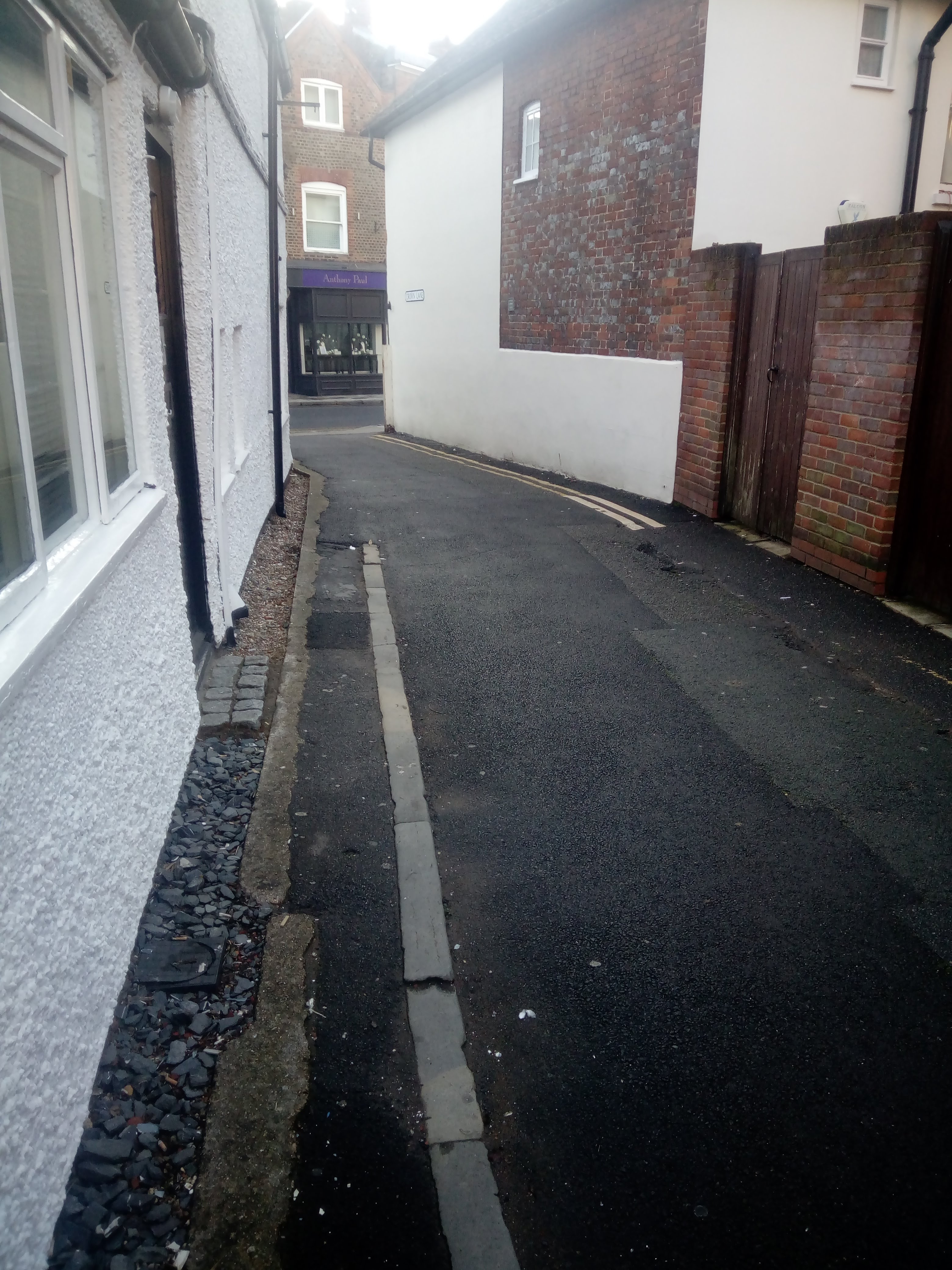
Miss Perfect and Some Tragedy In Crown Lane


Most people who have lived in this lane in Marlow have done so from the early 1890s onwards. Before that the lane existed as a way around to a few buildings but was only ever home to a couple of families at a time. It was sometimes early on called Spittal Lane as it comes off Spittal Street. (For a potential candidate date for the origin of Crown Lane, see the Crown timeline post here - under date 1650. )

On the 1861 census the White and Davis families had homes there. Anthony Davis was a labourer at the paper mills near the river while his wife Elizabeth was a housewife. Thomas White was a sawyer and his wife Mary Ann was a laundress.
Sadly two different residents of Crown Lane were found drowned in the Thames at Marlow- Thomas Holford in 1902 and Arthur Bristow in 1916. In neither case were there any witnesses so the respective juries at the resulting inquests returned verdicts simply of "Found Drowned".
Arthur Bristow aged 43 suffered from "locomotor ataxy". He believed his condition to be worsening and expected to soon lose the use of his legs. As a result he was very depressed and the implication from the evidence of those who knew him at the inquest was that suicide was a probability.  But no one saw him go into the water hence the "Found Drowned" verdict. The jury in his case donated their fees to the Red Cross. Such donations of fees tended to occur when the case heard had been particularly tragic, typically a suicide of an adult or the death of a small child. Both inquests took place at the Two Brewer's pub in St Peter's Street near the river. Local man Albert Truss helped to recover the body.

On the theme of losing the use of legs in 1900 resident "Frank" Tapping took out an ad in the South Bucks Standard thanking all those in the town who had donated money to him after he had to had his right leg amputated. This was in fact Harry Frank Tapping who would have been only 17 at the time. He was the son of Police Constable George Tapping and Mary. Frank appears on the 1901 census as a hairdresser and barber living with his parents and siblings in Crown Lane so the amputation didn't hold him back from starting a career. 
The family had moved there at some point in the 1890s. George was the constable for Lane End from at least 1889 to at least 1892. Prior to that he was stationed at Amersham.
He and Mary married in 1876. Her maiden name was Perfect hence this blog post title. I hadn't heard of this last name before and I had to check it twice to be sure!

The year of Frank's amputation 1900 was also a tragic year for another Crown Lane family when Elizabeth Tubb aged just 40 and a mother with half a dozen children still at home, died. Her husband William, then a labourer, had already had a very troubled life. His father had died at Medmenham when he was only a few months old. His mother brought him back to live with her parents in Dean Street Marlow. He became a shoemaker but found it hard to stay out of trouble. In 1868 he was prosecuted for stealing oats, in 1875 for not paying his lighting rates, in 1880 for rioting when the local Liberal candidate lost the election [more on this in future. Many local working people felt cheated and dispirited by this loss], in 1889 for stealing a piece of leather from Mrs Dewey's Chapel Street shop, and numerous times for failing to pay other local taxes. Poverty looks to be the main factor in these cases. When he stole the leather he said he was a father of ten who had no work for a week after his job with "Messrs Burrows" finished and he was now desperate. The case is a stark reminder of the fact that many families then could afford to make no savings and a single week without pay pushed them to the brink. William received 14 days in jail for that theft. This the court said was a mercy because of his hard pleading of his dire circumstances. The Messrs Burrows had a boot and shoe manufacturing workshop in Marefield, Marlow. 

He still lived in Crown Lane in 1910 when he was summoned for the last time I could find - this time for using bad language.

There was a laundry in Crown Lane in 1929 and an ice cream supplies business at the "Farm House" in the 1950s. When (or if) that house was a farm house I am unsure, it is on my very long "to do" list of further research! It was apparently a school in the early 1830s.

Sculptors Doreen and George Dereford had a studio in Crown Lane in the 1960s.
 
For histories of other Marlow streets or buildings see the "Specific Shops, Streets etc" option on the menu. All mentions of an individual on the blog can be found on the Person Index on the top drop down menu. 

Photographed Summer 2020.
Post written and researched by Charlotte Day. Photos by Kathryn Day.

Sources:
South Bucks Standard 16th November 1900 and 9th December 1910, Reading Mercury 1st February 1902, Bucks Herald 25th July 1868, 14th September 1889 and 19th August 1916. Newspaper copies all from the British Library Archives and accessed via the BNA March 2021.

GRO Marriage Index and Death Index online from their website.

1891 and 1901 census transcribed from microfilm by Jane Pullinger. Thanks Jane.

1881 census from Familysearch website, ran by the LDS [Intellectual Reserve Inc]. Accessed March 2021.

©Marlow Ancestors. You are very welcome to use these images or research for family history purposes if you credit this blog and link here so that our sources remain credited for the information they provided. Thanks!

Tuesday, July 27, 2021

The Old Police Station and Police Court, Trinity Rd, Marlow (Formerly Gun Lane)


 Police Court is top pic, police station below. Sorry about all the shadows! 


The 1869 date on this building refers only to the police court which was added to the existing police station when the latter was around 10 years old. This first part may have been converted into police use from a near derelict domestic building called The Garrison, sources conflict* Plans to add a room to the station for the purpose of holding petty sessions was mooted in 1865, but progress was very slow. The extension was opened in October 1869. It provided direct access from the police station so prisoners could proceed straight into the court. Normally referred to as the Petty Session Room in the first few years, there was also a retiring room for the magistrates. Sir William Robert Clayton donated a bust of the Queen and the Prince and Princess of Wales to stare down at offenders. In 1876, he donated an 8 day clock too. 

Previously the petty sessions were held in a small room of the Crown, which they had utilised for that purpose for many years. An agreement was made that the authorities could pay a pepper corn rent for it. (The Crown landlord collected one guinea from each magistrate per year in theory but not all actually made the payment.) The magistrates however frequently complained about the unsuitability of this accommodation. In particular they feared trying a poaching case because they said the court was overwhelmed with curious spectators (usually vocally supporting the poachers). It was hard to control the numbers coming into the tiny room, often resulting in everyone packed so close that you "could scarcely stick a pin in between them", as one person charmingly put it in 1865. This mixing of closely pressed men and women was "very disgraceful and often indecent" they said. Disruption of proceeding was not uncommon. Some questioned why the town hall could not be used instead, but this was let to the neighbouring Crown and the proprietors of that would not agree for a larger room to be used there. They said the court proceedings attracted a large enough mob of ne'er do wells already - aside from those answering a summons! A new room would allow the sessions to continue in "peace and quietness." Records suggest that some sessions were held at the police station even before the room was finished, although that can't have been easy space wise. 

The petty sessions room extension was completed quickly once permission was finally granted for it to go ahead. Once finished the "commodius" extension was praised as "well arranged with every accommodation." Such satisfaction was short-lived. The police station was made for a sergeant and 2-3 constables. Sometimes an
extra constable was bought in at weekends during Marlow's busy summer river season. Marlow was granted a forth constable in 1900. Complaints were made about insufficient lighting at the station, cramped conditions and dodgy heating. (Actually the first complaint about police station heating came as early as 1859!) Although improvements were made in fits and starts, Marlow did not get a new police station until the 1960's. 

The senior police staff were usually resident at the police station itself in Victorian times as you can see from census returns. (The unmarried junior policeman often lodged elsewhere, although at Marlow at least one is usually to be found lodging at the station.)  I believe the first police Inspector resident was Thomas Knott Clark who may well have arrived in 1858. He was certainly there by the time of the 1861 census - address "Police Station Gun Lane". Born in Hillingdon, Thomas was living in the station with wife Emma nee Cheese and their two eldest children Thomas age 3 and Emma age 1. Inspector Thomas would later return to the trade of his youth in Uxbridge - he became a coach painter in High Wycombe. The other 1861 resident in the Police Station was Constable William Nash age 21. In 1863 Inspector John Pearman took over and described the station as a "nice home with a good garden". 

The property included an airing yard for prisoners and later, stabling for horses. The stables were extended in 1910. 

The Petty Sessions were originally held twice a month, although hearings for indictable offences could be held at other times. The days of the week it operated on and the overall frequency varied over the years. The courtroom saw occasional other uses such as coroner's inquests and parish council meetings. A plea from the Marlow Rifle club in its 1859 incarnation to store their weapons at the Police Station was refused. The police felt they could only be conveniently stored in the corridor leading to the cells. This spot was considered a little too close to the prisoners for their liking, especially in the event of a riot. (A not infrequent occurrence in Great Marlow!)

Did the Marlow police patrol Dean Street and Marefield in pairs? This is a common Marlow story and the answer to that question is both yes, and no. 

In the earlier 19th century the area was both poor and home to many hardened poachers. Some arrests were certainly drawn out and bloody affairs - see the post here for details of one especially serious incident! It's unsurprising that the parish constables tended to take a couple of tithing man along to assist when attempting an arrest on one of these individuals but these were extraordinary, planned operations not part of patrol duties. 

But this must be tempered by the many narratives of crimes and arrests where the residents of Dean Street show no hesitation at going to the police for help themselves. It was not always "us and them".
In mid and later Victorian court cases when two constables give evidence about assisting in the same arrest,  or if both have witnessed the same crime, these things have nearly always occurred because the second man has been summoned by the first, not because they were patrolling together in the first place. And the delay recorded in help arriving means assistance was not just a few feet away. Marlow didn't have enough constables on duty at once to go about routinely paired up at that time. Remember they had to have men patrolling outlying places like Bovingdon Green and Handy Cross not just central Marlow. (Little Marlow got a constable in 1866) Also the narrative of events, particularly around domestic abuse cases, are full of single constables entering homes when they are aware of incidents occurring inside. They did not wait for back up. These were often brave men.

But if we move on to the 20th century there are numerous accounts in the 1920's and 30's of pairs of constables on patrol (although not exclusively in the Dean Street area by any means). So while the evidence definitely doesn't support a long tradition of paired policing in Dean Street, there was certainly a time when at least sometimes it was needed.

Sometimes those passing the police station and court in a less than sober manner caught the attention of those inside. At least one man who sang a bit loudly outside was arrested and bought straight before the magistrates for a telling off. Labourers William Laurie and Albert Wingrave probably felt a little less merry after their arrest for drunken behaviour outside the Police Station in 1907. They were fined 10s each plus costs. They received a night in the cells too. And in 1912, Florence Collier of Trinity Court had the misfortune of being overhead using bad language at her children, by the police within the station. She was summoned but it was decided to be lenient to her and dismiss her with a caution. She probably swore that little bit more quietly in future! 

In 1883 suspected sheep rustler James Howard mounted a daring escape from custody in the police station. This deserves a post of its own, which will follow in future.

*Did you know?
Marlow man Charles Carter acted as architect for Beaconsfield police station (opened 1870) through his position as the county surveyor. Charles was also responsible as architect for what is now the Masonic Centre, the new Blacksmiths Arms at Handy Cross, and the Primitive Methodist Chapel (now Liston Hall) amongst many more projects. 


Above, the Police Court sign. The brickwork visible around it is in the English Bond pattern, not particularly fashionable at the time though it came back into fashion in later Victorian times. It was likely chosen for its strength.

*We are working to confirm the exact date the building came into use as a police station. The police were established in Trinity Lane by 1861, but they may well have been there from 1859 based on descriptions of the interior of the building then in use. The former parish lock up in the base of the Town Hall was convenient for the old petty sessions held adjacent. A man to look after that lock up was sought in 1856 - wage of 15 shillings a week with a uniform of hat and coat provided. An earlier "cage house" was also located near the Crown. In 1852 the old lock up was described as a "filthy hole" with no convenience or adequate means of ventilation. It was however not impossible to escape from, as happened on several occasions. Jesse May, arrested for robbery with 3 others,  found his way out in 1853 through a gap in the "railings" said to measure just over 25cm by 21cm which does not seem entirely credible. But whatever the hole size, he did escape and was not apprehended again for 5 months. 


Related posts:

Victorian Sergeant John James Maneely biography here

History of Gun Lane here

Parish Beadle Pocock here

Crime and disorder in old Marlow here

A full list of Marlow crime related posts can be found under the General History option on the top drop down menu. 

Use the A-Z person index to find every mention of your ancestor - there is over 6,000 former Marlow residents currently listed as of July 2022.  

This post researched and written by Kathryn Day. Further research by Charlotte Day.


References

County Compendium, Diary, Statistical Chronicle and Magisterial and Official Directory 1879. Ed - Sir John Richard Somers Vine. 

Accounts and papers volume 25, Great Britain Houses of Parliament, 1849. 

The Builder, December 10th 1870, digitised by Google. 

Berkshire Chronicle 22 October 1859. 
Bucks Herald 22 October 1859 - thanks to Mathew Peterson.

Dickens Dictionary of The Thames 1856 edition. 

Bucks Chronicle and Bucks Gazette 1 July 1865
South Bucks Free Press 30 June 1865, South Bucks Standard 18 May 1900 & 25 January 1912. Windsor and Eton Express 9 October 1869, Bucks Herald 09 June 1866 & 5 July 1884, Windsor, Maidenhead and Eton Journal 15 May 1876, Bucks Advertiser and Aylesbury News 31 Jan 1852 : all at the British Library Archive. 

Kelly's Directory 1883, 1903, Kelly's Directories Ltd. 

Dozens of petty session case narratives, too many to list individually! 


©Marlow Ancestors. .

PHOTO ID ANYONE?

 Can anyone help a fellow family history researcher Linda identify where this staff photo may have been taken in Marlow? Underneath are some...