Search This Blog

Showing posts with label Chapel Street. Show all posts

Wednesday, January 15, 2025

George Cole, Great Marlow


Grave reads:
George Cole died Apr 18 1834 aged LXIV years (64!)

And wife Mary who died Feb 19th 1817 age ?? years

Grave mentions that George was late of Royal.....but Royal what can't be made out!

Research Notes:

The "Royal..." Was  referring either to his time in the Royal Artillery or his time at the Royal Military College at Remnantz West Street where he was a Sergeant instructor to the cadets. To find out more about life for the cadets there please read this post. After the College moved from Marlow in 1812 George set up a  private day school for boys where Liston Hall is today in Chapel Street. He was a fervent Wesleyan so perhaps would have been pleased to know that the site of his home and school became a Primitive Methodist chapel after his death (before becoming Liston Hall). In fact George was credited with actually starting Methodism in Marlow by persuading the preacher who visited Henley every week to make a stop at Marlow too. Early meetings were held in an unglamorous location- under a tree by the "Common Slough" which was at the junctions of Spittal, Chapel and Dean streets in Marlow. 


Related posts:

To read a detailed post about the life of the military cadets George taught see Charlotte's post here.

A history of the Wesleyans at Marlow here

Index to church and religion related history posts for Marlow here.

Grave photos and transcriptions index here.

More posts about historic residents of Chapel Street indexed here.

Researched and written jointly by Charlotte Day and Kathryn Day. Photo by Kathryn.

Sources Included: 

Charlotte's transcription of the original surveyor's notes for the 1833 Parochial Assessment of Great Marlow.

South Bucks Standard 2nd September 1898. British Library Archives, via the BNA.

The Methodist Times. January 1902.

© Marlow Ancestors. You are welcome to use this material for family or local history purposes with credit to this blog.

Monday, October 7, 2024

The Most Difficult Job In Marlow History?

 Marlow is a place where even the election to an unpaid parish position could result in civil disturbances, accusations of bribery and corruption and occasionally bloodshed. Elections to parliament were even worse. The 1880 election riot, and women's bread riot of 1800 are probably the best known. Someone had to officially call these elections or polls and announce the often unpopular (with the disenfranchised) results, and for the first half of the 19thc the man with the short straw was Henry Stallwood. 


Hidden history of Quoiting Square

Henry was of relatively humble origins and yet he came to wield some power and responsibility. Born in 1807, I believe he was the son of William and Maria Stallwood and therefore brother to influential Chartist Edmund Stallwood whose biography I've linked to below. William ran the small Three Loggerheads beerhouse in Quoiting Square (later The Queen), and Henry lived next door for a while. He worked as a young man as a shoe maker like William. (Combining beer selling and boot and shoemaking is almost a cliche in Marlow at this time.)  But it's Henry's parish roles we are going to focus on. Quoiting Square was the centre of non conformity in Marlow, home to the Congregational Church or Salem Chapel as it was then known. It was also the centre of liberal and "radical" politics (the Clayton Arms pub was in particular, named for local landowner and liberal political  candidate Sir William Clayton of Harleyford Manor.) So many of the residents of West Street, Oxford Rd and Quoiting Square  were identified at this time with being "independent" either in terms of how they voted or how they worshipped (and usually both). 


Marlow was regarded as a pocket borough, which returned two M.Ps. In other words, it was in control of the majority land owners the Williams family of Temple House. Generally it was considered, rightly or wrongly, that if you were one of the minority of Marlow residents with the right to vote, and you were one of Williams tenants, you'd better vote for him and his running partner or you might find yourself promptly evicted or trade withdrawn from your business. Accusations of voter bribery and intimidation were common on the other side too. Who you voted for was publicly known after all. So in 1835 Henry, and William Stallwood, found themselves commemorated in a list of 34 "Independent Voters" who'd dared to vote against the status quo, unsuccessfully as it turned out.  This list was intended to mark the bravery of those concerned but it probably marked them out for a certain amount of abuse from opposing quarters too. 


Parish Constable - A Bloody Business

I've mentioned one fairly thankless task Henry will have, that of returning officer for the borough. But Henry may have come to mind to those who voted him in because he'd already fulfilled another clutch of very difficult roles in Great Marlow history. These were those of parish constable, tithing man, and hayward. You might think a little country town might not be an especially stressful place to be a petty constable. Unfortunately for Henry you'd be wrong. Marlow had a reputation as a centre for poaching and some of these men were violent, both to keepers, witnesses against them, and to the arresting officers. Generally Henry took the option of  safety in numbers and a group of tithing men and petty constables did their best to surprise the offenders at home. The tussle to arrest one of the most notorious poachers, watched by a 100 strong crowd in 1840, is covered in detail in this post here. You will see from that that in 1842 Henry inflicted some severe injuries on the same suspect during an arrest. Henry was not afraid to use the staff given to him shall we say. Were the suspected criminals violent on arrest because the police were rough to them or was it the constables felt they were entitled to give as good as they got? Hard to say but it's fair to say Henry and his colleagues often had the crowd against them, and they were very much outnumbered. When Henry as tithing man was attending the Marlow horse races* in 1836, his attempts to keep the course clear nearly got him a ducking in the river. He was implicated in an assault by a parish constable on a race goer who had apparently ignored instructions to stay behind a line. The man received a head injury, and the crowd thought the constable and Stallwood had used excessive force to make their point. No action was taken against Henry but the constable was successfully sued for damages. 


Henry the sleuth 

Henry was a parish constable for much of the 1830 and 40s. Technically any householder could be selected for this role, which was then unpaid, and the position lasted a year. But if you were selected, and didn't want to do it, you could nominate a substitute and pay them to do the job for you. Henry was obviously one who was willing to take more than his fair share of turns. He was regarded as a brilliant constable, at least by those who didn't feel the brunt of his official staff. 

He took the role seriously, and very frequently we can find him patrolling the streets at all hours of day and night looking for the criminally inclined. (In this age of violent arrests, Henry was nevertheless usually patrolling alone. There were not enough police to do otherwise even if they wanted to.) He seems to have been a vigilant soul. To give one example from 1838.. One night, Henry sees William Meads lurking suspiciously outside the shoe shop of John Beck. He waits and watches as William breaks open the shutters, and goes inside. William then emerges back  through the window and sidles off. Henry follows him back to his lodgings, collars his man, and finds 12 pairs of shoes about his person. William Meads had a previous conviction for theft and so the sentence was inevitable - transportation for life. 

A bold thief attempted a break in at Henry's own house in 1854. (He was then living in Chapel Street.) The bolts were too strong to break through. They did manage to get into a store and liberate 2lbs butter though. 


More jobs for Henry

In 1839 Henry was elected to the position of surveyor of the parish roads. It was a hotly contested affair with numerous candidates, and allegations yet again of nefarious tactics.  Why did anyone care so much about what seems a role of only very local importance? More people had the right to vote for these parish positions than had the right to vote, and candidates were promoted by one political party or another so it became a way to show support for them. Many of those who won were the "liberal" or "independent" voters in political elections and they said it showed what the result would be in terms of their choice of M.P if the franchise was wider. Henry obviously did a good job as he was returned with little opposition the following year. In this role he had to check the roads were in good order and repaired in good time if not. 

Then in 1842 he was nominated for the joint position as registrar and relieving officer  (eg for the administration of poor relief funds) for the Marlow district of the Wycombe Poor Law union. The previous man in the job has been sacked due to numerous "defalculations" in his accounts.  How many of these roles Henry wanted to fulfil in their own right is hard to say, but I suspected he was generally put forward to represent the liberal interest whenever an opportunity arose. On this occasion he was unsuccessful at the poll, although he did come second. 

This was a time the parish position contests were getting yet more political. A sustained attempt to ensure Conservative voters turned up at the parish vestry in 1843, meant all "rad" holders of parish positions were ousted - including "Lord Chancellor Stallwood" as one paper put it. No more parish constable Stallwood either. However any attempt to keep our man out of local affairs were doomed to failure. 


Dirty tactics of another kind

Henry was still occupying parish positions in the 1850s and 60s. He continued in the unpopular (elected and this time paid) role of parish rate collector for more than 20 years from 1849. In other words, he issued demands for payment of the local taxes 3 times a year, and then came to collect the money due. Marlow people did not like paying their rates in general. In this job he would clash with some of those on his own side politically who objected to some specific rates or how they were administered. But Henry showed no favour and was not averse to applying a little pressure on the late payers. One  complained that Henry employed a group of "dirty boys" to "huzaa" (shout and create a hullabaloo) outside the house of anyone who wasn't ready to pay the first time he called to collect his dues. The magistrates were sceptical that someone in a respectable position would do any such thing, but when asked Henry happily admitted that he did employ one boy to create a disturbance! He suggested the youngsters' friends probably tagged along. The J.Ps responded that Henry had "a painful duty to perform".


He was obviously doing his best to be impartial as regards collecting the rates but I suspect he sympathised with those who felt they were too high. He was one of the founding members of the Marlow rate payers association, and at its inaugural meeting in the Clayton Arms in 1866, he was elected to the chair. Their brief was to watch over parochial spending  and ensure everyone got good value for money. 


From 1859 he was also the parish inspector of nuisances and chair of the Nuisance Committee. This usually meant investigating reports of overflowing cesspits, stinking drains and overgrown piles of farmyard manure. The scale of the challenge facing Henry here is hard to imagine. In his first year he reported  605 cases of nuisance within the town! This only accounts for those cases where he found there was a legal cause for complaint, not every one he had to investigate. Let's hope he didn't have a good sense of smell.


These kind of offences were not just unpleasant but often dangerous to health. In 1866 Henry chaired a meeting which aimed to prevent another cholera outbreak in the town. (In recent years there had been ones in 1832 when 49 people died, 1849 with 12 deaths, and 1850 with "many" fatalities.) It was settled upon to begin a house to house inspection to look for dodgy wells whose water would be tested. It was also decided to organise a subscription for a new parish pump to provide access to clean water.  I'm not sure which pump this was - the ones in Quoiting Square and St Peters Street are both possibilities. 

I will mention one last role, which he kept up to his death - county court bailiff. 


At election time

As mentioned above, one of Henry's most eye catching roles was the one of returning officer.  He took this on in 1836 and continued it for decades. This involved him taking the official public nominations for "right and proper persons" to represent the borough in parliament. Special hustings were erected outside the town hall/ Crown in Market Square for this to take place. If only as many candidates were bought forward (and seconded) as there were seats, this was straightforward. If not, a show of hands in favour of each would be M.P was requested. Henry had the job of deciding if two people had a clear majority of support. If not, he would declare a poll was necessary, and formal voting would take place on another day shortly after. If Henry's decision was disputed by either side, a poll could also be requested by those present. I don't think the show of hands ever actually settled the election, it was more of a formality. Henry usually gave some speech appealing for calm and good conduct.  He was present on the platform throughout voting  and supervised the recording of each eligible persons vote in the poll book. He then had to announce the winner. The actual voting part of the day was usually accompanied by some shouting and jostling but the real trouble generally began once the victor came forward. I don't think Henry was ever injured as a result, but as missiles were recorded as thrown at the stage more than once, he may have just learned when to make a speedy exit.  Winners and losers almost always make a point of thanking Henry for his even handed behaviour and diligence in this position. 


Henry himself was not prevented from engaging in political causes. In 1867 he was present at a reform meeting at The Greyhound Inn. Almost all those publicly recorded as attending were non conformists. He put forward a proposition that the franchise should be extended to the working class and that there should be a clamp down on voter intimidation and bribery. This was unanimously carried. In particular Henry wanted to see those accused of either offering bribes or accepting them punished properly. Other votes were to support the use of a secret ballot. 


Family man

I've not mentioned much of Henry's personal life because his public one has taken up so much room! Married to Mary (b c 1809), he had several children including little Clara who died after 3 weeks illness in 1853. Another daughter, Mary Ann would be a school teacher as a young woman. As such she was considered for the position of schoolmistress at the Union workhouse school at Bledlow but in the end was unsuccessful. I've wondered whether this Mary Ann may have been one of the juvenile pupil teachers of the Marlow girls British school but more research is needed. Henry was definitely an early supporter of the Marlow British schools (that is ones that were non denominational in their religious teaching) and was on the committee to start the first one (boys only originally) in 1852. Mary Ann also worked as a dressmaker. 


The Stallwoods were members of the Congregational Church in Quoiting Place (Quoiting Square now). Henry was a proud teetotaler like so many of his fellow worshippers. He said he took the pledge in 1841 and never looked back. He addressed the local temperance society several times. 


It's hard to imagine Henry had much leisure time but we know where he could be found when he did -  at the Great Marlow Literary and Scientific Institute reading room in the High Street. He was a supporter of this from the start, and often sat on the committee. 


Goodbye Henry

Henry died in the summer of 1872 age 65. The Bucks Herald declared he had been a "shrewd, industrious and diligent man" who was "painstaking and efficient" in his work. At that point he had moved to Cambridge Terrace (Cambridge Rd). Marlow would have to find someone else to do their dirty work!


Additional information:

Chartist Edmund Stallwood : here

 Early policing - crime fighting societies, parish constables, tithing men, sheep stealing and the night watch here

Index of posts related to Quoiting Place / Square: here

Index of posts about riots, dodgy elections, bribery and other crimes here

*Marlow Horse Races- comprehensive history, updated October  here

The British schools in Marlow: here

The Literary and Scientific Institute - here

Three Loggerheads beerhouse : here

All mentions of a person or family here can be found in the A-Z person index on the top drop down menu. 

Written and researched by Kathryn Day.


SOURCES INCLUDE:

1833 parish assessment, from original in our possession. 

Robson's Commercial Directory 1839. 

Census - transcript from the originals by Jane Pullinger. 

Windsor and Eton Express February 11th 1854, 13th December 1862, 11th August 1866, 23rd March 1867 - Slough Borough Libraries

Report of The British Schools Society 1856. 

Bucks Herald 6th January 1838,  31st March 1860, 2nd Jan 1862, 27th July 1872. Bucks Gazette 28th March 1840 & 5th November 1842, Bucks Advertiser and Aylesbury News 20th July 1872,  Berkshire Chronicle May 11th 1842, Reading Mercury 5th November 1853 & 23 March 1867  - all British Library Archive. 

"England and Wales Death Registration Index 1837-2007," database, FamilySearch (https://familysearch.org/ark:/61903/1:1:2JT4-32Z : 31 December 2014), Henry Stallwood, 1872; from "England & Wales Deaths, 1837-2006," database, findmypast (http://www.findmypast.com : 2012); citing Death, Wycombe, Buckinghamshire, England, General Register Office, Southport, England.


© MarlowAncestors


Thursday, January 19, 2023

Wellicome Burial and Research


John Wellicome Senior. Born 1773 died August 6th 1840.
Ann Wellicome born November 1781 Died July 1861.
Ann Wellicome Junior born 18.... Died September 188..

Graveyard of All Saints Church, Great Marlow.

Notes: Name occurs as Wellicome, Wellicombe, Wellicom, Willicombe etc. Some members of this family were Non-Comformist Christians. In 1833 there were two men called "John Wellicombe" in Marlow- one who lived in Chapel Street and one who lived in Dean Street. The John above is likely the Chapel Street one as his son John was
later certainly in Chapel Street. John junior had many trades including running the Cross Keys. More on him here
Ann who died 1861 was the wife of John senior and the other Ann on the grave is likely their daughter Ann Mary.

To find all mentions of a family or individual here use the A-Z person index in the top drop down menu - there are now 4,500 people listed there. 
Grave index: here

©Marlow Ancestors. You are very welcome to use this image and information for family or local history purposes with credit to this blog. 

Thursday, January 5, 2023

Arthur Barnard And The Photograph Problem


If you were a bike-less Edwardian lady resident of Marlow you may have stared at the confident young woman gliding around town on their bicycles with a touch of envy. While attitudes to cycling, and lady cyclists in particular, were not always supportive, it was also recognised by many as a healthy form of exercise. There were no shortage of cycle agents in Marlow and you could buy a model actually built within workshops in the town. Learning to ride the "machine" was a little more difficult for ladies however, as they were hampered by skirts. You might hope that a relative could assist you to perfect your technique on some quiet road away from the prying eyes of laughing boys. But what if you had no one to guide you? You might consider finding a tutor to give you a formal lesson or two. Of course these lessons might sometimes be a "hands on" experience until your balance was perfect. So any tutor would have to be unquestionably professional and respectable. Fortunately, there was a upright businessman in Marlow who were offer just such tuition. Step forward the young and - apparently - impeccably respectable Mr Arthur Barnard of Spittal Street's Barnard's Stores. Arthur was a church (or rather chapel) going man and the bandmaster for the local Christian youth group the Boys Life Brigade.  Unfortunately Arthur's reputation would eventually come down with something of a crash but more of that later! 


King of the road

Arthur was naturally a keen cyclist and as such he belonged to the Marlow Cycle Club, eventually acting as it's president or "Captain" from the late 1890s. This comes across as a sometimes eccentric group who could work a bicycle or tricycle into almost any event if they tried! (You can read about it in more detail here ) But their Bicycle Gymkhanas were big attractions at the time and the members, in club colours were part of all kinds of processions and parades. Arthur's group decorated their cycles with flowers, flags and ribbons for these events. Arthur and wife Harriett (married 1888) had a tandem bicycle, usually the only one in parade, and so were often singled out for particular notice. The pair won several prizes for the best decorated bike and a silver medal in 1899 for the best illuminated bike in a regatta related lantern parade. 


During this time Arthur also extensively advertises his "Cycle Stores and Ladies [cycle] Riding School" in Chapel Street. He stated that he had taught a number of fashionable ladies and leading inhabitants to ride their bicycles and so he could be trusted to offer a professional and discreet service. "Personal tuition in every case." He would travel to you if you wished your first wobbly efforts to happen within your private garden. He only offered tuition to children and ladies, which is not unusual as men were often supposed to be able to learn the hard way "on the go". He continued to sell both new and used bicycles into the 20th century. 


I can get you anything...


Arthur was born in Essex in the 1860s, but as a teenager he was living with his parents and siblings in High Wycombe. His father was an ironmonger of Totteridge Rd and the young Arthur worked as an errand boy. In the late 1880s Arthur moved to Marlow to set up as a grocer in Chapel Street with wife Harriett.

Mr Barnard comes across as one of the most energetic and enterprising of Marlow's late Victorian and Edwardian businessman. His cycling tuition service was only one of the many strands in his commercial bow. His main business was his Cash Stores in Chapel Street - a high class provision store according to Arthur -  and later one in Spittal Street which offered a greater range of hardware. In fact Arthur maintained a shop on both sides of Chapel Street for many years, before securing the large Spittal Street premises. But Arthur's motto was that he could supply you with anything and everything at the lowest price compatible with good quality.  You have the feeling if someone wanted a kangaroo from Australia he'd probably have found a way to supply it! The "cash" part of the business name, not always used in advertising, reflected the fact Arthur did not offer credit. You could not put your shopping "on account" or "on the books". This means he would not have been a regular shopping stop for the poorer of Marlow residents who relied on credit to get by, at least until they had run out of those willing to offer it.  (Some so called cash stores did in fact offer credit to wealthier customers!) It seems Arthur may also have been part of a co-operative group/buying society for a time. He also earned money by performing as a musician and offering tuition in this. 

You could purchase a gramophone at all his stores. (I've noted that almost every cycle seller in Marlow had a sideline in gramophones or the like. Timberlake's in the High Street specialised in both for example.) 

 There were plenty of rival grocers in town but Arthur had his specialities including Wiltshire and home cured hams and "marvellous" tea. But it was the more "under the counter" items that Arthur offered that would most interest the authorities. 


Plain clothes sting!

In 1906, Arthur was arrested after a plain clothes police operation at one of Barnard's stores. His offence? Selling indecent photographs and prints. (Postcards would appear to be included). Arthur plead guilty but given that he had sold them directly to a policeman it's hard to see how he could do otherwise! He admitted buying a few of the cards from a passing traveller, with the intention only of showing them to his friends. He claimed these friends had encouraged him to buy more and "weak willed" he had agreed to do so. But the police must have had some tip off that such images were generally available to purchase. Much was made at trial of Arthur's position of trust within the boys brigade and also within the PSA (Pleasant Sunday Afternoon, a chapel social club which operated from several Marlow places of worship). He was fined £50 and the images were destroyed. It's difficult for us to read between the lines of carefully worded reports. The images might not have struck us as indecent by our standards but this is not the case with all such Victorian images by any means. They were not all as prudish as we sometimes imagine! 

Arthur had traded partially on his unimpeachable good character. He had involved himself in many Christian and charitable endeavours (such as donating food to the Marlow Cottage Hospital and a box of cigarettes to every volunteer returning from the South African wars in 1901). No doubt many would have been astonished that he had found himself in court for anything, let alone his particular offence. 

The events must have lost Arthur some business and caused much embarrassment to his family. 


Arthur's Chapel Street premises above. The "cash stores". He also had a premises on the other side of Chapel Street at the same time which look to have been the focus of the cycle trade - that building was the Dean Street end. 


Above, 1891 Barnard's advert. Courtesy of Michael Eagleton.  Tea siftings available at a bargain price of 1s 4d a lb would be one of the relatively few cheaper items available from Arthur. 


On a lighter note..

The instrument that Arthur is usually recorded as playing was the flute. He did so at the Primitive Methodist Chapel for fundraising events and teas. The Primitive Methodists were fortunate to have many skilled musicians amongst their congregation and supporters and so Arthur performed alongside those playing violas, violins, cellos and the chapel's harmonium (often played by Charlie Plumridge).  

He was one of those that set up the Marlow Drum and Fife Band (there has been more than one - some comprising members of the Rifle Volunteers or church groups for example). Arthur was Band Leader and quite literally lead  them through the streets of Marlow on many town occasions, wearing a smart uniform. On some occasions the band performed in the streets on Christmas Day itself, in friendly rivalry with the Marlow Salvation Army Band, and others. In December 1892 we are told that the members were "blowing their whistles and banging their drums with irrepressible energy". Buying and maintaining the instruments and uniforms had a cost, and it seems the band was frequently short of cash  and sometimes members. Reports of their AGMs show Arthur tried to stay optimistic nevertheless. In fact if you saw a Drum and Fife Band performing anywhere locally, there is a high chance Arthur would be there. He had the monopoly of local band leaderships, also acting as the head or instructor of the Medmenham, Frieth and Little Marlow Drum and Fife bands in the 1890s. But still he advertised his willingness to take on yet more roles in this field "distance no object". 

Then in 1903 the Boys Life Brigade* was formed in Marlow. A lot of it's activities were focused around life saving in a literal sense - first aid, stretcher bearing exercises etc. But it is probably mostly remembered for having a Trumpet and Fife band under bandmaster ..you guessed it ..Arthur Barnard. The BLB was a uniform wearing non denominational youth group that was intended as an alternative for the Church of England's Church Lads Brigade which was not open to Christian boys who did not attend the parish church and Sunday school. As there was a good number of non conformist and Catholic families in Marlow, the new brigade was instantly popular. Arthur's own son was a member, and he played a drum. The Brigade band marched through the town on one or two Sundays a month and then "fell out" to allow the children to attend their respective Sunday Schools. You might think that a rush of young men to join a religious group would please Victorian parents. Well it did please some, but the Vicar of All Saints was not one of those. Arthur and he engaged in an angry exchange of letters in the local press. Those connected with the Parish Church were upset that some boys from their church had chosen to join the new Brigade rather than their own group. Also when the BLB Sunday parades broke up, some C of E boys were joining their chapel going friends at rival Sunday Schools. The vicar accused Arthur and other adults of failing to prevent them doing so. Arthur protested that while the Vicar had forced some of his own young parishioners to give up belonging to the non denominational BLB band, Arthur himself welcomed all boys as members to their group. He said it was natural that the children would sometimes wish to stay together and join their friends at a different Sunday school to do so. Arthur's group was serious in their non denominational focus. The band performed at a 1909 fete held at Gyldernscroft in aid of the chancel improvement fund of the parish church for example. They held their annual grand concert in the Music Room in St Peters Street. 


Arthur's involvement with the Brigade ended around the time of his conviction. He had put a lot of his own money into the group, and this is presumably the origin of the "Barnard Debt Fund" that the Brigade were paying back for several years afterwards. 


Harriet died in 1918, and Arthur in 1924. He was only 59 years old. You can see their grave at Marlow here


*The BLB met in the former Salvation Army drill hall in Oxford Rd from 1907/8. Wednesday afternoons were band practice days. Other activities included running football and cricket teams, athletics meetings, a weekly gymnastics class in winter, a small members library and all round "healthy amusement and recreation". In 1908 there were 50 members, including the band. Club nights were twice a week. They also had a swimming hut near the Complete Angler. A list of known members and officials will follow as requested as soon as time allows! The Brigades  band was renamed the Marlow Town Band in 1911 and made available to hire by general public. Note however the "town band" has had a lot of incarnations. 


To find all mentions of an individual or family here, see the A-Z person index in the top drop down menu. It contains over 4,000 individuals and counting.


General Marlow history - here

Other Spittal Street and Chapel Street shops and shopkeepers  - here including Edwardian property occupiers no. by no. here


Sources include:

Marlow Guide 1903 & 1905. 

1891 census transcript from microfilm by Jane Pullinger. 

South Bucks Standard May & December 1892, August 1894, April 1897, June 1901, March, May & June 1903, November 1909. 

Kelly's Directory of Buckinghamshire 1920. (Kelly's Directories 1920) 

Reports on the Boys Life Brigade in England, 1907. (Courtesy of Andrew Grahame)  

Buckinghamshire Examiner 06 Apr  1906. This copy via the BNA partnership with the British Library Archive. 

Marlow Directory and Tourist Guide, South Bucks Standard. 1891. 

Marlow Directory and Almanack 1907 & 1915. (Marlow printing co/Welbourne and Simpson) 


Arthur's Spittal Street store. The place to go for gramophones, the latest records, sewing machines, brooms, tinware, pots and pans, China, and more. This building replaced a few small cottages set further back from the road, one of which was a long time cordwainers premises. Arthur opened it in 1915 - see advert below. 


Written and researched by Kathryn Day. 

© MarlowAncestors. 


Tuesday, May 17, 2022

The Spindlo Family Bakers *Updated Nov 2024*

Richard Spindlo and Mary Ann Richardson married in the Henley Registration District in 1870. He was a baker just like his father Thomas and had been born according to his census entries at Knowl Hill Berkshire though he was baptised at Wargrave and spent some of his childhood there. Mary Ann grew up at Grey's Hill outside Henley in Oxfordshire and worked as a servant in Henley before her marriage. Her father William was a sawyer.

Shortly after their marriage Richard and Mary Ann had moved to Marlow and opened a bakery come grocers in Chapel Street. The building they occupied was a then newly built one which sadly no longer exists. The bakehouse was a separate structure out the back complete with a large seven bushel bread oven and a flour storage loft above. The Spindlos were likely the first occupants to use the premises as a bakery as prior to that the property on the site was in residential use only. The family often baked the giant loaves that decorated the tables at the parish Harvest Thanksgiving teas. 

Either Richard found it hard to please himself when it came to horses, ponies, carts and carriages or he had a sideline selling them as he frequently advertised them for sale. He also seems to have occasionally acted as a house agent.

The Spindlo's neighbours were a mix of working class and middle class householders, some shops and several pubs. 

In 1875 Mary Ann looking out of her bedroom window saw her newish neighbour James Harris who had not long since come out of the army in the garden of another neighbour, Eliza Creswell. He was smearing something on her tulips. He then poked about in the radish bed. Mary Ann didn't know whether he was doing something for the Creswells or not and said nothing. But when Mrs Creswell complained that her tulips were dying Mary Ann recalled the incident and told her about it. Mrs Creswell saw red at what she thought was sabotage. She let out a torrent of abuse at James Harris over a two day period. He went to the police saying that he needed protection from her as she had threatened to harm him and had made his little girl cry. The magistrates were not much convinced that he had not been in Mrs Creswell garden but found that she had threatened him. They didn't think he ought to be that afraid however. Both Mary Ann Spindlo and her husband gave evidence in court.

Later that same year Richard advertised for a young man to help out in the bakery part of the business. He must already know how to make dough. A comfortable home and good wages was promised to the successful applicant.

The couple had two children in the 1870s, Charlotte Ellen and Richard John. By the time of the 1881 census they had a live in servant to help in the home, teenager Martha North.

In 1886 Richard was fined along with many of the other Marlow bakers for selling bread to the public without weighing it precisely. His loaf was found by an inspector to be slightly short weighted. This offence was so common it would be a rare baker that did not clock up at least one conviction for such. It is very unlikely there was any intent to defraud customers. It is not easy to make any loaf to an absolute exact ounce in weight. Nor would most customers have wanted to stand waiting while their loaf was weighed and then had bits lopped off or odd slices added until the scales showed an exact weight.

He died aged just 46 following a painful illness the next year. Mary Ann took over the business, assisted by her son. In 1896 she was paying £30 a year rent for the premises (residence and bakers shop) plus £12 extra to rent the outbuildings which included the large bakehouse with flour store mentioned above.

In 1894 her employee William Soley was found to be seriously ill with what looks to our modern eyes as testicular cancer. Mary Ann drove him in her baker's cart to the hospital in Cambridge Road for an emergency operation. Sadly he reacted badly to the chloroform given to him and died. (Read more here)

In 1908 her own son Richard John (b 1878, also a baker, and known as John to distinguish him from his father) died following an unsuccessful operation at St Thomas Hospital London for "an internal complaint". He was just thirty years old. He left a widow Eliza Ellen AKA Ellen or Nellie (nee Harris) just three years married to him. Richard was a frequent singer in local amateur concerts including for the Choral Society and was also a member of the Congregational Chapel choir. Ellen also performed in this way though less often. Richard played in various different positions for Marlow F.C (and before that the Marlow Antelopes and Marlow Rangers), very successfully giving "splendid support" to the team over several seasons. His funeral was a largely attended affair. After a service at the Congregational chapel which was filled to capacity, a procession went to Holy Trinity where the young man was buried. Representatives of Marlow Football club, the chapel choir and the National Deposit Friendly Society of which Richard was also a member, all attended. 

Mary Ann continued to live on the bakery premises but her daughter Charlotte took over the running of the business. She described herself as a baker and confectioner. The grocery side of the concern had been left behind. In the 1910s she was usually given as being in Spittal Street. This was a continuation of Chapel Street. Whether she was actually in different premises however is open to question as Marlow people were extremely sloppy and / or confused when it came to rendering Chapel Street and Spittal Street addresses.

In 1922 she married a Mr Nash.

By 1939 the former Spindlo bakery had been taken over by Maurice Hunt.


Post written and researched by Charlotte. 


Related Posts:

To find other posts about Chapel Street or Spittal Street people see this index.

All mentions of anyone on this blog can be found by consulting the A-Z Person Index on the top drop down menu

Everyday life in old Marlow post index here


©Marlow Ancestors. You are very welcome to use this research for family or local history purposes if you credit this blog.

Sources included:

Kellys Directory 1911 and 1915. Kellys Directories Limited.

GRO marriage registration index.

South Bucks Standard 18th December 1908. Reading Mercury 11th December 1875. Bucks Herald 8th May 1875. British Library Archives via the BNA.

Census 1881, 91,1901 my transcription from microfilm.


Tuesday, March 29, 2022

Highwayman Peter Rivers

Marlow's history is scattered with a few home - grown highwaymen. One of the earliest I have come across is Peter Rivers.

Peter was born circa 1673 and raised in Marlow by parents able to afford to send him to school and to pay for his apprenticeship to a cordwainer. I have not found his baptism but there is a good chance he was a close relative of the Peter Rivers of Marlow who issued his own trade token in 1667. This elder Peter found himself twice facing suits in Chancery over property in Marlow, at least one of which he lost. 

After completing his apprenticeship Peter junior was free to marry. As a bride he chose Sarah Spicer and the couple tied the knot in High Wycombe in 1698. 

In 1702 Peter, either the elder or the younger, was thrown in jail because he could not pay his debts.

One of the Peters tried his hand at running an alehouse or beershop but had his licence revoked after it was found to have been incorrectly issued and he of too poor character to hold such. Both men had frequent connection to those involved in the brewing trade in Marlow- in terms of both who their friends were and who their enemies were (!)

Peter junior certainly had severe financial difficulties. That he admitted to while he was in jail. So bad were those difficulties that he could not see any way out of them. Peter took another man's advice to "raise contributions on the Highway" - that is become a highwayman. Armed with firearms he and his fellow Marlovian John Carter (a common name but could be the John Carter who lived about then in Chapel Street, Marlow) robbed Henry Howard of 3 shillings 4 pence, a pair of silver buckles presumably lifted from the victim's shoes, and a silver corkscrew (!)

A lack of criminal experience led to Peter's quick apprehension, trial at the Old Bailey and sentence to death for what he insisted was the only crime he had ever committed. The Old Bailey tried him as the robbery occurred on the roads of Middlesex near Uxbridge.

Peter was hung on Friday 17th April 1730. He claimed to be around 57 years of age at the time. Whilst in jail awaiting death he was described as "sullen and morose". He told the staff that he was very conscious of the shame he had brought upon his family by his conviction.

John Carter got a last minute stay of execution following a petition sent to the Secretary Of State from 25 Great Marlow residents. Amongst those supporting John were Marlow's 2 M.PS and wealthy local gentlemen George Bruere Esquire and Sir James Etheredge. Why a petition for John and not for Peter?


For more crime based posts see under Crime on the General Marlow History Index here.

All mentions of someone on this blog can be found on the A-Z person index which covers several thousand people.


To read our recreated 1600s trade directory for Great Marlow and Little Marlow, see here and here


©Marlow Ancestors. You are welcome to use this research for family or local history purposes with credit to this blog.

Some sources used:

Http://www.cngcoins.com/Coin.aspx?CoinID=186828 (image of Peter Rivers senior's trade token)

Old Bailey Online, Ordinary Of Newgate's Accounts, April 1730. Ref OA17300417.

State papers, Secretary of State. National Archives, Kew. Ref: SP 36/150/1/98

"England Marriages, 1538–1973 ", database, FamilySearch (https://familysearch.org/ark:/61903/1:1:NJ14-SZZ : 6 January 2021), Peter Rivers, 1698.

http://www.bucksrecsoc.org.uk/QS-VOLUMES/QS5.html

Tuesday, February 15, 2022

Will Amey White Of Great Marlow 1795

Widow. Will proved 1796. Written 1795.

Says she is sick and weak.

All just debts and funeral expenses to be paid.

Son William 2 messuages with all the yard, garden, stable, barn, buildings and outhouses in the occupations of Thomas Davis and Robert Howard, and a close adjoining these properties in the occupation of Robert Moore the younger.

Daughter Ann Moss the wife of John Moss gets a cottage and garden in Gun Lane Marlow [now Trinity Road] in the occupation of Edward King Colines. From that property Ann and John are to pay the £15 John Moss owes to surgeon George Trash. If they refuse to pay it then they don't get the property. Instead it goes to testator's other daughters: Elizabeth Edmunds, Jane White, Sarah Hammond and Martha Camden and they to pay the £15 to Trash.

Daughter Sarah Hammond gets 2 cottages in Gun Lane in the occupation of William Stevens and Jasper Howard.

To daughter Jane White a messuage with a yard, garden and outhouses in Chapel End, Marlow [Chapel Street] in which testator now lives. She to pay out from it's value £10 to daughter Elizabeth Edmunds.

Executors son in law John Moss and Mr Joseph Plumridge both of Great Marlow. [Probably Joseph the brewer]

Witnessed by .... ?Laws shoemaker of Great Marlow, William Ba...r maltster of Great Marlow and Robert Goldsmith attorney of Great Marlow.

This PCC will is held by the National Archives, Kew. From them you can obtain a copy.

Transcription and summary of it by Charlotte Day.

©Marlow Ancestors. If quoting from or reusing my transcription (which you are welcome to do) please credit this blog.


Tuesday, January 11, 2022

Will Summary Thomas Langley Of Great Marlow

Will proved 1726

A sawyer now living at Chapel End, Great Marlow [Chapel Street]

Of sound and perfect memory.

Commends soul to God.

Asks to be decently buried.

After debts and funeral expenses paid: The house he now lives in to Martha ?Nagers of Great Marlow for life then to her son George and his heirs.

Said Martha the executor of the will with Mary .... widow.

He makes his mark rather than signs 

Witnesses: Ann ....land, Elizabeth Davis, William Allen.

Will summarized from a transcription I made of a will at the National Archives, Kew. 

©Marlow Ancestors. You are welcome to use this transcription for family and local history purposes, with credit to this blog.


Friday, January 7, 2022

Martha Cleobury

Martha Cleobury

Martha lived in Chapel Street Marlow by 1831 until her death at the age of 91 in 1848.

She was the widow of Stephen Cleobury who died in 1818. Presumably he was a relative of the Revd John Cleobury (d 1801) of Great Marlow and his wife Elizabeth who herself lived as a widow in Chapel Street in 1833.

Martha's 1848 death notice in the Oxford Chronicle calls her "highly respected and deeply lamented" while the Reading Mercury said that her death was "a cause of deep and universal regret" as her long life had been spent in piety, benevolence and other Christian values. Sounds like quite a lady!

Martha left a will in which the main beneficiaries were a host nieces and friends in Marlow. There is no mention of any children for Martha. Her death notice and census entries suggest a birth date for her for the 1760s. She married Stephen in 1802 at St Sepulchre's Newgate London. She was then Martha Beckett.

One of the nieces left a legacy was Susanna A'Bear who lived with Martha in 1841. She received a half share of Martha's table linen and sheets. Susannah was the daughter of Martha's sister Mary who had married Thomas A'Bear of Wargrave.

Two Marlow shopkeepers John Morris Senior the draper of the High Street [all about him and his family here]and James Bird Brooks of the Causeway were appointed executors of the will. John's son John Junior received a legacy of £19 19 shillings while James's daughter Amelia got £5.

The biggest legacy went to niece Ann Aveling wife of Edward who got £50 invested in stocks.

More Chapel Street related posts can be found listed on this menu

Post researched and written by Charlotte Day.


Sources:

Will of Martha Cleobury. PCC. Held at the National Archives and transcribed by me.

England Deaths and Burials, 1538-1991", database, FamilySearch (https://familysearch.org/ark:/61903/1:1:J8XF-G3T : 17 March 2020), Stephen Cleoburey, 1818.

1841 census England and Wales, transcribed from microfilm.

Pigotts Directory 1831 and 1844.

Oxford Chronicle and Reading Gazette 29th April 1848 and Reading Mercury 22nd April 1848. Copies held in the British Library Archives. Accessed via the BNA March 2021.

Parish registers, London Metropolitan Archives.

©Marlow Ancestors. You are welcome to reuse this research for family or local history purposes with credit to this blog and a link here so that the sources I list above remain credited for their input. Thanks.

Saturday, January 1, 2022

Ann Phillips Will

Will summary Ann Phillips of Great Marlow. Written 1822. Proved 1826.

Says she in good health with a sound mind.

Niece Ann Edwards wife of George Edwards of St John's Street West Spitalfields, London gets the home testator now occupies in Chapel Street Marlow with the gardens, outhouses and appurtenances belonging to it. To her and her heirs. If niece has no issue [that reach the age of 21 I think it says] then that property will then go to his nephew James So.... of Wooburn.

Niece Ann Edwards appointed executor.

Witnesses:

William Tapp, Mary Allnutt, Henry Allnutt.

You can obtain a copy of this PCC will from the National Archives.

Transcribed and then summarized by Charlotte Day.

For other wills see the Will option on the menu. Every mention of an individual on the blog can be found by consulting the Person Index.

©Marlow Ancestors. You are welcome to use this material for family of local history purposes with credit to this blog.

Saturday, December 4, 2021

The Eventful Life of James Croxon - Prisoner & Friend To The Poor

There have been Croxons/ Crocksons/ Croxens in Marlow and Bisham for a long time. The James who is the subject of this (long!) post was born in Reading circa 1807 before moving to Marlow where he had family connections. He was not the wealthiest man in Marlow. He was a baker for most of his life. To some he would become an advocate for the poor, and a stubborn defender of the rights of the many. To others he was a fraudster and troublemaker. What he undoubtedly did was draw attention to a number of issues affecting the lives of the less well off. It was his motive and credibility that was sometimes questioned. 


In the beginning...

Back to the beginning. In the 1833 Parish Assessment, James Croxon is listed as a West Street resident occupying a cottage and bakehouse with a relatively high value. This was near Borlase School. A few years later he had the valuable contract to provide the bread and flour for the Union Houses of the Wycombe district - that is the workhouses under another name. But then he lost this contract. His critics say this inspired a campaign to malign the Wycombe board of Poor Law Guardians in every way he could. He began an extremely prolific letter writing career, keeping the pages of the local newspapers busy with his complaints. 


James lands in gaol

However just after his loss of the bread contract in 1840, he was implicated in a forgery case and sent to Aylesbury Gaol. It was a little complicated to unravel, but in a nutshell James was accused of forging his father in law James Lee's signature on bills of exchange, and thus defrauding the Stephens & Co bank of money paid to Croxon on the strength of Lee's signature. It was said Croxon had been doing so for about 5 years. Eventually the bills were dishonoured, Lee denied ever having issued them and therefore refused to pay back the money given to Croxon by the bank. He said he was illiterate and so could never have made a signature, nor had he ever authorised anyone else to do so on his behalf. So Croxon found himself committed to gaol on a serious charge.

 The 1841 census finds him in the prison, with his wife Hannah nee Lee back in Marlow, alongside several of their children. At this point the family were living in Dean Street, home to several other bakers. At the trial, the case against Croxon fell apart. Several witnesses, including 2 lawyers clerks said that they had previously presented dishonoured bills under his own name to James Lee, and he had eventually paid them, including those presented by Croxon and had never questioned the right for Croxon to hold them. They also said another of Lee's married daughters Mary Ann Wigginton, had managed his affairs and been authorised to sign bills of exchange for him. Both Lee and Mary then changed their sworn statements made on two earlier occasions, that no bills of exchange had been issued. Lee said he did get Mary to organise these, but had meant to say it was only ever in relation to settling his own financial affairs, and never Croxon's. Mary said something similar, that she had meant to say only she had not organised any for Croxon in particular. She also said she thought the signature on the bills was in Croxon's handwriting but could not be certain. The case was dismissed but James Croxon's trouble was not over.  (See note 2 below for an contested election vote involving James Lee and Mary Ann Wigginton.) 


A second charge of forgery related to another signature on one of the above mentioned bill of exchange, that of farmer George Brangwin (Branguin in London news reports, an incorrect spelling) who had endorsed one for 50 shillings. George denied having done so. At trial, George did say he had put his name to another bill for the same amount some time before and Croxon's defence was the contested bill was just a renewal of that. The court decided against him, and James Croxon found himself sentenced to 2 years imprisonment with hard labour. 


Guilty?

At his trial, James Croxon was described as a most respectable looking person (although appearances can deceive of course!) and he was able to provide a number of character witnesses. He was not questioned directly, but his defence  did not change their story. It must be said that Croxon seems to have upset a number of local people, and at least one of them was the writer for the Bucks Gazette. He called James a "whining fanatic" and "canting hypocrite".  He poured scorn on Croxon for being a man who had tried just before his own trial to secure the release of three "desperate ruffians" who had been sentenced to transportation for life for a brutal assault on a young woman. These three men (Bishop, Taylor and Harding) had apparently paid Croxon to write an appeal on their behalf which was then refused. (For the full sad story of this horrifying attack on Patience Martin and the aftermath, see the post here)

The Gazette also accused Croxon of being a "meddling busybody" who put off people from the cause of teetotalism that he was said to promote. In fact they said with Croxon off in gaol, the idea of becoming a teetotaler had suddenly become more appealing. Croxon was most likely a non conformist. We believe he worshipped as one of the Salem Chapel congregation, this we will hopefully confirm later. He clearly upset those unwelcoming to his message. So reports of his conduct have to be filtered through this prejudicial reporting locally. There is also a political element as James sympathised with the liberal & radical cause in town, rather than the Tories who held Marlow as a pocket borough. In 1835 he was listed as amongst the 34 "independent and spirited voters" who had voted against the continuance of Williams as MP. Votes were not secret then and it was said there were many who had wished to vote the same way but had expressed fear of doing so as Williams was their landlord. 


Aftermath

What can poor Hannah Croxon have made of the case with her husband pitted against her father and sister? Whatever the truth of the story, it is a definite fact that the Croxon's had long standing financial problems and they had just lost their main breadwinner for two years. Things must have been very difficult indeed for Hannah and her children. Hannah was present on the day of Mary Ann's sad death in 1865 so any estrangement between the sisters was not permanent. 


I suspect the financial implications of his imprisonment cast a long shadow. He appeared as an insolvent debtor in court in both 1850 and 1853 spending 40 days in prison for debt on the last occasion. At these hearings he gives his occupation as baker. On the 1851 census he is listed as living in the poor and populous Dean Street. Ten years later he is in Chapel Street. In both 1851 and 1861 he had two of his adult unmarried daughters living with him (both working as satin stitch workers or dressmakers) as well as his young son Laban and later a lodger too. The young women's income must have helped the family budget although satin stitch was usually low paid work. Mrs Croxon was a victim of theft in 1859 when a quantity of washing was stolen from her garden along with articles from at least a couple of other houses. Such as lost must have hit hard. 


James Croxon wields his pen

James was not a man to let those in authority off if he suspected laziness or incompetence, rightly or wrongly so. Throughout the 1860's in particular he filled the columns of the local papers with letters (those that would print them anyway) in particular disputing how the poor law guardians did their work. This group set and administered the poor rate and managed the workhouses, including that at Marlow. James thought he could do it better, but he was unable to stand for election to the board as it seems he did not occupy property of sufficient value to meet the requirements. He thought the rules should be changed to allow him a chance for election. The guardians did read out his letters at meetings but say he made a number of vague accusations and seemed confused about the law and what was in their power. James was not easily deterred and continued to hold the guardians to account. He noted they had failed to have their books open for inspection by ratepayers on the required number of days for example, and got that rectified. He also rightly questioned why those receiving poor relief were expected to queue outside in all weathers, rather than receive it indoors as formerly. The previous distribution place was the Clayton Arms but it came to be felt that using a public house was inappropriate so the spot outside the distributor's house was used instead. A letter supporting James in this matter spoke of his "humane efforts" to support the poor. Poverty was a sufficiently heavy burden for the aged and sick to carry it said without further indignities being heaped upon them. Some suspected James himself wrote these letters of support. If he did, he was an eloquent writer who spoke with awareness and compassion. He had other battles, refusing to pay the church rate after protesting on its unfairness to non conformists and the inflated costs, as he felt them, of collecting it. He also tried to get the tender for doing work for the new sanitary inspectors in 1865, but failed. We will leave James with his most successful project. In 1865 he was one of prime movers to set up the Marlow Rate Payers Association. No chance now for parish books to linger uninspected! 

I have not found the death of James, but his wife Hannah died in 1880. 


Notes: 

1. 

Bill of exchange. Lee signs the bill promising to pay Croxon (or whoever has the note) 50s at a set time in future. Instead of waiting for his money, Croxon takes this to the bank and they give him a portion of the value owed (minus a handling fee as they are inconvenienced by not being able to claim the funds back from Lee until the note is due to be paid) When the note expires, Lee has to pay the bank who bears the note the full amount stated plus any interest applied. Bills could be renewed, sold on etc. It seems Croxon had paid most of the bills off himself, Lee only being chased when he did not. The banks would not accept bills signed by just anyone. You had to be someone thought a respectable citizen likely to be able to fulfil the amount. 


Note 2. 

Previous brush with authorities for grocer come timber dealer James Lee and daughter Mary Ann Wigginton. The vote of Lee in the 1831 election was considered by some to be invalid. You could only vote if you occupied property of sufficient value in the right area. Lee's vote in the election was based on his occupation of a Dean Street house with shop, stabling and small timber yard. (Dean Street was known as Well End then, it's not the same as the hamlet by Little Marlow) This shop had been managed for some time by Mary Ann, even before her father retired from this part of his business. 

James was however discovered to have left the premises 2 or 3 years before the election, to go and live in Little Marlow. His daughter Mary Ann and her new husband William Wigginton, a barge man, had taken over the shop, and Wigginton's name was above the door. Mary was however still the one managing the business. James claimed that he still paid the rent and used the outbuildings for storage but this was not considered enough to make him resident by those contesting the vote. Their complaint was thrown out however and the vote stood. 


Mary Ann Wigginton was the subject of an coroner's  inquest, held at the Greyhound in 1865. Her husband had accused the doctor (Dr Oliver) attending her of being drunk on duty and hastening his wife's end by giving her the wrong medicine. The full story of that is available here


Written and researched by Kathryn Day 


Related posts: 

To find every mention of your ancestor here, look at the A-Z Person Index in the top drop down menu. There is over 3025 people there. For general Marlow history posts see the General History option here where there are also links to other posts related to crime. 


Chartist Edmund Stallwood here

1847 election riots here


©Marlow Ancestors

SOURCES

Archibald, Thomas Dickson, Streeton, Arthur Towers - Analytical Digest of cases published in the New Series of Law Reports. (1847)

Barron, Arthur Report of Cases of Controverted Elections in the Fourteenth Parliament. (S Sweet, 1849)

1847 Kelly's Directory. (Kelly's Directory Ltd)

Slater's Commercial Directory 1852

The Law Journal papers 1847.

The Sun(London) 22 Jan 1841, 7 Aug 1851, 6 April 1853 - copies from British Library Archive through BNA partnership. 

Bucks Gazette 23 Jan 1841, as above

Windsor & Eton Express 26 Dec 1840

Bucks Herald 31 Jul 1880, as above

South Bucks Free Press 02 May 1862, as above

List of Insolvent Debtors, 1850-1855, (R Jenkins 1974)

1841,51,61 Census transcript from microfilm by Jane Pullinger. 


Thursday, November 18, 2021

Who Lived Here In West Street?


For many years in the Victorian era Richard Smith Senior boot and shoe maker (baptised Marlow 1786) had his premises here. Wife Ann. Their son Richard Junior (baptised 1815 Marlow) was also a boot and shoe maker in the same premises and has the distinction of playing cricket at Harleyford House in 1846 for the entertainment of Prince Louis Napoleon Bonaparte. The prince was a guest of William Clayton at the house during the week of Marlow horse races. For the history of Marlow Races see my blog post here.
Richard Senior died in 1856.

Richard Junior's 1895 obituary in the local press says that he was also a regular Marlow cricketer. Amongst the regular umpires listed was Thomas Bowen. This was Richard's very near neighbour in West Street Thomas Bowen of the Red Lion. 
One of Richard's matches was played just down the road in West Street in the meadow then behind Remnantz. He was on a team representing West Street who had challenged a Chapel Street team to a match.
Richard Junior's wife Jane appears on the census as being born in Mountfield Sussex which is quite a way away. I hope one day to discover how she winded up in Marlow. Sadly she died aged only 49 in 1878. She and her husband had suffered the loss of their five year old daughter Harriet in 1861 and only one of the twin daughters born to them in 1867- Gertrude- seems to have survived her earliest infancy.

Photographed November 2020. Post researched and written by Charlotte Day with some additional research by Kathryn Day.
To find historic occupiers of other West Street buildings see "Specific Shops, Streets...Etc" on the menu. All mentions of any individual on this blog can be found on the Person Index. Over 1200 people are listed so far. More individuals with sporting links can be identified by choosing General Marlow History on the menu and then the sub category Sports Related.

Sources:
1841-91 censuses. [I used census information transcribed from microfilm by myself or Jane Pullinger]

South Bucks Standard July 5th 1895 [obituary]. Copy held at the British Library archives and accessed by me March 2021 via the BNA.

Parish registers and GRO death registrations.


© Image and words Marlow Ancestors. You are very welcome to use this content for family or local history purposes if you credit this blog and link here.

I have identified historic occupancy of buildings in some Marlow roads by cross referencing wills, photographs, property transactions, property surveys, censuses (which often do not give properties in actual order unfortunately), court cases and more.
It is a major task and a long term project, being uploaded here gradually. Occupancy of some properties can be traced to the 1700s.

Wednesday, November 3, 2021

Artists in Marlow History

The riverside setting of the town and the nearby Quarry Woods have long made it a beacon for roaming artists (including no less than JMW Turner, see my post on the history of Marlow Bridge for more). Some decided to stay on.

Below I have outlined some of those I have found to be connected to Marlow. 

On the 1841 census portrait painter Giles Blake, originally from Bisham, can be found living Chapel Street Marlow with his brother Richard, a frame maker. Earlier records show that Richard was also a carver and gilder. The two men lived 1841 with their mother Eliza. 

A couple of years later Giles had left Marlow for Marylebone, where he married Louisa Newman and remained. He later described himself  as a colour man or oils man. I see no evidence of Giles achieving any fame but clearly he was accomplished enough to make a living from being a portrait painter for at least a few years. His brother Richard continued to live in Marlow, latterly in West Street. He worked as a gilder and a photographer. His wife Rebecca ran her own photography business from their West Street home doing portraits but also street and country views. More on her here

Those who wanted to learn to draw themselves could pay for lessons at the Marlow Institute when it opened its permanent premises late in the 1800s.

The drawing professor of the Royal Military Academy in West Street 1802 to 1808 was watercolorist William Alexander. He was trained at the Royal Academy and later worked in the Antiquities section of the British Museum.

Exhibitions of art were held in the town centre from at least 1893. A Marlow Artists Society was founded 1895. Though it had a male-dominated leadership, the Society also had female members such as Maud Henderson  who had a minor artistic career in drawings. She was staying with her mother at Old Wharf Cottage Marlow when the Society formed and so joined.

Perhaps the best known of the professional founder members of the Society was Frank Percy Wild. Of Northern origin he initially visited the area as a summer holiday maker. He and his new wife Beatrice seemed to make Marlow their permanent home circa 1893. They lived at the Eyrie which was renamed Gossmore House in 1899*. He had a studio in Chapel Street known as Dial Studio. The studio was periodically open to the public, especially before Frank sent works up to the Royal Academy. Marlow saw them first. Small local exhibitions combining both amateur and highly regarded professional artworks were an interesting feature of late Victorian Britain. Royal Academy artworks in your local town centre with a chance to meet the artist in person, at the same time as admiring your neighbours enthusiastic daubs. For all our modern efforts to make art accessible we don't really compare! Frank taught art part time at the private Convent Higher School in St Peters Street from 1894.

Frank specialised in portraits but also painted many Marlow riverside scenes. Do a Google and you will easily find them. The most amazing of his portraits was probably a miniature on ivory of Nina Poore , the size of a shilling, and painted as a wedding gift to her from her future husband the Duke of Hamilton. It was set in a jewelled case bearing her family arms. 

Dial Studio was initially used by animal portrait painter Basil Bradley. Obviously not worried about getting his hands dirty, Basil was also one of Marlow's volunteer firefighters. He lived in Marlow from at least 1888 to circa 1892. He was born in London but most closely associated with the Manchester School.

After Frank Percy Wild relinquished Dial studio another artist Carleton Grant took it on.

An amateur artist who had her picture displayed at an exhibition at the Royal Academy exhibition in 1892 was Florence Hannam of West Street, daughter of a jeweller.

Bovingdon Green (and around Marlow Common) was something of an artists colony in the Edwardian and Pre-War era attracting both British and European artists in various media. Most were temporary visitors but in the 1915 Kelly's trade directory sculptor Conrad Dressler was still listed at White House Bovingdon Green (or Marlow Common). A founder of the Medmenham Pottery Company, in the 1890s with his wife, he hired a house in Glade Road, The Limes, before later moving up to Bovingdon Green where the pottery was expanding to. More about the Pottery here

Following a disagreement with his secretary Conrad was accused of violently attacking him with his walking stick dark night on Bovingdon Green leaving the victim lying briefly unconscious with a head wound. 

Conrad as you might have guessed from his name was of German descent, though London born. A full post about the pottery at Marlow Common is available here

Suffragette and artists Mary Sergeant Florence of nearby Lords Wood, Marlow Common and Edith Hayes of Bovingdon Green are discussed more fully in my Groundbreaking Women in Marlow History post published last year here

Edward John Gregory lived more in the heart of town, at Brampton House. The painter was also the president of the Royal Birmingham Society of Artists. He and his wife Mary are both buried in Marlow.  I will add a photo of it to the blog in future.

Artist George West Cope RA had a very unhappy time at school in Marlow in 1818 at Prospect House but was not of local origin. More on that school in a dedicated future post. 


Separate longer biographical posts on artist Martha Higginson here and photographer Rebecca Blake here


To find every mention of a person here see the A-Z person index in the top drop down menu.  


Some research sources:

Kellys Directory Buckinghamshire 1915 from the University of Leicester archives.

Census transcription my own from images of census pages provided by the LDS church at a family history centre except for London censuses which were via the Familysearch website operated by the LDS, accessed July 2020.

Bisham baptismal register, digitized by Google Books accessed July 2020.

Tate.org and National Portrait Gallery online for information on Dressler.

Bucks Herald 23rd May 1896. Copy at the British Library accessed via the BNA August 2020 [For Dressler's assault case]. Bucks Herald 30th April 1892 as previously. 

A Dictionary of Artists of The England School by Samuel Redgrave 1874. Copy from the Bavarian State Library. Published by Longman, Green and Company. Digitized by Google. Accessed September 2020.

Wikipedia article on Edward John Gregory, accessed October 2020.


©Marlow Ancestors. If reusing this work, please link back here so my research sources remain linked to the work and properly credited for the information they gave me.


Wednesday, October 13, 2021

Early District Nurses in Marlow

Written and researched by Charlotte Day.

In the days before state provision of medical care members of the public only had access to the services of a district nurse if local people could get together and raise money for such services.

In Marlow, the Provident Nursing Club, later called the Provident Nursing Association, was founded in 1908 to provide nursing care at Riley Nursing Home in Chapel Street plus a visiting district nurse and midwifery services. Locals paid a subscription or one off fee for services. The poor could be exempted from payment.

The very first district nurse recruited was Nurse Andrews who was possibly Scottish. She was considered quite a catch as she was a well experienced nurse, such being in high demand and short supply. Nurse Andrews started work in August 1908. By December 1910 (probably some months earlier) she had left her job. No wonder. In her first three months as district nurse for Marlow she had managed an average of 100 visits a week on her bicycle (provided free along with her uniform by her employers). This number did not include several what were described as "casual visits" a week to other patients, presumably to check up on those thought vulnerable to recurrent illness who were visited "just in case".

Nurse Andrews was replaced by Nurse Elizabeth Fanny Manners who was originally from Burghfield in Berkshire and born in 1872. Her father George was a domestic coachman then a cab proprietor and parish councilor for Burghfield. Before becoming a nurse Elizabeth had been a domestic servant in Bournemouth to the Tull Family who had moved there from Berkshire.

In December 1917 the Bucks Herald reported that the committee of the Provident Nursing Association had voted her a £10 bonus for her "invaluable efforts". Her workload may have been even more onerous than that of her predecessor as she was covering patients in both Marlow and Medmenham. The Association tried to recruit a second nurse to help her but found it impossible. As a result the Medmenham patients were passed instead to the nurses of the Hambledon branch of the Association after the end of 1917.

Nurse Manners appears to have lived at Remnantz Lodge (now 81 West Street) when she first arrived in town. This would make sense as this was owned by the Wethered family who were big supporters of the Provident Nursing Club / Association. She later lived with the Peddle family headed by Harry and Edith in Chapel Street. Harry had as a young man working at Turville vicarage suffered a serious accident. He collapsed when working deep down a well because of the presence of poisonous fumes. The man who risked his own life to rescue him from the well received a Royal Humane Society medal. Thanks to the quick efforts of doctors Harry was able to go home the next day. His survival was considered a miracle. If anyone appreciated the value of having medical provision readily available, it was the Peddle family.

Elizabeth Manners was still the only district nurse in Marlow in 1919 and probably in 1921 too. She had returned to her native Burghfield by 1939 and died in Oxfordshire in 1946.

Post by Charlotte, additional research by Kathryn.

Related Posts:

Kathryn's post about the setting up of the Provident Nursing Association in general here.

My biography of Marlow midwife Sarah Price here

Biography post on Matron Cole of the Cottage Hospital here

Nurse Mary Ann Cassidy biography post here


Sunday, October 10, 2021

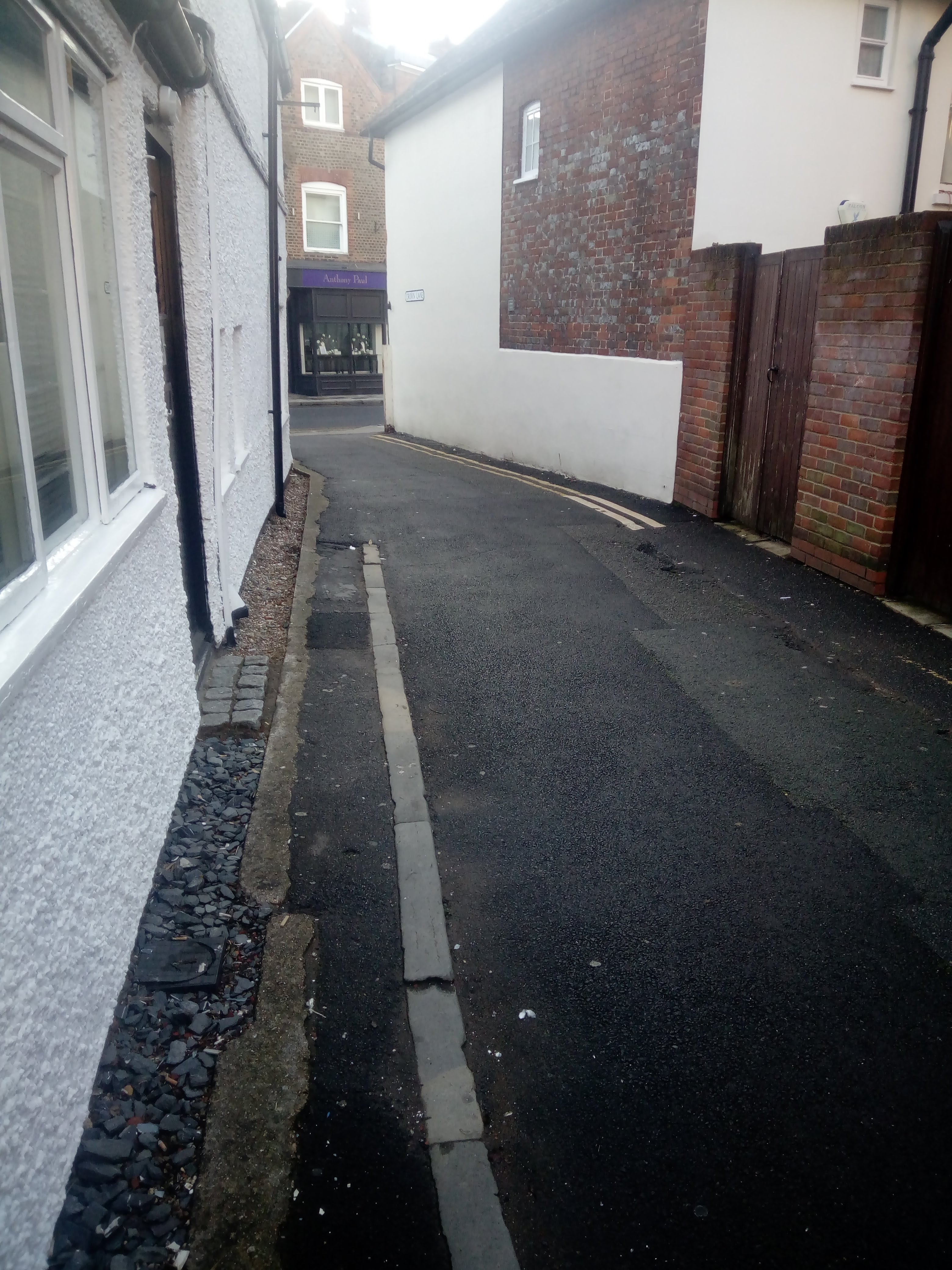
Miss Perfect and Some Tragedy In Crown Lane


Most people who have lived in this lane in Marlow have done so from the early 1890s onwards. Before that the lane existed as a way around to a few buildings but was only ever home to a couple of families at a time. It was sometimes early on called Spittal Lane as it comes off Spittal Street. (For a potential candidate date for the origin of Crown Lane, see the Crown timeline post here - under date 1650. )

On the 1861 census the White and Davis families had homes there. Anthony Davis was a labourer at the paper mills near the river while his wife Elizabeth was a housewife. Thomas White was a sawyer and his wife Mary Ann was a laundress.
Sadly two different residents of Crown Lane were found drowned in the Thames at Marlow- Thomas Holford in 1902 and Arthur Bristow in 1916. In neither case were there any witnesses so the respective juries at the resulting inquests returned verdicts simply of "Found Drowned".
Arthur Bristow aged 43 suffered from "locomotor ataxy". He believed his condition to be worsening and expected to soon lose the use of his legs. As a result he was very depressed and the implication from the evidence of those who knew him at the inquest was that suicide was a probability.  But no one saw him go into the water hence the "Found Drowned" verdict. The jury in his case donated their fees to the Red Cross. Such donations of fees tended to occur when the case heard had been particularly tragic, typically a suicide of an adult or the death of a small child. Both inquests took place at the Two Brewer's pub in St Peter's Street near the river. Local man Albert Truss helped to recover the body.

On the theme of losing the use of legs in 1900 resident "Frank" Tapping took out an ad in the South Bucks Standard thanking all those in the town who had donated money to him after he had to had his right leg amputated. This was in fact Harry Frank Tapping who would have been only 17 at the time. He was the son of Police Constable George Tapping and Mary. Frank appears on the 1901 census as a hairdresser and barber living with his parents and siblings in Crown Lane so the amputation didn't hold him back from starting a career. 
The family had moved there at some point in the 1890s. George was the constable for Lane End from at least 1889 to at least 1892. Prior to that he was stationed at Amersham.
He and Mary married in 1876. Her maiden name was Perfect hence this blog post title. I hadn't heard of this last name before and I had to check it twice to be sure!

The year of Frank's amputation 1900 was also a tragic year for another Crown Lane family when Elizabeth Tubb aged just 40 and a mother with half a dozen children still at home, died. Her husband William, then a labourer, had already had a very troubled life. His father had died at Medmenham when he was only a few months old. His mother brought him back to live with her parents in Dean Street Marlow. He became a shoemaker but found it hard to stay out of trouble. In 1868 he was prosecuted for stealing oats, in 1875 for not paying his lighting rates, in 1880 for rioting when the local Liberal candidate lost the election [more on this in future. Many local working people felt cheated and dispirited by this loss], in 1889 for stealing a piece of leather from Mrs Dewey's Chapel Street shop, and numerous times for failing to pay other local taxes. Poverty looks to be the main factor in these cases. When he stole the leather he said he was a father of ten who had no work for a week after his job with "Messrs Burrows" finished and he was now desperate. The case is a stark reminder of the fact that many families then could afford to make no savings and a single week without pay pushed them to the brink. William received 14 days in jail for that theft. This the court said was a mercy because of his hard pleading of his dire circumstances. The Messrs Burrows had a boot and shoe manufacturing workshop in Marefield, Marlow. 

He still lived in Crown Lane in 1910 when he was summoned for the last time I could find - this time for using bad language.

There was a laundry in Crown Lane in 1929 and an ice cream supplies business at the "Farm House" in the 1950s. When (or if) that house was a farm house I am unsure, it is on my very long "to do" list of further research! It was apparently a school in the early 1830s.

Sculptors Doreen and George Dereford had a studio in Crown Lane in the 1960s.
 
For histories of other Marlow streets or buildings see the "Specific Shops, Streets etc" option on the menu. All mentions of an individual on the blog can be found on the Person Index on the top drop down menu. 

Photographed Summer 2020.
Post written and researched by Charlotte Day. Photos by Kathryn Day.

Sources:
South Bucks Standard 16th November 1900 and 9th December 1910, Reading Mercury 1st February 1902, Bucks Herald 25th July 1868, 14th September 1889 and 19th August 1916. Newspaper copies all from the British Library Archives and accessed via the BNA March 2021.

GRO Marriage Index and Death Index online from their website.

1891 and 1901 census transcribed from microfilm by Jane Pullinger. Thanks Jane.

1881 census from Familysearch website, ran by the LDS [Intellectual Reserve Inc]. Accessed March 2021.

©Marlow Ancestors. You are very welcome to use these images or research for family history purposes if you credit this blog and link here so that our sources remain credited for the information they provided. Thanks!

PHOTO ID ANYONE?

 Can anyone help a fellow family history researcher Linda identify where this staff photo may have been taken in Marlow? Underneath are some...