Search This Blog

Showing posts with label Two Brewers. Show all posts

Monday, August 14, 2023

1833 Parochial Assessment Great Marlow St Peter's Street


I am gradually transcribing the original 1833 handwritten parochial assessment working notebooks of the assessors which my family own along with related correspondence. The purpose of the assessment was to calculate local taxes for 1834. The books were updated with additions and corrections up to circa 1839. Any such updates are highlighted in my transcription.

Format of my transcription:

Name

Property occupied

Annual value of each property

Any comments or research by me in square brackets

By Charlotte Day.

©Marlow Ancestors. Use this information if you wish but please credit this blog.

Duck Lane [Also called St Peter's Street which is it's modern name, sometimes in the past called Old Bridge Street too. The name St Peter's does NOT derive from the church as this was not built until the 1840s. The name St Peter's Street was used alongside Duck Lane much earlier]

Thomas Clinkenbury 

House and garden

£5

*****

Timothy Chance [two men of this name headed households in this street. The other in a smaller cottage was a bargeman.]

House and garden

£5

*****

Richard Oxlade

The Blue Banner house [Pub, premises there till at least 1862 before becoming a house. This was very close to the River Thames and the water's edge. There was another pub of this name in Marlow in Henley Road later in the 1800s] and yard.

£8

*****

Christopher Copas

House and Garden

£5

*****

Aaron Oxlade [shopkeeper aged about 67. In St Peter's Street by 1830 when Pigotts Directory lists him. He had married Mary Truss at High Wycombe in 1800. She took over the shop after his death. She was specifically a grocer, Aaron just "shopkeeper". The shop was later licensed to sell beer as well. The Richard of the Blue Banner above was their son]

House and garden

£6

*****

Samuel Barnes [He owned this and other property in the street which was all sold 1850 after his death. His friend Richard Gibbons below was one of his will executors].

House, yard, garden, stable and lofts

£20

Malthouse

£15

*****

Thomas Gibbons [he was a coal merchant. Brother of Richard below]

House, yard, garden, stable and chaise house

£20

Orchard

£5

Wharf at Bankside

£15

*****

Richard Bye [Had recently moved from Abbey Farm Little Marlow. He moved again by 1841. He married the year of the assessment Mary Hewett, by her first marriage Mary Hawkins, some years his junior but she left him two years later. More on this couple in a post here. Mary's first husband had also run the Two Brewers in his time].

Two Brewers house [pub], yard, stables and garden

£12

*****

Samuel Carter

House yard and garden 

£9

******

John Shanks [journeyman blacksmith. In 1833 a court case to get back his alleged ancestral property Finnemoor, a farm near Marlow from Joseph Townsend failed. 1841 blacksmith Church Passage. 1851 blacksmith St Peter's street, 1861 St Peter's Street Blue Banner]

Cottage and garden

£3 10 shillings

*****

George Easley

Cottage and garden

£2 10 shillings

*****

John ?Fusten

House ["and garden" crossed out and "woodhouse" added later]

£6

*****

Thomas Gardener [a market gardener]

Cottage [the words "and garden" later crossed out]

£5

Garden [not attached to his cottage, further down the assessment]

£4

*****

George Newbery [Tailor. Still in street 1841 when aged about 75]

Cottage

£4

*****

William Coleshill [died prematurely in 1837. Widow Martha continued to live in St Peter's Street]

Cottage and garden

£4 10 shillings

*****

Richard Heath [labourer, in street since at least 1823]

Cottage and garden

£4 10 shillings

*****

Richard Gibbons [had a small brewery and also made rope. Sent to Newgate Prison in 1842 after giving false evidence to an inquiry into one of Marlow's many dodgy parliamentary elections. Brother of Thomas above. The property occupied here was inherited from their dad. Richard later rented Samuel Barnes' malthouse listed above as well. Richard was a friend of Samuel's and one of the executors of his will].

House, garden, mill house, counting house, yard, stables, lofts, store rooms, large yard, store house, brewhouse with malt lofts etc

£35

*****

The following people occupied cottages with an annual value of £3 each:

James Downing [labourer. Still in street in same cottage 1841]

John White [bargeman, see below for another John White]

Timothy Chance [2nd person of that name in Street. This one was a bargeman, wife Ann who continued to live in the Street in the 1840s]

Widow Neighbour

Widow Moore [Jane Moore widow of John Moore bargeman who died 1814]

Robert Corby [painter?]

William Lewington [on 1841 census he was said to live in "Mill Yard"]

George Hawes [labourer]

Joseph Gimmet

James Harding

Henry Clark

*****

Occupying cottages each with an annual value of £2 10 shillings:

George Collins

John Hawes

*****

Each occupying a cottage and garden with an annual value of £4:

Widow Butler x2 [could be an accidental repetition of an entry or two Widows Butler occupying identically valued property]

*****

Each occupying a cottage with an annual value of £4:

Henry Clark

Robert Oxlade [probably the shoemaker of this name]

*****

Each occupying a house and garden with £5 annual value:

William Croxen [usually spelt Croxon]

John White [seems to have started as a bargeman but became a beerseller here by 1838 until at least 1852. Wife Eliza. Cottage no longer exists. Name of his beer house is currently unknown. Note that there was a different John White, also a bargeman in St Peter's Street at the same time, see above].

Elizabeth White [the first name originally left blank, name Elizabeth added later in pencil]

*****

Occupying cottage and garden with an annual value of £4 10 shillings:

Samuel Hobbs [Later at the two Brewers]

*****

Cottage with annual value of £1 10 shillings [an exceptionally small value. This must have been a one room hovel]:

Ann Clark [lacemaker]

*****

Robert Gudgeon [also occurs as Gudgin. He worked in the paper mills. His wife Charlotte's grave is here. In 1843 he lived in St Peter's Street in a rented "newly built" stone house erected a few months earlier so he had moved within St Peter's Street]

House and garden

£5

*****

Late Bradshaw [no first name]

House, lawn, stables, yard, coach house, large garden and orchard

£25 [In 1837 a Mr Bradshaw a poor man of Duck Lane, that being an alternative name for St Peters Street, suffered a terrible fire at his cottage that left it completely destroyed. He was much burned when rescuing his children from the blaze. The family lost all their possessions. Two neighbouring cottages were badly damaged. This must be a different Bradshaw as the man called Bradshaw in the assessment above is far from poor if in a £25 house. This earlier Bradshaw he has either died or moved from St Peters Street in 1833, 4 years before the fire, as his recorded occupation is as "late Bradshaw", though the two Bradshaw men may be related] 

*****

John Morgan [draper, premises High Street. More here]

House, yard, offices

£10

*****

Ann Bond [widow. For more on her, her husband and an odd burglary Ann suffered in this house see here]

House, yard, garden

£25

Coach house belonging to Badger

10 shillings

*****

Martha Badger [likely widow of William]

Cottage and large garden

£5 10 shillings

*****

John Badger

House and garden

£4

*****

James Brown

Cottage and garden

£6

*****

Brown [no first name]

House and garden

£7 10 shillings

*****

Robert Jonathan Oxlade [in 1813 a man of this name was a shoemaker. Son of Robert Jonathan Oxlade senior who sold up his business -of an unknown nature but he owned a malthouse- and left Marlow in 1787. Obviously Robert junior had decided to return to the town]

House and two gardens

£9

*****

William Davis [could be the man of this name who was a Marlow beer seller in 1831, though presumably now of different trade as his premises are not noted as a beer shop or inn]

Cottage and garden

£4

*****

George Davis

Cottage and garden

£5

*****

John Collins

Cottage and garden

£5

*****

Thomas Frith

Cottage and garden

£4 10 shillings

*****

Transcribed and researched by Charlotte Day.


©Marlow Ancestors.


Friday, December 24, 2021

Ringing In The New Year, Old Marlow Style


I've covered Christmas celebrations in Victorian Marlow. But I realised the town had many New Year traditions too, so this post is dedicated to them. 


In the late Victorian period a New Years Eve ball was a regular feature. The Crown Hotel/Upper Crown had hosted a Christmas ball for many years. The New Year one was usually arranged for others but still hosted by the Crown. For example in 1897, it was a ball for those attending the town hall dance classes. While it was a chance for the adult pupils to dazzle their friends and family with their new skills, anyone could apply for a ticket to attend. Did they stop to mark the transition from one year to the next? Original sources don't tell us! But the balls tended to start at 9 or 10pm and continued until dawn so those attending certainly were awake at the stroke of midnight. Marlow Football Club was another of many organisations that saw their annual ball hosted at the Crown in January. 100 people attended this in 1899. 


Thames Bank house hosted a servants ball for their staff,  friends and neighbours on New Year's Eve 1875. More than 100 guests were present. The evening was organised by housekeeper Mrs Taylor and butler Mr Wilson but everyone in the household was said to have contributed to the "very pretty" decoration efforts. After 2 hours of energetic dancing to the accompaniment of a quadrille band, the dining room was opened up for supper.  The company were said to be "deeply gratified at the richness, variety and profusion with which the tables were temptingly set out". After this rest, it was back to dancing until the early hours! 


Then there was many concerts advertised for the new year although not all took place on December 31st or January 1st. The Primitive Methodist Chapel (now known as Liston Hall) traditionally enjoyed a concert, usually performed by their enthusiastic choir (40 strong) and almost always followed by a public tea in the Sunday school room. The purpose of this was to fundraise for the never quite satisfied building debt fund. If anyone was an enthusiastic giver of teas, it was the Marlow Primitive Methodists. The Prince Of Wales offered frequent concerts for New Years Eve, such as a special smoking concert and supper in 1902. Unfortunately their licence required them to close at 11pm, so they sang Auld Langs Syne just before,  followed by God Save The King of course. 


One of the most touching traditions was the large dinner provided by John Langley at the Verney Arms in Dean Street. Those invited were all men aged over 50 from the Dean Street area, which was one of the poorest neighbourhoods in town. Langley really did invite everyone, with 70-100 men in attendance. This dinner ran for many years in the late Victorian and Edwardian era. "The dinner is looked upon as a sort of reunion and looked forward to by those that take part." The men sat down at 8pm to roast beef, mutton, steak and kidney and veal and ham pies, "xmas" pudding, mince pies, cheese and celery. (1908 menu) It may have occured after Christmas but the festive fare must have been welcomed. 


"Watch Nights" were popular on New Year's Eve in the chapels in town. These were late night religious services and prayer meetings. Although many had a very long heritage in one form or another, they were increasingly suggested as a more responsible and moral alternative to the alcohol based or secular celebrations.  The Wesleyans and Primitive Methodists held a joint watch night in 1902, to pray "the old year out and the new one in." The Salvation Army's watch night was sold as a musical evening, with prayers. 


One thing that probably strikes us the most when looking at advertising material from Marlow retailers is how often New Year gifts and New Year greeting cards are specifically advertised in addition to Christmas offerings. Obviously those who could scarcely afford to celebrate Christmas were not going to celebrate in any way again a week later. But so many shops took the trouble to promote their New Year offerings in the late Victorian and Edwardian period that it must have been more common to exchange cards at the time. The gifts tend to be small, with one advert suggesting they were sort of little token gift you might bring when visiting friends or family you didn't have chance to see at Christmas time itself. "This is the month for new year's gifts - you are just in time for the small present you meant to give at Christmas." (Rowe the jewellers, High Street 1908).  The stationers Smith & Co advertised that they had a "large selection of New Year presents to choose from" in 1897, not to mention calenders and diaries of course. Other shops you could browse New Year cards include Charles Page Drye's Marlow Printing Works and W H Smith (stationer not the draper of same name). Smith's also sold every novelty in calenders according to their 1899 boast. Sadly it doesn't seem any have survived so we can't see just what counted as a novel calendar design! The Printing Works was also the place to go in January for your copy of the Marlow Almanac and Directory. This carried useful information such as details of church services and court sittings, and the name, address and occupations of all those involved in trade. A handy way to get the low down on all your neighbours. 


January sales are also nothing new. W H Smith advertised their "traditional annual sale" in January 1905 with bargains in every department. It would continue for most of January. If there was something more common than a January sale, it was one that was extended due to popular demand. 


The last tradition to mention is the bellringers new year eve supper, usually hosted by the Two Brewers. Members of the Bellfry (bellringers) met for the meal which sounds at times to be rather well lubricated. They sang songs and sometimes rang hand bells as well. The ringers would then make their way to All Saints to ring out the old year and ring in the new one. Usually they rang a peal just before midnight and then rang another just after. On other occasions they rang 12 strokes at midnight itself. How many must have waited to hear the sounds of the bells


Researched and written by Kathryn Day. 

© MarlowAncestors

Related Posts 

Victorian Christmas in Marlow part 1 here and 2 here, Edwardian Christmas here

Skating on the Thames etc here

Bonfire night in Victorian Marlow here

A listing of other posts about every day life in old Marlow  here

Easter and May day here


Sources include:


South Bucks Standard 3 & 31 December 1897, 6 January & 22 December 1899, 3 January 1902, 6 January 1905, British Library Archive. 

Bucks Herald 9 January 1875, 3 January 1908. As above. 

Notes from Elsie Coster. 


©Marlow Ancestors 


Sunday, December 5, 2021

Marlow's Historic Graffiti


Photos above- Visitors to this St Peter's Street pub, the Two Brewers, certainly liked to leave their mark. The earliest dated inscription we could find was from the 1840s.


Immediately above- this carving of names on a house in West Street is included for comparison. It was said to be a rite of passage, if a frowned on one, for Wethered boys to carve their first initials and those of their friends on the wall of this West Street property. Cadets from the Royal Military College also marked this wall. Sadly much of the original and oldest carving seems to have disappeared in the last 20 years along with the Victorian pull door bell which still worked in the 1990's. 

Other carved names and initials were visible all along the 7 Cornered Alley in Marlow in the past but have disappeared as the brickwork has been replaced. Look for some of the older looking bricks and you may be able to make out some initials, dated from the 1940s+ while they are still visible! 

Photographed November 2020.

See previous post The Unhappy Marriage of Robert and Mary Bye for a story about one of the historic landlords of the Two Brewers here.

Other pub content, including for the Two Brewers, can be found by looking at the Pub Related option on the menu.
Look on the "Specific Shops, Streets....etc" option on the menu for more posts related to either West Street or St Peter's Street.

©Marlow Ancestors. Reproduce images if you wish for family or local history purposes with credit to this blog.

Sunday, October 10, 2021

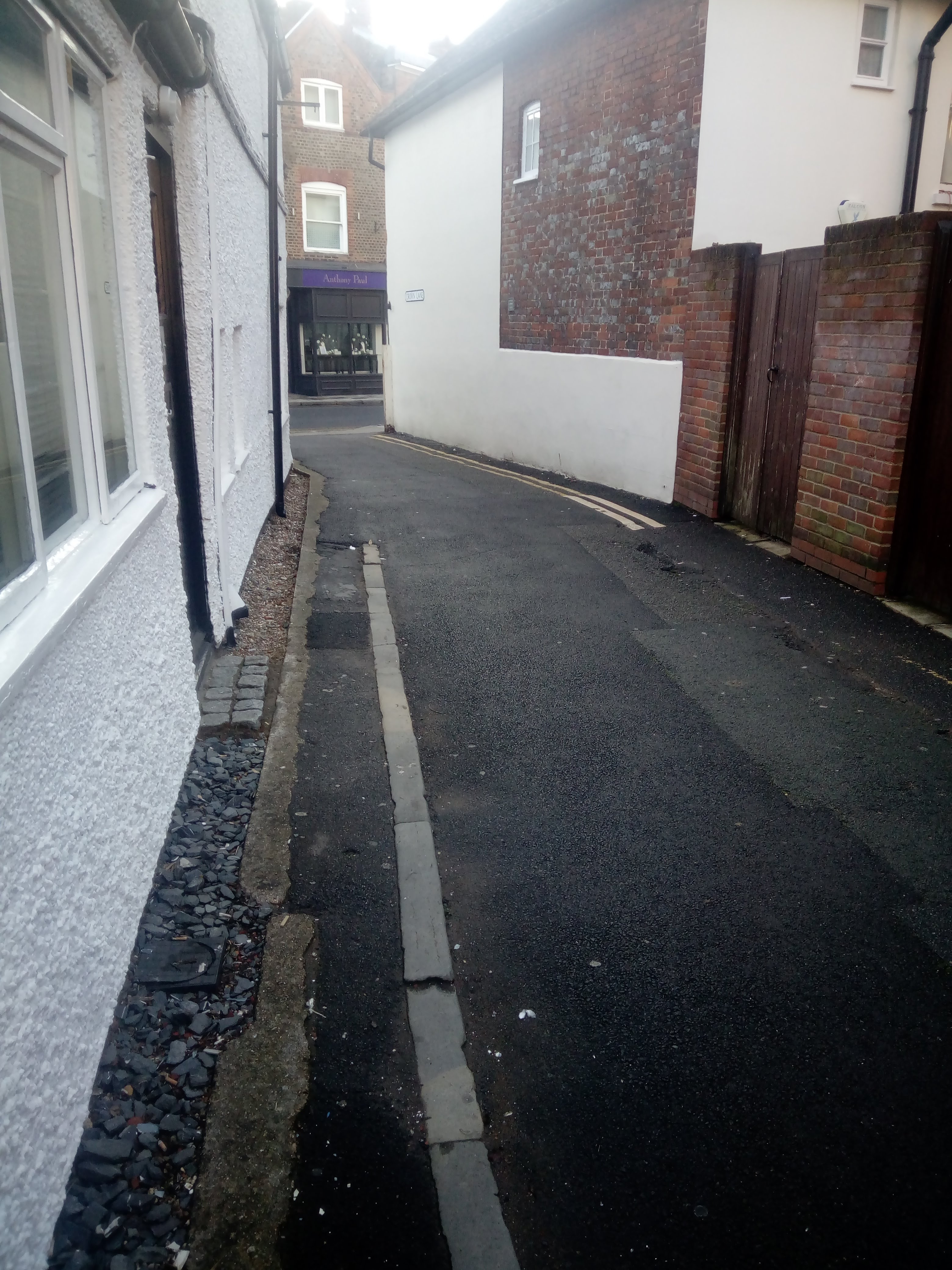
Miss Perfect and Some Tragedy In Crown Lane


Most people who have lived in this lane in Marlow have done so from the early 1890s onwards. Before that the lane existed as a way around to a few buildings but was only ever home to a couple of families at a time. It was sometimes early on called Spittal Lane as it comes off Spittal Street. (For a potential candidate date for the origin of Crown Lane, see the Crown timeline post here - under date 1650. )

On the 1861 census the White and Davis families had homes there. Anthony Davis was a labourer at the paper mills near the river while his wife Elizabeth was a housewife. Thomas White was a sawyer and his wife Mary Ann was a laundress.
Sadly two different residents of Crown Lane were found drowned in the Thames at Marlow- Thomas Holford in 1902 and Arthur Bristow in 1916. In neither case were there any witnesses so the respective juries at the resulting inquests returned verdicts simply of "Found Drowned".
Arthur Bristow aged 43 suffered from "locomotor ataxy". He believed his condition to be worsening and expected to soon lose the use of his legs. As a result he was very depressed and the implication from the evidence of those who knew him at the inquest was that suicide was a probability.  But no one saw him go into the water hence the "Found Drowned" verdict. The jury in his case donated their fees to the Red Cross. Such donations of fees tended to occur when the case heard had been particularly tragic, typically a suicide of an adult or the death of a small child. Both inquests took place at the Two Brewer's pub in St Peter's Street near the river. Local man Albert Truss helped to recover the body.

On the theme of losing the use of legs in 1900 resident "Frank" Tapping took out an ad in the South Bucks Standard thanking all those in the town who had donated money to him after he had to had his right leg amputated. This was in fact Harry Frank Tapping who would have been only 17 at the time. He was the son of Police Constable George Tapping and Mary. Frank appears on the 1901 census as a hairdresser and barber living with his parents and siblings in Crown Lane so the amputation didn't hold him back from starting a career. 
The family had moved there at some point in the 1890s. George was the constable for Lane End from at least 1889 to at least 1892. Prior to that he was stationed at Amersham.
He and Mary married in 1876. Her maiden name was Perfect hence this blog post title. I hadn't heard of this last name before and I had to check it twice to be sure!

The year of Frank's amputation 1900 was also a tragic year for another Crown Lane family when Elizabeth Tubb aged just 40 and a mother with half a dozen children still at home, died. Her husband William, then a labourer, had already had a very troubled life. His father had died at Medmenham when he was only a few months old. His mother brought him back to live with her parents in Dean Street Marlow. He became a shoemaker but found it hard to stay out of trouble. In 1868 he was prosecuted for stealing oats, in 1875 for not paying his lighting rates, in 1880 for rioting when the local Liberal candidate lost the election [more on this in future. Many local working people felt cheated and dispirited by this loss], in 1889 for stealing a piece of leather from Mrs Dewey's Chapel Street shop, and numerous times for failing to pay other local taxes. Poverty looks to be the main factor in these cases. When he stole the leather he said he was a father of ten who had no work for a week after his job with "Messrs Burrows" finished and he was now desperate. The case is a stark reminder of the fact that many families then could afford to make no savings and a single week without pay pushed them to the brink. William received 14 days in jail for that theft. This the court said was a mercy because of his hard pleading of his dire circumstances. The Messrs Burrows had a boot and shoe manufacturing workshop in Marefield, Marlow. 

He still lived in Crown Lane in 1910 when he was summoned for the last time I could find - this time for using bad language.

There was a laundry in Crown Lane in 1929 and an ice cream supplies business at the "Farm House" in the 1950s. When (or if) that house was a farm house I am unsure, it is on my very long "to do" list of further research! It was apparently a school in the early 1830s.

Sculptors Doreen and George Dereford had a studio in Crown Lane in the 1960s.
 
For histories of other Marlow streets or buildings see the "Specific Shops, Streets etc" option on the menu. All mentions of an individual on the blog can be found on the Person Index on the top drop down menu. 

Photographed Summer 2020.
Post written and researched by Charlotte Day. Photos by Kathryn Day.

Sources:
South Bucks Standard 16th November 1900 and 9th December 1910, Reading Mercury 1st February 1902, Bucks Herald 25th July 1868, 14th September 1889 and 19th August 1916. Newspaper copies all from the British Library Archives and accessed via the BNA March 2021.

GRO Marriage Index and Death Index online from their website.

1891 and 1901 census transcribed from microfilm by Jane Pullinger. Thanks Jane.

1881 census from Familysearch website, ran by the LDS [Intellectual Reserve Inc]. Accessed March 2021.

©Marlow Ancestors. You are very welcome to use these images or research for family history purposes if you credit this blog and link here so that our sources remain credited for the information they provided. Thanks!

Saturday, July 31, 2021

Food in Victorian Marlow.

The food eaten by different sorts of Victorian Marlovians can be reconstructed from court cases where food is stolen from larders, gardens and fields as well as businesses; reports of local celebration meals and wedding feasts; adverts put out by shops, hotels and restaurants; coroner's inquests  and crime reports that describe the meals eaten by those mentioned if it is relevant; postcards; Poor law records and many more sources.


Fish / Seafood:

Of course the river offered some opportunities to catch your lunch. Eels were amongst the possible wildlife that could be ensnared but they became increasingly rare during the Victorian era. The landlady of the Complete Angler Hotel, Mrs Parslow, always kept some in reserve when she could, strictly for her favourite customers.

For up to about a dozen men at any one time catching fish was not a hobby but a trade. Very few did so to sell the fish commercially, most via a boatbuilder or pub go between, hired themselves and a boat out to visiting "sportsmen" who wanted to fish for 'sport' and benefited from a Marlow fisherman's expert local knowledge. The Two Brewers and Compleat Angler both retained their own fishermen for guests in season.

Changes to the river flow caused by the new bridge as well as growing pollution and over fishing meant salmon were rare by the mid century. Other fish were still present however and few professional fisherman were still working at the end of the Victorian era. It is not usually possible to know whether those late examples were ever selling catches or only selling their expertise to allow tourists to catch their own. Another question is were other Marlovians eating any commercially caught fish from Marlow? The first fishmonger shop I've so far definitely located was in 1831 ran by George Draper in Chapel Street. Elsewhere in the country the majority of local fish caught tended to be rushed up to London or other major centres rather than be sold to locals. In the same way some country people complained that if they lived within transport distance of London they struggled to buy the fruit and vegetables grown in their home area because the London market consumed everything. Even access to fresh milk could be an issue. 

So we can't say for certain that any commercially caught Marlow fish was available to buy here. Possibly a certain percentage could be bought from a fisherman at the riverside. Apart from the Marlow eels at the Complete Angler no reference to local fish being available at any local pub or hotel has been found by me. That doesn't mean that it wasn't served only that the proprietors didn't consider it desirable or unusual enough to bother advertising its availability.

Someone was selling herrings out of barrels in town mid century, probably a grocer. These certainly sold fish sauce and salted fish.

Oyster stalls were a popular feature of the Regatta. At the time oysters were not as expensive as now. On an everyday basis fish could be eaten at any meal. What surprises a modern person today who reads cookbooks and menu planners from the Victorian age is just how frequently fish was eaten for breakfast- fried or in pies especially. One well off Marlow man in 1885 celebrated the start of perch fishing season with a breakfast of just caught fried perch dressed with parsley.


Fruit:

Commercial fruiterers resided very much on Dean Street in the Victorian age. All seemed to have been involved in the wholesale trade, some also retailed to the public. The Benning family in the late Victorian High Street were grocers, ironmongers and fruiterers. As well as fresh fruit they sold canned fruit such as pineapple. More about them here. At Christmas time fresh oranges and grapes were also sold in Marlow grocers for those that could afford them. It was also to grocers you went for dried fruits for your Christmas pudding or general baking. You would need to stone and stalk your own raisins at home then which renderd cake making very laborious.

Apple pies and cherry pies are mentioned multiple times as being stolen from Marlow and Little Marlow homes. Cherries were grown commercially at a small scale around Marlow and on a large scale at Flackwell Heath. You might have bought your cherries from visiting gipsy sellers too, who were common in the area and set up at most summer fairs and events that they could. Cherries not strawberries were the archetypal summer fruit of the Victorian era.

The fruit grown by the gardeners of the wealthy residents of Marlow can be seen from the local horticultural show results. These were already in full swing by the time Victoria ascended the throne. It took until the early 1870s for ordinary people to feature in these competitions if they were not professional gardeners. Fruits grown by rich Marlovians were: apples, plums, peaches, nectarines, pears, greengages, melons, strawberries, rhubarb and grapes. Melons were grown in special pits heated by decomposing horse manure. Lovely! So popular were these that the fact that a house had a melon pit could be featured in the sale particulars for that property (such as was the case for Spinfield House).

Ordinary Marlovians according to the show results were more likely to be growing: apples, pears, redcurrants, whitecurrants, blackcurrants, plums, gooseberries and raspberries. Note the greater amount of bush fruit grown by ordinary people.

From the hedgerows poorer residents gathered blackberries, mirelles, haws, sloes and crab apples (and young hawthorn leaves to snack on, until at least the 1940s!)


Vegetables:

Greengrocery hawkers were also centred on Dean Street in early times. They sold predominantly vegetables and salad leaves with fruit more likely to be sold at fruiterers. Many of those I find mentioned as involved in the green grocery trade turn out upon examination to have no shop but to be itinerant sellers going door to door or selling in the street. These were catering by and large to the poorer residents of Marlow and nearby areas.

The poorest of all could afford to buy very little. Women and children routinely stole into farmers' fields to pull off turnip and swede tops to cook as vegetables. The court reports of the 1800s are littered with prosecutions for this. Marlow Bottom because it was lonelier was a hotspot for this kind of activity. Some of the court cases are truly heartbreaking as the families prosecuted were absolutely destitute.

Swedes themselves by the way were usually grown in southern England as animal feed and not for human consumption. A World War 2 propaganda campaign by the government convinced us to give them a try as they were cheap and easy to produce en masse at a time of food shortages. The few cases of Marlow folks stealing swedes not just their tops would have been cases of the most dire desperation. Public prosecution for this would have been utterly humiliating. It was the social equivalent of being caught stealing grass or dog food to eat. 

Nettles were certainly eaten as a nutritious soup and stew ingredient, especially by gypsy families but others too, not necessarily out of poverty. Cookbooks of the era which were aimed at middle class families sing their praises as a blood strengthening food. Giant puffball mushrooms were once common in fields near the river and provided a large feast for those who found them. Mushrooms as a whole were much loved by Victorians, with mushroom ketchup a popular homemade condiment.

Watercress was grown by early Victorian times between Marlow and Medmenham as well as at Little Marlow. It was a very popular vegetable throughout the era both cooked and raw. So much so in fact a plate of it might be included on the breakfast table in season as a dish in its own right alongside the toast, pies and other dishes.

The vegetables and salads grown by the gardeners of the wealthy residents of Marlow are described in reports of local horticultural shows throughout the era: cucumbers, carrots, potatoes, celery and cauliflower feature most highly. Not often entered into shows but highly fashionable throughout the era was sea kale.

More ordinary citizens entered such shows from around the early 1870s. Women as well as men were then growing prize winning crops. Vegetables grown by these more humble householders were: lettuce, marrows, peas, turnips, onions and carrots. Probably, judging by seed stock advertised by Marlow seedsmen (stand alone businesses or a sideline for ironmongers) we can add beetroot as well as brussel sprouts and broccoli to that list.

Allotments arrived in Marlow in the 1880s.


Herbs, Spices etc:

Wild garlic leaves could be picked (sneakily) in Marlow churchyard as well as in the countryside around town.

Exotic spices were easily available at the grocery shops in the town centre, if you had the cash to spare. Preserved ginger was a favourite in Victorian England eaten as both a sweet and used in baking, especially around Christmas.

Seed Cake made with caraway seeds was almost an obsession throughout the country and was sold ready made by Marlow bakers.


Meat=

The most popular foodstuff to steal from Marlow household pantries was bacon, followed by cheese and pies*. These pies might be sweet or savoury. What meat was in the "meat pies" is almost never specified.

The most common meat stolen from shops after bacon was pork.

Any local, personal or national event celebrated by a dinner in the Victorian age tended to be centred around feasting on roast beef. Marlow records show here was no different than elsewhere. By far the most usual Victorian Christmas dinner given in ordinary family homes, workhouses and in places hosting workplace, charity or Sunday school festive dinners was roast beef and plum pudding not the turkey or goose of popular imagination. Actually beef and plum pudding was the standard year-round celebration meal for Victorians. The "plum pudding" became "Christmas pudding" for a few weeks every year when it was served at Christmas time aflame with some holly on top. So Marlow celebration dinners throughout the year featured plum pudding.

In 1884 a poor Marlow man was mentioned as having had a supper of "hog pudding and chitlets". Most sources say that hog pudding was a very peppery sausage made in Southwestern England rather than Buckinghamshire but perhaps it had a local variant. I did find a contemporary recipe that gave a sweet dessert made with hog fat the name "hog pudding" too so there's room to doubt. The "chitlets" that Marlow man ate was perhaps a dialectal way of saying chitterlings, sausages made of hog entrails a sign of poverty.

On the other end of the price spectrum the "Excelsior pork pie" was a speciality of Death and Son bakers of Marlow. They operated in both West Street and the High Street in later Victorian Marlow. What made the pie so superlative is sadly not specified.

It is likely that some Marlow people are "Buckinghamshire Badger", a speciality of nearby Stokenchurch which was a savoury suet pudding of bacon. Bedfordshire clangers, the local equivalent of Cornish pasties, were certainly eaten in rural Buckinghamshire as well as Bedfordshire but I have not seen as yet any Marlow specific references to that.

Butcher's shops were in the High Street, West Street, Spittal Street and Chapel Street. A biographical portrait of Rachel Hall a butcher of West Street has previously been published on this blog here See also my posts on butcher Jason Povey, who got involved in political bribery here and Emily Carter a Victorian butcher of Spittal Street here.

Some of the Marlow butchers had stalls at Marlow Market in Market Square once a week. This had become solely or mostly for meat by the 1870s. The meat sold on these stalls was the poorer quality, cheaper options.

By the 1880s some meat could also be bought from grocer's shops. They had long sold bacon which they might cure on their own premises but to sell other meat was something of a stepping on the toes of the butchers.


Baked Goods and Desserts:

Marlow had no shortage of bakers. These all sold flour for home baking as well as their own baked products. Some also functioned as corn dealers. Most were also pastry cooks selling sweet baked goods ranging from little penny sponge cakes for one person to large celebration cakes. Only the wealthy could afford to buy the latter. Marlow bakers advertised ready made birthday and iced Christmas cakes by the 1880s. Early Victorian Christmas cakes were not alcoholic and  usually not iced or served with marzipan either. They were intended as a plain, easily digestible dessert alternative to rich plum puddings for children. If Marlow bakers or confectioners supplied the Twelfth cakes that were popular in the early and middle 1800s for Twelfth Night parties and balls I cannot discover it, though it would have been unusual if they did not, at least to order.

Confectioners mainly sold sweets but sometimes functioned as pastry cooks as well and so also offered cakes and pastries, especially in the pre Victorian era. They might be grocers too!

In Victorian times home cooks could pay to bake their own pies and breads in the bakers' ovens after the bakers themselves were finished for the day. You have to remember that many early Victorian, and some later Victorian families had no oven at home or only a tiny one. 

Gingerbread stalls featured every year at Marlow Fair and the Regatta. They were a magnet for children.

Death and Sons bakers produced their own biscuits called the Marlow Pioneer Biscuits [South Bucks Standard 22nd February 1895, advertising accessed via the BNA March 2021]. Our grocery shops also sold ready made biscuits and cakes by the 1880s.

A biographical post on the Sawyer family bakers of Marlow is on the blog here.

Desserts in general in Victorian England were eaten daily by those that could afford the ingredients. You could buy ice from fishmongers such as Allams in Market Square in order to make your own icecream or sorbets, the standard centrepiece desserts of Victorian dinner parties. Otherwise trifles, steamed puddings, fruit tarts, syllabubs featured highly. Give a Victorian cook some bread or cake crumbs, cream and jam and she could whip you up about a hundred different desserts each with a slightly different name and method. Though I have found no reference to one being served in Marlow at least two Victorian cook books contain recipes for desserts called Marlow Pies. One of these books has two quite different recipes within its pages for Marlow Pie. These two recipes are also quite different again from the recipe in the other book. I have tried the latter and it is like a very sweet puff pastry treacle tart. I intend to investigate these Marlow Pies and their origin more fully.


Dairy Products:

Most Marlow grocers were also cheesemongers. Stand alone cheesemongers seem to have no presence though they did in earlier times. Advertised cheeses in Marlow were all hard cheeses and none were said to be locally produced. Stealing cheese from householders was quite common.

Bread and cheese was THE working class packed lunch of the 1800s. Poor little Thomas Lunnon aged 7 had just such a lunch stolen from him right from off his school premises in Little Marlow in 1892 [South Bucks Standard 7th October 1892]. He had carried it there in a basket.

Ice cream was usually made at home but those not able to do so could enjoy a portion from one of the several ice cream sellers who pushed their special barrows around the streets in the summer. Most of these were not local men. Many regarded the ice cream men a nuisance because they tended to attract a street-blocking crowd of children and adults. One such seller from Reading found himself in court after he was accused of causing traffic chaos on Marlow bridge with his barrow. The police observed 40 people gathered about him. Let's hope supplies held out! 

If you wanted to make your own you could buy ice for your churn from the fishmonger. Homemade iced desserts because they were difficult to produce were very much a status symbol. Vanilla ice cream was the most common but brown bread ice-cream made with toasted sweetened brown breadcrumbs was also a huge favourite in this era. I made some myself and I can only say it left me cold!

Milk was available from several town dairies or directly from some farms. 


Poultry and Game:

Both were typically bought from poulterer's and in poultry's case sometimes directly from local farmers. The farmer's wife typically had charge of this side of the business. For more on the early Victorian poulterer John Way of the High Street see here.

Stealing fowls from farms and homes was very common in Victorian Marlow. Reports of thefts which are not also accompanied by reports of the successful arrest of the guilty parties are unusual so perhaps the Marlovians responsible weren't very good at it.

Poaching for pheasants was a Dean Street speciality! These however were usually sold rather than consumed by the poachers. The illicit catching of rabbits or hares however kept many a Dean Street area family from going hungry. It also cost them heavily in terms of fines and lost income from jail time when the poachers were caught.


Nuts:

Walnuts were grown as a crop on almost every Marlow farm. They were much loved by Victorians who pickled them while still green and made walnut ketchup as well as utilising them in ways we would be more familiar with today. As they were valuable they were targeted by thieves.

From the countryside filbert nuts could be gathered in places. While beech nuts are edible if  cooked and plentiful around the town I have not found any reference to their use by Victorian Marlovians.

Almonds were very popular in Victorian cooking and found at the grocers, who also sold chestnuts in the winter. I have yet to find any reference to hot chestnut street sellers in Victorian Marlow.


For visitors:

The Compleat Angler, the Greyhound Hotel in Spittal Street, the Two Brewers in St Peter's Street, The Fishermen's Retreat and the George and Dragon on the Causeway all specialised in catering for the picnic and boating parties that came to visit Marlow.

By the 1870s the mess left behind by picnickers on the banks of the river was already considered a nuisance [Bucks Herald 18th August, page via BNA February 2021].

Great Western Railway offered special picnic party fares to Marlow from London and elsewhere. Favourite nearby spots were the fields near Gossmore in Marlow, Quarry Woods at Bisham, Winter Hill and Bisham Woods. All those places were at times haunted by begging children pleading for food.

Picnics in the Victorian era were very substantial affairs. A tea kettle was usually brought along and a spirit stove (coffee was not the done thing). A typical picnic contained multiple joints of meat, savoury pies, cold desserts (including the beloved plum or "Christmas" pudding), salads, fruit fresh or stewed or both perhaps with biscuits to dunk in the latter, fruitcake and gingerbread. Yes all of that. There might be sandwiches, though not always. Picnickers might just take bread rolls as an accompaniment to the other dishes. If they did take sandwiches it wasn't the cucumber ones we often associate with the era. They were for afternoon tea and considered too insubstantial for a picnic. A cucumber to be cut into cool chunks and offered as a snack usually went along however. Cucumber sandwiches weren't insubstantial in calories though  as they were often spread with both butter and cream!

*****

* my calculation. Thieves must have felt it was their lucky day when they broke into William Suthery's Little Marlow home in the 1850s and found all three ripe for the taking!

Written and researched by Charlotte Day.

Related Posts=

Food in 1700s Marlow here

Historic cost of living in Marlow, including the cost of many food items from different specific Marlow shops in the Victorian era here

The Poaching Perrys here

The temperance movement in Marlow here

A Victorian Christmas in Marlow here

©Marlow Ancestors. You are very welcome to use this material for family or local history purposes with credit to this blog.

Thank you to Jane Pullinger for her family's information.  

Also of use= 

Royal County Directory for Beds, Bucks and Berks, 1876. [Marlow market information]

South Bucks Standard 23 September 1898. 


Thursday, July 29, 2021

List Of Landlords Of The Two Brewers, and Fishermen's Retreat Hotel, St Peters Street. *Updated*

Updated August 2025

THE TWO BREWERS


This building is still in existence and still trading as a pub.

1755 claimed start date for the pub 

1770 - John Ireland landlord

1772 - used for an auction

1776 - Passing mention in the Oxford Journal, it is hosting an auction. 

 1795 - William Carter or Widow  Carter. Building has arched cellar, walled garden, and spacious stabling. Premises up for sale in this year. It's "extremely commanding and advantageous situation" at the foot of Marlow Bridge is emphasized. Owner was the late deceased maltster Henry Smith who had had a malt house in the High Street.

 1823 - G. Hawkins. Other source say John.

 1824 - John and Mary Hawkins. 

 1826 - John Hawkins who died of  Smallpox that year.

1831 - Mary Hawkins, John's widow (nee Hewett).

1833 - Richard Bye. Marries Mary Hawkins who is widowed. Widow of John Hawkins. More on this couple in a post here.

1837 - William Bavin. Previously a chairmaker. Went to first incarnation of Carpenters Arms c1843. See also The Clayton Arms.

1839 - Samuel Hobbs  See his grave here In the 1833 Parish Assessment a Samuel Hobbs is listed as an occupier of a cottage elsewhere in St Peters Street. Samuel seems to have come from High Wycombe originally.

 1844 - Samuel Hobbs "Duck Lane"

 1851- Elizabeth Hobbs. Widow of Samuel above.  See her grave here

 1853 - Elizabeth Hobbs.

 1854 - William Truss (also a sexton).

 1862 - bottle of gin and 10s stolen from till while Mrs Truss away from it. 

 1869 - William Truss.

 1871 - John C Truss.

 1883 - John Clark Truss.

 1894 - John Clark Truss.

 1896 - J C Truss 2. William Truss.

 1899 - E. S. Truss.

 1902-1910 - final stop for many  motoring clubs on their regular  "runs". 

 1903 - Emily Sophia Truss. At this point John Clarke Truss (below) was letting apartments at neighbouring Weir House.

 1907 -  John Clark Truss - bellringer too.

 1911 - John Clark Truss (Junior)

1914 - John Clark Truss is also a boat proprietor.

 1915 - John Clark Truss. In this year severe floods mean the pub can for a while only be accessed via a raised plank walkway. 

 1918 - "late J C Truss"

1925 ? - John C Truss. Died 1939 at Weir Cottage after retiring from the Two Brewers just over a decade before. After retirement he became a traveller for the Wethered's Brewery.  

c1926 Thomas Alfred Neate takes over. 

1939 - Thomas Alfred Neate

1952 - Thomas Alfred Neate retires, but stays in Marlow. He died 1959. 

1958 - H.H Gummer


The Two Brewers, above, on right.

To see a small sample of the historic graffiti carved into a wall at the Two Brewers, see here

THE FISHERMAN'S RETREAT HOTEL /FISHERMENS RETREAT (the latter rendering of the name was on the front but the other was often used too).


This was opened by William Spark(e)s in 1873 after his former premises The Barge Pole in Church Passage became due for demolition. Originally described as a "first class boarding house". It was converted from a house. William also spent time in charge of the Black Boy in Church Passage. (You can read a post about the Spark(e)s family here ) Referred to as Fisherman's Arms in the 1877 Post Office Directory. Housing is now on the site. It was very close to the Two Brewers. Some evidence points to the fact that it was commonly if not officially known as The Barge Pole for the first couple of years. It was also frequently recorded as The FishermEns Retreat, a name which appeared above the door but FishermAns Retreat is the form which almost invariably appears in advertising and at licensing hearings. The owners probably gave up correcting this! Despite becoming increasingly up market, it was still used as a "local" drinking hole by working class residents in the first 15 years or so. This is pointed to by the names and occupations of people drinking there who are mentioned in passing during court hearings, news reports, inquests etc. They include labourers and others who also lived in St Peters Street for example. (E.g "jobbing man" of St Peters Street John Lloyd in 1880) 

1873 - William Sparkes (Read a detailed post on him here)

1875 - William Sparkes dies, widow Maria takes over. See his grave here

1877 - Maria Sparkes, widow. In this year the retreat hosts the inquest relating to death of young labourer Timothy Young at Marlow Place. He was killed when the 10ft high brick and flint garden wall he was employed to help demolish collapses upon him. He was trapped from running away by some shrubs planted nearby. Other workers were also injured. This is during improvement works at Marlow Place when it is converted back to a house after spending much time as a school. 

1878 - described by The Field as an economic and comfortable place to stay, especially for anglers. 

1879 - "As cosy a retreat from the cares of the world as a man may desire" - Bells Life in London and Sporting Chronicle. 

1880 - Albert D Symes.  Still described as a "public house" during court case this year. Transfer to John "Hodenot" - see below

1881 - John Hoddinott (Born Balcombe, Somerset) John is a keen angler himself. 

1882 - John is assaulted by John Neighbour and Walter Bowles who are reluctant to pay for the beer, mineral water and cigars that they have consumed. Neighbour is convicted of pushing John and spitting in his face while Bowles breaks a window at the Retreat. Both are fined with the threat of 14 days imprisonment if the fine is unpaid. After the window is broken, the police are called and Neighbour and Bowles decide to pay but the damage has been done. 

1885 - John and Elizabeth Hoddinott cater for 40 guests each day at breakfast during a busy August weekend. 

1887 - hosts Fire Brigade dinner, one of many such events. 

1880's - frequently used as retreat after racing for regatta crews as well as visiting societies and clubs on their annual river outings. 

1891 - John Hoddinott ( John died in the 1890's Flu pandemic. For more on the outbreak, see my post Here ) Described as one of the most comfortable hostelry on the river (Evening News, May 1891)

1895 - Has collection box on the premises for Marlow Cottage Hospital. Both the Hoddinotts were frequent in their own financial and practical donations to the hospital. "Fishermen's Retreat Hotel"

1903 - Mrs Elizabeth Hoddinott, John's widow. 

1907 - Mrs Elizabeth Hodinott qv


1911 - Elizabeth Hoddinott

1915 - Recommended for closure without compensation as fully licensed premises, by Renewal Authorities of County Licensing Committee, continues as hotel however.

1920 - the Misses Hoddinott

1927 - described as "residential hotel". Does also take short term guests however. 

1932 - up for sale. It then comprises 8 bedrooms, one good bathroom, a office-reception, lounge, dining room, sitting room, kitchen and 3 servants bedrooms. Outside there is a barn, garage and stabling. 

1933 - substantially altered, updated and extended, with new entrance door (the one currently for Duck Lane House). It was discovered the existing Retreat was in a bad state  of repair. New supplies of hot and cold water, new sanitary fittings and electric lighting were all put in.  Architect for this work was G Berkley Wills of Marlow, with local builder R H Harris & Co as the principal contractor. We are told the finished property was decorated throughout with a colour scheme centered on "dove grey", the 1930s equivalent of Magnolia. The other two entrances were added later, when the property was extended again. 

1939 - Mrs Dorothy Herbert. Private Hotel. 


Researched by Charlotte Day and Kathryn Day.


This post is updated as new information emerges. All listings are as noted in original sources, including alternative spellings. Where multiple sources list an individual's name, only the first and last mention are listed here unless there is any alteration in how they are recorded, for example when an additional occupation is noted. Note that some listings may in fact refer to fathers and sons sharing the same given name so be sure to double check this. 

Many Marlow landlords changed premises and there can be other family members running other establishments. Some places changed how they described themselves - or how they were viewed - and so licensed premises listings here take in not just beer houses, pubs and inns but common lodging houses and hotels too. We mainly focus on pre WW1 listings but sometimes list later names if it ties in with research we are helping with. To find every mention of an individual here, use the A-Z Person Index in the top drop down menu. There's 3,000 people listed there currently! 


SOURCES -

1853 Mussons and Cravens Commercial Directory, (compiled 1852).

Kelly's Post Office Directory- 1859,1864,1869,1877,1899,1903, 1907,1911,1915,1920. Published by Kelly's Directories Limited.

Dickens Dictionary of the Thames from Oxford to the Nore (1880 Edition, issue 2)

Census 1881,1891. Transcribed from microfilm by Jane Pullinger.

Historic newspapers, held at the British Library and accessed via the BNA March 2021:

Bucks Herald - 13 May 1837, 9 Jan 1915, as above. 

Reading Mercury - 6 & 20 July 1795, as above. 

Oxford Journal - 24th June 1826, as above

Maidenhead Advertiser 14 April 1877, 26 August 1885,  as above

Robson's Directory 1839, 1844. Via University of Leicester Archives.

South Bucks Standard 7 June 1895, as above

Sunday Mirror 26 June 1927. 

Morning Post 18 June 1909

Pigots Directory 1823

Weekly Dispatch London 26 June 1927. 

©Marlow Ancestors. 


Tuesday, February 23, 2021

The Unhappy Marriage of Richard and Sarah Bye

In 1833 a 38 year old widow, Mary Hawkins, married publican Richard Bye. Mary had a daughter Sarah from her first, 14 year marriage to John Hawkins who had also been a publican. She was née Hewitt.

Richard was (approximately) nearly 20 years older than his bride. He ran the Two Brewers in St Peter's Street right by the River Thames. He perhaps hadn't been there long as only the year before he had been running Abbey Farm in Little Marlow but gave it up and sold all his stock and equipment by auction. Mary's first husband was the previous licensee of the Two Brewers. It may be that Richard married Mary to take over the business. I do not mean that the marriage was especially selfish or mercenary on his part. Marriage was very often in those days more of a financial practicality than a romantic adventure. Help running the pub would have been just as important to her. At the time of the marriage she hadn't yet been to prove her first husband's will.

In John Hawkin's will Mary inherited all his possessions for life while she remained his widow. As soon as she remarried all those goods went to their daughter Sarah. This was a necessary precaution as marriage robbed women of property rights. Mary's goods if left absolutely to her would have become any new husband's goods instead and could be sold by him, used up, given away or left to someone unrelated to John Hawkins or the daughter he wanted to be his eventual heir and there would be no legal remedy for that.

In the Spring of 1835 Mary, in position of his executor, sold many of these possessions including luxury mahogany furniture, feather beds and a pony and trap. Whether this was legal or not I am unsure. It is my understanding she could sell the property with the next heir's consent but Sarah was not legally yet an adult able to give it.

Did Sarah receive the money raised? It's doubtful for reasons given below, however her mother may have been acting in desperation if there were already problems in her home and she felt the need to leave. Certainly the goods had already been removed from Mary's home to Platt's farm where her mother was living "for convenience". Mary perhaps had in effect already left her second husband.

Certainly by July Mary had permanently removed herself from Richard Bye.

Richard reacted by taking out notices in the local press calling her departure illegal and warning tradesman that he would not pay any bills she accrued for food, shelter or other necessities so they shouldn't give her any such. As her husband he was legally obliged to settle any bills she contracted. In cases of separation it was believed by some that such a newspaper warning could get around that obligation though this seems to have been seen as legally debatable, and not in any case honourable regardless of the circumstances behind it.

Later in the 1800s a form of separation though of course not divorce could be agreed upon. A husband would agree to pay a set amount of weekly support to his wife and she in turn formally agreed not to claim her legal right to live under his roof and under his protection. Judicial records covering Marlow show such cases being agreed in the courts multiple times, but the period of Mary's unhappiness was too early a one in date for this solution even if her husband would have been amenable.

The way Richard expresses himself in the press suggests that he thought she might be trying to organise things for herself but she did have family locally.

The year after Mary left Richard her mother Ann Hewett of Marlow left her half her clothes and an annuity of £10. This legacy was no more or less than Mary's sister received so feels like no sign of disapproval. Mary's daughter Sarah is also remembered in the will.

By 1841 census (if not actually before) Mary was living with her brother William, his wife Susan and other brother John at Marlow Mills.

Richard had left the Two Brewers and was staying at the Three Tuns Inn in West Street Marlow with the Muspratt family.

Sarah Hawkins was working as a servant at the house of Wadham Wyndham of Beech Lodge. This makes me think she did not have the benefit of the money from the sale of her father's possessions. Sad to see she was not also taken in by her Hewett uncles. Theirs was a crowded household it must be admitted, and perhaps Sarah preferred financial independence.

Mary cannot be found by me on the 1851 census. Richard Bye was lodging then at Chapel Street Marlow. He defiantly described himself as married and a retired victualler. He died 1860.

Mary's brothers had moved together to nearby Hambledon, where William was farming. 

Sarah Hawkins worked as a servant away from Marlow in another household. That is the last time I see her in records.

Post researched and written by Charlotte Day.


Sources:

My transcriptions of the wills of Ann Hewett and John Hawkins, copies at National Archives, Kew.

Census my transcription from microfilm except 1851 Hambledon which was from Familysearch. Intellectual Reserve Inc. Ran by the LDS church. Accessed online November 2020. 

Great Marlow Parish Registers, my old transcriptions.

Reading Mercury 3rd August 1835. Copy at British Library, accessed via the BNA online November 2020.

GRO death registration index, online. 

Property records held by my family.

©Marlow Ancestors. 


Related Posts:

To find every mention of someone on the blog use the Person Index option on the menu. There is also a Pub Related option for more pub history content. 

Landlords listing for the Two Brewers: here

History of Abbey Farm: here

General Great Marlow history posts: here

So far this blog contains mention of approx:

4,000

people from or associated with Marlow.


PHOTO ID ANYONE?

 Can anyone help a fellow family history researcher Linda identify where this staff photo may have been taken in Marlow? Underneath are some...