Search This Blog

Showing posts with label Crown Lane. Show all posts

Thursday, July 16, 2026

Life in 1950s Marlow Part Two Employment and Homes

Employment 

Major employer Wethered Brewery off the High Street, celebrated a bicentenary in 1958 with two garden parties for employees. Other larger employers in the town were the local council, Poppets Beads and the building trade in general. 

Poppets beads were plastic costume jewelry items. The company moved into the former cinema in Spittal Square in 1953. The old projectionist's room was used as the manager's office and the old seating area for production. Many of those employed by the company actually worked from home, only visiting the factory to collect the beads which they then strung into necklaces and other pieces. Both men and women were involved in the bead making. The same company also made aircraft parts as a sideline! In 1955 this division moved into its own Chapel Street premises with only a tiny bit of work still taking place amongst the bead making in the old cinema. Soon the cinema was deemed too small also and Poppets left to take over a nearby disused lamp shade factory. The former cinema was eventually acquired by the local council who intended to demolish it and use the site for housing, though this did not end up happening.

On a smaller scale in terms of employment there was Sunnydene and Quarry laundries, the newer cinema in Station Road, Toy Works Limited a toys, games and sporting goods factory in Court Garden (established 1943), the Victoria Engineering Company in Victoria Road, the Greenwich Saw Mill, the Marlow Coach Building Works in Newtown Road (which mainly built caravans such as the Marlow Tudor), C.C.K Limited at 53 High Street which produced women's scarves etc, Dairymaid Ice Cream Supplies in Crown Lane (commercial supplier, run by S.A Hawken), Mines and Putnam high class furniture makers in Station Road, Arnold's factory in Marlow Bottom which made wooden needlework boxes and automatic bottle wash machines plus possibly furniture, the Westhorpe sand /gravel pits and the various local schools, shops, pubs, cafes / tearooms, hauliers, and farms.

Toy Works as mentioned above proudly stated that though a few parts had to be imported from France or Germany most of their products were made with local labour only. Many of their toys were traditional wooden ones like bagatelle boards. The packers were usually female.

C.C.K Limited had moved to Mill Road Marlow from London because of the Blitz and chose never to return to the city after the war ended. Their products were made of plain or printed silk, rayon and wool. As well as fashion scarves they manufactured practical aprons in plastic or woven materials. I haven't been able to find out if their products were actually stocked by any shop in Marlow itself or whether they were all sent elsewhere.

I am aware that a Louisa Dereford and George Dereford ran "Marlow Mosaics" in this era but whether this was their own artistic enterprise solely or whether it was a business that employed additional mosaic artists I am unable to say at this point.

Employment opportunities in the 1950s could still be much constrained by the gender of the job seeker. It worked both ways of course- no one would employ a male nanny or maid but women had especial difficulties. The local press routinely carried job adverts that specified the gender that the successful candidate would have to be, and for the majority males were what was being sought. Some roles you might not predict did go to women more than men however. The traditional assigning of poultry on farms to the care of women for instance is reflected in the desire expressed by the owners of Bencombe Farm at Marlow Bottom in an advert for a female employee to run the poultry and turkey deep litter system there.

It was not uncommon for it to be specified that a prospective female employee who directly engaged with the public would need to be good looking as well as professionally competent. For example when Mac Fisheries in Marlow High Street wanted a female shop assistant in 1955 their advert in the Bucks Advertiser said that she must have a "good appearance and attractive personality". They do however get marks for specifying that the delivery van driver that they also found wanted at the same time could be male or female. That would have been quite unusual.

Marlow's first female police officer, W.P.C Ellington, arrived in 1954 after she transferred from High Wycombe.

Female workers doing exactly the same job as men were paid less than them. It was reasoned men had families to support so needed more money however this reasoning was of course nonsensical as thanks to the recent war the number of households with a female breadwinner had probably never been higher. Pay rates for those doing the same job also varied by age in many industries. Younger workers on farms, in most shops or in certain Post Office roles for instance whether male of female were paid less than those of the same gender over 21 or over 32 depending on the job. 

Get the right position and you never knew where it might take you. The Reading Mercury of 16th August 1958 reported that  Angela Chalk of Marlow and another former stable girl at Pinches stables in Field House Farm had the previous year won jobs working in the stables of a wealthy countess in France.

Those seeking a new situation either locally or further afield could make use of the I.H.B employment agency at 92 High Street Marlow or the government labour exchange. Under the Notification of Vacancies Order 1952 employers in most categories had to recruit only through scheduled employment agencies or the labour exchange. This was intended to mean the government could prioritize filling jobs in critical industries ahead of any others. Understandably, it was not popular with those employers who were de-prioritized. They could advertise a position in the newspaper but applicants had to go through official channels to make any application and stood a chance of being refused permission to contact the advertiser if it was thought they could be of better use to an essential industry or service. Men over 64 and women over 59 could apply for jobs without restriction as presumably they were considered too "old" for the essential industries. The order was rescinded in 1956.

Though the farming industry was less of an employer than it had been previously, it was still an important part of the national economy. A Young Farmer's Club had been formed in Marlow by 1954. Farm hands worked from 7.30am to 6pm Monday to Friday and half days on Saturdays. Increasingly other workers were getting their Saturdays off and a couple of weeks of paid holidays a year too. This coupled with the low agricultural industry pay and the long daily hours involved meant the abandoning of land based jobs by country people. Between 1948 and 1954 the number of female farm workers in the Marlow District fell by three quarters and that of males by over half. Mechanisation could only make up for these losses to a certain degree.

General labour shortages generally meant employers had to think of other ways to attract staff. Fines and Putnam the furniture makers of Station Road advertised that their employees could enjoy music while they worked as well as a canteen. Those wanting domestic staff in Marlow often reassured prospective candidates that they would be included in fun outings as part of their job.


Homes

The 1950s was still a notable era for the building of social housing. The council put out tenders for the building of 14 new council houses at Westhorpe Road for instance in 1954. In 1959 the last 38 older houses remaining in Dean Street were ordered to be demolished as the long standing Marlow slum clearance schemes first stage finally drew to a close. Multiple homes in Queens Road were similarly declared unfit for human habitation and compulsorily purchased for future demolition at around the same time. By the end of the decade the council was the biggest landlord in the town. 

The former Carriers Arms in Wycombe Road (now demolished) was used by the council as a hostel for those who had nowhere else to go in the early and mid 1950s. They took over the premises from the Ministry Of Housing. It is possible that originally evacuees or refugees had been put in the building. There was a critical shortage of even this temporary type of accommodation. There were still families living in metal shacks early in the decade at Beechwoods and in converted wooden sheds at Marlow Bottom (as owners and as tenants). The Marlow Bottom situation incensed Wycombe Rural District Councillor Mrs McKelvie who lambasted her colleagues for dragging their feet on providing new homes, rental or to buy, for those living in such structures. The situation was more complicated than it seems. Planning restrictions from on high meant people who had bought land in the village and had put up a temporary home on it while they raised funds for a more substantial structure were prevented from completing their dream despite having sufficient money to do so. In other words it wasn't only poverty (though it certainly could be) that forced people into living in such structures. Home owners could be ready, willing and able to make their shack a comfortable home but were told such work would contravene new planning regulations curtailing fringe developments. In a hope of exceptions or a governmental change of heart people clung on in their shacks or tried to sneakily extend or improve them without being noticed.

For private buyers in Marlow two estate agencies come auctioneers were available in the shared premises of no 37 High Street, Simmons with Gray and co, at no 84 there was George Kendall estate agent, valuer and auctioneer and at no 3 auctioneer and estate agents Lawrence and Laird. New homes were being thrown up everywhere possible in the Marlow urban area during the 1950s once materials and labour shortages caused by the war had eased, including the Wycombe Road and Oak Tree Road area, at Highfields, Lock Road, Chiltern Road, Riverside Drive, Gypsy Lane and Spinfield Park. While shortages of materials did remain private homes could only be built with a (hard to come by) licence from the council, Under rules set down by the Ministry of Housing priority was to be given to social housing on all potential urban development land.  

Bungalows remained highly desirable homes. A small 4 room bungalow in Wethered Road with a bedroom, bathroom, kitchen and living room could be bought in 1954 for £1750. Most homes were in the £2,000 - £4,500 bracket however.

Not every home yet had electricity in the 50s. Some of the older pre-war council houses for instance received electric lights and sockets in 1957 but others remained without it. Certain Chapel Street homes would not install electricity until the 1970s. The Electrics Company (Marlow) Limited in Market Square despite its name sold many calor gas appliances. These were not only stoves but lighting apparatus, gas powered fridges and gas fueled irons too. Many people kept oil lamps in case of winter power failures. Where electricity was present it was not necessarily installed in every room of a house. In any case in the early 1950s winter electricity demand often outstripped supply and Marlow users could expect one, even two, scheduled days a week when their supply would be turned off. These were notified of in advance as colder days drew near. The southern Electricity Board had an office and showroom in the High Street.

Coal and coke for fires were supplied by amongst others G.E Stevens of West Street and George Deane and Co (who had taken over the business and name of old Marlow company W.T Porter). Deanes were also one of the town's removal companies so very useful to have around! Early in the decade coke and coal supplies were not sufficient for the town needs due to nationwide problems. This left families having to severely ration their use of hot water at times.

By no means all Marlow homes had a bathroom in the 1950s, or even an indoor loo. Indeed there were houses without bathrooms in Wycombe Road in the mid 1960s, and in South Place even later, in the 1970s.

Antique furnishings were clearly popular amongst 1950s Marlovians. Bishop Limited in West Street specialised in antique silver, Sheffield plate and fine porcelain and there were at least two further antique shops on the town. There was also Walker's Antiques in the High Street. Secondhand but not antique furniture was sold by Taplins in Oxford Road. Buying secondhand furniture was seen by many as preferable as pre-war items were regarded as better quality. 

New furniture, carpets and other home furnishings could be bought from Norman Heals at 44 High Street as did Alan Hunt's Market Square shop. Mr Hunt's wares could be bought by way of a hire purchase scheme with payments spread over a period of up to two years. He also sold bedding from his second premises in Spittal Street. Hines and Putnam of Station Road were high quality upholsterers early in the decade who proudly made and marketed the "Marlow Suite" of sofa and armchairs. They moved from Marlow later in the decade but seem to have continued to make the Marlow suite. 

Washing machines could be purchased from Platts radio and television shop but there was still laundry services in the town -Quarry Laundry offered a free sock darning service to their customers - and hand washing in tubs wasn't yet quite redundant. Older people thought it superior! 

Pretty much every little usual item for DIY or home maintenance could be bought from the packed Chalk's ironmongers in the High Street, which under different but related families had a long heritage in Marlow. See my post here for the history of this building.

Not every home had a telephone by any means in the 1950s but the public call box provision in the town was expanding. The hamlet of Munday Dean got its first box during the 1950s.

For sources for this series of posts see Part One.

Researched and written by Charlotte Day.

©Marlow Ancestors. You are very welcome to use this research for family or local history purposes with credit to this blog.


Sunday, June 26, 2022

Meakes and Eddowes Ironmongers


Joseph Meakes started an ironmonger business in Spittal Street circa the late 1860s. He went into business with his son George so the business was called "J Meakes and Son". Previously Joseph had worked as a whitesmith. The Meakes family were very heavily involved in the smithing trade, including his father Thomas who faced bankruptcy in 1830. More on that here. In the past ironmongers manufactured themselves much of what they sold in their shops.

In 1874 Joseph and George advertised for an additional assistant for their shop. The successful applicant had to be able to help with their bell hanging and gas fitting sidelines. 

As local agents for the Silber lighting system (oil fuelled) they also fitted out the new Marlow Station building and platforms with lighting in 1873*. 

Joseph died at Windsor in 1880, two years after the sudden death of his wife Elizabeth. George carried on the business. His customers included Wethereds Brewery in the High Street for in 1890 it was reported that his employee William Night or Hight fell off a ladder when descending from the brewery office roof and broke his leg.

George was a busy man- he founded the Meakes and Redknapp Marlow boat building business in the 1886 too. Tickets for the occasional river excursions put on by Meakes and Redknapp were sold at the Spittal Street shop. He was also a founder member of the Thames Boat Builders Association.

George's son Joseph George became a marine engineer and boat builder. 

John Eddowes managed the ironmongers for several years in late Victorian times because of George's declining health and the fact he had two businesses to run. 

George died in 1903 at the age of 68 with his funeral being held at Cookham Dean. He had been living at Grove House there for some years.

John Eddowes took over the shop entirely in March 1904 and traded under his own name thereafter. 


John and his wife Lillian came originally from Staffordshire. Soon after taking over John was already winning work from the local council. He supplied them with equipment to water the dusty roads and repaired street lamps for them for instance.

John's adverts pushed the use of gas for heating the home as a cheaper and less bothersome method than a coal or coke fire. Interested customers were invited to view his gas fires in operation. John hired a barn in nearby Crown Lane for extra stock storage.

Before taking over the business the Eddowes lived in Chapel Street. They later lived off premises again, at Kenton House, Victoria Road.


Above, advert from 1907. Ironmongers, engineers, bell hangers, gas fitters, builders merchants etc. They say they have the largest showroom for mantle pieces, tiled stoves, hearths, ranges etc in the district. 

Note: there were a lot of Meakes about in Marlow including multiple Josephs. The Joseph who founded the ironmongery business is not to be confused with the Joseph a blacksmith and publican of Fingest / Lane End for whom see here or Joseph Meakes, blacksmith of Little Marlow. Joseph of Fingest / Lane End was the nephew of Joseph of Little Marlow however.

Related posts:

Joseph the ironmonger's brother Henry Thomas Meakes ran the Cross Keys pub, see here.

For more Spittal Street related posts including other shopkeepers see this index.

History of the gas works and supply in Marlow here

**More about the building of Marlow Station can be found here


Researched and written by Charlotte Day.


Above 1905 advert for Eddowes. Reused in 1907!


Sources include:

Reading Mercury 31st January 1874. British Library Archives via the BNA.

Censuses transcribed from microfilm by Charlotte 

Marlow Guide 1903, 1907. 

Marlow Almanack and Directory 1907. 

Marlow Almanack and Guide 1915

Bucks Free Press 10th October 1873. 

Kelly's Directory 1913


Sunday, October 10, 2021

Miss Perfect and Some Tragedy In Crown Lane


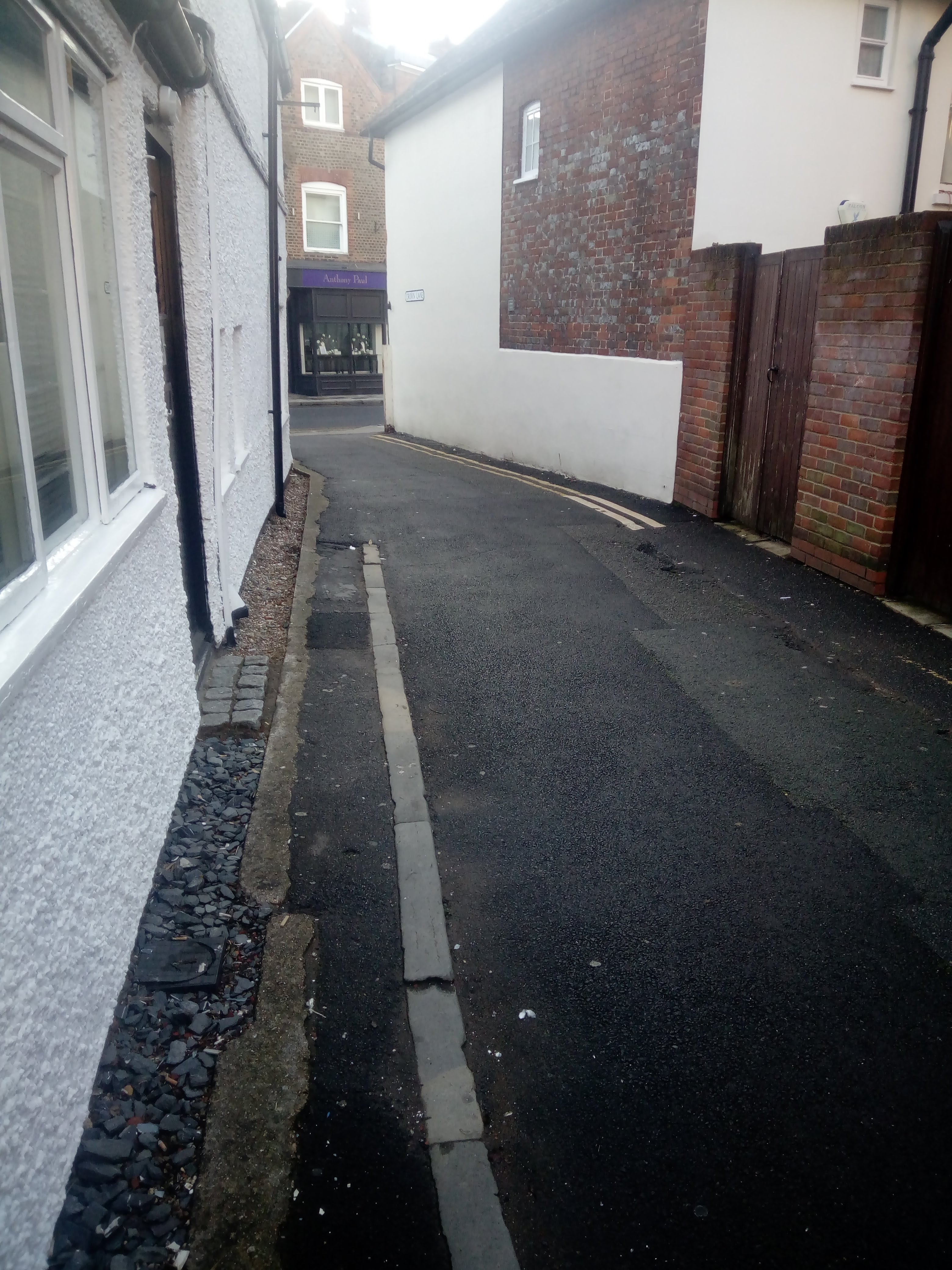
Most people who have lived in this lane in Marlow have done so from the early 1890s onwards. Before that the lane existed as a way around to a few buildings but was only ever home to a couple of families at a time. It was sometimes early on called Spittal Lane as it comes off Spittal Street. (For a potential candidate date for the origin of Crown Lane, see the Crown timeline post here - under date 1650. )

On the 1861 census the White and Davis families had homes there. Anthony Davis was a labourer at the paper mills near the river while his wife Elizabeth was a housewife. Thomas White was a sawyer and his wife Mary Ann was a laundress.
Sadly two different residents of Crown Lane were found drowned in the Thames at Marlow- Thomas Holford in 1902 and Arthur Bristow in 1916. In neither case were there any witnesses so the respective juries at the resulting inquests returned verdicts simply of "Found Drowned".
Arthur Bristow aged 43 suffered from "locomotor ataxy". He believed his condition to be worsening and expected to soon lose the use of his legs. As a result he was very depressed and the implication from the evidence of those who knew him at the inquest was that suicide was a probability.  But no one saw him go into the water hence the "Found Drowned" verdict. The jury in his case donated their fees to the Red Cross. Such donations of fees tended to occur when the case heard had been particularly tragic, typically a suicide of an adult or the death of a small child. Both inquests took place at the Two Brewer's pub in St Peter's Street near the river. Local man Albert Truss helped to recover the body.

On the theme of losing the use of legs in 1900 resident "Frank" Tapping took out an ad in the South Bucks Standard thanking all those in the town who had donated money to him after he had to had his right leg amputated. This was in fact Harry Frank Tapping who would have been only 17 at the time. He was the son of Police Constable George Tapping and Mary. Frank appears on the 1901 census as a hairdresser and barber living with his parents and siblings in Crown Lane so the amputation didn't hold him back from starting a career. 
The family had moved there at some point in the 1890s. George was the constable for Lane End from at least 1889 to at least 1892. Prior to that he was stationed at Amersham.
He and Mary married in 1876. Her maiden name was Perfect hence this blog post title. I hadn't heard of this last name before and I had to check it twice to be sure!

The year of Frank's amputation 1900 was also a tragic year for another Crown Lane family when Elizabeth Tubb aged just 40 and a mother with half a dozen children still at home, died. Her husband William, then a labourer, had already had a very troubled life. His father had died at Medmenham when he was only a few months old. His mother brought him back to live with her parents in Dean Street Marlow. He became a shoemaker but found it hard to stay out of trouble. In 1868 he was prosecuted for stealing oats, in 1875 for not paying his lighting rates, in 1880 for rioting when the local Liberal candidate lost the election [more on this in future. Many local working people felt cheated and dispirited by this loss], in 1889 for stealing a piece of leather from Mrs Dewey's Chapel Street shop, and numerous times for failing to pay other local taxes. Poverty looks to be the main factor in these cases. When he stole the leather he said he was a father of ten who had no work for a week after his job with "Messrs Burrows" finished and he was now desperate. The case is a stark reminder of the fact that many families then could afford to make no savings and a single week without pay pushed them to the brink. William received 14 days in jail for that theft. This the court said was a mercy because of his hard pleading of his dire circumstances. The Messrs Burrows had a boot and shoe manufacturing workshop in Marefield, Marlow. 

He still lived in Crown Lane in 1910 when he was summoned for the last time I could find - this time for using bad language.

There was a laundry in Crown Lane in 1929 and an ice cream supplies business at the "Farm House" in the 1950s. When (or if) that house was a farm house I am unsure, it is on my very long "to do" list of further research! It was apparently a school in the early 1830s.

Sculptors Doreen and George Dereford had a studio in Crown Lane in the 1960s.
 
For histories of other Marlow streets or buildings see the "Specific Shops, Streets etc" option on the menu. All mentions of an individual on the blog can be found on the Person Index on the top drop down menu. 

Photographed Summer 2020.
Post written and researched by Charlotte Day. Photos by Kathryn Day.

Sources:
South Bucks Standard 16th November 1900 and 9th December 1910, Reading Mercury 1st February 1902, Bucks Herald 25th July 1868, 14th September 1889 and 19th August 1916. Newspaper copies all from the British Library Archives and accessed via the BNA March 2021.

GRO Marriage Index and Death Index online from their website.

1891 and 1901 census transcribed from microfilm by Jane Pullinger. Thanks Jane.

1881 census from Familysearch website, ran by the LDS [Intellectual Reserve Inc]. Accessed March 2021.

©Marlow Ancestors. You are very welcome to use these images or research for family history purposes if you credit this blog and link here so that our sources remain credited for the information they provided. Thanks!

Saturday, July 17, 2021

More Where in Marlow Was? Part 2

Avenel - house, Cromwell Gardens (see below) Advertised in 1909 as "away from motor dust and noise". Rent: £50 per annum. Built by May 1902.

Avonel - house, Station Road.

Baden Villa - Glade Road. 

Beaulieu - Glade Road, used as apartments. Mrs Emma Bonnett is one charmingly named landlady 1902-4. 

Beckett's Row/ Beckett Row - few cottages in Dean Street. 

Bloom Corner - farmhouse (or sometimes used as such), off Gossmore Lane. 1908 - "better known as the Riverwoods Estate."

Carson's Lane - described as located near the Hand and Flowers in 1883, it's probably Spinfield Lane or one leading off it. Carson owned Spinfield house. 

Coiting Place - not infrequent early spelling of Quoiting Place / Square

Eastwood - Institute Road

Eothen - houseBeaumont Rise

Gravel Pit House - Dean Street. The gravel pit was located in area between Berwick and Seymour Court Rds,  now filled with housing. 

Holland Road - still extant but a house that would be given this street address now may have been described as located simply in "New Town" in the past. 

Hospital Lane - Crown Lane, early alternative name. 

Ingledene - Claremont Road now, may be addressed as Claremont Gardens Estate in the past.  

Institute Rise - early name for Station Rise, used alongside Junction Road - the latter had however also been used for other developments.  For the full list of names that Station Rise and it's twin Beaufort Gardens have been known as see under Upper Station Rise in this list here.  NB although some residents of what we call Station Rise (then Lower Station Rise) used Institute Rise as an alternative name, it was more often used for what was then more usually known as Upper Station Rise or Beaufort Gardens as it is now called. 

Junction Road - Early name for Beaumont Rise.  It was however also used later for what is now Station Rise, in the early days of that street's development AND was in use for Claremont Road ditto before the name Claremont Road was officially adopted in 1901. 

Keswick House. High Street (No. 25 but numbering changed since then) and also another in Beaumont Rise.

Lily Cottage - Claremont Road, originally address given as New Road before the eventual official name of Claremont Road took off. NB New Road has been used for several newly laid out roads in Marlow on a temporary basis.  2. Glade Road. May in fact be the same as above, as Glade Road was given as address for many homes actually in nearby places in this era as it was a more established residential area, and development around it was more piecemeal.

Lilyville.  Dedmere Road. 

Marlow Lane - usually used for portion of Munday Dean Lane that's at Munday Dean itself. 

Merefleet / Mereflett- Beaumont Rise.

Myrtle Cottage- Beaumont Rise.

New Road Hill - brief use for Seymour Court hill, or modern Lane End road which becomes Seymour Court Rd town end. Recorded 1894, 1895. 

Oaks, The - Institute Road, appartments. 

Oaklea Cottage - West Street. 

Quarrydale Road - off Newtown Road. Address may also be given as New Town or Marlow Fields. 

Rossendale - Glade Road. Apartments and used for summer season lets.  

Spittal Lane - alternative name for Crown Lane mainly pre 1860's. 

Station Villas - Dedmere Road. Edwardian. On the same side as the station, the first group of terraced houses you pass after Station Approach when heading away from the town. 

St Joseph's  - house, Institute Road

St Peters Cottage - in Station Road, not St Peters Street. 

Sycamore House - house, opposite old Post Office in West Street used as a school for girls by Mrs Ann Winter 1860's and  private lodging house 1875- 1901, under Mr and Mrs Jacob Ransom, then as a shop 1902. See also The Sycamores. 

The Sycamores - house, near Marlow Lock. Often let to summer visitors. Not the same as Sycamore House but often confused with it. In Mill Rd now, but may be described as located at Thames Bank or on Thames Lawn in the past. 

Thornton House - Claremont Gardens

Valetta - Cambridge Road


The first part of Where in Marlow Was.. can be found here and parts no 3 here, no 4 here, Five here


Compiled by Charlotte Day with some research also by Kathryn Day.

*To find all mentions of a street or house you are interested in, see the drop down menu above for the Places index and Pub listings* 


©Marlow Ancestors. You are welcome to reuse this research with credit to this blog and a link here. 

PHOTO ID ANYONE?

 Can anyone help a fellow family history researcher Linda identify where this staff photo may have been taken in Marlow? Underneath are some...