Search This Blog

Showing posts with label Foxes Piece. Show all posts

Monday, October 14, 2024

Foxes Piece Marlow History

Foxes Piece was originally a name given to a meadow off what is now Glade Road (which was a mere track then). This was on the opposite side of the road from the modern Foxes Piece flats and school. The meadow got the name from school proprietor George Faux (pronounced Fox) who with his wife Ann, a former servant of Princess Amelia, ran a private boys' school where Cedar House is now from 1757 until George died in 1797. The pupils used the meadow as an extension of their playground and as a cricket pitch. A detailed post about this school with more about the Fauxes can be found on the blog: here.

Across the road from the school were two more fields called "Upper and Lower Foxes" comprising between them parcels of land known as Foxes Two Acres, Foxes Little Two Acres and Foxes Lower Acres, presumably also once used by Faux. Over the years all these fields became known collectively just as Foxes Piece. The Faux school meadow site was eventually built over but the name Foxes Piece lingered for the rest of the fields and for the area around them.


 Above, from the 1839 map drawn by William Francis for the Platts Farm estate sale which included land within Marlow Fields such as Foxes Piece. The land is shown as plots 20-23 comprising lot VII here. Glade Road can be seen running between plots 20 and 21. 

Part of the site amounting to 23 acres extending down to the side of Glade Road as well as Little Marlow Road was hired out as private (and not particularly cheap) allotments by the end of the Victorian area by landowner Sir William Clayton. Previously they had been let to farmers. The allotments were put up for sale in one lot in 1910. At the time land in the Glade Road area was highly desirable for property development. The buyer was John Langley, whose interesting biography Kathryn has written in a post under our Marlow Heroes series here. He did not immediately build on the site. Part of this land was later given by John to the town for the building of the Cottage Hospital.

In 1939 part of the Foxes Piece were bought by the Urban District Council under sanction of the Ministry of Agriculture and Fisheries and the Ministry of Health at a cost of £1300 for use as community allotments. These are the modern allotments.

During the second world war many evacuee children came to Marlow. There was relatively little playing space for them or for the children who were already living in the town so the future school site at Foxes Piece was purchased for £800 by the council in 1940 as a recreation ground which became known as Foxes Piece Playing Fields. It totalled 8.5 acres.

After the evacuee families left Marlow the recreation ground remained in use for local people for a few years but in the 1950s Foxes Piece First School was built on part of the site between 1954-56. There were only three classrooms back then plus cloakrooms, a staffroom and scullery. It isn't clear whether any part of the playing fields were retained for public use or whether the whole of the playing fields were enclosed for the school use. I remember being told multiple times by Marlow people as a child in the 1980s /90s that a public right of way ran through the school playing fields and that you were allowed into the fields themselves at the weekend. I remember them seeing people walking dogs there and many people walking through the school grounds on a weekend as a shortcut. My dad took me through there himself. I am sure that that was not with the council blessing and certainly the site is not open access today! I presume that the lingering belief that the grounds were public land was a throwback to the days of the official playing fields there.

In 1966 it was decided that the critical shortage of infant school places in the town meant that new schools had to be built. Foxes Piece was picked as the site for a middle school to adjoin the first school. Following an over two year build the school welcomed its first pupils in 1969. It had a 320 child capacity. The two schools together combined were then known together as Foxes Piece Infants School with Mrs Nye as the new head. Later the schools were again  referred to separately as the First School and Middle School.

By 1969 the school buildings were used as polling stations in elections, something which gave the pupils some welcome days off!

Newly built next door were the local authority owned rental flats of Foxes Piece (the first families moved in 1964/1965). The flats were initially usually described as Foxes Piece Estate. Council houses in the Newfield Gardens area were also in their early days referred to under that name sometimes.  

Meanwhile the Foxes Piece allotments continued. They were mostly unfenced until 1974 when sadly the theft of produce and some vandalism forced their enclosure behind fence and padlock. They remain in cultivation today. More on the history of the various allotments in Marlow and those who used them here.

Written and researched by Charlotte Day.

Sources:

1833 Parochial Assessment of Great Marlow,  surveyors working notebooks in my family possession and transcribed by me.

1839 map, copy in my family possession.

Personal Interviews.

Bucks Herald cuttings May 10th 1940 and 16th July 1910.

Bucks Examiner December 2nd 1955. British Library Archives via the BNA. Reading Evening Post February 11th 1966. As previous. Reading Mercury February 11th 1939. As previous.

© MarlowAncestors 

Wednesday, December 8, 2021

World War Two In Marlow part 2 1940-41

 Part Two 1940-41 - updated October 2025.


1940- Winston Churchill's scientific advisor Frederick Lindemann, of German origin but hater of the Nazis, moves his Statistics Department from London to Sentry Hill House on the edge of Marlow. The building was requisitioned by the government for the war effort. Members of the department lodged there, and worked there of an evening to escape disturbance in the Blitz. Filing cabinets were transported to the house in the backs of cars which was perhaps not the most secure way of doing things. The department left in 1942.

Frederick's father Adolf had lived in the neighbouring house The Heights at the time of his death in 1931 so Frederick already knew Marlow well when he arrived.

Jan 1940 - blacking out of the windows of all the town schools has been completed. Residents are reminded to step carefully off pavements and listen hard for cars when walking around at night.

Jan 1940- general meat rationing is about to begin so the townsfolk need to register with one of the town butchers. Bacon and ham are already rationed.

Jan 1940- a row in the cemetery is to be reserved for the graves of the anticipated war dead.

Jan 1940- the ARP is giving out baby head protection helmets in the town.

February 1940 - elderly Edwin Wye of Victoria Road is struck by a car he couldn't see and which couldn't see him thanks to the blackout when he steps into Spittal Street.

April 1940- doorstop salvage collections begin of paper, rags, bottles and metal for the war effort .

May 1940 - £800 is spent on buying the piece of land known as Foxes Piece in Marlow for a recreation ground thought necessary because of the increased numbers of children in town due to evacuations. Authorities are very aware of the even greater numbers expected to arrive in the coming months. That recreation ground is in the present day the site of Foxes Piece School.

May 1940 Colonel M .O Clarke A.R.P officer for Bucks lives White Lodge, on the edge of town. (Bisham)

August 1940- the council gives up the metal gates of Higginson Park and some metal benches there to the war effort but decide to keep on to the railings around the Causeway enclosure for now. An hydraulic lorry is to be bought for the town's salvage collections.

August 1940- Fitzroy Clayton of Harleyford fined for allowing lights to be seen from his house during the blackout. He blames his guests.

September 1940- multiple bombs fall in fields off Old Pound Lane near to Pen's Place, leaving 21 craters. Other bombs also hit the outer edges of the town injuring some in Berwick Road and a further resident, Leo Ryan is killed. Ryan's Mount in Marlow will, in the future, be named for him. For security purposes or perhaps for reasons of keeping up morale, the local press during the war do not report bomb deaths or injuries as anything other than fatal or non-fatal "accidents" occuring to local people.

September 1940 - a plaque is out up in Borlase school chapel to commemorate  the first former pupil from the school to doe in this war- W Tagell of High Wycombe who drowned when his naval ship went down. 

September 1940 - the first anniversary of the war breaking out is marked the following Sunday with a national day of prayer.

September 1940- the town launches a Spitfire Fund.

September 1940- Folley Brothers at Sheepridge Little Marlow fined for not complying with an earlier order to turn over a portion of their land to ploughing. They say the land is using yo graze cattle which is surely part of supplying food for the war already.

October 1940 - the air raid shelter for the Infant School in Oxford Road is being built but the other schools in Marlow are still without them. The cellar of the Clayton Arms pub will be used by the infants as a shelter if needed before they have their own one complete.

October 1940- A letter to the Bucks Free Press from an anonymous refugee in the town criticizes the town's large house owners for supplying no meals and refusing the women staying with them from using the kitchens to make their own. Instead they have to walk down to the refugee canteen in town. It also highlights the overcharging of refugees for their accommodation in town.

October 1940- road accidents in the town are up despite far fewer cars being on the roads. This is put down to the blackout.

October 1940- rules banning council housing tenants from taking paying lodgers is to be relaxed as so many refugees in the town need somewhere to stay (this rule does not seem to have been stuck to previously anyway in practice). The Freemasons Hall us being used as overnight emergency accommodation for those who arrive in town without anywhere organized to stay. These are mostly people who have fled bombing in London.

October 1940- Finnamore Wood Camp outside the town has been built and is being used to house evacuated girls from an Ilford school. The King and Queen briefly visit them while in the area.

October 1940- Bucks Agricultural Committee hears that some farmers are reluctant to ask their assigned land girls to drive tractors or do "rough work". It also however hears from farmers who say that their land girls have no problem with any such tasks, in fact they have been found to be better than the former male workers at such things.

November 1940 - Lucy Nicholls Stanley the soon to retire landlady of the Chequers in the High Street is fined for not filling in alien registration forms for most of her guests, as required by law. These had to be filled in whether someone was foreign or not. She has been fined twice this year already for blackout offences. At least she can receive foreign guests if they come to her. Nearby High Wycombe has been designated a Protected Area and no civilian foreign nationals may enter to work or stay without police or home office permission.

November 1940- the Women's Voluntary Service is based at the Armoury Institute Road. They are collecting underwear and costs for bombed out families elsewhere.

November 1940- there are 855 refugee children in Marlow plus 441 adults.

November 1940- plans are mooted for adding special concrete block walls in front of the windows of the town's council houses so that their front rooms effectively become bomb shelters in themselves. I'm not sure how that was going to work! Construction begins in Berwick Road council homes the next month.

December 1940- donate any binoculars you have to opticians so that they can be sent to the front where there is a shortage. Meanwhile magazines can be donated at the Post Offices to be sent to troops abroad.

December 1940- those trying to flag buses down in the gloom of a winter evening are warned not to use a torch to signal to the driver to stop. Instead they should carry a white hanky or white cloth and wave that.

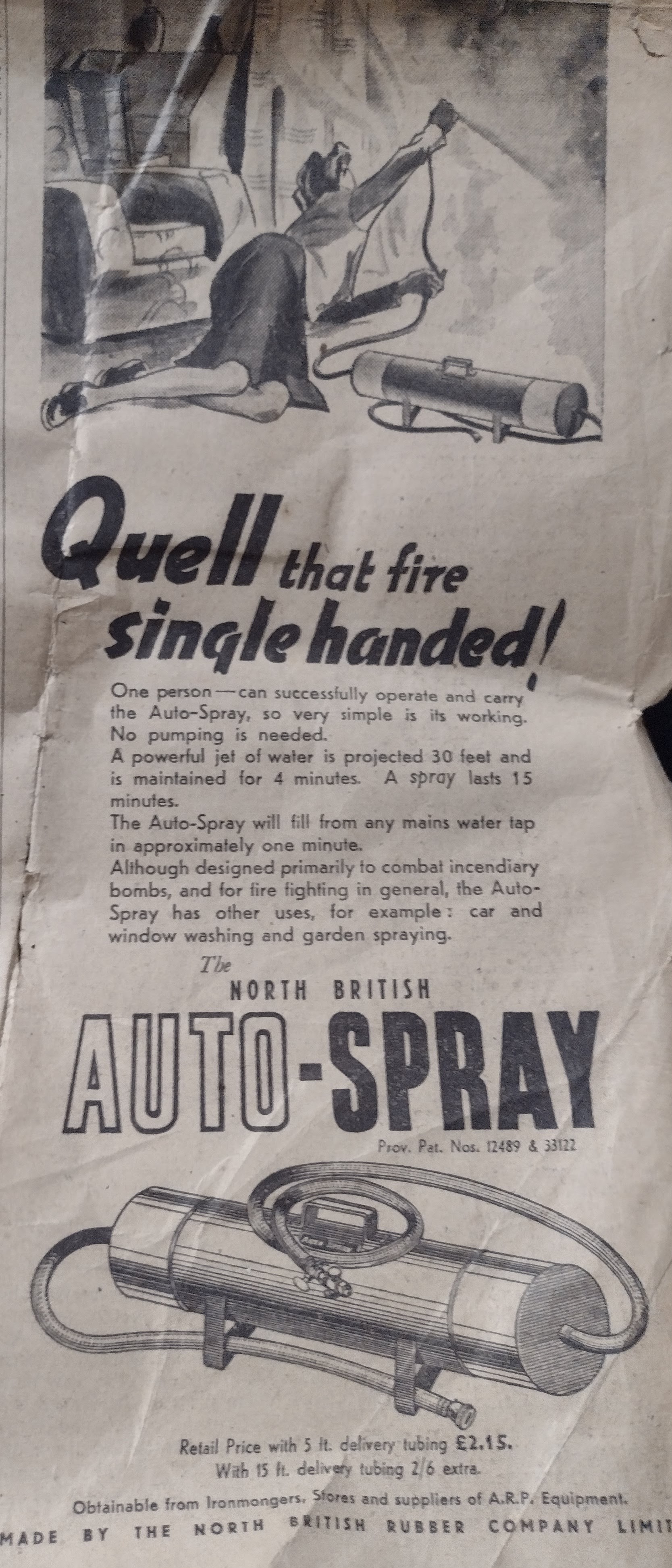
December 1940- all business premises in the country told they should have fire watchers (paid or community volunteer) because of the risk posed by German incendiary bombs.

1941- Spinfield, a house in Spinfield Lane partially taken over for accommodation of RAF personnel. Danesfield House has by then also been seized entirely for RAF use, including by photographic reconnaissance officers. Soldiers in camouflage hide in the woods protecting this base.

January 1941- work is ongoing to build more air raid shelters in the town for the schools.

June 1941- Marlow F.C lost to Reading in the final of The Berks and Bucks Red Cross Cup, organised to raise money for the Red Cross Fund. Over £120 was raised.

June 1941- a motor launch comes along the Thames through Marlow several times one Sunday. The occupants use a loudhailer to urge women they see on the riverbank to sign up to take serving men's places in factories and workshops. A novel idea! 

December 1941- Nazi sympathiser and British Fascist Frederick Joseph Rutland living with his brother in law Henry Rupert Hood-Barr and Spinfield, a house in Spinfield Lane West, Marlow as mentioned above arrested by police on suspicion of espionage and later interned for the duration of the war. He was suspected of passing secrets to the Japanese while in America and the Pacific. He had been decorated for his aerial reconnaissance work during WW1 for the RAF. Frederick had been spied on by people working for MI5 and based at Spinfield House for some time.

Part one of Marlow In World War Two deals with preparations for the war and the first few weeks of it as is available here. Part Three moves on to the years 1942-3 and can be read here.

Interested in WW1 in Marlow? Kathryn has a detailed year by year series of posts on it 

1914

1915

1916

1917

1918-19


From October 1941. 


More sources:

Bucks Examiner 27th June 1941. British Library Archives via the BNA.

Bucks Free Press 9th February 1940, 11th and 24th October 1940. Bucks Free Press Archives.

Papers of Frederick Lindeman, Nuffield College Library, National Archives catalogue.

Operation Crossbow: The Untold Story of Photographic Intelligence and the Search for Hitler's V Weapons. By Allan Williams. Published by Random House. 2014. Read more about Danesfield in the war in this interesting book.

The Times, October 15 1941 - thanks to Archibald Friend for a copy of this. 

Historic advertising literature.


To find all mentions of an individual here, use the A-Z Person Index in the top drop down menu. New content added weekly. More than 10,000 Marlow people are mentioned.

Tuesday, August 17, 2021

A History Of Marlow Allotments


It's hard to know the date the first allotments in the modern sense arrived in Marlow as all the first ones were privately rather than council owned and they tended to be small scale. Records don't really exist for the establishment of these couple of acre concerns. But one of the first, and the oldest still existing, is the Parish allotments off Munday Dean Lane, aka the Workhouse Field allotments. This is part of land known as "the Berwicks" for hundreds of years, and believed to be part of an historic charitable bequest. 


Although laws had been enacted in the times of George III and William IV to empower churchwardens and overseers of the poor for example to take over parish land for use by the labouring poor, this did not seem to happen in Marlow. The 1882 Allotment Extension act tried to clarify and strengthen the earlier acts, and this was followed by the 1887 Allotments Act that compelled authorities to provide land for allotments were demand was felt. The parish in Marlow just pipped the last act. In 1886 the Vicar and churchwardens hatched a plan to turn the field adjacent to the former workhouse into allotments. In February they went to the 6 acre field to divide it into 41 plots (or 44, depending on who you believe). They made an occasion of it and some of the future allotment holders went along to witness the division. The annual rent would be 6d a pole, with most plots 20 poles in size. This was regarded as an "exceedingly low" rent at the time. The number of applicants had exceeded the number of plots. The Churchwardens were said to be "extremely satisfied" with their effort. Although mention is made later of the Vicar (Rev Fearon) wondering whether any other Parish land could also be turned into allotments, the plan was shelved despite the success of the workhouse field site. Probably this was because there was a big increase in privately owned allotment grounds in the next few years. The tenants of all of these had to be artisans or labourers. The potential gardeners were required to swear to their status, and there was clearly some quibbling about who exactly was a member of that group. In 1901 the agreement was worded to say access to a plot at the Parish allotments was restricted to the "labouring poor." At meeting of parish council that year, the question was raised as to whether the several parish councillors who rented plots there really qualified under that condition. It does seem doubtful that they would have classed themselves as either poor or labourers under other circumstances considering they were business owners. But the parish council said no favouritism had been shown. 

The next large scale allotment that is still with us today was at the area known as Hanging Hill off Prospect Road. (From 1886/7) This was owned by Mr Micklem who must have seen the success of the nearby Parish Allotments, and thought he could put his own large field to profitable use in the same way. He would also charge 6d a pole. He was not wrong about the demand for more plots, as every one was snapped up within days of Mr Micklem announcing his intentions. By 1890, the Board of Agriculture reported the fact there were 217 allotment plots in Marlow across all sites. 

Around this time small areas off Glade Road were also let as allotments. These were on the other side to Foxes Piece and were also run as a business. Some only had 1-2 plots. They quickly earned the reputation for charging high rents for indifferent ground. Foxes Piece allotments, owned by large scale landowner General Owen Williams, started in December 1889. He had previously let the land to a local farmer, but allotment provision were regarded as a better way to earn money. They also undercut the Glade Road neighbours - at first! All of these allotments could be described as "the Glade Road allotment gardens" or the Marlow Fields allotments so it can be hard to split the history of the sites. The stated size of Owen William's Foxes Piece actually let as allotments varied hugely. The "other" site, largely forgotten now, on the east side of Glade Rd belonged for many years to Robert Hammond Chambers, who also owned the long vanished "Marefield Allotments" for a while. The latter was a 4 acre site also described as located "in Dean Street opposite the Bank beerhouse". It was actually just beyond Berwick Close as you head down Berwick Road towards Munday Dean. Other very small sites were located off New Town Road, the largest of which was Mrs Marshall's measuring just over an acre. 


Poor labourer, high rents

Hammond Chambers was a controversial land lord for the allotment holders. He charged 10d a pole which was described as an extremely high price. (1895) He was not the only private owner of allotment land to charge this level of rent however. A letter to the local press signed "a working man" complained at these high charges in Marlow. He had been told that as some plot holders defaulted on their rent, the remaining ones had to be made to pay in order to make the sites profitable. Charitable enterprise they were not. Our letter writer complained that Mr Dorsett had promised to act on the high rents when he was up for election as a councillor but nothing visible had been done. The following month, the Marlow Parish Council tried to address the problem. They wrote to both of the Glade Road allotments owners who were now charging the same "unacceptable" 10d a pole rent. While Owen Williams agreed to reduce the rent back to 6d, the reply recieved from the agents acting on behalf of Hammond Chambers was "unsatisfactory." It was a landlords market it seems. In this year, 54 acres were under cultivation in Marlow as allotments. The cheapest plots were 4d a pole. 


The light fingered and quick fisted

The variety of vegetables and fruit on offer at the allotments proved a tempting sight to some of the lighter fingered Marlow residents. For example, two ladies recieved a 5s fine each for helping themselves to turnip tops at Foxes Piece in 1892. (Turnip tops were often eaten at this time, and were also sold as "spring greens".)

There are reports of rival plot holders coming to blows. Some disputes with petty beginnings ended up in court. In 1900 George Boddy, a labourer from Eton Place and Hanging Hill plot holder, found himself before the magistrates bench for pulling up his allotment neighbours John Dormer's broccoli plants. John had made a path across his plot which other people had also began to use. He turned a blind eye until some of those wandered off the path and trampled his crops. He therefore decided to dig up the path and plant some broccoli where it had been. George said he thought path was a shared one and objected. He was heard to threaten to pull up the new plants so when they were indeed destroyed, he was summoned. As no serious harm was done, George escaped a fine but was made to pay 5s 6d costs. 


The problem with pigs

Pig keeping was a problematic occupation in Marlow. The various parish officers responsible for dealing with nuisances often had to deal with complaints about people erecting a pigsty against a house, not necessarily their own! At the time, pig keeping was allowed at both the Glade Road allotment gardens and at Hanging Hill and Marefield. As Glade Road was increasingly developed for middle class housing, the presence of the pigs became a little contentious. The medical officer of Marlow Urban District Council braved a visit to the sites after an avalanche of complaints in 1897. He went on a warm day in July and could not disagree that the local residents had a just cause for complaint after experiencing the smell from the manure first hand. (He counted an incredible 157 pigs on the Glade Road sites and 73 at Hanging Hill). The poorly constructed styes with no proper bases or drainage were ordered to be improved or taken down. But the problem just sprang up again elsewhere! In the meantime, Glade Road residents hoped for a favourable wind in the opposite direction. 


Chicken and pigeons could also be kept at most of the allotments. The former were a frequent target of thefts. In 1900 several fowls were stolen from the Glade Road allotment of Spittal Street butcher Thomas Carter. Baker Henry Sawyer of Little Marlow was found guilty of this theft along with a similar one in Wycombe Road. His punishment? 14 days imprisonment with hard labour. 


Allotments, a tonic for the working man. 

Allotment gardening was regarded as a wholesome activity that would encourage the poor to be industrious - a well meant if misplaced thought when it concerned manual labourers who already knew the meaning of hard work all too well. Classes for allotment produce were introduced into local horticultural shows with cash prizes on offer. Some classess recieved no entries however and so these particular ones were abandoned. It's hard to know why some classes were not supported, but perhaps the allotment holders could just not afford to pay the entry fee required to submit veg in all the classes they would have liked to. Competing for different allotment prizes clearly bought a lot of fun and pride for others. Another idea to encourage the gardeners was to hold lectures on relevant subjects, sometimes on the allotment grounds themselves. A large number of working men attended lectures organised by the Marlow Technical Education Centre at one of the Glade Road allotments in 1894. They had secured Richard Dean, a fellow of the Royal Horticultural Society to give talks on how to make allotment gardening profitable. He spoke of the striving to produce better and better crops that could be encouraged by some friendly rivalry if the plot holders could organise their own show and horticultural society. They decided to do just that. 


Later history

The 1908 Allotment Act acknowledged that many local authorities had dodged earlier requirements to provide land for allotments where demand existed so it made provisions more explicit and extensive. In Marlow a committee was formed, meeting in the Institute, to look into the issue of whether more allotments needed to be provided. They had received many letters asking for more plots to be made available. They decided to investigate who the people were making these requests and whether "the demand was genuine." Perhaps they thought a landowner hoping to flog some land to the council was writing fake letters? Unfortunately it was up to the Parish Council to police themselves in regard to this vetting and however many letters were sent to them asking for plots, they always decided the need for more allotments was not sufficiently demonstrated. To be fair to the council they said not everyone replied to their letters asking the wanna be allotmenteers to come to a meeting to state their case. The fact this was going to be held on a work day when there was no paid time off probably had something to do with that. However, the Parish Council report on the land then let as allotments is interesting. Hanging Hill, Foxes Piece, Marefield and Glade Rd allotments were all still in operation. Potential future sites were identified off  New Town, Little Marlow and Dedmere roads. 120 people again wrote to the council in 1910 asking for more allotments, and again the request was ignored. No doubt this was partially sparked by Foxes Piece going up for sale. Initially knocked down unsold, it did eventually find a buyer in Marlow Urban District Council chairman John Langley. He paid £1,300 for 23 acres - some of which was not in horticultural use at the time. He did however continue to allow some of the site to remain as allotments. Some of this land would a few years later be donated to the town for the building of Marlow's second Cottage Hospital. 


This blog deals with events up to 1920's but I will just add that in 1939 the Marlow Urban District Council wrote to the  Minister of Health and to the Minister of Agriculture and Fisheries for sanction to acquire some land at Foxes Piece for use as allotments at a cost of £1,300. The following year mention is made of the acquisition of the "playing field known as Foxes Piece" for £800. Part of the motivation for the extended playing field provision was the influx of war time evacuees in Marlow. This part continued in use as playing fields for a while before the building of Foxes Piece First School 1954-56. The allotments remain, not as large as they once were of course.

Related posts

Where your gardener ancestor worked: here

Marlow heroes Bonny & Corby, related to Hanging Hill here

History of Foxes Piece area - here

General Marlow history posts: here


To find all mention of your ancestor here, use the A-Z person index in the top drop down menu. There is currently over 6,000 people in there.  To find other posts about Glade Rd, see the Specific Shops, Streets etc index in the same menu. 


Researched and written by Kathryn Day 

Sources:

Hall, Thomas H. The Law of Allotments - being a treatise on the law relating to the allotment of land for the labouring poor (Longmans, Green and Co, 1886)

Local newspapers including:

Reading Mercury 11 November 1939, Bucks Herald 13 February 1886, 10 February 1933, Maidenhead Advertiser 17 December 1886, South Bucks Standard July 13 & 26 September 1894, 20 March 1913. All copies at British Library. 

Board of Agriculture report into allotment cultivation at Marlow 1890.


©Marlow Ancestors


PHOTO ID ANYONE?

 Can anyone help a fellow family history researcher Linda identify where this staff photo may have been taken in Marlow? Underneath are some...