Search This Blog

Showing posts with label Plumridge. Show all posts

Wednesday, March 12, 2025

Edwardian Spittal Street and Spittal Square Part Two

EVEN NUMBERED PROPERTIES SPITTAL STREET.

Note: Our Marlow ancestors were terrible at giving precise or consistent street addresses for themselves or others, knowing exactly what number they lived at (!), and the authorities made some confusing even bizarre property numbering decisions (don't get us started on Berwick Road... ). Some properties in Market Square at the bottom of Spittal Street were officially numbered as if in Spittal Street and would be described as being in Market Square or Spittal Street depending on the whim of the describer. They are included here. Properties in Spittal Square were also numbered as if in Spittal Street. Most of those were given even numbers. Throughout history Spittal Street and Chapel Street which run into one another were repeatedly confused. Never believe any property is definitely in one street rather than the other without multiple pieces of evidence!

***Edwardian building numbers are not necessarily those of the modern day*** Several of the properties mentioned below no longer exist.

In this post I follow the popular perception of the "Edwardian age" as extending 1901-1914. Some incidents in the earlier lives of the named residents are also included. Spittal Square addresses are very sloppy and reconstructing this street was tough.  If anyone has been missed we hope to remedy that as soon as possible.

2 - 4 George Dorsett's grocery shop. Really in Market Square but numbered as Spittal Street at this time. Bacon curer too. 

6 - 8 William Fisher's butcher's shop. Managed in a day to day basis by Frank Fisher from 1905 but William still in charge of the business overall. William was involved in an accident in 1910 when his horse drawn trap was in collision in the High Street with another vehicle and he was thrown out of it. William was much injured but fortunately had no broken bones. In the Edwardian era William supplied meat and groceries to the Union workhouse school in Bledlow Bucks which took children from Marlow and elsewhere. The quality of the meat he provided was questioned more than once. It has be said that the premises of William were considered a continuous serious health hazard by his Spittal Street neighbours and he was multiple times in court over sanitary breaches. The details are somewhat stomach churning and as you may have recently eaten we'll just draw a veil over the details. Like many butchers he kept some animals for slaughter - mostly pigs- out the back of his premises. In the Victorian era he had kept a stall at Marlow market too but it isn't clear whether he was still doing that in this era. By the end of the Edwardian age William no longer lived on the premises of his shop, but in Glade Road. His wife Elizabeth was nee Webb of the Webb of Field House Marlow family. William himself came from Aylesbury originally.

Premises on the edge of Market Square.

10  Sometimes given as Market Square but numbered as Spittal Street. Shop of Thomas "Tom" Rippington (bn 1879) fishmonger in 1907 and 1908. He also dealt in game and poultry. Smoked haddock a speciality! He was an assistant fishmonger on the 1901 census so must have come into his own business after that. Thomas is not to be confused with his dad Thomas Rippington of nearby Chapel Street who was not a fishmonger but a shorthand writer and marine store dealer. Tom and his wife Ruth moved to Great Missenden in late 1910 or 11 and his former Marlow premises were taken over by Nelson and Sons butchers. 

12 Sydney Smith's greengrocers. Members of this family continued the shop there for some years.

14 - 16 Bernal Harman chemist until his death in 1906 when his son Henry "Harry" Harman took over. A full biography of both Bernal and his son is already on the blog here. Long term chemist premises. 

18 William Smith, draper's shop. Wife Martha Jane ("Jane") born circa 1853 Maidenhead but William was a Londoner of origin. He was one of Marlow's volunteer firemen. Martha died after what was said to be a long and painful illness in 1908 at their home The Garth, Beaumont Rise. William continued to live at The Garth as a widower with his children Herbert and Dora. (Currently a greengrocer & sweet shop) 


Advert, 1905. 

20 Ironmongery ran by George Meakes until his death in 1903. Assisted by John Eddowes who then took over. A biographical post on these two is already on the blog here. Currently M&S food. 

22 - 24 Arthur Barnard's stores which were built at the very end of the Edwardian era. He already has a biography on the blog here where you will also find information about his two other shops. Prior to that three very small cottages stood on the site. Those properties were previously occupied by Thomas Andrews the hairdresser (wife Elizabeth), H Carter and the Steele family headed by William and Rosanna "Rose" Steele. William was a french polisher on his own account. His and Rosanna's son Sydney died of wounds he received while fighting in the First World War at Salonika. The Steele family previously lived at Bovingdon Green but had to leave when their thatched cottage burned to the ground. It was thought a spark from their fire of furze ignited the thatch. No one in the family was hurt and the family's possessions were saved. A lack of available water for the fire brigade and the fact the road from Marlow was so bad that the fire engine got stuck had contributed to the fire's destruction of their home. Using furze for fire would have been common at Bovingdon Green and Marlow Common as it could be gathered easily in the vicinity. Currently Marlow Bookshop. 

26 - 30 The Greyhound. For the Edwardian and other landlords of this historic  inn / hotel see here. (Demolished) 

32 Jacob's family home & store. Ralph Jacobs was a "marine store" dealer - that is a seller of secondhand items that would largely be of interest to those in trade or craft occupations (e.g carpentry tools or lead piping). They also traded in secondhand items a householder might use for gardening or home maintenance tasks. Examples of such items would be cloths  that could be used for cleaning, slop pails and garden tools. He later also operated as a rag and bone man and offered shoe repairs. His shop was at 32 but he also kept a storeroom for larger items in Duke's Place. His sons John and Ernest both helped in the business. Sadly Ernest was killed in action while fighting in the First World War. The mum in the family was Emily Margaret. This property no longer exists. In the first world war the Jacobs collected many items for the war effort. Demolished. 

34 Over the Edwardian period George Dean boot and shoe maker and Ellen White needlewoman both occupied this cottage at different times. This property no longer exists. The cottage was a very old one that had in Georgian and Victorian times been a grocer's shop. To read about the grocers who operated from no 34 in the 1800s see here (Eagle Family) or here (East and Harriman). The latter post contains some upsetting content. Demolished. 

36 - 38 a largish property divided up in several ways. Wiggington family premises for many years. Robert Wiggington the coal dealer with a sideline in timber dealing operated from here as apparently did George Aughton a timber dealer who had a sideline in coal. George was also later recorded as a greengrocer and haulage contractor. Robert Wiggington died unexpectedly while out on his coal van in 1915. The property incorporated a shop (officially 38) which was ran as a general shop in the Edwardian era by Miss Emma Glynn Jones the Wiggington's granddaughter and later by George Aughton's wife Charlotte. This property no longer exists in any way.

40 - by the 1920s incorporated into number 38. This property no longer exists. In 1915 just after our era R Hawkes.

42 -cottage considered unfit for human habitation in 1907, owned by a Mr Collins. Probably lived in then by Mr J Edwards. This property no longer exists. 

44 cottage considered unfit for human habitation in 1907, owned by a Mr Collins. Probably lived in then by Mrs Young. Must have been refurbished as in 1915 just after our era no 44 was lived in by Walter Tew. This property no longer exists.

46 The Cross Keys SPITTAL SQUARE properly. Historic landlords listing here

48 at the end of this era the home of John Baxter. In earlier Edwardian times it was George Baxter, "wardrobe dealer" (that was a second hand furniture dealer not just selling wardrobes) who lived here.  SPITTAL SQUARE. Note the Rippington's wardrobe dealers was at no 2 Chapel Street next to the Cross Keys. Due to the bizarreness of the street numbering no 48 Spittal Square was actually on the opposite side of the street from the Cross Keys at no 46 which from bare numbering you would think would be next to it.

50 the home of widow Mary Ann Walker embroiderer at the start of the Edwardian era. She lived there with her niece Miss Mary Ann Stockbridge born 1857, who was a maker of embroidered baby bibs for her aunt's business, and then following her own death on her own account. Both women were beneficiaries of the will of Mary Ann Walker's husband Henry (who ran the baby linen and bib manufacturing business with his wife) following his death of bronchitis in 1894. The family had occupied this property since at least the 1870s. The Walkers employed many women in the town as embroiderers. Henry had spent his youth in the army, where he rose to the rank of Sergeant, not an easy thing for an ordinary man to do in those days. During his time serving in India he was part of the force which seized the famed Koh I Noor diamond and fought against the Indian Mutiny. After he left the armed services in 1864 he returned to Marlow, married and set up the embroidery business with his wife. SPITTAL SQUARE.

52-54 bakery of Walter Harris (also confectioner) and then Mr W Clark. SPITTAL SQUARE.

56 Mrs Mary Holland seamstress, self-employed. SPITTAL SQUARE.

58  John Birdseye. Baker there since at least the early 1890s. Spittal Square. He was in the same block of 4 properties as Frank Harvey the chimney sweep see above, so was an even number. John was born circa 1831 in Chesham. His wife Eliza was of Marlow origin. She died in 1904 and so late in the era as a retired widower John went to live with his daughter Sarah and son in law James Gray (a grocer and rent collector) at the impressive house Thamesfield near the river. Back in 1897 when Queen Victoria's jubilee was being celebrated in Marlow John put on an unusual public display when he exhibited some bread and cakes which he had made for the 1887 Jubilee, 10 years previously still in very good condition! John as a younger man served as a parish constable. The graves of Eliza and John are on the blog here. Both were members of the Baptist Church in Marlow and helped to raise money for its Glade Road building. Their daughter Sarah was a Congregational Chapel member.

When John Birdseye retired Edward Harvey baker and confectioner (wife Alice nee Barnes) took over. Early in the Edwardian era John sold bread and beer in nearby Chapel Street. They lived York Road.  Harvey's bakers was in operation for many years and was fondly remembered by many people. This property no longer exists. SPITTAL SQUARE.

60 the home of the West family headed by couple Emma and Owen West. Late in the Edwardian era Emma lived here as a widow supporting herself by working as a charwoman. SPITTAL SQUARE .This property no longer exists.

62  Francis "Frank" and Annie Harvey. Frank was a chimney sweep. In a block of 4 properties in SPITTAL SQUARE not far from the corner with Chapel Street. This property no longer exists.


Unplaced people of Edwardian Spittal Street, may be on either the odds or evens side of street unless otherwise stated. By unplaced I mean not certainly placed, there is often conflicting information:

Samuel and Rose Higgs. Samuel was a boot maker.

Mr Price who had a shop here in 1905 in which a fire broke out.

Mr Ransom butcher?

Mrs Elizabeth Sexton dressmaker and furrier. Born circa 1848 in Dorking Surrey. A widow who lived with her daughters Eleanor and Winifred, sister Eliza Plumridge and a lodger. Elizabeth had moved to Marlow from Maidenhead. Initially she lived with her daughters in Oxford Road. Eleanor married into the Gurney family of Glory Farm, Penn. Before marriage she worked as a stationary shop assistant.

Annie Trash milliner late in the era. Even numbered side of the street.


And in Spittal Square unplaced people =

Mrs Atkins or Adkins. Near the corner of Chapel Street. Sometimes because of the property's corner position described as being in Chapel Street itself. 

John and Jane Bryant early in the Edwardian era. John was a shopkeeper.

M Fisher the greengrocer.

Charles and Emma Hawkes. Charles was employed as a shoe maker. 

Joseph Hawkins carpenter.

Tillion family. In the same block of four properties as Frank Harvey the chimney sweep so an even numbered property. Charles Tillion was a packer for a fisherman. See also The Horns, Chapel Street landlord listing. 

Researched and compiled by Charlotte Day. ©Marlow Ancestors. You are very welcome to use my research for family or local history purposes with credit to this blog. 

For selected sources see Spittal Street part one which deals with everyone who lived in odd numbered properties

Wednesday, September 4, 2024

Landlords Prince Albert Moor Common

Not to be confused with the briefly in existence Prince Albert in Marlow. Both came under Marlow for licensing requirements.

Gaps in dates represent gaps in our knowledge. For full historic lists of pub landlords many with pub histories attached in the Marlow district see the Pub Related Index.

1851-63 Joseph Jones. Wife Mary. Joseph also worked as a butcher.

1868- unknown landlord. Two customers found to have stolen pheasants upon their person in the tap room. They'd been poaching of course. 

1869-72 Edmund Shervall /  Shurville / Shervill / Shervel / Shurvell. Says on census that he was born in Great Marlow. May be the baptism 1836 Medmenham to unmarried mother Elizabeth. Wife was Eliza. Edmund was an agricultural labourer for most of his life including while the landlord of the Prince Albert. Eliza would have ran the pub on a daily basis while Edmund got another wage. This was a common set up in smaller pubs which could not get enough trade to function as the family's only income source. Edmund, Eliza and their children left for West Wickham, Kent.

1872 -86  Richard Ayres who was also a woodman. The J.ps granting Ayres the licence express the wish that he will live up to his prior good character and will not run the premises "in accordance with the very bad traditions" of the place!  In 1885 John Wakefield who lived at the pub was accused of sheep stealing from Barmoor farm Marlow. He worked at Greenlands, Hambledon. Sent to quarter sessions for trial. He seems to have been a relative of the Ayres. 

1886 - 97 Alfred Webb. Wife Sarah. Note: Alfred had a niece with the last name Ayres. This is a very common local last name but may mean Alfred was related to previous landlord Richard Ayres. Alfred's wife Sarah was assaulted by a customer who she had asked to leave in 1894 . [could richard have gone to ship inn cadmore end and died age 58 in 1895]. Alfred was charged with selling liquor at 11.20 pm when the pub should have closed at 10pm. He argued that those in the pub drinking were friends and relatives whom he had invited to have supper and a drink with him after they went to a sale together. They had arrived back at 10.50 pm, the pub had closed on time.  Sat in tap room as it was the only room still with a fire burning and it was a cold night. Bench believed him and case dismissed.

1897- 1902 James Frederick Plumridge. In 1901 used for inquest when a woman Emma Tibbs drowned herself and her 6 month old baby daughter Winifred in the water tank of their new home in Moor Common. Her husband said that his wife had known better times and was depressed at living in small cottage especially when she found the cottage had fleas. She had been up all night dealing with them and was exhausted.

1902 - J Grover or Grove briefly before James Frederick Plumridge again, also briefly. The pub enters a period of instability with frequent landlord changes, suggesting a difficulty in making the business a going concern.

1903 - Henry Talbot landlord. Customer jailed for assaulting him. Grabbed throat and tried to push him into the fire. Customer was disorderly and had been asked to leave premises.

1905 - Frederick Ward

1908 - Charles Read transferred to George Ambrose 

1910 Frank Edwin Wallace  who transferred licence to Thomas Plowman.

1910-1914 Thomas Plowman. He was  on the census as a widower (wife had been Emily originally from Bisham Berkshire). Thomas was originally from Sussex and had worked as a carpenter in the years before he took on the pub. He lived with his daughter Elizabeth and little grandson at the Prince Albert.

We generally list landlords up to around the time of the first world war. The pub is still there today.


Researched by Charlotte Day. 

Selected sources - 

England and Wales Censuses transcribed by me from microfilm except 1911=

"England and Wales Census, 1911," database, FamilySearch (https://familysearch.org/ark:/61903/1:1:X7KQ-2JV : 22 July 2019), Thomas Plowman, Hambledon House, Oxfordshire, England, United Kingdom; from "1911 England and Wales census," database and images, findmypast (http://www.findmypast.com : n.d.); citing PRO RG 14, The National Archives of the UK, Kew, Surrey.

and 1881 West Wickham "England and Wales Census, 1881", , FamilySearch (https://www.familysearch.org/ark:/61903/1:1:Q27W-92K7 ), Entry for Edmund Shervell and Eliza Shervell, 1881.

Windsor and Eton Express 12th September 1868. British Newspaper Archive, via the BNA. South Bucks Standard 26th October 1894 and 19th March 1897 both British library archives, via the BNA. Maidenhead Advertiser May 8th 1901 as above.

South Bucks Free Press 28 December 1872 

Duttons directory 1863.

https://familysearch.org/ark:/61903/1:1:N6DJ-X8R

©Marlow Ancestors. You are very welcome to use this information with credit to the blog.

Wednesday, September 27, 2023

The Men Who Built Marlow #4 - Frederick Plumridge

This is the forth in our series about the men and families who quite literally built the town of Great Marlow. No series could be complete without a mention of the ancient Marlow family of Plumridge (Plumeridge, Plomidge) who probably have the longest unbroken connection to the building trade of any of our featured families. Plumridges have been involved in the brick and tile making and bricklaying trades throughout the 1700 and 1800s into the 20th century. The numbers of Plumridge men who appear on census returns as a brick layer is astonishing. But this is not the full story. Firstly because the term was used in the early Victorian period for people who we would more generally call builders today and because other sources give more specific descriptions of their roles which sometimes included stonemasonry, tile making and brick making for example. The other trade very strongly associated with the Plumridges in the Georgian and Victorian period was beer selling, usually pursued by the same individuals who were otherwise builders etc. It is sometimes a surprise for families to find that an individual who only had room to put what they regarded as their principal occupation on a census return were actually also the official licence holder for a beer or ale house. The reason they could pursue two occupations was the help of wives and adult children who actually did most of the bar work, as well of course of paid employees. To find all of the beer houses and pubs connected to the Plumridge family, see the A-Z person index in the top drop down menu or search for their connection to a particular pub using the index here. (They definitely built the Wheatsheaf and Duke of Cambridge and very possibly the Prince of Wales.)


BACKGROUND 

If you had walked around the Victorian Queens Road, Eton Place and the Cambridge Road / Place area you would have found a good number of houses both occupied by and built by a Plumridge. Most have unfortunately now been demolished. However the surviving Duke Of Cambridge pub was certainly originally built by William Plumridge as a beer-house in approximately 1865. Cambridge House is also believed to have been originally built by the Plumridges. The family were at the helm of the Duke for the best part of a century, and were naturally  its first ever proprietors. 


ENTER FREDERICK

Today's specific subject is Frederick Plumridge b1858 to builder William and wife Emma nee Judge. His grandfather was also a bricklayer and publican. William was the landlord of the Duke of Cambridge as mentioned above, a role that Frederick's older brother William Henry would also take on. (There are several Frederick Plumridges connected to Marlow who were born at around the same time.) Mum Mary's family also included members who followed the bricklaying trade such as brother George. 

Young Frederick was working in the family bricklaying business from at least the age of 14. This was the normal age for a young man to begin his trade. He could have no better people to learn from than his very experienced family. He grew up at the Duke in Queens Road, an area that was much developed as time went on. But the Duke still backed onto market gardens and farm fields. (The pub itself  had a large field that was hired out for events. It was used for events like the cricket match between employees of the Plumridges and that of fellow builder Carter in 1866. The Plumridges won). The Plumridges owned several cottages and a shop in the area, including a set of 4 almost opposite the Duke which no longer exist. Numerous Plumridge young men worked as bricklayers for the Corby building family too. (The Corby builders are covered here)

In 1877, Frederick married Emily Langley of Marlow. They subsequently moved just around the corner from Queens Rd into the populous Dean Street. By 1881 Frederick was already the foreman in the family building business. Late in that year he moved into the bigger Hawthorn Villa in Cambridge Road, which was owned by his father (and another home possibly built by him or another Plumridge). This had a garden at the front and rear, with a greenhouse which indicates another Plumridge talent - gardening! Many of the Victorian Plumridge men of Marlow can be found enthusiastically entering the local flower shows while William at the Duke maintained many fruit trees which he manipulated to produce crops regarded as freakishly large and abundant. 

At some point Frederick set up in business alone. Later he would move to Oxford Road and York Road. 


ON THE ROAD WITH FREDERICK

In 1883, Frederick was voted into the role of parish surveyor of the highways. This was a hugely important and responsible job, and one that would prove to be remarkably stressful for poor Frederick. He was required to view the condition of the highways continually and to organise for the repair and maintenance of the roads. He had a horse and pony at his disposable at first which his contractor could use to fetch the gravel and flints needed to repair potholes and the like. He had to make sure the roads were kept clear, something that proved mostly impossible in the time of the annual fair which was held in the main streets of Marlow. He did manage to bring some prosecutions when travelling salesman set up booths in the middle of the Market Square or the Causeway at other times though. He had a difficult time in 1884 dealing with serial offender farmer William Creswell who had a penchant for ploughing up and diverting inconvenient footpaths and incorporating bits of land along the highways into his land. You can read more about that and miser William here .


But by far the most difficult part of his job was organising the collection of the highway rate or tax. Frederick was supposed to collect it, and he had to make good any arrears not collected out of a deposit he had to pay each year. This was to ensure he worked hard to collect everything due to the parish. The trouble for Frederick was that he inherited a number of carried forward uncollected dues, after the death of the previous surveyor Robert Carter. The parish books he was supposed to use to judge who should pay what sound like they were in something of a muddle.  Frederick received conflicting advice as to whether he should collect dues from the owners or occupiers of the liable properties. Neither side generally wanted to pay. He said he had considerable difficulty in collecting anything and that too much of the population was actually too poor. Those owing overdue amounts often said that his predecessor had not collected money from them, so if they hadn't paid Carter, they wouldn't pay him either. He was able to summon non payers to court and did so to some degree but the magistrates did not always force the defendants to make good all the amount. He could also decide that some households were exempt from paying, mostly due to the small size of their home. But when he went to the court to ask for their official exemption, he was told that every one of the several dozen people he wished to exempt had to appear individually. None of them turned up the next day. Frederick decided not to pursue these households for the rates anyway and marked them down as exempt regardless. This would come back to haunt him. 


I think the truth is that Frederick Plumridge had to square a financial duty to collect rates, a pragmatic nature and awareness of the reality of the real poverty faced by some in Marlow. He had down well for himself but he had also grown up close to the poorest part of town. When he became aware that the wife of George Allen who he had summoned for non payment of rates had sold her little children's shoes in an attempt to make up the sum, he paid the owed amount himself in full. It was a kind act, and Frederick said this was just one example of "great poverty" that he encountered. He was voted back into the role annually until 1891 when I am not sure he actually stood for election. In any case, two years later his final accounts had not been signed off. The auditor decided that Frederick had not tried hard enough to collect some of the outstanding sums. A resulting public enquiry was held at the Institute (now the library) and Frederick appeared to defend himself. He was fighting an attempt to make him personally liable for £54 worth of unpaid rates. He was unfortunately unsuccessful. 


On one occasion in 1891 Frederick was called home from the magistrates court by wife Emily (then living in Oxford Rd) as a matter of urgency. She was experiencing the most sickening odour coming from a neighbour's overflowing cess pit, made worse by some building or decorating work going on there. He found the source of the stench and offered materials to help suppress the smell but when this was refused, he had to call in a fellow parish inspector, the surveyor for nuisances. 


OTHER PROJECTS FOR FREDERICK

Frederick Plumridge was responsible for building the new rifle range used by the local Rifle Volunteers, of whom he was a member. The newly laid out Quarry Wood Road to Cookham Dean in 1890 meant the old range needed to be moved and the contract to take it down and build the new was won by Frederick. The "District Inspector of Musketry" inspected the butts and declared them excellent.  

Other areas that we can be sure Frederick worked on to build or extend homes were Station Road in 1891 and York Road.  


SPORTING HERO

Those who might not have relished Frederick knocking on their door with a rates demand in hand, were nevertheless very pleased to see him on the football field. He was a very successful goalkeeper for Marlow Football Club when they were at the height of their fame. He played for them for 4 seasons in the 1880s and in 3 out 4 of those, Marlow conceded only 1 game. A very safe pair of hands Fred must have been! He had gone to Borlase school and sometimes joined "Old Borlasian" teams too. 

And Frederick also helped to grow the next crop of Marlow footballers as he set up the Marlow Antelopes* youth team and acted as their secretary for several years. His son, also Frederick, was one of those who played for the Antelopes. Frederick junior was also a talented ice skater on the frozen meadows of Marlow, winning a number of informal races in the 1890s.

Like many young Marlow men, our Frederick was a keen rower and a lifetimes worth of practice saw him represent Marlow rowing club successfully, for example at the Henley Regatta. He served on the rowing club committee too. Despite all this he also found time to be a member of the Volunteer Fire Brigade in Marlow. 


GOODBYE FREDERICK

At some point in the late 1890s Frederick gave up his own business but continued to work for others in the building trade. But eventually he decided to take a turn at that other very Plumridge occupation, beer selling. In late 1908 he moved to Windsor with wife Emily and his children in order to run the Clayton Arms in Market Street there. But poor Frederick was already ill. His condition suddenly and seriously deteriorated within a few months of his assuming the licence. He was taken to the St Thomas Hospital in London but died shortly afterwards. He was just 51 years old. Poor widow Emily would eventually take on the licence herself, after son Albert did so for a short time. His funeral took place at Holy Trinity church in Marlow with "many manifestations of esteem and respect". 


Researched and written by Kathryn Day. 


FURTHER INFORMATION:

Building families (Men who Built Marlow) Lovell here Bond here Corby here

Duke of Cambridge Queens Road:

Historic landlord listing here

*More about the Antelopes football team here

To find more about specific streets that Frederick and Emily lived in see the index here

Sources:

Census 1841-1891 - transcription from original microfiche by Jane Pullinger, with thanks. 

1833 Parish Assessment, as held by my family. 

1851 Tithe Map, courtesy of Jane Pullinger. 

Kelly's Directory for Buckinghamshire 1847. 

Dutton Allen & Co Directory 1863. 

Bucks Herald 21 April 1877, and 31 March 1883. 

Reading Mercury  19 May 1883. 

South Bucks Standard 30 May 1890, 9th Jan 1891,  22 September 1893. 

Windsor & Eton Express 5 August 1911. 

Maidenhead Advertiser 1903

Researched and written by Kathryn Day. 

© MarlowAncestors 

Tuesday, September 19, 2023

War Dead Congregational Church

The Imperial War Museum has transcribed the memorial to the members of the Congregational Church (as it was then called) in Quoiting Square Marlow who fought in the First World War.  The transcribed names are listed below and I have added some research into those young men.

Bartlett, Gilbert

Batting, Horace

Grove, William B

Keates, Ronald

Loaring, William J

Peddle, Alfred 

Plumridge, Albert E

Robinson, William

Smith, Henry J


Research:

Gilbert Bartlett. Son of Mrs and Noah Bartlett. Born 1891. His dad ran a grocer's shop in West Street overlooking Quoiting Square. I believe Gilbert is also memorialised in the WW 1 memorial in Sir William Borlase School, which he certainly attended. He had emigrated to South Africa by the time the war started and was thus serving in the South African infantry when he died in 1916. More about his parents in this post where you can find a picture of their premises as they are today.

Horace Batting. Born Horace John Batting 1897 to Charlotte and John Batting. Dad was a gardener. He himself was a grocer's assistant. Lived York Road as a small child. As a 13 year old Herbert was soloist in the Congregational Church's choir. Lance Corporal in the Royal Fusiliers. Died 29th April 1917. On the war memorial at Arras. Parents had previously suffered the loss of their 3 year old daughter Gertrude.

William B Grove. Born 1897 to George and Emma Grove. Lived 1901 Cambridge Place, Cambridge Road. Died 1915. Kings Royal Rife Corps. Featured on the Menin Gate memorial. Dad George worked on the river as a boat building labourer, waterman and a steam launch driver as well as being an amateur rower.

Ronald Keates. In full Ronald Sidney Keates. Born 1895 to Anne and James. Grew up West Street Marlow. Age 10 won a prize in Marlow Horticultural Show 1905 for a bunch of wildflowers he had picked. I know it is a minor thing to mention but the image of the child Ronald wandering peacefully in the fields enjoying the flowers struck a chord with me when I read it considering what he would later live through. Private in the Oxford and Bucks Light Infantry. Before the war he was a clerk. His father James was a builder's foreman, elected parish constable and town councillor.

William J Loaring. Private in the Royal Fusiliers 13th Battalion. Killed 4th August 1917 by a sniper. Included on the Menin Gate Memorial, Ypres. Employed at Morgan's the drapers in the High Street before the war. The Morgans were also Congregational Church members. To see an historic photo of the premises where William worked or to read more about the Morgan family see my post here

Alfred Peddle. Born 1894 to Alfred and Helen Peddle.


Above, grave of Alfred Harry Peddle. Killed In Action in France March 2nd 1917 age 22. Of the King's Own Yorkshire Light Infantry.  Grave is in Marlow Cemetery. He is buried with his parents who lived in York Road at the time of his death. He was a plumber.

Albert E Plumridge. Albert Ernest. Born 1881 in Bisham. Did not die until some years after the war. It may have been considered that his military service caused his death nevertheless. He was badly gassed in 1917 and was sent home to hospital in Stourbridge England. Albert was a worker at Temple Mills before becoming a motor launch driver on the river. He lived at Bisham with his wife Edith (née Finch) at first before moving to West End Gardens Marlow. These houses still exist but are not now known under that name. They are in Henley Road Marlow. Albert had been a regular player for Bisham football team as a teen / young adult, sometimes serving as the Vice Captain. I think he may also have been a rower.

William Robinson. Possibly born 1885 to Alice and William Robinson.

Henry J Smith. The town's main war memorial gives the name H.W Smith which was Henry William, who may be a relative. Henry J was a Private in the Buck's Battalion.

Researched and written by Charlotte Day.

For detailed posts on Marlow in WW1 see Kathryn's Posts 1914  1915  1916  1917  1918 and 1919

For more church related content see the Church Related option on the menu. There are also A-Z Person Indexes, Graves  and Wills options on the menu.

Sources Include:

Transcription of the memorial is ©WMR-8379. Imperial War Museum. Available on a Creative Commons BY-NC licence. 

Commonwealth War Graves Commission. Details of memorials on the continent and dates of death.

Bucks Herald 25th August 1917. Copy held at the British Library archives. Accessed March 2021 via the BNA.

South Bucks Standard 23rd December 1910. As above.

Reading Mercury 25th August 1917.

1891 and 1901 Census transcribed from microfilm images by me.

World War One Service Records 1914-20 database online. https://familysearch.org/ark:/61903/1:1:QVBG-1V55 WO 363. National Archives, Kew.

War Memorial All Saints Church, Marlow (commemorates all denominations).

Written and researched by Charlotte Day. 

©Marlow Ancestors. You are very welcome to reuse our research if you link here so that the sources listed above remain credited for the information they provided.

Friday, July 14, 2023

Victorian Postmen Plumridge

 The Plumridges of Marlow would have been well known to our Great Marlow ancestors as builders, bricklayers, beer-sellers and brewers. But today's subjects are two of those comparatively rare few to have followed a different occupation, at least some of the time!  Both had connections to the Post Office. First up is Daniel Plumridge who was a postman in Victorian Marlow. 


There have been a large number of Plumridges in the Great Marlow Parish area from the Tudor era, if not long before. Daniel was one of those born just outside Marlow itself c1839, in Cadmore End. (Usually rendered as "Cadmer End" or "Cadmor End", Fingest Parish in the earlier days). His parents Thomas and Rebecca worked in what must be some of the most typical occupations in this area at the time. Thomas spent his working life largely as an agricultural labourer and chair maker, while mum Rebecca was a lacemaker. Cadmer End was the more populous part of Fingest Parish at this time, but it was and still is a beautiful rural area. It formerly had a number of brickworks ..bricks and Plumridges are never far apart! Daniel however began to work from a young man as a postman in Cadmer End. Despite all the travelling involved in a rural route, in the Victorian imagination the role of a rural postman stereotypically went to someone lame or not perhaps as mobile as they had once been who could not keep up as an agricultural labourer. How many of these limping postman were actually about is hard to say, but young Daniel certainly did not fit that image. Whether he filled that other stereotype of taking a good while to complete his round by stopping at each cottage door for a gossip we don't know. But as a letter was the primary means by which the inhabitants recieved personal news from afar, both good and bad, he must often have been a longed for sight hoving into view in his uniform. It was noted that into the 1890s few Marlow homes had letterboxes within their front doors, which greatly slowed down the delivery of letters, as the postman had to wait at each house for the door to be opened so he could hand over the mail. An appeal was made to install them, and not to delay the workers in their rounds too much with chit chat. But who knows if anyone took any notice! 


Although postman were usually called letter-carriers in the early days in general, I have noticed that locally "post man" was in popular use much earlier. Postman was adopted nationally as it better reflected the work of the men when they began to carry packages too. 


In 1864 Daniel married Elizabeth Hannah Davis. Elizabeth was the daughter of the Bovingdon Green beer sellers William and Hannah Davis of The Jolly Cricketers. The couple set up home in Queens Road and Cambridge Place, Marlow. Other Plumridges filled several of the homes in this area, and had indeed built some of them. The pub in the road, The Duke Of Cambridge, also had a Plumridge at the helm and indeed had been built by them. At this point Daniel was working as..a bricklayer. Was it for one of his Plumridge relatives? Very likely. Later, Daniel is referred to as chairmaker.  In any case Daniel must have liked his work for the postal service as a few years later, he is back in the role of postman, this time in Marlow. Elizabeth's paid work was as a dressmaker, and the couple also took in lodgers. 


Daniel remained a post man into the early years of the 20th century, living in and around Queens Rd for some 30 years. (At the time of his daughter Rosa's marriage in late 1901, he had moved a few minutes away to Quoiting Square.) It must have been interesting for him to see how the town expanded with new developments, especially at the hands of various Plumridge builders. Marlow's Victorian residents could enjoy more than one post delivery a day (3 in 1880) except Sundays when there was one. In the same way the boxes were emptied more than once. The exact schedule varied over time, except on Sundays. Usually the longer distance items came by train from Maidenhead and by mail cart before that. When Marlow got her own station, the post arrived in town sooner and so deliveries were moved back too. At the time that Daniel started his work in Marlow, the last letters left here on the 4.15pm train, but this was eventually moved back to just after 8pm. Deliveries were even made on Christmas Day itself (although just one usually). 


In 1891, the Plumridge's 14 year old son George Henry was working for the Post Office, as a telegraph messenger. This role was usually given to younger men, but it was regarded as a responsible one and a good start. Messages received at the telegraph office naturally had to be taken to the recipient and this was the messengers responsibility. 


The community had to rely on the honesty of their letter carriers, an issue in the public eye here in 1885 after Marlow man James Morgan spent a year in prison for stealing postal orders entrusted to him as a postman in Bedford. He was taking on a temporary cover role in that town - otherwise he was a chimney sweep. In total he stole 3 postal orders over two weeks. Nothing of a similar kind seems to have troubled those recieving mail within Marlow itself. Morgan received a reduced sentence because he was only a temporary relief postman so it was considered a less severe  betrayal of trust. He had not lived in Marlow long before his apprehension.**


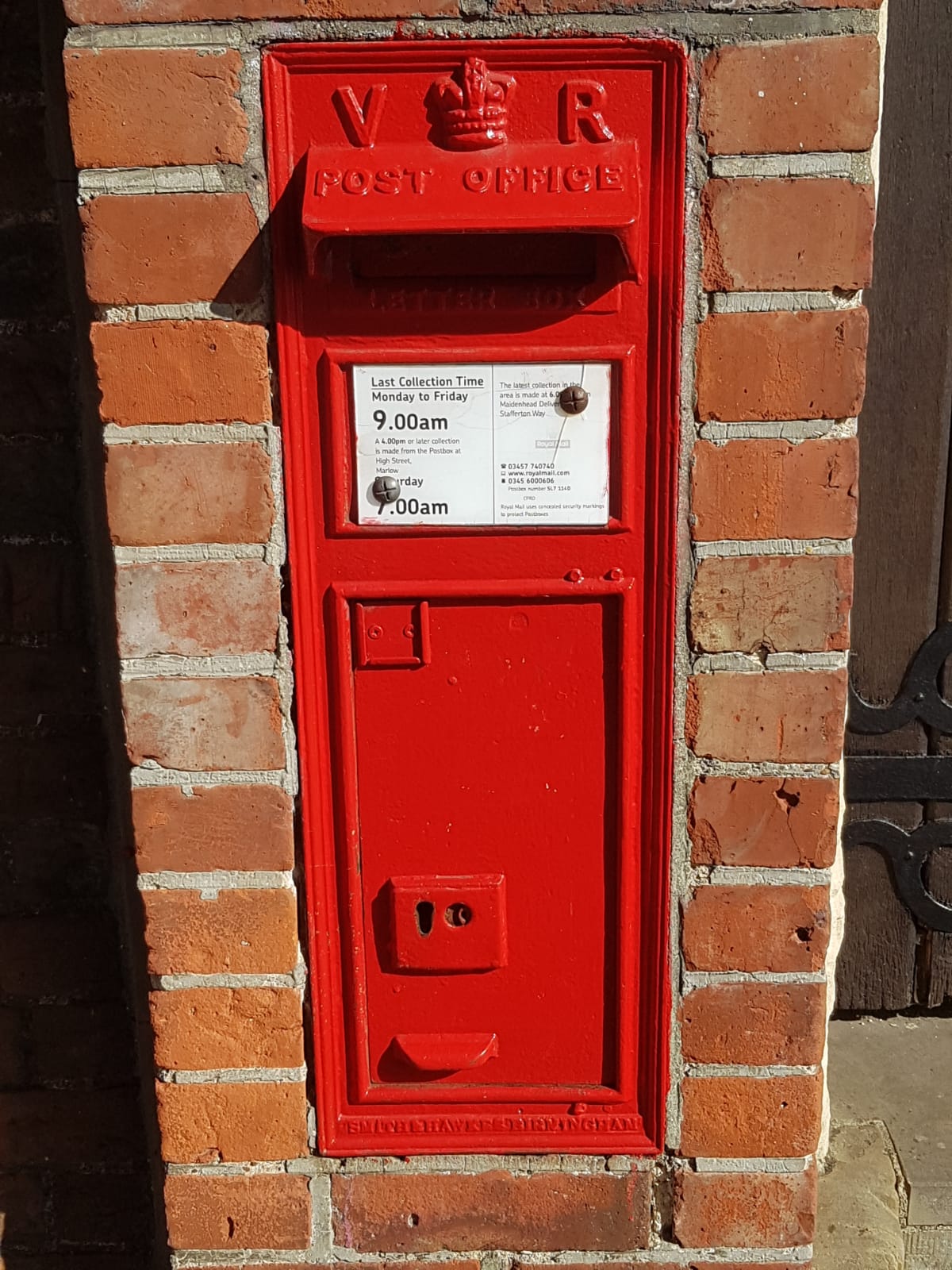
If the postal staff had opportunities for mischief so did members of the public. Daniel sometimes arrived at post box to find that a miscreant had broken off the enamel tablets fastened to the pillar boxes. These gave the details of the the collection times. An appeal was made by the postal authorities locally in 1891 to plead with people to leave this essential information alone! 


Another annoyance for Daniel was the "cribbed, cabined and confined" conditions in the main post office in West Street, especially in terms of the space available for recieving packages. It had occupied two different sites there at various times but neither one had been designed to deal with the explosion in popularity of the post. In 1894 it was finally decided to go ahead with long debated plans to move the post office. Institute Road was the first considered site but the town was not happy with this. In the end the grand and attractive Cromwell House in the centre of the High Street was secured, although not until 1897, opening early the following year. It was converted from a house*. (Even this did not please some of the residents of West Street who lamented having a slightly longer journey to reach the main branch now it was no longer in their road. Plans were made for a sub post office there for their convenience! You could also find another sub post office within a couple of minutes of the High Street, in the grocers on the corner of Station Rd and Mill Lane as it was then. In 1897 Mr Yeoman was in charge there. See pic below.)


William Plumridge of Lane End 

Our second Plumridge connected to the post service is non conformist William Plumridge, of Lane End, son of James and Esther. William worked as a chairmaker and later as a baker, grocer and sub post master at Lane End throughout the late Victorian period. He was assisted by wife Mary nee Ellis and sons Thomas and William at times. William junior's work delivering bread for the family business made him a witness in the Moor End Common murder case which you can read about here

 William senior was obviously a hardworking individual but on his death as an elderly man in 1904 he had a number of debts. His estate could not cover these, to the embarrassment of his family. There is nothing especially unusual about this but the unexpected resolution of the issue was.  Three years after his death William made headlines around the country. An anonymous well wisher paid all of his debts off in full, long after his creditors had resigned themselves to writing them off.  He or she did so as a "token of esteem" for William and his family. The identity of the benefactor(s) was not seemingly revealed, at least not publicly. Perhaps they had spent the years between the death and pay off saving the necessary funds (£167) or perhaps they had been away and unaware of the problem until 1907. Either way, it was a nice thing to do. William junior succeeded his father as sub post master and grocer, also acting as a house agent. Multi tasking obviously ran in the family! There were Plumridges fulfilling the roles of sub postmasters and bakers in Lane End for long after the period our blog covers. 


Written and researched by Kathryn Day. 

Further information:

*History of Cromwell House can be found here

**James Morgans wife applied for parish relief for herself and her 4 children while her husband was awaiting trial at the Bedford Assizes. The Board of Guardians rule was that no "outdoor" parish relief could be given to the family of those in prison, including those waiting trial. (That is no assistance other than a ticket for admission to the workhouse could be offered.) However Marlow's Walter Lovegrove, one of the Guardians  spoke on the behalf of Mrs Morgan, and pleaded for compassion. He was seconded by Marlow's vicar and fellow board member Rev Arthur Fearon who reminded everyone the principal of innocent until proven guilty. In the end a vote to give the family 3s a week plus three loaves of bread was carried unanimously despite grumblings from 3 members about the rule bending. It was one of many examples of Walter Lovegrove speaking out firmly in the interests of Marlow's poor and unfortunate. The relief stopped when James was convicted. 

To find every mention of an individual here, use the A-Z person index in the top drop down menu. There's over 6,000 people listed there. Great Marlow itself is the focus of this blog but for other posts relating to Lane End, Cadmore End and around that we do have, see the index here

If you are interested in some of the other families who quite literally built our town, see the Men Who Built Marlow posts Lovell here Bond here   Corby here

SOURCES: 

Kelly's Directory for Buckinghamshire 1852, 1883, 1905, 1911,1920,1939. (Kelly's Directories Ltd) 

Notice - Changes to Postal Delivery - 1874, 1875, 1877. Thanks to James Purdsey for a view of these. 

Census, 1841-91 - Transcript from the microfilm made by Jane Pullinger. 

Oxford Journal 29 May 1847. 

South Bucks Free Press 5 May 1860

Chesham Examiner 21 January 1891. 

Boston Guardian 7 December 1907, and South Bucks Standard August 1894 - these two copies via the BNA. 

Slough, Windsor and Eton Express Oct 31 1885 - Slough Libraries. 

© MarlowAncestors


Monday, July 3, 2023

Plumridge Graves And Research, Great Marlow


Arabella, beloved wife of C E Plumridge, died Jan 9 1918 age 54. 

AND the above mentioned

Charles Edward Plumridge died February 22 1942 age 77

This grave is in Marlow Cemetery. 


Above, Jenny, devoted wife of A T Plumridge died Jan 22 1928 age 45. Also Arthur Thomas Plumridge b 1882 d 1971.  This Grave is in Marlow Cemetery. 


Further Information:

Charles was a bricklayer and builder, one of a vast number of local Plumridge men to have that profession in the last few hundred years. For example his father James and grandfather William also had this role. William was also the landlord of the White Hart Inn in Chapel Street and man responsible for building the Wheatsheaf. Beer-selling was the second favourite historic Plumridge occupation! Charles married Wiltshire born Arabella in 1888. She had moved to Buckinghamshire to work as a housemaid. They lived at "New Road" in the spring of 1891 - a term that has applied to more than one Marlow road in the past but in their case very likely refers to what we now call Claremont Road. In December of that year, the couple's address is given as Lily Cottage, Glade Rd. Lily Cottage is later referred to as located within Claremont Rd - it was by no means unusual for homes in the Claremont area to be referred to as Glade Rd as Glade Rd was developed first and the other road names came with more development around it so the two addresses may in fact be the same.  Lily Cottage was the setting for a frightening incident for Arabella in late 1891. She was home alone one evening, waiting up for husband Charles to come home, when she suddenly heard footsteps on the floor above. She had heard no one come in, and when the footsteps began to descend the stairs, she fled the house in panic. Arabella took refuge with a neighbour until Charles returned at 9.30pm. He lit a candle and made a search of the house only to discover a clock had been taken from a bedroom. The night was so dark and the area still mostly unlit, that despite a neighbour accidentally bumping into the intruder on his way out, and the neighbours daughter hearing him approach the house earlier, no one could positively identify the criminal. A Maidenhead man staying at a Dean Street lodging house was initially arrested as he matched the description of a suspicious character lurking around Glade Rd earlier. There was no actual evidence he was responsible though, and the case was dismissed. But the experience of Charles and Arabella caused the local magistrates to make an appeal for locals to lock their side doors as Arabella admitted both this and their front door were left unfastened. It also helped secure more public lighting for the area ..albeit a little slow in coming! Later the couple would move to no 6 Station Rise. 

Charles was a member of the Marlow branch of the Bucks Rifle Volunteers and a keen footballer. 


To find all mentions of an individual or family here, use the A-Z person index in the top drop down menu. There are more than 6,000 people listed there, with many more to come. 

Other grave images can be found in index  here


©MarlowAncestors. 

Saturday, June 3, 2023

A Job For The Servants

 This post deals with some of Marlow's most hardworking former residents, the servants. In particular we will be looking at how they got their jobs. 


For those employed at a farm, the early Marlow Fair was a traditional hiring opportunity. (Primarily in the pre Victorian era) The first day was used as a hiring fair. Although mainly used to recruit the likes of carters, ploughman, dairy maids and agricultural labourers, I have found references to indoor staff like general servants at a farmhouse gaining employment at this time. Those seeking employment often carried a symbol of their trade, such a tool, to speed the recruitment process. 


Another traditional place to find staff was to apply to the vicar who would be reasonably likely to know of a youngster from a "respectable" family who was available to hire. Others placed adverts in local or even London papers laying down their requirements. Sometimes the adverts are strangely specific such as requiring a housemaid aged between 45-55 years of age. Preferences for protestant or church going servants were not uncommonly stated. The requests could be placed on the Victorian era at the local newspaper agents such Smith & Co in the High Street, or bookseller George Cannon. As time went on it was more common for staff without positions or seeking new ones to advertise their own availability. They often asked replies to their posts to be sent care of one of the stationers or other shops. Best not to let an employer whom you still lived with that you were planning to seek new pastures!


Shops were the usual given place of contact for those advertising or seeking positions in the pre Victorian era too. For example drapers and bankers Messrs Wilkinson and Borroughs can frequently be found fulfilling this role in the 1790s. One such especially detailed advertisment for a cook in 1795 is fairly representative. It asks for a healthy, clean and good tempered lady between 30 and 40 years of age who crucially has had smallpox already (and was therefore hopefully immune from getting it again). This cook would have control of all downstairs and would have the assistance of a combined kitchen and dairy maid. She must have experience and knowledge of general cooking and pastry making, pickling and preserving in particular. The lady would need a good character from her previous position of course. (An "undeniable character" as they express it. The term unexceptional character was even more popular meaning the same thing.)


Miss Hurrell's Servant Registry Office

Evidence suggests that several shopkeepers were running de facto recruitment agencies. But from the late Victorian period, both employers and employees could take advantage of Miss Eliza Hurrell'd official Servant Agency. Eliza was born in Surrey in the early 1840s but she joined family in Maidenhead by 1871. She likely worked as a servant as a young women in common with most of those running a servants bureau Otherwise she appears as a dressmaker at first. By 1881 she had moved to West Street, Marlow with her brother Robert, a journeyman printer. At this time she had begun to recruit servants on the behalf of others if she had not done so before. "Miss Hurrell's Registry Office" began to feature regularly in the small ads and trade directories. At this time servants' registry offices had a somewhat mixed reputation. They were convenient but were accused of profiteering by charging fees to both servants for being put on the books and potential employers for having a servant placed with them. Others thought that they encouraged staff to believe it was so easy to get another position they needn't stick at any job, so they would constantly chop and change employers. Worse accusations were made of the larger registry offices who sometimes provided accomodation to women between positions, with over priced lodging fees charged for crowded and unpleasant rooms. Eliza was not one of these establishments and as she remained in business for many years, she presumably satisfied both parties well enough. 

In early 1891 Eliza became the third wife of farmer Emmanuel Plumridge*. Emmanuel actually fulfilled many roles and has featured in our blog often before. Use the A-Z person index in the top drop down menu to find every mention of him here. After her marriage Eliza placed a number of adverts alerting the ladies of Marlow and district of her change of name. These adverts also say that "owing to the scarcity of servants with good characters" she had been unable to supply servants to all those who had applied to her. Which is a neat way of saying that she only supplied those with the best of references. She would nevertheless endeavour to continue to place "good servants in good positions." Those seeking work through Eliza were expected to attend her office every day to hear of new opportunities. The office was then in Spittal Street, where the Plumridge's had a little shop. Most provincial servants' registry offices seem to have been within shops ran by the person placing servants rather than stand alone businesses. Eliza would interview both staff and employees to find out their needs, probably in her own living room. 

Adverts were also placed by Eliza on behalf of staff seeking new roles. For example in 1885 she was seeking positions for a 21 year old general servant who was a "dissenter and total abstainer" with good cooking skills. Adverts requiring an applicant to follow a particular branch of the Christian religion or to be a regular church goer were not uncommon then.  Otherwise a "strong and active" woman with good character was looking to be employed as a kitchen-maid, while an experienced 23 year old wanted a position as a plain cook. (Everyday cooking, not just the preparation of toast and gruel!) She was placing servants not just in Marlow, but in and around Maidenhead, Windsor, Surrey and London. They were almost entirely in domestic roles but she did place at least one young woman as a servant in a small private temperance hotel in London - an ideal and allegedly comfortable situation for "respectable girls" according to Eliza. 

 You may think that Eliza's experience with finding trustworthy staff would prevent the family suffering their own domestic troubles. Unfortunately within a year of their marriage, Emanuel Plumridge had need to prosecute a former employee for embezzlement. He sold milk from his farm, and hired James Faulkner to deliver it and take payments. Unfortunately James ran off with the takings and was not tracked down for nearly a year. On arrest he confessed immediately and was sentenced to 6 months imprisonment with hard labour. 


In the later Edwardian era when Eliza Hurrell had passed away, the chief servant registry in town belonged to the Smith family, of Rose Villa, Beaumont Rise and Beaufort Cottage. Mrs Smith advertised for servants needed over a fairly wide area including Wycombe, Oxford and Maidenhead as well as sometimes further away such as London or Brighton. The ads tend to be short of detail, and certainly rarely mention pay or conditions. Mrs Smith was also busy arranging the letting of accomodation in Marlow for "the river season". 


The shop in blue was one of probably two Spittal Street locations used by Miss Hurrell's Servant Registry Office. It was used for similar purposes by Mrs Norcott many years later. Eliza was a member of the Wesleyan church just up the road in Spittal Street. 


*Emanuel/Emmanuel Plumridge was one of Marlow's most hard working individuals himself. Born in Lewkner in c1832. His first wife was Ann Cross ( married 1853), his second Hannah Turner (married 1873). For much of his life he worked as a ganger on the railways first for the Great Marlow Railway Co, later for Great Western. He later became a farmer, milk seller, haulage and cartage contractor (on his death William Dean took this over), house agent, shop keeper, hurdle maker and council contractor for various rubbish clearance projects. He died 1897 and is buried in Lane End churchyard. Eliza outlived him by several years and continued to place servants after his death. At first he farmed at various places that had been part of the former common fields, in particular what was known as Field Farm (later the site of Captain Marshalls Menagerie and the home known as The Eyrie, later Gossmore House). Later he was at Copy Green Farm. 

Written and researched by Kathryn Day. 

Further Information:

To find other posts linked to specific occupations, see the index here

To find all mentions of any individual or family here, see the A-Z person index in the top drop down menu. As of March 2023 there were over 6,000 historic Marlow residents mentioned there with many more to come. 


SOURCES

Kellys Directory of Buckinghamshire 1883 (Kelly's Directories Ltd) 

Census information from the transcripts of Jane Pullinger and Charlotte Day. 

South Bucks Standard 1 May 1891, 10 May 1895, 17 September 1897, 28 October 1897, 4 June 1909 (British Library Archives) 

Reading Mercury 08 October 1892 as above. 

The Solicitors Journal and Reporter 1895, digitised by Google. 

The London Gazette, 1895 collected edition. 

Servants, Employers, and Registry Offices by "W.M" 1865. No publisher listed. 

Social Notes Concerning Social Reforms, Social Requirements & Social Progress  (Simpkin, Marshall & Co, 1878)

 Report from The Royal Commission on Labour, Sessional papers - (HMSO 1894)

The Servants Magazine or Female Domestics Instructor (1848)

Half Hour in a Servants Registry Office - Anon, as included within Wonderful London: It's Lights and Shadows of Humour and Sadness (Tinsley Bros 1878)

Encyclopedia of Domestic Economy by Webster T Parkes (Longman, Brown & Green 1852). 

Maidenhead Advertiser 1885. 

Reading Mercury 11 January 1796. This from the British Library Archive, BNA 


© Marlow Ancestors


Saturday, April 1, 2023

More Great Marlow Strays

Lost track of a Great Marlow born or resident ancestor? Look for them in these Great Marlow Strays listings.  If we come across mention of someone from Great Marlow living, dying, marrying or otherwise popping up elsewhere in the country, we collect the information and post it here. To find all mentions of an individual or family on the blog use the A-Z person index in the top drop down menu.  


Etheredge - see Moore


Elliott, 

MARRIAGE - 1685, Elizabeth Elliott of Great Marlow, spinster aged about 22, daughter of William Elliott, butcher, to Richard Stocke of St Trinity in the Minories, citizen and Merchant Taylor of London, bachelor age 22.  


Fitzpatrick - Henry of Great Marlow to Esther Swift of Brentford, Middlesex. By licence. March 1745, At George's Chapel, Hyde Park Corner. 


Frewing - Rev J J, eldest son of James Frewing of Oxford Road, Marlow. MARRIAGE - 11 August 1892, to Blanche Maria Harris, daughter of Charles Harris of Tewkesbury. At the Congregational Church, Tewkesbury.  (South Bucks Standard 26 August 1892)


Hackshaw, Henry

MARRIAGE: Henry, eldest son of Mr J Hackshaw of Great Marlow to Emma Harrison of "Mead-Row, near Godalming". At Holy Trinity Church, Paddington. 3 October 1850. [Sussex Advertiser, 15 October 1850]


Hone, Susanna: 

1. DEATH Paris, November 1844. Eldest daughter of late John Hone, Esq of Great Marlow. Age 22. [Morning Herald, London 25 November 1844] 

2. DEATH At Tunbridge Wells, Kent. Age 70. February 1869. Widow of John Hone of Great Marlow. 

Hone, Annie - MARRIED at Tunbridge Wells, April 10 1850. To Rev George Goldney M.A. of Southfield.  [Gentleman's Magazine, 1850] Only surviving child of the late John Hone, Esq of Great Marlow. 


Harris, Mrs (no first name given)

DEATH - May 28 1894, St Mary Cray Kent. "Born Chapel Street 1826", 48 years resident in Marlow. (Newspaper cutting, untitled,  June 1894.)


Jorden, Elizabeth - See Morsender. 


Lovegrove, Miss Charlotte

Died age 83 in Brixton on March 29th 1865 [Bicester Herald April 7th 1865]


Lovelace, Lydia MARRIAGE - of Great Marlow to John Butler of Wooburn. St James Chapel, Mayfair, January 1746. 


Mealing, Robert

MARRIAGE - Robert, of Great Marlow to Sarah, daughter of William Evans of Cheddar Somerset. Marriage took place at St Michaels Church, Chester Square, London, by Rev J H Hamilton on 7th October 1862. (South Bucks Free Press, 11 October 1862)


Moore, Catherine

MARRIAGE - April 1683, Catherine Moore, spinster of Great Marlow, to Sir James Etheredge age 26 bachelor of The Inner Temple. She age 20, and married with consent of her mother her father being dead. At "St Bennet Finck, London", by licence. 


Morsender (qv), Robert 

MARRIAGE - widower and labourer of Great Marlow to Elizabeth Jorden widow also of Great Marlow. St James Chapel, Mayfair April 8th 1729. 


Plumeridge, Joseph

MARRIAGE  - Joseph of Great Marlow to Rebecca Woodley (of Harwell?) Berks. At Harwell, 12 Feb 1779. By licence. 


Salter, Agnes 

MARRIAGE - October 1607 to Richard Sanders, at Chesham. Both of their mothers are widows. (Transcript Chesham Parish Registers by John W B Pegge, 1904)


Smith, Mathias

MARRIAGE - April 1680, Mathias Smith of Great Marlow, widower age about 55 to Mary Glew, spinster of St. Pauls, Covent Garden, Middlesex, aged about 45. At All Hallows in the Wall, London. Mary married "at her own despose" that is needed no parental consent as she was an adult according to her testimony. 


Trew, William. Surgeon of Great Marlow. 

DEATH - at father's residence in St Peter's, Thanet, Kent. Age 36. February 24th 1851. Father given as Thomas Trew, Esq. (Medical Directory of Ireland.  John Churchill 1852. Does not just list Irish doctors)


Wilcocks, Joseph

DEATH - at "Slow nr Windsor" (Slough?) Of Great Marlow, July 1793 (Bath Chronicle, 18 July 1793)


Additional Sources:

The Register of Baptisms and Marriages at St George's Chapel, Mayfair, edited by Sir George J Armymage, (Mitchell & Hughes, 1889.)

Notes from the parish registers of Harwell, Berks taken by Rev F J Williams, 1909. 

Allegations for Marriage Licences Issued by the Vicar General of the Archbishop of Canterbury, edited by George Armytage (Mitchell & Hughes 1890) 

©GreatMarlowAncestors

Sunday, November 13, 2022

Colonial Meat Stores, Spittal Street

 Colonial Meat Stores opened in Spittal Street premises by 1891. They may well have been the first tenants of the premises which were built in 1883. Proprietors Frank and Caroline Baker lived at 4 Queen Square High Wycombe where they had another branch of their business. Colonial meat was usually cheaper than British meat though the public generally had to be convinced it was of equal quality. There was also a colonial meat store ran by Albert Fleet in West Street. See those premises and read more about Albert here.

Frank and Caroline took out a flurry of ads in the early days of their business advertising their bargain beef, mutton and lamb.

A few days before Christmas 1892 a poor woman of nearby Dean Street bought two pennyworth of meat from them but had nothing to serve with it to her husband and eleven children because of the family's great poverty. Her husband's trade of shoemaking was in the doldrums. He went into the fields near Holy Trinity church to see if the owner Emmanuel Plumridge* would give him some turnips. He did not see Plumridge but took the turnips anyway believing he would not have been refused them if he had been able to ask for them. A constable caught him however and sent the matter to court. Emmanuel said too many turnips were being taken from his field but he did not want the man dealt with with any harshness. The magistrate fined the accused a token shilling, which was paid by a compassionate person in the court. 


Centre, the former Colonial Meat Stores, occupying the left and central portion. 

Frank Baker died young in 1896 but his wife continued to run both branches of the stores until at least 1899. Subsequently it was run under the same name by the Wise family then Grace & Co. 


Above, advert 1907. 


*Emmanuel was a grocer and farmer who lived in Spittal Square.


Find more shop histories or Spittal Street specific posts on this index

Thousands of Marlow people are listed on this blog. Look for anyone you are interested in on the Person Index on the top drop down menu. 

Sources included:

1891 census England and Wales, my transcription. 

The London Gazette. (1896). United Kingdom: T. Neuman.

Bucks Herald 24th December 1892.

Marlow Almanack and Directory 1907. 

©Marlow Ancestors. Reproduction welcome with credit to this blog for family or local history purposes.


Tuesday, October 4, 2022

Young Offenders At Marlow

This post is to give an idea on how children who committed crimes (in the eyes of their elders) were treated in Victorian Marlow. Some of our juvenile offenders have already received a post of their own. This is a more or less random selection of a few others that we came across during our research. 


The first thing that is obvious is the child's family would have a bearing on the sentence the young one recieved. If the miscreant was considered to come from an otherwise respectable family, this fact is carefully noted in reports and considered a mitigating factor come sentencing time. But if the child's parents were considered lacking in such respectability, the child was feared to be more likely to commit another misdeed and was without doubt treated more harshly.  It's unlikely a middle class child committing a theft would get sent to a  reformatory for example. So the child's appearance in court and that of their parents mattered. 


Thomas Plumridge

Going in date order, our first case is from 1843 and it involves Thomas Plumridge who is described at "about 11". He was caught stealing a piece of pork from grocer Joseph Eagle* of Spittal Street. There are two possible candidates for this young man - one the son of William and Ann of Gun Lane, the other from Handy Cross. The tearful lad presented a truly penitent appearance in their eyes.  He was able to present witnesses as to his "excellent character" which along with a guilty plea helped him escape with just 3 days in prison. He had been put up to the theft by other unnamed boys he said. Sometimes a explanation like this worked in a child's favour, in other cases it had the opposite effect and bought down warnings against a moral failing and inability to resist sin. Thomas does not seem to have erred again regardless! 


Emily Grace

Moving to 1860, we come to a contrasting case, that of twelve year old Emily Grace**. Emily was up in court for theft. She had gone into the Washbourne's Seminary for Young Ladies (a small private day and boarding school) and removed several items belonging to the young pupils from the place where the girls hung their clothes. These were later detailed as a hat and coat valued at 4 shillings and a hat and cape valued at the same. At the same time she was accused of stealing an umbrella from the parish church. Umbrellas were relatively more valuable as well as easy to abstract so were not infrequent subjects of thefts at the time. Emily was seen at the Washbourne's when the clothes were missed and a search at her home revealed the missing items hidden away. It may well be they intended to pawn them. Young Emily confessed and plead guilty at trial. Unfortunately for her, she was not regarded as coming from a strictly respectable home. The wider Grace family were frequently before the bench. PC Nash considered her a victim of bad parenting and suggested it would be "beneficial to remove her from the scene of her vice for a time."  The newspaper reports were also quick to accuse her elders as providing "very indifferent training" to Emily. A household that was considered likely to encourage their offspring into a life of crime, or at least one that did not prove capable of controlling an errant child was just the sort the authorities feared. And so Emily was considered the ideal candidate to be sent to  reformatory. This was a sort of prison come school where the children were taught "honest industry" in the hope they would gain legitimate employment on release. She was put into prison for 2 weeks first, which was at the time a requirement, and then was handed over to a representative of Hampstead Reformatory for Girls where she was sentenced to spend the next 3 years. (The minimum term was 2 years.) These institutions varied hugely in quality, but Hampstead was thought to be one of the better ones at the time. Let us hope it was. The father of Emily, Richard Grace, was summoned a few months later for failing to make the compulsory maintenance payments towards his daughters upkeep at the Institution. The newspapers headed that reported again that Emily was a victim of "bad bringing up". The court considered that Richard was earning good money and could easily afford to pay for Emily but "cared little" about doing so. 


There was no possibility of remaining annoymous if you were child criminal. Public shame was no doubt meant to act as a deterrent. But it must have made it difficult for the girls trained in their "honest industry" to get jobs thereafter, at least in their home area. Emily was 15 on her release. Obviously many young unmarried women were servants and this might well have been the job Emily was always destined for. But now she had a public bad character it was going to be difficult for her to access  this big source of employment. In the end she went to work as a servant for Elizabeth Keene, who is supposed to have taken her on out of charity. But less than a month into the job, Elizabeth missed a pair of boots which were found in Emily's possession. Emily confessed to taking them and this time she was sentenced to serve 9 months in Aylesbury gaol with hard labour. She was 16. On release Emily returned to live with her parents. She would go on to have two illegitimate children, before marrying James Smith in 1879.  (She was unable to prove paternity for the second child born 1871 so no money was forthcoming from the alleged father, John Howard. At the hearing where that was settled there was said to be raucous scenes with much swearing from both sides!!) The couple moved to Essex, the birthplace of James.


George Robinson

Next "criminal" is 12 year old George Robinson. He was guilty of doing what seems at first to be simply behaving as a child - running through a Marlow Bottom field with some other boys while playing a game. However corn was growing there and crop damage was taken seriously at a time when many farmers were operating on a small margin. The other lads got away, but George was recognised and somewhat unfairly was made to pay costs amounting to the whole estimated value of the corn damaged by all the group - 10s. His mother Emma said George was a good boy and she appealed for mercy as he "had no father". In this case it meant she was a widower. She explained that George worked to help support his household, along with brother William age 14. Both were working as furriers then but George was previously a shoemaker. Emma was a needlewoman. The court said they would be as lenient as possible and so George recieved a 6d fine plus costs and the compensation mentioned above. If his mother had not been able to pay, George would have been required to spend two weeks in jail. 


 Owen Hatch 

Lastly we have a case from the end of the era. Owen Hatch age 7 had set alight two pig styes and a shed at Cookham Dean. All were completely destroyed. It would cost elderly  owner Henry Clark at least £5 to replace them. As he had "respectable parents" and was normally well behaved, he was let off with a telling off.  It seems that Owen had been playing with matches and acting only out of misplaced curiousity. The petty sessions established that Owen's family could not afford to compensate Henry Clark for his heavy loss as the father was not in regular employment at the time. Therefore it was decided to set up a subscription fund so well wishers could make good his loss. I believe the amount was comfortably raised. 


Related Posts:

*You can read about Joseph Eagles grocer shop here

 **More about the Grace family (caution, some distressing content) here

The Washbourne's school here

Crime and punishment in old Marlow: here

Pictures of the old police station and police court and it's history : here

Case of Mary Ann Burt, child thief  here 

To find all mentions of an individual or family here, use the A-Z person index in the top drop down menu. There's over 4,000 people listed there. 

Cookham Dean and other areas near Great Marlow - post list here


Written by Kathryn Day. 

Sources: Washbourne family research by Charlotte. 

Judicial record summary by Jane Pullinger 1975. 

Census 1841,51,61 - transcript from microfilm  by Jane Pullinger. 

Reports From The Commissionees Vol 38, Great Britain House of Commons. 1866.

Wilkinson, Robert  - The Reformatory and Industrial Schools Acts 1866 with notes etc  (Knight and Company 1867)

The Reformatory and Refuge Journal 1860.  (Reformatory and Refuge Union,1861)

Slough, Eton and Windsor Observer 28 September 1889. Slough Library. 


© MarlowAncestors.

Monday, July 4, 2022

1833 Parochial Assessment Great Marlow Part 42

 The next part of my gradual transcription of the original handwritten working notebooks used by the assessors to compile this assessment. These faded notebooks have long been in the possession of my family, and also contain some pencilled in corrections from the later 1830s, though not in these parts.

I am uploading the parts out of order that they appear in the assessment. Instead I transcribe and add them as they chime in with research I am doing for myself or others.

©Marlow Ancestors. Use this transcription with credit to this blog.

Name

Property occupied

Annual worth of that property

Any notes by me in square brackets


Hooks Cottages

Woodrow [no first name]

House and garden

£6

*****

William Stevens

House, garden and shop

£6

*****

Edward Pratt

Cottage and garden

£4

*****

Oakengrove

William Smith

Cottage and garden

£4

*****

Jordan [no first name]

Cottage and garden

£5

*****

William House

House, garden and stable £6

Part of a garden at Lane End 

10 shillings

*****

Thomas ?Fulton

House and garden

£5

*****

Burrough's Grove

John Green

Horse Shoes House [pub], garden, stable, woodhouse and garden

£8

*****

Wymers

Henry Webb

House, lawn, flower garden, stable, chaise house, garden, a cottage and small garden

£21

*****

Handy Cross

William Earies (Earis/Eyres/Ayris)

The Blue Flag house [Pub] shop, shoeing house, cottages, stable and garden

£9

*****

Each occupying a cottage and garden with an annual value of £3:

Jeffrey Sears

John Plumridge

George Wye

*****

Ragman's Castle

William Dance

Cottage and garden

£4


©Marlow Ancestors. Reproduction very welcome for family or local history purposes with credit to this blog.


Monday, June 6, 2022

Moor End Murder

 28th March 1891. 

Charlotte Cooper, an unmarried woman in her early 40s, left her little cottage at Moor End near Marlow to go on a trip to High Wycombe. She shared her home with her parents Henry and Jane. 

Henry was aged 67 and still working as an agricultural labourer. Though he had been born in nearby High Wycombe he had for some years lived in Bourton On The Water in Gloucestershire and as such was known as "Gloucester Cooper" in the hamlet. He worked at Moor End Farm, probably specifically as a cowman. Seven or eight years previously he, while suffering from sunstroke, had fallen off a hayrick. Since then he had suffered from bouts of dizziness and a "bad head". His wife Jane, in her seventies, suffered from an illness that rendered her paralysed and confined to her bed. She could speak but could only eat with a spoon. On the day in question she was in her bed, while Henry sat smoking his pipe downstairs. He had been able to lead the cows out that morning but his "bad head" was troubling him he told his daughter.

Charlotte was not overly concerned however and left for High Wycombe. Charlotte would say later that Henry was a patient and uncomplaining carer for her mother despite Jane accusing him of not doing anything for her and not really liking her. It seems these feelings were caused by her illness rather than reality.

When she returned, not receiving a reply from her father and puzzled as to why she found his boots set aside and hat on a chair if he was not in, she went upstairs to find him in the bed slightly conscious and covered in blood and her mother lying dead beside him. Henry had cut her throat with his razor, and then stabbed himself in the abdomen and throat in an attempt to commit suicide. She ran to a near neighbour Mrs Grimsdale, landlady of the Black Boy pub, who went to fetch the police while Mrs Grimsdale's daughter remained with Charlotte, comforting her. Dr Francis Culhane came up from Marlow to attend the scene.

Barely alive, Henry was taken to the Marlow Cottage Hospital. Dr Culhane said that Henry became very violent there and it was considered necessary to use the straight jacket in order to attempt care of his injuries. 

The inquest into her death was held at the Moor End farmhouse. The jury reached a verdict of willful murder against her husband. A few days later he died and another inquest was held for him this time at the Cottage Hospital.

Charlotte Cooper was the main witness in both enquiries.

That madness tended to run in families was a strong belief in later Victorian Britain so inevitability the mental health of the wider Cooper family was inquired into. Charlotte could not tell the court much about her father's side of the family but she admitted that she had a brother who had died in an insane asylum (perhaps her brother Thomas, she had half brothers too from either an earlier marriage or earlier relationship of Jane Coopers).

Her near neighbour Sarah Humphries testified to hearing Charlotte scream and run out of the house after she came home. She also saw her leave in the morning, helping to prove Charlotte could not have killed her parents herself as did the testimony of William Plumridge junior who delivered bread to the house while Charlotte was out. He spoke to Henry, making him likely the last person to see him alive. Henry looked "strange" he said and in answer to enquiries about his wife said that he feared that she would never be well again. Dr Deane of Hambledon who had visited the Cooper's earlier in the year said Henry had become "weak in the head". 

Some of the inquest jury members donated their fees for serving to the Cottage Hospital.


Related information: 

Biography of Dr Francis Culhane: 

here

Other posts relating to the Moor End/ Lane End area of Great Marlow Parish here

Index of crime related posts: here

All mentions of a person or family here can be found in the A-Z person index in the top drop down menu. 


Sources:

South Bucks Standard 3rd April and 10th April 1891. Buckinghamshire Examiner 8th April 1891. Bucks Herald 11th April 1891. All British Library Archives via the BNA.

"England and Wales Census, 1851," database with images, FamilySearch (https://familysearch.org/ark:/61903/1:1:SG27-CXN : 9 November 2019), Charlotte Cooper in household of Henry Cooper, Bourton On The Water, Gloucestershire, England; citing Bourton On The Water, Gloucestershire, England, p. 49, from "1851 England, Scotland and Wales census," database and images, findmypast (http://www.findmypast.com : n.d.); citing PRO HO 107, The National Archives of the UK, Kew, Surrey.

"England and Wales Census, 1861," database with images, FamilySearch (https://www.familysearch.org/ark:/61903/1:1:M7GZ-TCT : 3 March 2021), Henry Cooper, Gloucestershire, England, United Kingdom; from "1861 England, Scotland and Wales census," database and images, findmypast (http://www.findmypast.com : n.d.); citing PRO RG 9, The National Archives, Kew, Surrey.


Slough, Eton and Windsor Observer, April 11 1891,/Slough reference library. 


Tuesday, April 26, 2022

The Tucker Family of Queens Road

Fanny and William Tucker appear on the 1871 census in Queens Road, making them some of the road's earliest residents. I couldn't read William's occupation but in later records he was a wheelwright. Children Rose aged 6, Joseph aged 3, Mary aged 1 and little baby Caroline completed the family. To help with the children the couple had a nurse living with them - 64 year old Phoebe Wood. This was a poor family so it is possible Phoebe was getting free accommodation in return for helping out, but she certainly also worked as a nurse for others with children outside that household.

The couple, minus the nurse remained in Queen's Road at the time of the 1881 census. Earlier in 1881 Fanny took William to court for his alcohol fuelled cruelty to her. He had told her he was throwing her out. When she refused to leave her home and young children he beat her and pushed her out the door. She remained outside all night in the cold. This was not the first time a similar thing had happened. In the morning she went in to make her children's breakfast and found William just as threatening to the point she had to leave again. The magistrate who heard the case raged at William for his "unmanly" behaviour and sentenced him to 14 days in jail. This may not sound much but for any assault in those days, it was. Without any income coming in from her husband during those two weeks Fanny would have suffered too. She must have been highly motivated to try to shock William out of his behaviour to launch the case. None of the children then living at home seem to have been working yet- 15 year old Ada and 13 year old Joseph were both still described as scholars. Sadly Ada died the next year.

Prior to her marriage Fanny (nee Darvill, daughter of Joseph Darvill and Rebecca nee Hopcraft) had worked as a lacemaker. Aged 13 she was listed as such living with her already widowed at age 28 sister Jane Rogers, a grocer on the 1851 census in Monks Risborough, Bucks. Life probably wasn't easy for Jane and Fanny as Jane had been summoned the year before for failing to pay her poor rates. Living with her sister was presumably a choice rather than a necessity for Fanny however, as her parents were still alive, in Monks Risborough. Dad Joseph was a hay dealer and carrier, mum Rebecca was a dressmaker.

The Tucker family were still in Queens Road in 1891. Sons William aged 17 and Charles aged 15 were working as garden labourers. There were market gardens off Queens Road which may have employed them.

In 1897 William senior was a 60 year old in the Wycombe Union workhouse. He was one of several men upon which suspicion was thrown that they were pleading inability to work whilst being able bodied and fit to support themselves. He was ordered to undergo medical tests. The outcome of these I haven't found.

By 1911 as a widow Fanny went to live with her also widowed son Joseph who was a coach builder living in Oxford Road. I believe she died in 1915. Joseph's wife had been Julia née Plumridge whom he married in 1890.


Queens Road as it is now, most buildings are modern. It would be unrecognisable -bar the Duke of Cambridge pub- to the Tuckers. 


Related Posts:

For every mention of any individual on this blog see the A-Z person index on the top drop down menu. 

Everyday life in old Marlow post index here

Duke of Cambridge landlord listing: here

Index of posts relating to specific streets, properties etc here 


Researched and written by Charlotte Day.  Census transcribed by Charlotte Day and Jane Pullinger. Census information always remains Crown Copyright.

©Marlow Ancestors.

PHOTO ID ANYONE?

 Can anyone help a fellow family history researcher Linda identify where this staff photo may have been taken in Marlow? Underneath are some...