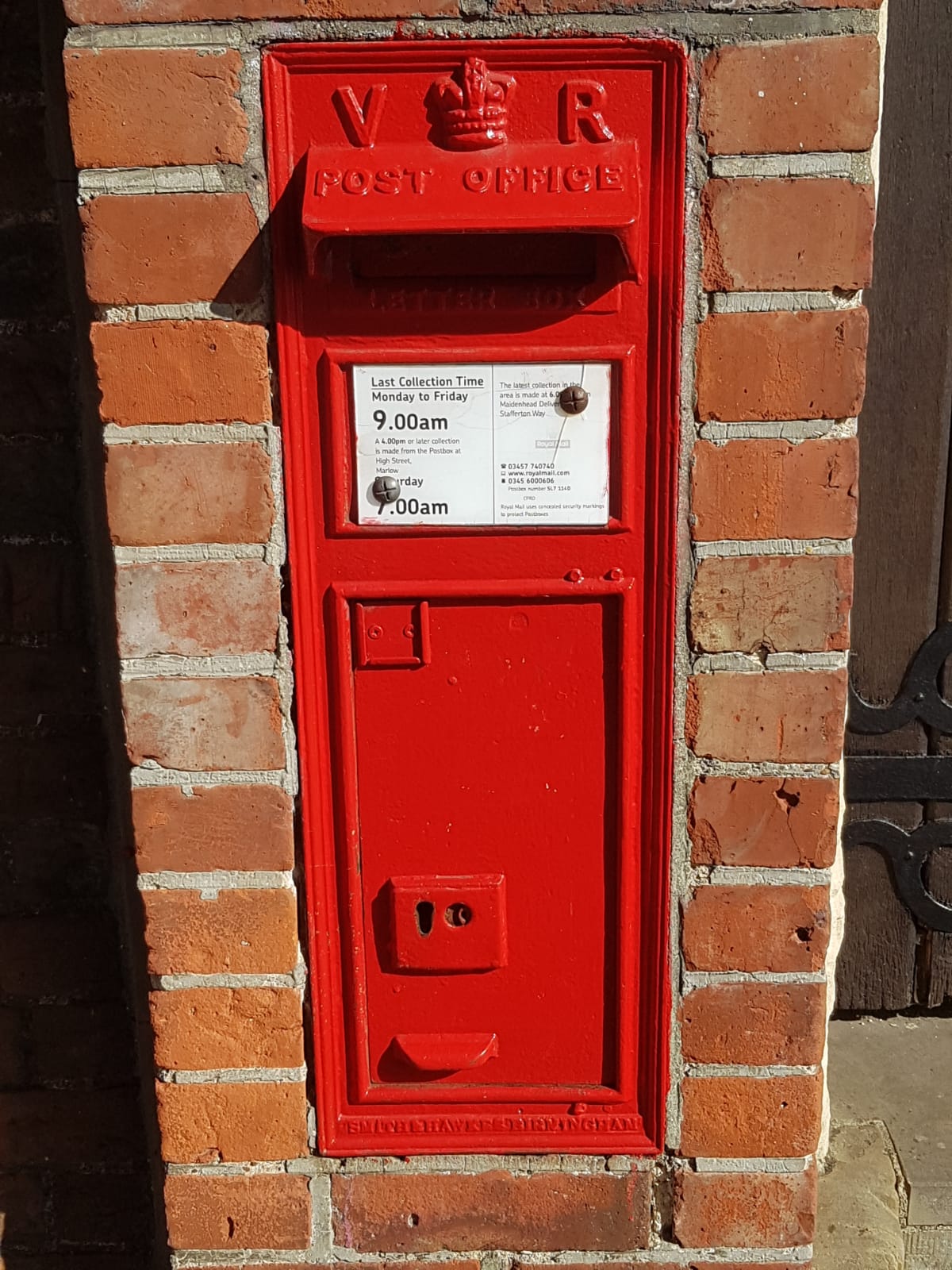
This post is a tribute to the lost and ancient little chapel at Ackhampstead near Moor Common / Finnemore. (Otherwise known as the chapel of St. Mary de (or le) Moor/More.) Ackhampstead was latter part of Great Marlow parish for certain civil purposes so we sometimes get enquiries about it. No one was exactly sure when it was built but generally the tradition was that it was a chapel of ease for the wealthy Brinkhurst family of The Moore in the Tudor era. That seems very likely. They were later Catholic recusants who lost a lot for sticking by their faith. Some of the Victorian villagers believed it was specifically a female Brinkhurst that had established the chapel and who knows they may have been right. More on them in another post. Either way it was old, and apparently beautiful.
The Moore(s) would later be known as Moor farm.
The chapel had continued in use for centuries. There wasn't ever many houses immediately about it - Ackhampstead was a tiny hamlet. People who recorded they lived there may also otherwise describe themselves as resident at The Moor, Finnemore/Finnemoor or "Fennymore" but usually it was accepted there were about 12 cottages in the Regency and early Victorian Ackhampstead. This meant a population of about 75 people in 1849. Although the parish authorities had an exact idea of where the boundaries of the district of Ackhampstead were, in every day life the farm labourers residents were much less precise in how they defined their home. The Black Boy beerhouse at Moor Common is occasionally referred to as part of Ackhampstead. The residents of the handful of cottages at Chisbridge Cross ("Chusbeech" , "Christbridge" and a hundred other variations) were considered part of Ackhampstead chapel district too.
The problem for the locals was that Ackhampstead might have been surrounded by Buckinghamshire, but technically it was an outlying part of the parish of Lewknor Uphill in the Diocese of Oxford. This was not very practically or financially convenient for the vicar of Lewknor 8 miles away. He appointed a curate for Ackhampstead but the wages came out of his own living which was the gift of All Souls college, Oxford. In 1842 the new vicar was Rev Edward B Dean. A few years later he was accused of trying to shed Ackhampstead from his parish by any means necessary so he'd no longer need to provide for a curate. He was very determined to be rid of it for sure but we can't see into his heart and truly know what his motivations were.
"In good sound and durable repair"
In August 1848 Benjamin Disraeli presented a petition from the parishioners in Finnemore who claimed the Bishop of Oxford was suppressing them. They were asking for the governments protection against the injury they said the Bishop was planning to subject them to - specifically pulling down their ancient chapel. It was signed by all the landowners, farmers and cottagers there, bar one lady who said that she didn't want the chapel to go but didn't want to upset the rector and curate of nearby Hambledon who were criticised in the petition. They attempted to address the question of whether Ackhampstead was a drain on parish resources. They pointed out that the vicar of Lewknor had the benefit of just over 9 acres of glebe land around Ackhampstead chapel plus he received a portion of the rent from Moor and Finnemoor farms, and the great tithes from all the land in Moor and Finnemoor which was then commuted to a rent charge. (Ready cash more desirable than a portion of crops etc by now.) Plus the small tithes of Cadmore End. The residents said that to the best of their knowledge the chapel was established for the benefit of the residents of Moor and Finnemore (Ackhampstead). It was well attended by worshippers from both of those places and from further afield and the building was in "good sound and durable repair" as they put it. This last point is important because it doesn't seem it was disputed at that time and it makes what happens later especially sad.
Those signing the above petition believed that the Vicar of Lewknor was going to give up a portion of his living to sort of persuade Hambledon to adopt Ackhampstead as part of their parish. The point of doing so would be to close Ackhampstead in favour of a new church at Frieth they were then building and it would also increase the living at Hambledon. The farms and cottages at The Moor in particular were "remote and distant" from Frieth they said but a "remarkably short" distance from Ackhampstead. The Bishop of Oxford had sanctioned the demolition of their chapel without consulting them and now their only option was the "great expense and trouble" of challenging that decision in the ecclesiastical court of the same bishop who wanted the chapel closed. The petition didn't do any good but it bought a lot of press attention to what was happening at Ackhampstead. The Bishop said the court was not presided over by him and was subject to regular law processes. What's more the demolition wasn't his idea, but the Vicar of Lewknors (although he supported it). However Ackhampstead landowner Joseph Townsend had previously received a letter from the provost stating that the judge might in fact be the bishop or his commissary.
Wanton and disorderly conduct
I mentioned above that the rector and curate of Hambledon were criticised in the petition. It was a slur on their honour to suggest they were motivated by financial rather than spiritual gain. The curate of Hambledon had been conducting the services at the chapel. (Prior to that the chaplain of the Royal Military College junior branch in Marlow had done the honours.) The Ackhampstead residents said the services had been held at the "improper, inconvenient and uncanonical hour" of 6pm. They seem suspicious that the clerics were making the services as difficult as possible to attend in order they could say they were unpopular and would scarcely be missed. Six pm doesn't sound too bad an hour to us but it was a different thing in the winter when travel was down unlit and notoriously muddy and difficult to traverse dark lanes. Curiously it was claimed that the late hour of service was encouraging "wanton and disorderly conduct" among the "rustic" population gathered about the chapel after dark! A constable had been called more than once to keep order while the worshippers were inside. Who were these troublemakers? Perhaps Cadmore Ender's - see below! In response to this complaint the Bishop of Oxford had ordered that services should be held at 10.30 am and 3pm. But the villagers said this order was ignored.
Another argument advanced was that Ackhampstead was just too far from the rest of the parish to be convenient for those living in those places who were also not very close to Lewknor. Well those at Ackhampstead had the answer to that. They would personally donate to the cost of building a church somewhere else that would suit these other hypothetical people, as long as their own chapel at Ackhampstead was allowed to stay open. They REALLY wanted to keep it.
Arguments for closure
Now for the other side of the argument. Phillip Wroughton of Ibstone House said there was no evidence the chapel was intended only for the benefit of those at Ackhampstead/Finnemoor rather than the parish as a whole. So the needs of everyone no matter how far they they lived from Ackhampstead should be considered. He said the chapels maintenance was provided for out of a general rate paid for by everyone and the principal residents of places such as Cadmore End and Studderidge (Stutridge) districts had always maintained pews there at times. So it was quite reasonable that the chapel should be effectively be moved somewhere more central in the parish in order to suit the most number of people.
50 people who said they lived outside of the Moor and Finnemoor district but whose family used Ackhampstead chapel anyway wrote to the Bishop to support his idea of closing Ackhampstead. This was because they said they were happy to go to the new church at Frieth as it was nearer to them. If these out of district worshippers stopped going to Ackhampstead, probably only 20 worshippers would be left they claimed. So it might as well be shut up. The Bishop published this favourable letter and his grateful reply. This was followed by a letter from 46 people in Cadmore End also supporting the decision.
The other main argument in favour of closing Ackhampstead chapel down was it was difficult to get to because of the state of the footways and lanes leading to it. The naysayers said those coming from the South or West had to cross Moor Common which "during the great part of the year, and always after wet, is a swamp" or otherwise cross some meadows ("swampy" ) or some fields ("virtually impassable" except in the summer.) There were no houses on the east. From the North it was accessed either through a "dirty field" or through a farmyard and along a lane that was considered difficult to traverse all year round after rain. The previous winter people had preferred walking through a ploughed field to passing up that lane. However this claim about the difficulty of travel was treated with some scorn in the press. It was only a matter of concern for those making the journey and those same people were overwhelmingly in favour of continuing to do so, mud or no. Joseph Townsend pointed to those from outside Ackhampstead who claimed to make up most of the regular worshippers there. If the journey was so difficult why did do so many of them make it and not travel to Hambledon for example instead? Joseph said those attending often came from Hambledon itself or Frieth. He added that he had made a path at his own expense and partially through his private land to allow pleasant access to Ackhampstead from the direction of those two places. He had allowed this to be appropriated for general use as a footpath, but those mentioning the marsh and miry fields had forgotten to mention it. And should anyone suggest that Joseph had no right as a resident of Wood End to interfere with Ackhampstead matters, he countered that no one seemed to mind it when he donated money to the Vicar of Lewknor to look after Ackhampstead. (Money that several years later had not been spent on the project it was collected for - the fencing in of the glebe land around the chapel.)
There was much debate about whether the various cottagers would be closer to Ackhampstead or the new Frieth church. One side said of 11 cottages they considered to be within Ackhampstead, only 6 were closest to the ancient chapel and for some of those the difference was only 40 yards. (The Lewknor/ Hambledon parish boundary line was partially made up of the outer wall of one of those cottages.) For those that would be left further to travel, the inconvenience would be made up as there was a good "hard road" to Frieth they said.
Be careful in Cadmore End
At this time it was suggested that a church might be built at Cadmore if Ackhampstead closed. It's funny to think of it now but Cadmore End or "Cadmoor" / "Cadmer End" as it was often known was considered a "wild place". Partly this was apparently because the residents lived so far from their mother church. The result? "A deplorable state of spiritual destitution". I don't know what the agricultural labourers of Cadmore were up to exactly to cause this spiritual panic but saving their souls was apparently the real motivation for providing a church closer to them. I'm not sure that really holds water as those advancing this argument admitted that Ackhampstead was only one and a half miles away from the riotous Cadmore Enders of which there would be about 150 in number. If they wouldn't make such a short journey to Ackhampstead would they bother to turn up at another chapel slightly nearer? And there was also the chapel at Lane End, also one and a half miles away. I don't think the suggestion by the Ackhampstead residents that they'd contribute to the cost of a chapel like Cadmore was taken seriously. This was despite the fact they claimed to have £600 of the projected £800 promised already. It was claimed that Lewknor wasn't a wealthy living and couldn't support two chapel of eases so if there was going to be one in the spiritual wasteland of Cadmore End, the other had to go. On the other hand, those at Ackhampstead said that if things were so bad at Cadmore, no doubt the church would be happy to pay to do something about it without interfering with Ackhampstead.
It was strongly denied that Hambledon parish was going to get any payment to take on Ackhampstead. In fact the curate of Hambledon would lose his stipend for preaching at Ackhampstead if it closed.
Your district or mine?
Part of the problem was the issue of whether Frieth would be a built as a chapel of ease for Hambledon or would be part of a proposed new church district. This doesn't seem much of an issue in our eyes but it mattered for the reasons Joseph Townsend stated in a letter to the local paper. Technically if those at Ackhampstead were to continue to live in a different church district from Hambledon and Frieth, they did not have the automatic right to attend services in those places. They could only attend "on sufferance" as the worshippers from Hambledon had been allowed to attend Ackhampstead in the past. But if Frieth was made a new district, with Ackhampstead made part of it, they would be able to attend Frieth in their own right. I don't think anyone was seriously going to enforce these residential requirements because it's obvious that no one had done so in the recent past here. But it was a matter of principle to Joseph that the Ackhampstead people should not be cast adrift without really belonging to the nearest place of worship. Of course if a church was built at Cadmore End it would be in the same existing Lewknor Uphill parish as Ackampstead, and they could form a new district together.
Decisions made
Back to the court case in 1849. The villagers and the two major landowners in the area (Sir William Robert Clayton of Harleyford with 300 acres and Joseph Townsend of Wood End with 134 acres) were in agreement they wanted and needed the chapel. Their plea via Disraeli included the desire that it should be possible to quickly and easily obtain justice if coming up against the ecclesiastical authorities. As things stood a "want of wealth " subjected citizens to injury in the face of the "uncontrollable power" of the ecclesiastical law. Well Clayton and Townsend did not suffer from a want of wealth and presumably it was they who paid for the appeal. But the point was understood in the national papers and the fight was partially presented as the poor against the wealthy. The Bucks Advertiser, on the side of the Ackhampstead people, said of the Bishop of Oxford "those that do not speak of him with contempt regard him with indifference".
The Consistory Court was presided over by Dr Phillimore (chancellor for the Diocese of Oxford) who said he thought it right to consider the Bishop of Oxfords views "with attention and respect" although the Bishop would have to abide by any decision he made. Not the most hopeful start perhaps. The court had been adjourned eleven times previously though, so I'm sure the petitioners against were more than ready to get things underway. (On 9 occasions it was because Dr Phillimore wasn't in attendance. This treatment did not go unnoticed in the national press). It was determined that those opposed to the chapels removal would not be allowed to be heard directly as they had expected but only through a legal representative, which increased their costs.
Dr Phillimore considered the information from the endowment of Lewknor vicarage in 1412. This stated that it was entitled to all tithes from Ackhampstead and Fennymoor and that divine service should be held at Ackhampstead every Sunday by either the vicar or a chaplain appointed by him. In 1685 the tithes of Ackhampstead were to go to Ackhampstead chapel along with the small tithes of Cadmore End. The first decision was did he have the power to grant a faculty (permission) for the removal of Ackhampstead chapel anyway? The answer he decided was yes and it was now time to consider whether he should.
Ackhampstead's residents had strongly objected to the idea you could legally move a church. They thought the only precedent was in a case of a dilapidated one in which case a vestry (parish meeting) could be called and a rate (tax) could be decided upon to pay for the demolition of the old and rebuilding the new, in the SAME spot. Ackhampstead was in a fine condition. A vestry had been called, and in this all of the residents of Ackhampstead had voted against the move. But they weren't the only ones invited - all parishioners in Lewknor could attend and the majority of those had voted for closure. Ackhampstead said the opinion of people who actually used the chapel should be the ones listened to.
In the end, the decision was made the chapel should go. No appeal options were left. The villagers would be given the benefit of attending Frieth but those with seats (eg family pew) in Ackhampstead would not be given them at Frieth automatically. There were however some conditions to Dr Phillimore's permission. The faculty would be granted subject to an £800 bond payable by those applying for it (Rev Dean of Lewknor) as a reassurance that the chapel should be rebuilt (or rather replaced, at Cadmore End) and that they would meet the costs of the building. (Actually they planned to raise a subscription fund to pay for the construction.) He suggested that two specific clauses should be inserted in to the faculty - one to prevent a local rate (tax) being levied to pay for the church in the end, and secondly one to protect the old chapel from "desecration". I'm not sure if the second was included in the final version but if so, it was not abided by.
Final service
The last service was held on 3rd June 1849 "to the deep regret if the poor who had so long worshipped within its sacred walls". Even this wasn't managed sensitively. The villagers attending did not know in advance that the doors would be shut to them afterwards and that they'd never be allowed one last look inside. (Although see below) It was presumed that as a decision had been made to proceed with a church at Cadmore End, Ackhampstead would be allowed to stay open until it was finished and ready for services. But this didn't happen. The vicar of Lewknor announced after the service "without a word of comment or explanation" that the chapel was now closed.
Frieth church of St John the Evangelist was consecrated by the Bishop of Oxford in June 1849. It was indeed paid for by voluntary subscription. Questions were raised as to whether it would be big enough at 150 sittings to meet the needs of all those from the Hambledon area who said they'd prefer to attend there, as well as those from Ackhampstead. An extension was made to the building in 1872 it "not being sufficiently large for the congregation attending it" so these concerns were probably justified. The new south aisle was constructed by Marlow builder Mr Corby.*
Demolition job?
You probably noticed the Ackhampstead residents accused the Church of not only wanting to shut their chapel but actually pull it down. Was this actually realistic? Although it's easy to find example of long abandoned chapels that had been converted into other usage, it doesn't seem to have been considered dignified or proper for Ackhampstead to be used for something else. The idea of pulling down an ancient structure horrified some. But those who thought it would otherwise fall into ruins said such an obvious sign of neglect would be "distasteful". I think the real problem was if the chapel was left standing, the Lewknor parish wouldn't have wanted to pay for its maintenance just for appearances sake, and possibly couldn't afford to. It's a pity no record of any bequests relating to its upkeep were still to be found.
What was lost.
When Frieth Church was built it was said to be about 7ft longer and 2 ft broader than the existing Ackhampstead chapel.
The best descriptions of Ackhampstead come from the first few years after its closure. I'm especially grateful to the reporter of the Bucks Herald who described it in 1850. He thought it was beautiful and probably one of the oldest chapel of ease in existence. The bell had bore the date of 1665 he said.
The main gist of the Bucks Herald article was to record his astonishment at how a chapel which had been complete and in good repair just a year before had degenerated into such a state. It was "bare ruins". The lead had been stripped from the font first. Then the hangings had vanished from the pulpit and reading desk. This was followed by the loss of the glass and lead from the windows, the inscribed bell, many of the pews and the reading desk. Worse still an old bricked up door had been broken through and the stone and brickwork had been partially destroyed. The writer firmly blamed the church authorities for failing to properly secure the building after the final service. He said for 5 months it had stood unprotected, and even after that someone had got in and took up the floor, roof, remaining pews and seating. The building deserved better he said, and we can only agree. He thought if it was thought better to let it disappear it should have been razed with "reverence and dignity".
A guide to ecclesiastical topography published in 1850 says that Ackhampstead chapel was a small, poor affair (in terms of decoration or monuments probably) with no particular features of interest although they do not mention it being in a ruinous state so it's not clear when they visited. These guides obviously take time to compile. It's also worth noting that this book covered the diocese of Oxford and the material was submitted for "correction" as necessary to the Archdeacon. He probably would not have wanted to dwell on the charms if any of such a bone of contention!
An especial concern at the time of the newspaper writers visit, was that no work had begun on Cadmore End church although it soon would be. By 1912 only a fragment of the flint walls of Ackhampstead remained. The visitor describing it then could only guess that it seemed to have been rectangular with lancet windows. Trees and shrubs were growing within the ruins.
We will never know who was responsible for this destruction. It was traditional to strip buildings and recycle materials, and if the Church authority did not seem to care what happened to it, why should the locals who could give the materials new life? It would be nice to think some of the contents such the hangings might have survived in the hands of one of those who fought so hard to keep the chapel open. The new Cadmore End church would bear the name of its destroyed namesake, St Mary Le Moor, and became an independent ecclesiastical parish.
NB:
Ackhampstead was later attached to Marlow for poor law, licencing and school purposes and became part of the ecclesiastical parish of Hambledon.
Written and researched by Kathryn Day.
Related Posts:
This blog deals with Great Marlow itself mainly but an index of posts about nearby places is available here
*For other construction projects of Thomas Corby see here
Index of church related posts here
To find every mention of a family or individual here use the A-Z person index in the top drop down menu.
If you are looking for an ancestor that lived at Ackhampstead and you are wondering where they might be buried (or married) try Lewknor, the mother church.
Sources include:
Kelly's Directory of Buckinghamshire/Oxfordshire 1899
The Ecclesiastical and Architectural Topography of England: Oxford Diocese - Royal Archaeological Institute of Great Britain (John Henry Parker, 1850)
An inventory of the historical monuments of Buckinghamshire - Commission on the historical monuments and constructions of England (HMSO 1912)
Wiebe, M G (Ed.) - Benjamin Disraeli Letters Volume 5, (Toronto University Press Inc, 1993)
Bucks Advertiser and Aylesbury News 9th June (which also quotes the Daily News of that month) & 27th October 1849;Bucks Herald 26 March & 4th November 1842, 21st & 28th October & 4th November 1848, 10th & 17th Feb, 7th April, 12 & 19th May, 9th & 23rd June 1849, 16th Feb 1850; Oxford Journal 20th October 1849; Reading Mercury 16th September & 28th October 1848. All these via the BNA.
The Times 21st August 1848.
The Victoria County History of Buckinghamshire 1925.
© MarlowAncestors