Search This Blog

Showing posts with label Clarke. Show all posts

Sunday, September 25, 2022

Handy Cross Farm History And Occupiers

Handy Cross Farm. Historically a mixed farm.

Existed 1741.

1781= for sale freehold (except a few copyhold acres). 366 acres, all but 11 acres within a ring fence. Meadow and arable land (Oxford Journal 03 February 1781).  Includes dwelling house, two tenements (cottages for farm workers etc)  and outbuildings. Let to Thomas Allen for £150 per annum. Also 67 acres woodland available with it. "Handicross". May be the same Thomas Allen at Pigeon House Farm 1784. 

1817= Bought by William James Atkinson (of whom lots more here).  Later owned by Lord Carrington.

1818 - tenant Richard Badcock is leaving the farm so there is a livestock etc sale on the premises. It includes 24 cows and heifers, 6 cart horses, 8 sheep and 20 pigs plus the usual selection of ploughs, dung carts etc. 

1843?= outgoing tenant Mr Stacey Rayment. 

1843-50= Daniel Carr. Had chickens and geese stolen from him in 1843. Subject to a serious rick fire one afternoon in 1844. Believed to be arson. (The Sun, 22 Jan 1844). Thankfully Lord Carrington the landowner had his own fire engine to help put it out. The wheat rick in which it started, containing 10 loads, could not be saved, but several standing nearby were undamaged. 

1851= 20 year old Ambrose Reddall Turney living with his sister Sarah and others in High Wycombe, then called Chepping Wycombe, described himself as a farmer of 320 acres employing 8 workers. There is a good chance that he, probably with his brothers, was working Handy Cross farm. See below.

1864= Mr Turney. Had no buildings on it then but by 1870 did at least have a barn and apparently also had a worker's cottage by 1875.

1866 - the Messrs Turney. 

1868= Ambrose Reddall Turney, John Turney and George Turney in partnership which was dissolved that year. These were brothers, the sons of John Turney. Ambrose was properly Alexander Ambrose Reddall Turney and also operated as the Parish Surveyor and Rate Collector for High Wycombe. He emigrated to the USA the next year. He and his brothers were mentioned in the will of their step grandmother Elizabeth Turney of Winslow which is transcribed on the Winslow history website. This also gives more background to the family. Link to this website here. The will of her husband can be downloaded from the National Archives.

1870= John Turney. Prosecuted his shepherd Mathew Clarke for refusing to work for him while injured. Mathew had hurt his arm trying to catch a sheep. John argued that the injury did not mean that Mathew was incapable of all work and that there were light duties he could perform on the farm. The court allowed Mathew to be released from his contract with John and ordered his employer to pay him £1 owed Michaelmas money out of which the court costs would be deducted.

1869= J and G Turney, presumably brothers John and George.

1871= John Turney. Poachers set traps for rabbits in his field that year.

1873= J Turney.

1877= J Turney. Seven of his heifers died in agony after workers from landlord Lord Carrington left open cans of lead paint where the animals could get at them and lick the poisonous paint. 

1878= J Turney sold off his stock of clover and hay etc as he was leaving the farm.

1881= whoever was at the farm sold off all stock and left.

1887-1894= William Morris, who also occupied nearby Hill Farm as well as farms in West Wycombe. The farmhouse was in 1894 put up to let and was then a 5 bedroom house with 2 sitting rooms and 2 kitchens (South Bucks Standard 22nd June 1894). It seems Edward Nuttall also occupied some of the land 1894-96 but the Morris family continued to farm most of the land even if they did not live in the farm house for a while.

1895= rooms and apartments in the farm house up to let. Bracing air is promised. By which was meant biting winds presumably as Handy Cross was renowned for suffering heavy snow, deep frosts, and harsh winds being in a slightly elevated position.

1901= W and T Morris.

1913= Morris family still farming there.

1920 - George Parker.

Ongoing research. This post will always be updated if new information arises. Gaps in the dates above represent gaps in my knowledge.

Related Content:

History and landlords of the Blue Flag pub Handy Cross here

And of the Blacksmith's Arms there in this post

More Handy Cross content indexed here

Other sources:

1833 parochial assessment Great Marlow, working notebooks of the assessors in my possession and transcribed by me.

"England and Wales Census, 1851," database with images, FamilySearch (https://familysearch.org/ark:/61903/1:1:SGBT-VMM : 11 September 2019), Ambrose Turney in household of Hannah Howlett, High Wycombe, Buckinghamshire, England; citing High Wycombe, Buckinghamshire, England, p. 1, from "1851 England, Scotland and Wales census," database and images, findmypast (http://www.findmypast.com : n.d.); citing PRO HO 107, The National Archives of the UK, Kew, Surrey.

1871 census, my transcription. Crown Copyright.

Researched and written by Charlotte Day.

©Marlow Ancestors


Monday, September 5, 2022

Blue Flag / Old Blue Flag Handy Cross

Today we would probably call this near High Wycombe but Handy Cross was historically in Great Marlow parish.

Property owned by the Clayton family and leased by Wethered's Brewery of Marlow. Sometimes referred to as The Blue Standard. 

 Landlords listing and history timeline:

1833 - William Earis. Premises consisted of a house, adjoining cottage and shoeing forge for a blacksmith. The surname Earis is a very Handy Cross one. It also occurs as Earys, Ayres, Eyres, Ayris, Airis, Aris etc.

1840-Mrs Earis keeps a shop at Handy cross (beer shop?)

1841 - The scene of a meeting of Liberal supporters (known as the Blues) after the election at Great Marlow. Clayton who owned the property was the successful Liberal candidate. The name of the beer house is definitely not a coincidence! The celebration was however premature as Clayton had a majority of just 1 and the  election result was over turned when some of the votes were considered invalid. A Tory candidate then overtook him in the polls and he lost the seat. 

1842 Susanna Earis widow of William of the Blue Flag died age 64. She may be the Mrs Earis who was a shop keeper at Handy Cross in 1840. In this instance "shop" may mean beer shop. Though in 1844 a Joseph Earis, (her son?) was running a grocers shop at Handy Cross and getting in trouble for selling alcohol in it without a licence.

1845 "Old Blue Flag"  - Joseph Earis. Wife Mary Ann nee Beesley. Joseph wants to press charges against three men who he says assaults his wife, her brother and her father at the beer shop. However the case is dismissed as it's considered all were as much to blame as each other. The Bucks Advertiser and Aylesbury News adds they considered that this was a "beer shop quarrel" caused by the "bad temper" of the landlord and wife. [October 25th 1845]

1863-64 = James Clarke / Clark.  James was an inveterate poacher! In 1863 for example he was fined for being in possession of a pheasant which he said he'd come across on the side of the road. Such things were happening to James a little too often go convince the authorities! In a previous case the same year he was accused by the magistrates of keeping his house open "for the purpose of concocting robberies".   They lamented they did not have the power to take away his licence. On the 1861 census he was a shepherd at Handy Cross with his wife Elizabeth who was a dressmaker.

1868 - William Harper

1869- Brewery were struggling to find a licensee sufficiently respectable for the magistrates to approve of. Sam Beasley has to try three times for the transfer before it's accepted. 

1869-72 Samuel Beasley / Beesley. Wife Mary. In 1870 Samuel's gun, knife and handkerchief were amongst other articles stolen from his premises (Bucks Advertiser and Aylesbury News 23rd October 1870). The thief was caught and earned 18 months in prison.  Samuel may have sold groceries on the premises too. The Beasleys took over the Royal Oak High Wycombe in 1874 and remained there until 1877.

1873- the police try to get the premises closed, saying it did not meet the minimum size requirements for an alcohol licence. Two adjoining cottages were being used for the business but their combined size couldn't be allowed to count, the police argued, as there was no door or other communication between the two cottages. The magistrate at the licensing hearing offered the brewery (Wethereds of Marlow) a chance to have the property surveyed and revalued but they said they were not bothered about keeping it open as they had the bigger Blacksmith's Arms also at Handy Cross. Yet the Blue Flag at Handy Cross is still mentioned as late as 1902. It is possible it continued as a lodging house only. Many of these had pub-like names and signs. 

1875- premises used for an agricultural auction.

1902- Last known mention of the Blue Flag, Handy Cross as existing (South Bucks Standard 4th July 1902).

Landlords and history of the nearby Blacksmith's Arms, Handy Cross here

Index of pub related posts on this blog here. Contains pubs Great Marlow, Little Marlow, Lane End, Medmenham, Well End.

Written and researched by Charlotte Day.

©Marlow Ancestors. You are welcome to use this research for family or local history purposes with credit to this blog.


Wednesday, April 27, 2022

The Fountains of Dukes Place / Burroughs Grove

 The Fountain family lived in Dukes Place Great Marlow from (at least) 1908 to (at least) 1913. Peter Fountain was born 1868 in Wendover Bucks to Emmanuel, a gamekeeper for Alfred De Rothschild Esq, and Charlotte. Mary Ann his wife was née Clarke and married him in 1895. 

Peter appears on the 1881 census as a 12 year old plough boy. The following year his family suffered the loss of his baby brother Henry. The 16 month old died from convulsions brought on by severe whooping cough.

By 1891 Peter lived at "Dirty Bottom" Marlow Bottom and was an agricultural labourer lodging with a 62 year old widower James Clarke who was presumably a relative of his future wife. In the years prior to his marriage however he was working as a gamekeeper for Lord Carrington. As such he appeared in several court cases as a witness for the prosecution when poachers were bought to justice. That didn't seem to stop Peter taking an interest in poaching himself - he was fined in 1901 for stealing a nest of pheasant eggs from another man's land. At the time this was classed as poaching because pheasants were game birds. This didn't seem to stop Peter being employed in later years as a gamekeeper.

Mary Ann was born around 1869 just outside Marlow at Burroughs Grove. I saw an online tree that gave her parents as William and Mary however on the 1881 and 1891 censuses she was living at Burroughs Grove as the daughter of David and Mary Clarke. David was a farm labourer. 

In 1908 Peter was fined for being drunk in Little Marlow. This was (at least) his second conviction for public drunkenness. (Fine 10s including costs.) By then the family had moved from Burroughs Grove to Dukes Place. Greater trouble came to the family through Mary Ann a few years later. In July 1912 she was fined £1 for stealing a pair of scissors and a hairbrush from Mrs Debbin at Prospect House. Mary Ann was not a very careful thief as after the act she went for a drink at the Horns public house just down the street from Prospect House. Multiple people in the tap room saw the stolen scissors on the floor at Mary Ann's feet and the hairbrush sticking out of her pocket. In December that year she and James Clarke (perhaps her brother) were found guilty of stealing a ferret from the garden of her Dukes Place neighbour Archibald Grainger. Again careful planning was not foremost in Mary Ann's mind. The theft occurred while another neighbour Mrs Ann Tilbury from no 2* Dukes Place was visiting Mary Ann and was thus a witness to her and James disappearing into the garden and coming back with the ferret. When suspicion began to be thrown at Mary Ann and James, Mary Ann told Mrs Tilbury not to admit to having seen them with the ferret, while James tried to get rid of the incriminating animal by offering it for free to a fellow drinker in the bar of the Railway Hotel. The original intent was to sell it. James tried to say he had found the ferret in the garden of the Carpenter's Arms around the corner from Dukes Place but the court dismissed this explanation.

In May 1913 Mary Ann was jailed for two months hard labour for stealing the hand bag of another woman on the train between Cookham and Maidenhead. Her accomplice was another Marlow woman Gladys Edwards. Inside the bag was 2 sovereigns which the women split between themselves and a gold watch and chain. Gladys kept the gold items. She sold the chain to High Street jeweller Frederick Rowe. The bag was thrown down a drain to hide the evidence. When arrested Mary Ann claimed that the bag was found by Gladys on the Maidenhead platform and having asked anyone around if it was their bag, decided to keep it when it was otherwise unclaimed.

Context for this is provided by a newspaper report that later the same year Peter was brought to court for abandoning his wife and family and thus rendering them as paupers dependent on the Parish. Poor Mary Ann may have been desperate when she stole the ferret. Her youngest child Annie was then only two years old. How much of her previous stealing had been acts of desperation caused by an uncommitted breadwinner? Peter said he left his home because it was used for "improper purposes". The Bench said there was no doubt his house was "badly conducted" but that was no excuse to leave. He was sent to prison for a month. 

Four years later Peter, during WW1, was arrested in Marlow as a deserter from the army. More humiliation for Mary Ann. 

Mary Ann knew what it was like to be on the receiving end of theft. When she was six her sixteen year old neighbour Sarah Green and Green's father John were jailed for breaking into the Clarke's home via a window and stealing from a box some shoes, 2 pairs stockings, a bonnet and 2 petticoats. The loot was discovered by a constable under the Green family's kitchen floorboards. Mary Ann was out with her mother at the time. Her brother William discovered the theft.


Above, Dukes Place in 2022 including the row known as Sunlight Villas/Cottages. 

*numbering in Duke's Place seems to have altered since.


Related Posts:

All mentions of a person on this blog can be found on the A-Z person index in the top drop down menu - 4,000 plus individuals are mentioned here. 

A short biography of another, earlier Dukes Place resident Elizabeth Keen is here.

Everyday life in old Marlow post index here

Index of posts relating to specific streets, properties etc here 

Other Borroughs Grove related posts here


©Marlow Ancestors. You are very welcome to use this material for family or local history purposes with credit to this blog.

Sourced included:

Census transcriptions from microfilm. my own.

South Bucks Standard editions 18th July 1912, 11th December 1913. British Library Archives.

Bucks Herald 16th October 1875. As above.


Tuesday, March 22, 2022

The Winfords of Thames Bank

Sarah and Harriet Winford are the subjects of today's post. Sarah was born into a comfortable position in life and died leaving an estate worth a fortune. She lived in one of the biggest houses in 18th century Marlow with an extensive number of servants at her command. But her life in Marlow was not free of its struggles as you will see.


 Sarah was already widowed when she arrived in Marlow, some time before 1769. Her husband was Hereford MP Thomas Geers Winford, who had changed his name from Thomas Geers on inheriting from his wife's childless uncle in 1744. The house Sarah moved to was known then as Goodyers, as Sarah herself clarifies in her will. She is likely the person responsible for re naming it Thames Bank House. (Later names include Lymbrook and Thames Lawn although Lymbrook/Limebroke was also used earlier to refer to the area around here and the Waterman's Arms). Situated on the banks of the River Thames, with then extensive views of the Quarry Woods, its location must have seemed idyllic - until Sarah began her tussles with the barge-men working on the river at least. More of that below. 


Thomas and Sarah had two daughters, Sarah junior and Harriet. Sarah married Sambrooke Freeman of Fawley Court in 1757. She was a regular at court and acted as a host to the likes of King George III on a number of occasions. The younger girl, Harriet lived a much quieter life. It seems she suffered from ill health over a considerable period and she never married, but remained with her devoted mother at Thames Bank. Harriet was fond of Quarry Woods and a particular bluff was adopted by her as a favourite seat and viewpoint. In fact it became known as "Miss Winfords seat". Sarah owned a boat and the family often took friends on river trips, attending for example a "waterparty" near Harleyford. They also took a trip to see Owen Williams newly constructed Temple House. A friend of the family accompanying them on this expedition thought Temple was grand enough on the outside but it was let down by the interior design!  This same friend also mentions a "temple" belonging to the Winfords, which was used for picnics. I have not seen this temple, a fashionable upper class accessory, represented in any illustrations of the house and it is not listed as a garden feature when the house is up for sale later. It may have been of a more temporary rustic design, or possibly was not located within the grounds of Thames Bank itself. (Having one on a eyot was also fashionable.)


A less desirable part of riverside living for Sarah was the fact the Thames was very much a working river and her home was located between Marlow Bridge and various wharves and the Lock. After Marlow received a new pound lock, she complained that the barges were now navigating the river closer to her home and worse still, they were spending longer tied up outside her garden wall.  This was a problem because the bargeman were apparently committing indecent actions outside the elderly ladies windows, causing her to keep her shutters facing the river firmly closed. You can read the full story of the bargeman and Sarah here. The other annoyances faced by Mrs Winford during her last years at the house were an attempted break in and a successfully managed theft of 15 bantams in 1789. 


Sarah seems to have been a keen reader, as she is listed as a subscriber to a number of volumes. In the past many books were only produced if enough people subscribed to cover the upfront production and printing costs. Donate enough and your name would be added in dedication within the first editions at least. Among Sarah's choices were a book of sermons from a Worcestershire vicar Charles Butt, while Harriet supported local author Thomas Langley's History of the Hundred of Desborough which included Marlow. 


Sarah died in early September 1793 aged 83. She had a considerable estate to leave, apart from the lease of Thames Bank. Shortly before her death she had inherited money along with her two sisters, from her brother Charles who died childless. Charles himself had been the beneficiary of another brothers will, William, who also left no issue. Three years later, both of these sisters died within a month of each other, one unmarried, the other a widow. So Sarah had to some degree benefitted from outliving most of her near relatives. She had over £9000 invested to leave to her two daughters. Harriet would receive the lease of Thames Bank, with Sarah receiving an additional £300 as well as her share of the investments. 


Sarah left a number of gifts to her servants. This was not altogether uncommon in itself, but she seems to have been a pleasant person to work for. Many of her staff members remained with the family for decades and what's more she paid for the gravestones of several of them - 3 of which can be seen in the churchyard of All Saints to this day. The churchyard is just along the river bank from Thames Bank.

 The will legacies were:

 To housekeeper Elizabeth Swan 10 guineas. 

To gardener Robert Stockbridge, 3 guineas. 

William Powell, coachman, 3 guineas if he was still in her service at her death. 

Former butler Robert Floyd £20. 


Above, grave of Robert Floyd. 

- D. January 26th 1801 age 74. "Useful servant and honest man" Erected at Harriet's expense. Read his will here


Cook Sarah Clarke 5 guineas. 

Housemaid Mary Whitty £15. [Harriet will pay for Mary's gravestone. On her death she had given the family 63 years service! See it  here]

 Other maids  Ann ?Tolner £4, Rose Bartholomew £4, Mary Walker £2.

Servants of Harriet if living with Harriet when Sarah dies: Ann James 5 Guineas. Harriet's groom (not named) 2 Guineas. Samuel Charles 5 Guineas. Samuel's children George and Sarah got £20 each. This was increased in a codicil to the will and Harriet was asked to act as the children's guardian.

All other servants in the house when Sarah dies: for "at least two years to receive half a year's wages" each.

Mr Harris, her steward in Worcestershire 10 Guineas for mourning. At Harriet's discretion 6 maidservants and and 4 male servants to get money for mourning too.

Poor of Astley, Worcestershire £20. (where Sarah had family connections)

Rev. Stephen Chase rector of Bisham 10 Guineas.


All the household goods, furniture and linen as well as Sarah's jewels and "trinkets" were left for Harriet's use, bar a purse of gold coins and some silver spoons for Sarah junior. 


Harriet died of a long and painful final illness in 1801. She was just 58 years old. She was buried, like her mother, at the Winford family vault at St Peters Church, Astley, Worcestershire. The following year the household contents of Thames bank was offered for sale, with "elegant household furniture" including a prized matching drawing room suite of chairs, sofa and curtains. 


Notes: Sarah was nee Lutwyche, of Lutwyche Hall, Salop. 


Written by Kathryn Day. 

© Marlow Ancestors.

Related posts:

Grave of Winford servant Samuel Clarke here

More Biographies of Marlow Families on this index

More posts about the people of specific Marlow houses (big and small) listed here


Sources include:

Will of Sarah Winford, transcribed by Charlotte from a copy held at National Archives, Kew. 

Reading Mercury 39 March 1789

Oxford Journal 1 June 1802

Sermons, George Butt 1791. 

Brown, William. Reports of Cases argued and determined in the High Court of Chancery, 1786. 

Climenson, Emily J (ed) Passages from the diaries of Mrs Phillip Lybbe Powys of Hardwick House, Oxon. 1899

Munby, Arthur Joseph. Faithful Servants,1891. Digitised by Google.  

Willis, Browne. History and  Antiquities, of the town, hundred and deanery of Buckingham 1755 

Century Magazine Vol 90 1801, digitised by Google. 

Monthly Magazine Volume 12, 1801. 


.


Saturday, December 18, 2021

Bank Of England, Dean Street History and Landlord Listing *Updated*

 THE BANK OF ENGLAND /THE BANK/ YE OLDE BANK

1833- building of the pub built but it not yet a pub.

1840 - Described as "recently built" (of brick with slate roof) and "now licenced for the sale of beer"  It is let to a "most respectable tenant". Leasehold with 3 years left on it is offered for sale. "Near the turnpike on the Oxford Road". Has bowling alley, coach house, 2 stables, detached wash house, and other outbuildings plus the large yard. Inside there is 4 bedrooms, a cellar, parlour, tap room and pantry. 

1841 - George Clarke, son of Richard Clark(e) who had had the Jolly Maltsters Dean Street. See here for more. That post contains details of some trouble George got into as a young man. George's sister Emma was in turn landlady of the Jolly Maltsters, Mint and Cherry Tree all in Dean Street.

1844 - George Clark

1853 - George Clark

1861 - George Clark ("Ye Old Bank"), also carpenter. Twice fined in the 1860s for opening his beerhouse at illegal hours. In 1867 a suspicious constable secretes himself into a pile of faggots opposite in order to watch the comings and goings, and sees several men enter. These thirsty souls flee on the constable revealing his presence. Pots of beer with some taken out can be seen around  the tap room and parlour.  Fine that time? £5. 

1865 - George Clark. Also sells asses' milk (!) This was considered good for delicate youngsters you could not tolerate cows milk, among other things. 

1871 - George Clark - also carpenter, and has lodgers

1873 - George Clarke "The Bank Beerhouse". Transfer to John Finch who came from The Alma. Wellers brewery only got the licence for the premises renewed on the condition a new tenant was found, as they believed George harboured the criminally inclined. Wellers say that George had already been given notice to quit but he proved difficult to dislodged. Some of the Hussars recently billeted in Marlow when they spent a few days here in 1873 had stayed at the Bank..in the stable with their horses!

1875 - John Finch 

1881 - John Finch (b.1843) "The Bank" Wife Sophia. (Also lodging house) 

1882- John Finch summoned for refusing to let a Constable see inside his premises. Something to hide did you John!? The next year John received a heavy fine and an endorsement on his licence for opening his beerhouse before the legally permitted time on a Sunday. In the space of 15 minutes 10 people were observed going through the open gates into the yard, and through the back door, emerging shortly afterwards with a suspicious looking jug. The constables followed a trail of beer spillages down the passage that lead to the cellar steps, down which they found John with a selection of beer containers with the dregs still in them. John claimed the wet spots in the yard were where he'd urinated! He also said no one had visited him there, and in the cellar he was merely changing the taps on a barrel. The police must have seen people passing up a public footpath nearby he thought. Unfortunately for John, a policeman Constable Birch lived only 500 yards away and had an uninterrupted view of the Bank Of England. The excuses offered by the drinkers are amusing to read. They happened to call on John (at 6.30am in the morning) for all kinds of reason other than buying alcohol apparently. Dropping off some potatoes, showing him a piece of flannel, and talking to him about a pig were amongst the reasons to drop by. One man was not so good at thinking on his feet and said he only stepped into the yard, but couldn't quite remember why. (Four of the drinkers were summoned and fined.)

1883 - H Finch. 2. Charles Grace

1886 - Charles Grace. Wife Mahala leaves Charles this year taking some money and belongings which Charles says belonged to him. So he has her summoned for theft but subsequently asks for the charge to be dropped. He says Mahala had returned the items and had apologised for removing them. It does not seem she had returned to live with her husband though. 

1886 - William Cox? 2. Frederick Cox. 

1889 - Frederick Cox 

1891  - George E Lyons (from London)

1896 - George E Lyons transfers the  premises to William Howard.

1899 - James or William Cottrell /Cotterill. 2.  William Chaplin or Chapman 

1903 - W Dawes

1908 - William Dawes. 2. Edwin Dewey 

1911 - Edward (qv) J Dewey

1915-20 - James Turney and his wife. Their son Private A E Turney was badly gassed in France in 1917.

1926 - Harry Perry. Changes his name by deed poll to Harry Price this year. 

1928 - Harry Price. Sells 5&1/2 barrels of beer a week. Considered for forced closure under the scheme to limit the number of licenced premises in an area, but does not make the shortlist. 

1937 - H Price. It's proposed to demolish the premises this year as part of a slum clearance plan affecting Dean Street, and because the site is wanted as part of the new development of homes for the dispossessed at Seymour Court Road. Brewers Benskins of Watford will be offered the opportunity to purchase a new site in Wethered Road for the re erection of the pub. Due to the disruption of the forthcoming war, the demolition never happens. 

1939 Ye Olde Bank of England - Harry Price and his wife. They continue on the pub to at very least 1960.


Above, the former site of the Bank. 

1959- old building is demolished and a new premises built at the rear of it, back from the road. A matchstick model of the old premises is presented to Mr and Mrs Price by one of the customers in honour of their kindness to his unwell son. The Prices enter into their new premises just before Christmas 1959.

Find more posts like this about pubs in Marlow, Little Marlow, Well End, Medmenham and Lane End listed on the Pub Related option on the menu.

All mentions of a person on this blog can be found on the A-Z Person Index in the top drop down menu. 

Post researched by Charlotte Day and Kathryn Day.

Building now demolished.


This post is updated as new information emerges. All listings are as noted in original sources, including alternative spellings. Note that some listings may in fact refer to father's and sons sharing the same given name so be sure to double check this. Many Marlow landlords changed premises and there can be other family members running other establishments. We mainly focus on pre WW1 or 1920's listings but sometimes list later names if it ties in with research we are helping with. 

See the Pub Related post listing here on the drop down menu to find out about other pubs, beer houses etc. A land lord listing for most will be published here gradually. 


©Marlow Ancestors

Wednesday, December 8, 2021

World War Two In Marlow part 2 1940-41

 Part Two 1940-41 - updated October 2025.


1940- Winston Churchill's scientific advisor Frederick Lindemann, of German origin but hater of the Nazis, moves his Statistics Department from London to Sentry Hill House on the edge of Marlow. The building was requisitioned by the government for the war effort. Members of the department lodged there, and worked there of an evening to escape disturbance in the Blitz. Filing cabinets were transported to the house in the backs of cars which was perhaps not the most secure way of doing things. The department left in 1942.

Frederick's father Adolf had lived in the neighbouring house The Heights at the time of his death in 1931 so Frederick already knew Marlow well when he arrived.

Jan 1940 - blacking out of the windows of all the town schools has been completed. Residents are reminded to step carefully off pavements and listen hard for cars when walking around at night.

Jan 1940- general meat rationing is about to begin so the townsfolk need to register with one of the town butchers. Bacon and ham are already rationed.

Jan 1940- a row in the cemetery is to be reserved for the graves of the anticipated war dead.

Jan 1940- the ARP is giving out baby head protection helmets in the town.

February 1940 - elderly Edwin Wye of Victoria Road is struck by a car he couldn't see and which couldn't see him thanks to the blackout when he steps into Spittal Street.

April 1940- doorstop salvage collections begin of paper, rags, bottles and metal for the war effort .

May 1940 - £800 is spent on buying the piece of land known as Foxes Piece in Marlow for a recreation ground thought necessary because of the increased numbers of children in town due to evacuations. Authorities are very aware of the even greater numbers expected to arrive in the coming months. That recreation ground is in the present day the site of Foxes Piece School.

May 1940 Colonel M .O Clarke A.R.P officer for Bucks lives White Lodge, on the edge of town. (Bisham)

August 1940- the council gives up the metal gates of Higginson Park and some metal benches there to the war effort but decide to keep on to the railings around the Causeway enclosure for now. An hydraulic lorry is to be bought for the town's salvage collections.

August 1940- Fitzroy Clayton of Harleyford fined for allowing lights to be seen from his house during the blackout. He blames his guests.

September 1940- multiple bombs fall in fields off Old Pound Lane near to Pen's Place, leaving 21 craters. Other bombs also hit the outer edges of the town injuring some in Berwick Road and a further resident, Leo Ryan is killed. Ryan's Mount in Marlow will, in the future, be named for him. For security purposes or perhaps for reasons of keeping up morale, the local press during the war do not report bomb deaths or injuries as anything other than fatal or non-fatal "accidents" occuring to local people.

September 1940 - a plaque is out up in Borlase school chapel to commemorate  the first former pupil from the school to doe in this war- W Tagell of High Wycombe who drowned when his naval ship went down. 

September 1940 - the first anniversary of the war breaking out is marked the following Sunday with a national day of prayer.

September 1940- the town launches a Spitfire Fund.

September 1940- Folley Brothers at Sheepridge Little Marlow fined for not complying with an earlier order to turn over a portion of their land to ploughing. They say the land is using yo graze cattle which is surely part of supplying food for the war already.

October 1940 - the air raid shelter for the Infant School in Oxford Road is being built but the other schools in Marlow are still without them. The cellar of the Clayton Arms pub will be used by the infants as a shelter if needed before they have their own one complete.

October 1940- A letter to the Bucks Free Press from an anonymous refugee in the town criticizes the town's large house owners for supplying no meals and refusing the women staying with them from using the kitchens to make their own. Instead they have to walk down to the refugee canteen in town. It also highlights the overcharging of refugees for their accommodation in town.

October 1940- road accidents in the town are up despite far fewer cars being on the roads. This is put down to the blackout.

October 1940- rules banning council housing tenants from taking paying lodgers is to be relaxed as so many refugees in the town need somewhere to stay (this rule does not seem to have been stuck to previously anyway in practice). The Freemasons Hall us being used as overnight emergency accommodation for those who arrive in town without anywhere organized to stay. These are mostly people who have fled bombing in London.

October 1940- Finnamore Wood Camp outside the town has been built and is being used to house evacuated girls from an Ilford school. The King and Queen briefly visit them while in the area.

October 1940- Bucks Agricultural Committee hears that some farmers are reluctant to ask their assigned land girls to drive tractors or do "rough work". It also however hears from farmers who say that their land girls have no problem with any such tasks, in fact they have been found to be better than the former male workers at such things.

November 1940 - Lucy Nicholls Stanley the soon to retire landlady of the Chequers in the High Street is fined for not filling in alien registration forms for most of her guests, as required by law. These had to be filled in whether someone was foreign or not. She has been fined twice this year already for blackout offences. At least she can receive foreign guests if they come to her. Nearby High Wycombe has been designated a Protected Area and no civilian foreign nationals may enter to work or stay without police or home office permission.

November 1940- the Women's Voluntary Service is based at the Armoury Institute Road. They are collecting underwear and costs for bombed out families elsewhere.

November 1940- there are 855 refugee children in Marlow plus 441 adults.

November 1940- plans are mooted for adding special concrete block walls in front of the windows of the town's council houses so that their front rooms effectively become bomb shelters in themselves. I'm not sure how that was going to work! Construction begins in Berwick Road council homes the next month.

December 1940- donate any binoculars you have to opticians so that they can be sent to the front where there is a shortage. Meanwhile magazines can be donated at the Post Offices to be sent to troops abroad.

December 1940- those trying to flag buses down in the gloom of a winter evening are warned not to use a torch to signal to the driver to stop. Instead they should carry a white hanky or white cloth and wave that.

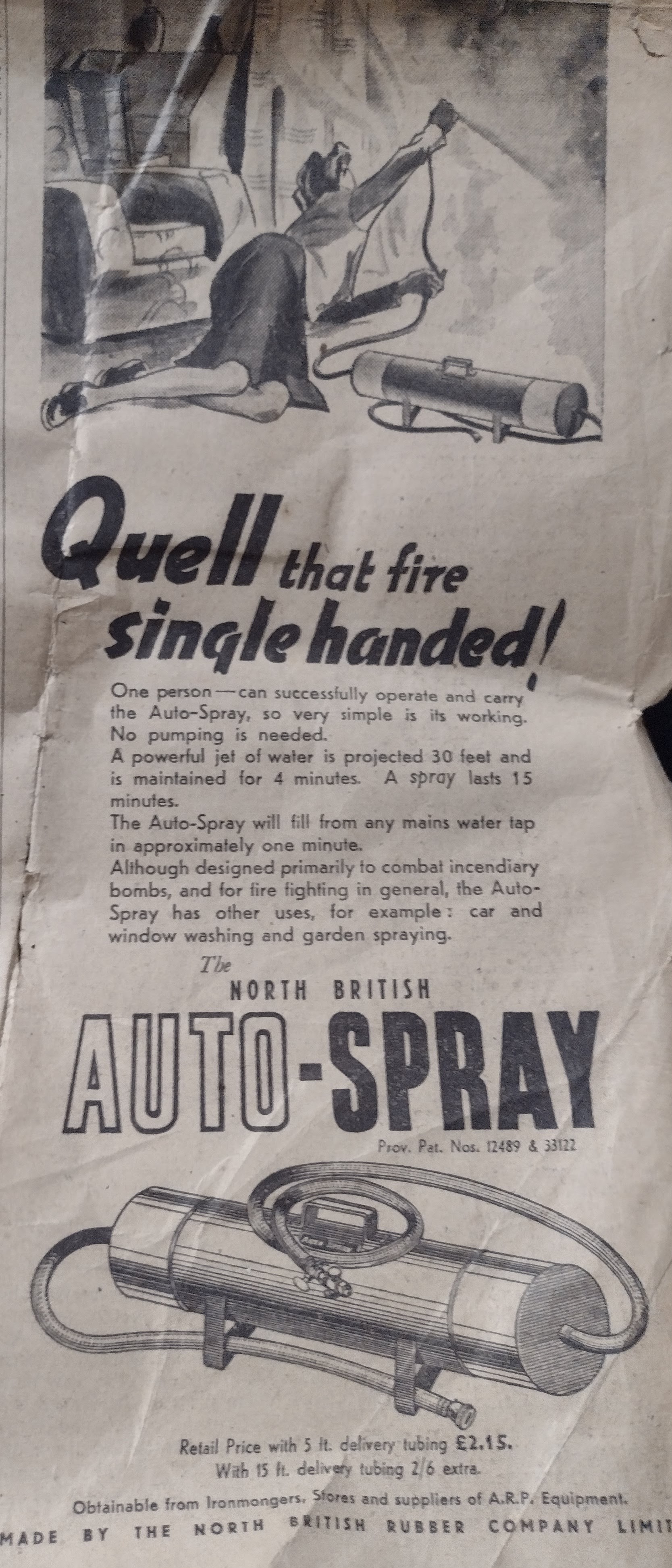
December 1940- all business premises in the country told they should have fire watchers (paid or community volunteer) because of the risk posed by German incendiary bombs.

1941- Spinfield, a house in Spinfield Lane partially taken over for accommodation of RAF personnel. Danesfield House has by then also been seized entirely for RAF use, including by photographic reconnaissance officers. Soldiers in camouflage hide in the woods protecting this base.

January 1941- work is ongoing to build more air raid shelters in the town for the schools.

June 1941- Marlow F.C lost to Reading in the final of The Berks and Bucks Red Cross Cup, organised to raise money for the Red Cross Fund. Over £120 was raised.

June 1941- a motor launch comes along the Thames through Marlow several times one Sunday. The occupants use a loudhailer to urge women they see on the riverbank to sign up to take serving men's places in factories and workshops. A novel idea! 

December 1941- Nazi sympathiser and British Fascist Frederick Joseph Rutland living with his brother in law Henry Rupert Hood-Barr and Spinfield, a house in Spinfield Lane West, Marlow as mentioned above arrested by police on suspicion of espionage and later interned for the duration of the war. He was suspected of passing secrets to the Japanese while in America and the Pacific. He had been decorated for his aerial reconnaissance work during WW1 for the RAF. Frederick had been spied on by people working for MI5 and based at Spinfield House for some time.

Part one of Marlow In World War Two deals with preparations for the war and the first few weeks of it as is available here. Part Three moves on to the years 1942-3 and can be read here.

Interested in WW1 in Marlow? Kathryn has a detailed year by year series of posts on it 

1914

1915

1916

1917

1918-19


From October 1941. 


More sources:

Bucks Examiner 27th June 1941. British Library Archives via the BNA.

Bucks Free Press 9th February 1940, 11th and 24th October 1940. Bucks Free Press Archives.

Papers of Frederick Lindeman, Nuffield College Library, National Archives catalogue.

Operation Crossbow: The Untold Story of Photographic Intelligence and the Search for Hitler's V Weapons. By Allan Williams. Published by Random House. 2014. Read more about Danesfield in the war in this interesting book.

The Times, October 15 1941 - thanks to Archibald Friend for a copy of this. 

Historic advertising literature.


To find all mentions of an individual here, use the A-Z Person Index in the top drop down menu. New content added weekly. More than 10,000 Marlow people are mentioned.

Wednesday, August 25, 2021

Jolly Maltsters, Dean Street Landlords and History

UPDATED BY CHARLOTTE APRIL 2023

May also appear as Jolly Malsters especially early on. On the Queens Road side of Dean Street, Spittal Street end. Almost next door to the Chairmaker's Arms. 

1823 - Richard Clark. He was son of Thomas Clark, tailor of Marlow. Richard was a beer seller by 1809. May have already been at Jolly Maltsters then. His nephews were prominent engineers Edwin Clark -  see here and Latimer Clark - see here

1830 - Richard Clark.

1831 - Richard Clarke. Well End as address, old name for Dean Street. 

1833 - Richard Clarke. He then moved to the Rose and Crown, Dean Street. 

1833 - 1839. Thomas Bowles. His wife was Emma nee Clarke, daughter of Richard Clarke above and his wife Hannah. Some of the Clarke family continued to live at the Jolly Maltsters with the Bowles for several years. Thomas died at the New Prison, Clerkenwell London in 1839. He had been arrested on suspicion of theft or handling stolen goods and put in jail to await trial. Soon afterwards he showed signs of madness - singing happy songs at one moment, begging to be allowed to go home and have breakfast with his wife at others as well as talking to himself. Within hours he was found dead in his bed in the hospital infirmary. It appears his mental health issues may have had at least in part a medical cause as his lips were described as having turned black and his pulse wild and he was uncontrollably shaking prior in the run up to his death. Thomas was buried in Marlow. The doctor suspected delirium tremens but decided after a post mortem that Thomas had suffered a "softening of the brain" and nervous collapse. Poor Thomas had appeared to think at times that he was at home at the Maltsters, and then became panicked when he understood that he was not there and feared that his victualler's licence would expire while he was away. You were required to reside upon the premises of any pub you had the license for so that was not an unfounded fear. Arrested as part of the same case were fellow Marlow men Jeremiah Humphreys (of the nearby Crown and Cushion Dean Street and son of Mary Ann Humphries nee Clarke who was daughter of Richard Clarke above) and Richard and George Clarke who were the brothers of Emma, (Thomas's wife) and the sons of Richard Clarke above. George would shortly become landlord of the new Bank of England pub in Dean Street. See here for more. Richard junior was transported for 10 years for burglary in 1840. He had targeted the premised of grocer and tobacco seller Mary Ann Wiggington in Dean Street. This crime was part of a politically motivated campaign of harassment against Mary's father James Lee who owned the business but had retired leaving his married daughter in charge of it.

In 1837 a customer Charles Russell had his coins snatched from his hands by another customer as he went to pay. The offender then fled!

1840- Emma Bowles widow of above. Married William Brown below. She was at the Mint Dean Street by 1861,and later at the Cherry Tree Dean Street.

1843 - William Brown who had married Emma Bowles, widow as above. Fined £2 plus 10 shillings costs for allowing cards to be played on his premises. The fine was regarded as severe and a turn around of previous turning of a blind eye to card parties at pubs during Christmas week. However the landlord had been cautioned for the same offence just before. 

1851 - William Bowles, son of Thomas and Emma Bowles. Later at Three Tuns. Also fruiterer. 

1853 - William Bowles

1854 - John Bowles (also fruiterer and boot and shoe maker, b. c 1800) Wife Eliza. 

1861 - John Bowles

1863 - John Bowles

1864 - Jn Bowles. Address given as Well End an old name for Dean Street, not to be confused with Well End, Little Marlow.

1865 - John Bowles dies age 56, Mrs Bowles takes over

1868 - Mrs Eliza Bowles (Widow of John Bowles)

1871 - Eliza Bowles as above. 

1872 - Eliza Bowles as above. Fined for allowing drunkenness on her premises and harbouring "people of notorious character". She received a soft warning for the former but a few weeks later in June, P.C George Parsons  found a man named Harris drunk in the passage with a cup in his hand (showing he had been drinking there) and another man, East, drunk further in. He also found two women there drinking with East who he said were known prostitutes - Elizabeth Woodley, and Matilda Cooper. Henry Davis the pork butcher was helping out Eliza on the night and strongly denied anyone was drunk although some were a "little worse for liquor"! Henry also said the two ladies accused of acting as prostitutes had behaved themselves with perfect propriety while there. The defence did not dispute the women's alleged profession but argued that they were not there on business. Did they not have the same right to enjoy refreshments at a public house when "off duty" as everyone else asked the defence.  The bench found against Eliza on both offences and she had her licence endorsed. Combined fine £2 plus £1 1s costs. Later in year the licence was transferred from Eliza to Thomas Bowles who had come from the Mint nearly opposite in Dean Street .

1881 - David Miles. "Licensed victualler" Wife Ann. 

 Researched by Charlotte Day and Kathryn Day.


Related Posts:

There are posts on this blog about individual families associated with certain pubs, as well as on individual pubs themselves so have a look at the Pub Related index here  & don't forget the Person Index for all mentions of someone on this blog. Find it on the top drop down menu. 

Posts about life in Dean Street and neighbouring streets here

More beer sellers than bakers -Temperance in Marlow here

Lists of posts about everyday life in old Great Marlow here

©Marlow Ancestors.


SOURCES

1853 Mussons and Cravens Commercial Directory

1833 Parochial Assessment, transcribed by Charlotte from the original copy owned by our family.

Kellys Post Office Directory 1864,1869

Pigots Directory 1823, 1830

Slaters Commercial Directory 1852

Census 1861,1871,1881.

Historic newspaper articles, accessed via the BNA :

Windsor & Eton Express 25 January 1868, as above


Friday, June 18, 2021

Say Cheese! It's Mrs Blake.


Rebecca Blake was a relatively unusual thing - a female Victorian professional photographer. She lived with her husband the frame maker, gilder and picture restorer Richard Blake in West Street Marlow. Theirs was the cottage far right in the photo above (modern number 86 with the bowed window). One of the rooms was presumably set up as a studio as the backs of her studio portraits only give the West Street address as her place of business. Rebecca also did street and country views. In fact a number of her town and country scenes were permanently on display in the window at West Street. You could go in and see the full collection if Mrs Blake was home. Husband Richard was quick to correct those who thought he was the photographer responsible. If you wished to view the collection when Rebecca was absent, Richard would ask you to return when she could show it herself. 

The Victoria and Albert Museum in London has one of her photographs on display - link below. The featured photograph shows Westhorpe House, Little Marlow. This house was identified for us by Michael Eagleton who writes the Marlow Memories column in the Marlow Free Press. Thanks to Michael for that.

Rebecca was born Rebecca Clarke in Little Marlow circa 1830 to John and Rebecca Clarke and grew up in Burrough's Grove just outside Marlow.

As a young woman she worked as a seamstress before she married Richard in London in 1860. Why they married in London when both were of Marlow origin I am unable to say but it is not uncommon to do so.  Nor can I say how Rebecca came to photography. (Her husband is however recorded as taking photographs of some local events in the early 1860s. He continued to do this - if Rebecca didn't get there first!)

She was already in business as a photographer the next year. After Richard's death in 1893 she took out an ad in the South Bucks Standard to say she had hired a workman to continue his business. The Maidenhead Advertiser paper extended its sympathy to Rebecca for the loss of her husband in a piece which said Richard had been an "original character" who had trained a cat of "phenomenal size" to do amazing tricks, played a host of musical instruments including a violin he had made himself and was willing to talk the ears off anyone able to listen to on the subject of Marlow history. He also kept an aquarium of native fish which he attempted to train to follow commands. He was apparently somewhat successful with his efforts in the form of performing minnow "Tommy Dodd", which he showed off with "childlike delight."

By the time of the 1901 census Rebecca defined herself as a picture frame maker only so it seems she decided to concentrate on that business over her photography one.

In 1903 she was elected to fill a vacancy in the Oxford Road Almshouses for widows. As well as a home she would have received a small weekly pension as an almswoman. At this point a local newspaper described her as "a much respected and deserving old lady". 

She died some time after 1911, seemingly not in Marlow.

Rebecca's brother in law was minor portrait painter Giles Blake. A post on other artists in Marlow history male and female, professional and amateur is available here

More posts on women who ran businesses in Victorian or Edwardian  Marlow=

Rachel Hall the West Street butcher here

Ruth North the toy dealer of West Street here

Mary Ann Parslow, famed Compleat Angler landlady here

Charlotte Sawyer the baker of West Street here

Multiple female ironmongers in the High Street here

That is just a selected few. You will find more women in business if you look on the "Specific Shops,Streets...ETC" menu option and follow the links to different premises or browse under the Pub Related option on the menu to find lots more female publicans.

To find all mentions of someone on the blog please use the Person Index, for a list only of more substantial mentions of someone try the Biographies of Individuals section on the menu. You will find more biographies of women of the almshouses there and more are to come.

Researched and written by Charlotte Day.

Sources:

https://collections.vam.ac.uk/item/O1408055/view-of-an-estate-photograph-blake-rebecca-mrs/ Link here

Kelly's Directory of Berks, Bucks and Oxon 1883 and 1885. Published by Kelly's Directory's Limited.

South Bucks Standard, 24th February 1893 and 27th February 1903. Maidenhead Advertiser 1st Feb 1893. Reading Mercury 25th July 1857. South Bucks Fred Press October 1883. Copies in the British Library archives.

1841, 51, 61, 71 and 81, 91 censuses transcribed from microfilm by me.

1901 census transcribed by Jane Pullinger from microfilm.

England Marriages database 1538- 1973 Familysearch (https://familysesrch.org/ark:/61903/1:1:NJ71-X6J : 13 March 2020)


©Marlow Ancestors. You are very welcome to use this research for family or local history purposes with credit to this blog.


Saturday, May 22, 2021

A Tribute To Our Bargemen *Updated*


This post is a tribute to some of the many Marlow people who worked on the river, and also to those of other towns that lost their lives on the Thames while passing through. 

The boatman and "bargees" had a contemporary reputation that was somewhat fearsome at times. They were often considered to be hard drinking, dishonest, dismissive of other river users and quarrelsome. The story of the "who ate puppy pies under Marlow Bridge?" jest at the bargemen is well known and is explored further in Charlotte's post here. The work the bargees did was skilled, physically demanding, as well as frequently dangerous. Some of the people who ran barges did well out out of the trade, and were later described as "gentleman" - William Creswell who ran The Swan barge with his brother in the 1830's and 40's is one example. William was also a substantial farmer, but he continued to be described as a wharfinger and bargeman or barge master for many years. He may no longer work the barges himself, but having done so was not a bar to respectability. Many Marlow people had wealth that was supported or created by industries that was entirely reliant on the work of the bargeman bringing in their raw materials and taking away what they wanted to sell. I have also noticed that the pubs most frequently associated with being the drinking holes of those working on the river, such as the Swan (ran by George Creswell of the The Swan barge for many years, brother to William) and the Black Boy and Bargepole, generate far fewer traffic for the petty sessions than many of the other inns. So the story is not a simple one of bad, rough boatmen causing nothing but havoc. Industry would have ground to a halt if that was the case! It's also worth noting that picking a fight with the working boatman was also a Marlow tradition with some who should have known better. Apart from those who thought it funny to mockingly chant the "puppy pie" slogan at the men, (usually high tailing it in the opposite direction pretty quick afterwards), the young gentleman cadets of the Royal Military Academy had a running feud with the bargemen. A young recruit said the origin of the quarrelling was long forgotten but the boys liked to lay ambush and set upon the men when they could in order to give them "a thrashing" to remember. The odds were rather in the boys favour as they were 30 boys to one bargee, "and several of us 18 years old and up". In turn the  cadets could expect a beating if they unexpectedly came across a barge hand when alone. The boys wore a uniform at all times so could not escape attention easily.  Former cadet John Le Couteur, who joined the Academy at age 13 in early 1808, recalled the running battles with the bargeman vividly. The boys threw dirt and stones from the bridge wholesale into passing barges. At one point the bargeman had enough and prevented some boys on a rare half holiday from crossing the bridge, handling them roughly. When word of this got around, it was said 150 boys went to the bridge to exact revenge. We only hear the cadets version of events, which saw them victorious against an untold number of gathered bargeman three or four lines deep apparently. The latter were said to be armed with everything from oars to bludgeons. The boys came with cudgels, and a hidden armoury of stones and catapults which were allegedly responsible for the boys victory. A ten minute battle on the bridge saw many boys hurt rather badly, and the opposition likewise. Someone had alerted the adult officers at the college who promptly arrived to restore order but not before those on both sides were to be found lying senseless. The cadets were confined to college for the rest of the day and were ordered not to engage in any further acts of the kind. No charges appear to have been made against the bargeman. The event may have got embellished in the retelling by cocky youths but it's interesting how battles of this kind were remembered by more than one cadet. 

The language the bargemen used may not have been what the polite society was used to. George Monk Berkeley writing in 1797 and recalling a memory of his mothers, said that once the service at All Saints came to a halt because the voice of a bargeman using loud colourful language on the river outside could be heard within the church. The Rev Cleobury was the incumbent then. 

And Sarah Winford, of Thames Bank, complained that the crews of barges were commiting "great indecencies" while moored outside her garden wall. Her servant Samuel Clarke said sometimes Mrs Winford had been obliged to close the shutters of all windows facing the river. They said the situation had worsened since the new lock had been built, with boats now passing closer to her home and mooring near there for 2-3 days together. She petitioned parliament on the issue in  1774 and a committee looking into her complaint recommended that a clause be added to the Thames improvement and navigation bill which would forbid the creation of any towing path or wharf between her garden wall and the river and forbid the anchoring, mooring or resting of boats anywhere near her garden, other than at the proper wharves and only when loading or unloading cargo. To facilitate this, it was announced in July 1773 that a "pile would be drove against Marlow winch and another pile 30ft from the bottom of Mrs Winford's wall" and once they were in place if a barge master was to "suffer his barge or boat to lie, continue or stop under the said wall, in the passage between the said pound and winch" will be prosecuted by the Thames Navigation commissioners. [Sarah Winford erected a gravestone to the memory of Samuel on his death, you can see it here]

Flash locks were long regarded as dangerous, and Marlow one of the worst. There are surviving reports of Elizabethan fatalities of boatman who were attempting to navigate the lock. Some thought this was because the lock was poorly maintained. Others that the fall of water was too "sudden and immense" even for a flash lock. John Willis, a bargeman drowned navigating the lock in 1772 after falling overboard, a few years before the new pound type lock was finished. 

Henry Allnutt, writing in the Anglers Journal in 1886, described the dangers of the old flash locks. The boats were hauled through the lock with the aid of a capstan and rope on the bank. If the rope should break, "the poor fellows [operating the capstan] were cast off flying into the air by the tremendous increasing velocity of the capstan unwinding itself". It was tedious and "most perilous" work that required a lot of strength. Henry, and both his father and grandfather had fulfilled roles within the Thames Navigation Commission.


Some lives claimed by the river

When we think of boatmen we don't perhaps think of people like barge boy "Master White" age 14. An orphan, he had been found a position on the Hope Barge, owned by Thomas Jordan of Bath. In the autumn of 1826, the Hope was moored at Marlow. The crew went to get supplies and refreshment in the town, sending the boy back to the boat with some things. When they arrived back at the riverside, the boy could not be found. The water was searched but the lad's body was not recovered until the next morning, 4ft from the stern and in 14ft of water. It was believed he had slipped and fallen from the moored vessel in the dark. In the reports of his death and inquest, his first name is not given. It does not seem the crew actually knew it. 

Another hazard is illustrated by the death in 1829 of James Spokes. He was working horses towing a barge travelling from a wharf at Spade Oak to Marlow. The rapidity of the "stream" was believed to have pulled the horses towards the river and to have caused them to slip and fall into the water. James was dragged in and while he managed to grab a branch extending from the bank, it slipped from his hand and he was drowned, along with the horses. He left a wife and two young children.

The fact that habitual drunkenness was not compatible with the skill and co ordination required to operate a barge is shown by what happened to some who tried to work them while a little inebriated. In 1826, William Winter was working on the Helen Barge travelling between Bristol and London via Marlow. He went to haul a line in, despite the warning from his brother not to attempt it as he had been drinking. He over balanced, and although a strong swimmer, sank and died despite his brothers efforts to rescue him. His body was not recovered for 3 days**, found just 40 yards from where he sank. 

Those working on the the River in other ways could also loose their lives. William Sayer of Dean Street, working as an ostler at the time, drowned while swimming horses at the back of Marlow Lock near Marlow Point. He was exercising an injured horse by swimming it across the river to aid it's recovery. It appears the horse got into difficulties with William astride it's swimming back and he fell off. He could not swim and a strong current had been noted there. 

And then there was George Cox, an engineer managing a steam launch for the summer season who fell off the launch in 1884, and did not surface. There are many more names we could mention. 

One Robert Goldswain, bargeman of Great Marlow, experienced another boat mans hazard in 1778 when he was press ganged into the navy while taking a load of timber to the Kings ship yard in London. He had a protection order from the Naval Board that was supposed to have exempted him from this indignity, as he was on naval business after all. Unfortunately for Robert, the press gang had been ordered by the Admiralty to ignore Naval Board exemptions as they were especially keen to recruit men who knew what they were doing around boats. He was put on board the "Conquestadore" and after a bit of passing to and fro and a court case, was returned home after a little more than 3 months in naval service. The court was aghast that the authorities admitted issuing protection orders to boatmen with the express intention of lulling them into a false sense of security so they would venture out onto the river ready to be pressed into service! 


 *For more on the woman's riots of 1800 which was also said to have involved some bargeman see this post here.  That post also contains reference to rioting bargemen in Marlow in 1766.

** Or much later the same day according to one report.  

For a biography of the barge owning family the Sparks see here and the Cresswells here

Will of bargeman John Piggot 1695 here

List of Great Marlow and Little Marlow bargemen 1700s (ongoing upload) here and 1600s here and here

And more on the cadets of the Royal Military College junior branch see here

Child drowning victims of Victorian and Edwardian Marlow here

To search for any individual on this blog use the A-Z Person Index option on the top drop down menu.

More river related posts can be found in the General History index here


SOURCES

Anglers Journal, Vol 6 . Article by Henry Allnutt, 16 June 1886.

Bentleys Miscellany, Vol 20. (Richard Bentley, 1846)

Berkeley, George Monk - Poems (J N Nicholls, 1797)

Salter, John Henry - A Guide To The River Thames (John Salter, 1881)

Wright, William - Fishes and Fishing (Thomas Caultley Newby 1858)

St Paul's Magazine Vol 5, edited by Anthony Trollope. 1870. 

Parliamentary Papers, vol 33, Great Britain House of Parliament (Houses of Parliament 1866)

Journals of House of Commons Vol 34 (HMSO 1804)

Reading Mercury 13 April 1772, copy at the British Library and accessed via the BNA, August 2020. 

Windsor and Eton Express 15 April, 4 November 1826, as above. 

Berkshire Chronicle 26 September 1829, as above. 

South Bucks Standard 18 October 1907, as above.

Bucks Herald 30 August 1884, as above. 

Oxford Journal 17 June 1773. 

Kelly's Post Office Directory 1847 (Kelly's Directories Ltd, 1847)

©Marlow Ancestors. 


 .


Wednesday, April 21, 2021

Clark and Clarke Graves, (Also Rose and Wade) Parish Church, Great Marlow, and at Bisham

Note this post groups Clark / Clarke graves located in All Saints Parish Church Marlow plus two at All Saints Bisham, but they may not be related! 


 Sacred to the memory of Frederick Clark, Feb 17 1812 age 51

"A husband kind, a father dear, a faithful friend lies buried here"

ALSO 

of one child who died an infant [Not named on grave]

At All Saints, Marlow


Above, Ann Clark - 26 May 1852 age 65

Josiah Clark 8 Nov 1870 age 88

Also on grave: 

William Rose 25 Feb 1829 age 94

Ann Rose 22 May 1836 age 84

At All Saints, Marlow


Above, Samuel Clarke. Erected by Mrs  or  Miss Winford in recognition of his 37 years of service as servant in her family. She erected similar graves for other loyal employees. No date visible now. He was 61. Believe he died 1800/1801. 

Mrs Winford lived at Thames Bank. Read about Samuels' testimony on Mrs Winford's behalf relating to the behaviour of some bargeman outside her windows here Another Winford servant grave can be seen here

All Saints, Marlow. 


This graves inscription above, is unfortunately facing the now fully grown tree but we have done our best to read it. 

Thomas Clark died October 182(9?) age 42. 

ALSO his children who died in infancy (not named)

ALSO - Susanna Clark - the bottom half is crumbled away so it is not possible to read her date of death as given here. This is located at All Saints, Marlow .


Above, John Clark d Jan ???? age 59. 

And Catherine died August 27 1831 age 83

ALSO

Mr. John Wade - date unreadable 

In All Saints Parish Church.


Above, grave of Helen, wife of George Clark. Died 10 April 1883 age 59. 

This grave is at All Saints Bisham. 


Above, John Badger Clark. Died March 26 1917, age 66. "Thy will be done"

This grave is at Bisham All Saints.


Use the drop down menu Grave tab to find other stone inscriptions, and the "Person Index" to see who else is mentioned on the blog thus far. 

©Marlow Ancestors. Reproduction of these images and transcriptions is freely allowed for local or family history purposes if you link back here and credit this blog. Thanks.

Friday, September 4, 2020

A History of Marlow Suspension Bridge to the early 1900s.


Before the current bridge was built Marlow had an infirm wooden bridge, that began at the end of St Peter's Street. It had only been built in 1788 and was made of oak yet storm damage and heavy traffic kept taking a toll on it. For years locals decried the state of the bridge on the grounds both that it was an eyesore and a danger. The bridge wardens tried to get official help to repair or replace the existing structure. However it took legal action against the County of Buckinghamshire to force them to organise a new bridge.

Not everyone agreed the bridge should be replaced rather than repaired. The artist JMW Turner sketched the old bridge at the end of its life and thought it one of the loveliest he had seen. He said that parts of the bridge were painted to look like stone.  An 1801 description agrees on the stone effect given by the white wooden ballustrades.  On the other hand, the Berkshire Chronicle in 1832 thought the old bridge was "cumbrous and ugly". 

Justices of the Peace decided a new bridge should be provided. The Bridge wardens owned some land which they could sell and put towards the cost but nowhere near enough. There were some rich people in the town willing to put some money up as subscribers but again not enough. The County took out loans. It was at first thought £2000 might be sufficient extra cash to build the bridge altogether - but estimates came in at four times that amount with the cost of the chains alone expected to be £2000 then. (And the estimates were themselves hopelessly optimistic) The county of Berkshire paid something towards the total. Still, a lot was going to be owed.

Tenders were put out and plans drawn up without every aspect of a financial plan on a concrete basis.

Work began in September 1829 when the bridge's designer and engineer John Millington laid the first stone of one of the pillars. Mr Owen Wethered first placed some coins as a sort of time capsule into the hole dug for that. The chains would be the patent links invented by naval man Capt Samuel Brown, as used on Brighton Chain Pier. 

The church bells rang in celebration and each worker present was given a token shilling and 10 pence as a gift. 

Ominously however as the town stood around that important first hole, it filled back up with water. So a planned official "laying of the first stone" (which would not actually be the first of course) ceremony with more pomp was postponed. 

Work progressed on the bridge at what seemed a glacial place. Weeks into the works there wasn't much to see beyond an enormous hole built for those pillars. Pumps had proved incapable of keeping water out of it. Millington asked the incredulous magistrates who had ordered the bridge what he should do about it. They replied that a qualified civil engineer such as himself would be rather more the person to know what to do than them. We must be fair to Millington and point out the pumps supplied to him were clearly not powerful enough but the powers that be baulked at more expensive but more effective pumps. What Milington was really saying was "What is it you think I can do about the bridge as you don't want to buy me a proper pump?" He claimed that it had always been agreed that he should be provided with a steam powered pump, and in the end one was purchased for his use at the cost of £400. He reasoned that it would only be in use for a few months and so could be sold thereafter for only a small loss. (He was wrong, and the pump only fetched £100 in the end.)

Marlow became a local laughing stock. Dark mutterings that the engineer was incompetent, even fraudulent grew. Issues beyond problems with pumps were at play. 

Right from the get go Millington had faced allegations that his bridge was not going to be strong enough to support itself. Other similar bridges had collapsed in recent years, critics argued. Some of those expressing doubts were involved with building it. Millington tried to prevent critics looking at his plans or speaking to the justices. Some of the bridgewardens were on his side and were willing to help him with this. Probably they felt he didn't need to have to justify himself to armchair experts. And all the while costs were spiralling. Some Marlow residents accused the bridgewardens of being fleeced by any which contractor or surveyor possible in pursuit of their white elephant vanity project. (Hardly fair - it wasn't they who specifically wanted a suspension bridge). Why can't we have a good old stone bridge came the cry.

In 1829, the Marquis of Chandos, on a visit to Wadham Wyndham at Beech Lodge, travelled to the construction site. He expressed surprise at the state of things and was "astonished to see no engineer or clerk of the works present." It was if these essentials had been done away with entirely he thought. Another of the party was heard to call the sight a "disgrace to the county." Although Milington had announced  in July 1829 that he would take up residence in Marlow to personally supervise the work, he left for London after a few months. William Francis, schoolmaster and thorn in the side of any underperforming person in authority, was also a prolific letter writer to the local press, often under the pen  name of Veritas. He poured scorn too on the bridges progress, and in particular the fact that Millington had apparently left supervision of the works to inexperienced teenage junior. This could not be Savage who was middle aged, so presumably another perhaps baby faced assistant was at work on site!

Poor Millington gave up and announced he was off to work on some mines in South America. He would leave full plans and instructions with assistant James Savage who was expected to complete the work. And he would like a full settlement of his account before he left! 

His bridge would not have fallen down it is fair to say. Copies of his plan managed to survive and later engineers who looked at them did not find them dangerous. They would have given Marlow pedestrian footways of 5 foot width rather than the slightly narrower ones there  today. However James Savage was not confident in the design (especially the load bearing capacity of the pillars which were to be in iron) and felt the instructions supplied to him were not good enough to work with. 

Perhaps Millington was as much fed up with the backbiting and factional nature of the town as regards the bridge as the engineering challenges it presented. 

Enter William Tierney Clark. Millington's design was junked in favour of one of his. Clark had built a similar bridge at Hammersmith and it was still standing which was pretty much the sole criterion on which he got the job. Marlow was nervous and it wanted reassurance. (Engineer Savage of St Katherine's Docks does not seem to have continued in his role.)

So what could go wrong?

Well how about broken down engines, unacceptable quality ironwork being supplied, threatening contractor's who hadn't been paid on time, incompetent workmanship on the created approach roads so that they were impassable, disputes with nearby landowners....

1830 came and went. So did 1831. The Bucks Herald thought rumours that bridge would finally be passable in January of that year might be true and if not, they feared the bridge would have it's name changed to the "Procrastination Bridge" by the world at large. The stonework had at least been finished the previous year, and it was, according to the Reading Mercury "very handsome."

National interest in the saga began to show itself. Visitors followed the earlier example of the Marquis and made a point of inspecting the scene and asking embarrassed locals and frustrated workers why the bridge still wasn't ready.

Things were getting ever more fractious on the bankside. In order to have an approach road to the bridge a small piece of land had been taken from the gardens of Court Garden House. The trees felled in the process were old and tall and Court Garden's then owner didn't feel that he had been adequately compensated for the loss of the timber they represented. This was a bit of hot air to be honest as the trees were clearly ornamental and likely never would have been cut down for sale as timber. He also complained that the bridge wardens had failed to build him a new boundary wall for his property. Wary of the expense involved when the project was already so much in the hole, they dragged their feet in resolving these complaints. 

 Nor could anyone agree as to how the loans for the bridge should be repaid. A locally levied income tax for the sake of the bridge was unpopular with those who were paying it, but equally plans to pay off the debt by charging every future horse, carriage and herd of cattle a toll to cross it were bitterly opposed. The income taxation continued in the end.

Persistent accusations about false accounting (through incompetence) directed at the bridge wardens didn't help the mood. Financial matters surrounding the bridge had got so complex between Bucks, Berks, the bridge wardens, landowners, a long list of changing contractors and suppliers etc it seems no one could agree who owed what to who let alone all the what, where, when or whys.

An additional expense was the basic repair of the old bridge in 1830 so that it wouldn't completely fall down before the new one was ready.

Those who did have faith in the suspension bridge were rewarded when 3 years almost to the day the original work had begun Mrs Clark's (perhaps wife of the engineer but there were Clarks in the town otherwise) carriage became the first vehicle to cross the new bridge. She was on her way home from London.

Officially the bridge opened on September 23rd 1832.

This meant the old bridge could be dismantled and sold in three lots by local auctioneer Thomas Rolls. He cautioned that as it was largely rotten not a lot should be expected for it. Someone acting for Rolls' company bought one of the three lots it was divided into in a (slightly shady one must say) attempt to pretend to other buyers in the room that it was a desirable thing. In the end £92 was raised. Not apparently what some had hoped for. It is interesting to compare the description of the wood with that appearing in the notice of auction which described it as suitable where strong timber would be required such as lock repairs! 

Not quite all bridge construction problems were then at an end. That badly laid approach road was still considered unfit for use in 1836. Tierney Clark still hadn't been fully paid by then and was preparing to sue.

Marlow did grow to love its bridge. It served as the end point for most races of the town's beloved rowing regatta as well as a great place to watch the event from. Punting races, when part of the regatta, used it as a starting point. 

Countless painters and early photographers came to Marlow specifically to capture the landmark.

On a sadder note the bridge became a suicide spot, especially in the late 1800s.

Someone who jumped from the bridge and didn't mean to harm himself was Alfred Perry of Dean Street. An employee of Robert Shaw the boat builder based by the bridge, 30 year old Alfred leapt off after apparently trying to prove he could do what an elderly fisherman had just demonstrated he could- dive from the bridge into the Thames. Unfortunately Alfred dived onto the asphalt path below instead. He was badly injured and expected to die but pulled through. It must have been an anxious time for his wife Ellen. They had a band of young children to support. Happily, Alfred was alive and well on the the 1891 census, though he had switched jobs to that of fisherman. 

The bridge attracted some anti-social behaviour. Within days of the bridge opening signs had to put up to discourage the little boys who were clambering onto the bridge and swinging from its chains. Three youths -Thomas Burns, William Cox and Roland Rose plead guilty to throwing stones from it in 1899. A letter to the South Bucks Standard in 1904 lamented the local habit of spitting from the structure.

Some vehicles could be problematic too. By the mid 1870s too-heavy vehicles using the bridge were stressing the structure and signs forbidding them to cross were first erected in 1877. They were largely ignored. In 1909 a traction engine pulling a cargo of very heavy lead caused the carriageway in the centre of the bridge to collapse. A team of men worked all night to free the engine from the hole it had created. Just weeks later an 8 tonne vehicle was caught going over it. Most drivers of overloaded vehicles were not locals but Thomas Lowe [or possibly Love, Jane found the original record hard to read] of Chalk Pitt Cottages was summoned for taking a heavy motor engine over the structure in 1908. In the same year, some councillors had demanded that heavier vehicles should be allowed to cross the bridge arguing that if it wasn't a strong enough structure to support them, it should be made so. 


Some Other Marlow People involved in some way with the bridge construction project:

Miss Symonds- more than a third of money loaned for the project came from her. Sadly I do not know her first name.

John Rolls- sold some of his land for the bridge to be built on (reluctantly). His brother Thomas was an industrious bridge warden. Left to him the project probably would have had far fewer problems.

Thomas Lovegrove- repaired the work's steam engine.

William Bond- one of those paid for carpentry work. He did most of it. A post on him and his father with a photo of their home is here on the blog 

Corby and Clifford building company for brickwork and stone masonry [Thomas Corby and Theophilus Clifford.] The latter named a daughter with the middle name Suspensiana after the bridge in 1829. A biographical post on Theophilus will be found Here

To find people on this blog select the Person Index option on the drop down menu. More general history posts are listed under General History on the menu.


To read about the adjacent  old Marlow church replaced at a similar time, see the post here

To read more about the old bridge and the repairs done in 1860 to the new bridge see here 

The legend of a bargeman eating puppy pie under Marlow Bridge here

Researched and written by Charlotte Day & Kathryn Day.

©Marlow Ancestors. 

Some sources and background reading:

A Memoir of Suspension Bridges by Charles Stewart Dewry 1832. Published by Green and Longman. Digitized by Google from a copy held by the University of Michigan. In this you can see Millington's design for his bridge.

Bridgewarden accounts and papers at Centre for Buckinghamshire Studies some of which were accessed by Jane Pullinger.

Newspaper copies held at the BNA: Berkshire Gazette 12th September 1829, Windsor and Eton Express 15th &19th September 1832, South Bucks Standard 17th June 1904, Maidenhead Advertiser 24th February 1909. Bucks Herald 9 October 1830.  Berkshire Chronicle 29 September 1832. 

Phillips, Geoffrey - Thames Crossings (David & Charles 1981)

1891 census from microfilm images transcribed by me and supplied by the LDS at a family history research centre.

Beauties Of England and Wales or, Delineations topographical, historical and descriptive, of each county - John Britton, Edward Westlake Brayley et al. (1801)

South Bucks Standard Directory of Marlow 1891. 


So far this blog contains mention of

4,300

people from or associated with Marlow.

PHOTO ID ANYONE?

 Can anyone help a fellow family history researcher Linda identify where this staff photo may have been taken in Marlow? Underneath are some...