Part Two 1940-41 - updated October 2025.

1940- Winston Churchill's scientific advisor Frederick Lindemann, of German origin but hater of the Nazis, moves his Statistics Department from London to Sentry Hill House on the edge of Marlow. The building was requisitioned by the government for the war effort. Members of the department lodged there, and worked there of an evening to escape disturbance in the Blitz. Filing cabinets were transported to the house in the backs of cars which was perhaps not the most secure way of doing things. The department left in 1942.
Frederick's father Adolf had lived in the neighbouring house The Heights at the time of his death in 1931 so Frederick already knew Marlow well when he arrived.
Jan 1940 - blacking out of the windows of all the town schools has been completed. Residents are reminded to step carefully off pavements and listen hard for cars when walking around at night.
Jan 1940- general meat rationing is about to begin so the townsfolk need to register with one of the town butchers. Bacon and ham are already rationed.
Jan 1940- a row in the cemetery is to be reserved for the graves of the anticipated war dead.
Jan 1940- the ARP is giving out baby head protection helmets in the town.
February 1940 - elderly Edwin Wye of Victoria Road is struck by a car he couldn't see and which couldn't see him thanks to the blackout when he steps into Spittal Street.
April 1940- doorstop salvage collections begin of paper, rags, bottles and metal for the war effort .
May 1940 - £800 is spent on buying the piece of land known as Foxes Piece in Marlow for a recreation ground thought necessary because of the increased numbers of children in town due to evacuations. Authorities are very aware of the even greater numbers expected to arrive in the coming months. That recreation ground is in the present day the site of Foxes Piece School.
May 1940 Colonel M .O Clarke A.R.P officer for Bucks lives White Lodge, on the edge of town. (Bisham)
August 1940- the council gives up the metal gates of Higginson Park and some metal benches there to the war effort but decide to keep on to the railings around the Causeway enclosure for now. An hydraulic lorry is to be bought for the town's salvage collections.
August 1940- Fitzroy Clayton of Harleyford fined for allowing lights to be seen from his house during the blackout. He blames his guests.
September 1940- multiple bombs fall in fields off Old Pound Lane near to Pen's Place, leaving 21 craters. Other bombs also hit the outer edges of the town injuring some in Berwick Road and a further resident, Leo Ryan is killed. Ryan's Mount in Marlow will, in the future, be named for him. For security purposes or perhaps for reasons of keeping up morale, the local press during the war do not report bomb deaths or injuries as anything other than fatal or non-fatal "accidents" occuring to local people.
September 1940 - a plaque is out up in Borlase school chapel to commemorate the first former pupil from the school to doe in this war- W Tagell of High Wycombe who drowned when his naval ship went down.
September 1940 - the first anniversary of the war breaking out is marked the following Sunday with a national day of prayer.
September 1940- the town launches a Spitfire Fund.
September 1940- Folley Brothers at Sheepridge Little Marlow fined for not complying with an earlier order to turn over a portion of their land to ploughing. They say the land is using yo graze cattle which is surely part of supplying food for the war already.
October 1940 - the air raid shelter for the Infant School in Oxford Road is being built but the other schools in Marlow are still without them. The cellar of the Clayton Arms pub will be used by the infants as a shelter if needed before they have their own one complete.
October 1940- A letter to the Bucks Free Press from an anonymous refugee in the town criticizes the town's large house owners for supplying no meals and refusing the women staying with them from using the kitchens to make their own. Instead they have to walk down to the refugee canteen in town. It also highlights the overcharging of refugees for their accommodation in town.
October 1940- road accidents in the town are up despite far fewer cars being on the roads. This is put down to the blackout.
October 1940- rules banning council housing tenants from taking paying lodgers is to be relaxed as so many refugees in the town need somewhere to stay (this rule does not seem to have been stuck to previously anyway in practice). The Freemasons Hall us being used as overnight emergency accommodation for those who arrive in town without anywhere organized to stay. These are mostly people who have fled bombing in London.
October 1940- Finnamore Wood Camp outside the town has been built and is being used to house evacuated girls from an Ilford school. The King and Queen briefly visit them while in the area.
October 1940- Bucks Agricultural Committee hears that some farmers are reluctant to ask their assigned land girls to drive tractors or do "rough work". It also however hears from farmers who say that their land girls have no problem with any such tasks, in fact they have been found to be better than the former male workers at such things.
November 1940 - Lucy Nicholls Stanley the soon to retire landlady of the Chequers in the High Street is fined for not filling in alien registration forms for most of her guests, as required by law. These had to be filled in whether someone was foreign or not. She has been fined twice this year already for blackout offences. At least she can receive foreign guests if they come to her. Nearby High Wycombe has been designated a Protected Area and no civilian foreign nationals may enter to work or stay without police or home office permission.
November 1940- the Women's Voluntary Service is based at the Armoury Institute Road. They are collecting underwear and costs for bombed out families elsewhere.
November 1940- there are 855 refugee children in Marlow plus 441 adults.
November 1940- plans are mooted for adding special concrete block walls in front of the windows of the town's council houses so that their front rooms effectively become bomb shelters in themselves. I'm not sure how that was going to work! Construction begins in Berwick Road council homes the next month.
December 1940- donate any binoculars you have to opticians so that they can be sent to the front where there is a shortage. Meanwhile magazines can be donated at the Post Offices to be sent to troops abroad.
December 1940- those trying to flag buses down in the gloom of a winter evening are warned not to use a torch to signal to the driver to stop. Instead they should carry a white hanky or white cloth and wave that.
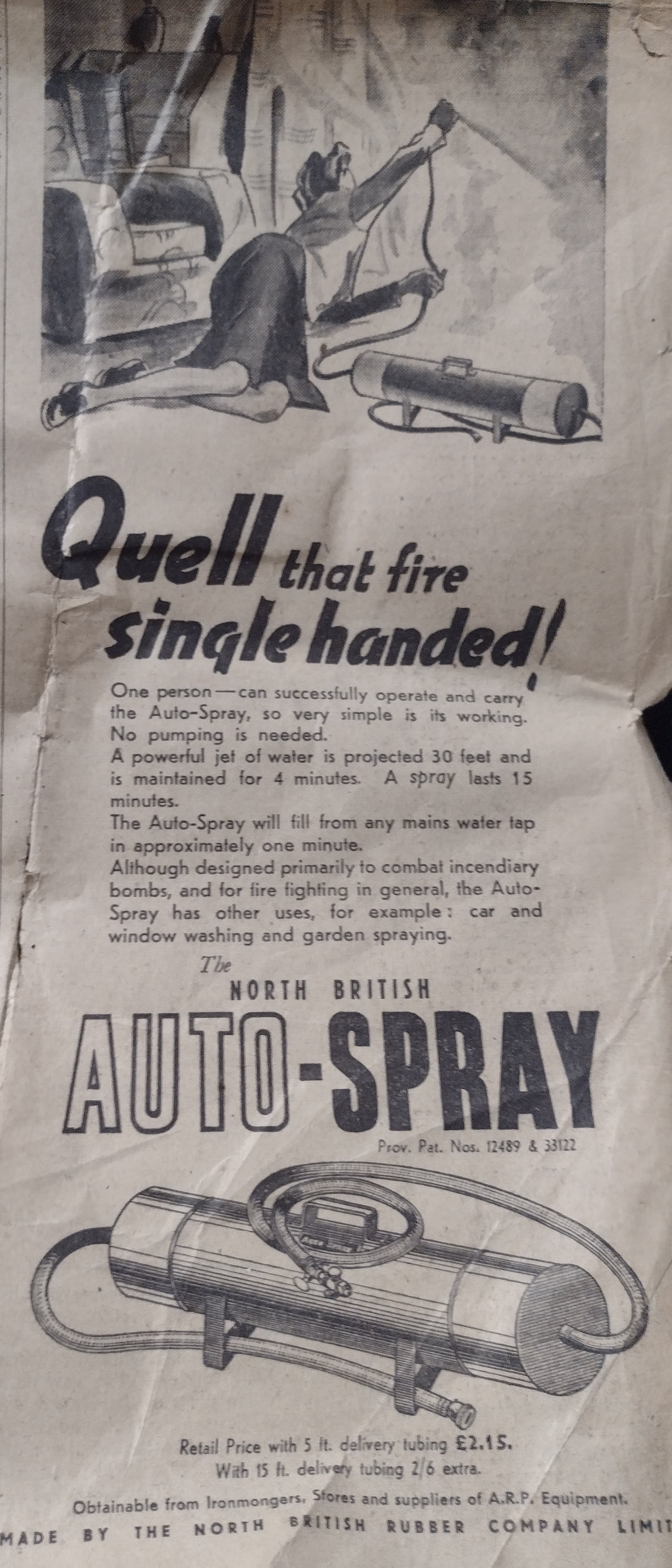
December 1940- all business premises in the country told they should have fire watchers (paid or community volunteer) because of the risk posed by German incendiary bombs.
1941- Spinfield, a house in Spinfield Lane partially taken over for accommodation of RAF personnel. Danesfield House has by then also been seized entirely for RAF use, including by photographic reconnaissance officers. Soldiers in camouflage hide in the woods protecting this base.
January 1941- work is ongoing to build more air raid shelters in the town for the schools.
June 1941- Marlow F.C lost to Reading in the final of The Berks and Bucks Red Cross Cup, organised to raise money for the Red Cross Fund. Over £120 was raised.
June 1941- a motor launch comes along the Thames through Marlow several times one Sunday. The occupants use a loudhailer to urge women they see on the riverbank to sign up to take serving men's places in factories and workshops. A novel idea!
December 1941- Nazi sympathiser and British Fascist Frederick Joseph Rutland living with his brother in law Henry Rupert Hood-Barr and Spinfield, a house in Spinfield Lane West, Marlow as mentioned above arrested by police on suspicion of espionage and later interned for the duration of the war. He was suspected of passing secrets to the Japanese while in America and the Pacific. He had been decorated for his aerial reconnaissance work during WW1 for the RAF. Frederick had been spied on by people working for MI5 and based at Spinfield House for some time.
Part one of Marlow In World War Two deals with preparations for the war and the first few weeks of it as is available here. Part Three moves on to the years 1942-3 and can be read here.
Interested in WW1 in Marlow? Kathryn has a detailed year by year series of posts on it
More sources:
Bucks Examiner 27th June 1941. British Library Archives via the BNA.
Bucks Free Press 9th February 1940, 11th and 24th October 1940. Bucks Free Press Archives.
Papers of Frederick Lindeman, Nuffield College Library, National Archives catalogue.
Operation Crossbow: The Untold Story of Photographic Intelligence and the Search for Hitler's V Weapons. By Allan Williams. Published by Random House. 2014. Read more about Danesfield in the war in this interesting book.
The Times, October 15 1941 - thanks to Archibald Friend for a copy of this.
Historic advertising literature.
To find all mentions of an individual here, use the A-Z Person Index in the top drop down menu. New content added weekly. More than 10,000 Marlow people are mentioned.


