It's sometimes hard for us to understand just how famous Marlow was as fishing resort, throughout all of the Victorian period. Many many people came here to enjoy the then abundant angling opportunities, and there is as a result numerous people who immortalised their experiences on the page. Throughout dozens of reminisces, one name is consistently recalled with affection above any other - Victorian "fisherman" Bob or Robert Shaw.
Robert, later of Robert Shaw and Sons* boatbuilders, was born in 1831 in Watlington, Oxfordshire, to butcher William Humphrey Shaw, and mother Susannah. When Robert was a boy, the family moved to Marlow, first to Dean Street then to the riverside St Peters Street.
Robert at The Angler
As a young man Robert came to work at the Compleat Angler at Bisham. This was directly opposite St Peters Street and an ideal place to employ a keen swimmer and angler. On the 1851 census, Robert is listed as a live in servant but it's likely he was already assisting with the lucrative side line of the Angler even then - catering to fishing parties. The visiting gentleman needed a guide to show them the best (and legal) places to fish, and also to handle the boat/punt and provide the live bait. A number of well known Marlow families were working as "fisherman" in this sense and while some were independent, others more or less attached themselves to serving the needs of a particular hotel or inn. The Compleat Angler was premier of these (or The Angler inn as it was more usually known then). Robert would have been the junior of the fisherman at that point, but he must have already stood out for his talent at "reading" the river. Because in 1850, he was appointed the water bailiff for the local Anglers Preservation Society. This was a responsible position and a huge sign of respect to receive it at such a young age. It meant he policed the river to make sure no one was taking fish when and where they shouldn't. He held the position for 34 years.
Although he later became famous as a boat builder and punt proprietor, Robert still was at pains to correct the 1881 Thames Preservation committee he gave evidence before, when they defined him only as a boat builder. He told them proudly he was also a fishermen. He was there to describe how fishing was protected on the Thames, among a wide ranging enquiry. It was the sort of job that could be difficult but a 1867 fishing guide described how his intelligence, love for the river and zeal had "earned him the respect and consideration of not only members of the club but that of the inhabitants of Marlow and it's vicinity who speak of him with praise." Others spoke of his handsome appearance, loud and cheerful voice, and polite and patient manner. Another account joked that "Bob" could be summoned at the Angler if you made the sound of a cork coming out of a bottle!
A carp weighing 8lbs and caught by Robert, was stuffed and put on display for a number of years at the Angler for guests to marvel out. It was one of a number of trophies gracing the Angler's walls.
At some point Robert seems to have began hiring out punts directly. It was a small start for what would become a big business very quickly. Robert did extremely well indeed financially.
If It Floats, Bob's Got It
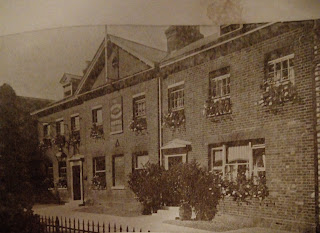
In 1872, Robert, now married with a number of children, moved from Bisham to a new built house on the other side of the river. (He married Elizabeth Jane White in 1854) This was Ryepeck House, on the river front near the Bridge. (Later usually rendered as Rye Peck and converted into a private residential hotel in 1895). A ryepeck is the name of the poles that punts are moored against and which are used to mark the end of a punting race. A very appropriate choice. He had started his boat building on this side of the Thames, and a little later he took over the Haynes boat builders premises immediately next to Marlow Bridge. He expanded steadily, and employed a number of workers, many not originally from Marlow. Not only would he hire you a selection of river craft by the day or hour (with or without a skilled person to pilot it for you) but he could build a pleasure boat or punt to your exact requirements, repair an existing boat, or house it outside of the river season. Are you a gentleman with a boat house at your residence that looks a little shabby? Robert could repair and varnish these too. Soon he could offer steam launches and house boats for hire, from Marlow or his Bourne End base also. And by 1904 you could charge your electric launch at Shaw's charging station. He could not build the larger vessels offered by his nearby rivals Meakes and Redknapp however, and workers from the two seemed to have had something of heated rivalry at times!**

A view towards the former location of Shaw's Boathouse, where Tierney Court is now.
A series of tragedies
Robert was sadly the person directly responsible for recovering a large number of bodies of the drowned from the river. Some he saw himself, others he found after being approached for help locating a victim with his dredgers. This can't have been a pleasant task, but Robert never refused his help. Tragically, in 1898, Robert's own 23 year old son Reginald and Robert's son in law Hedley Foster* were drowned near Medmenham. A third person with them, Lewis Slade, a Maidenhead auctioneer, managed to swim the 10 yards to the bank. The men were bringing the small sailing yacht of Lewis back to Marlow from Reading. Conditions were described as "squally" but were not considered too difficult for the two experienced sailors Robert and Hedley. Although reports initially said the boat capsized after it had been suddenly turned round, it seems that in fact it survived this initial accident. Some water was let in, and it appears that as the men attempted to deal with this, they were pitched over board. Reggie Shaw was a strong swimmer but Hedley could not swim at all. Reggie knew this and immediately went to his aid. Unfortunately Hedley panicked and grasped Reggie so strongly that both were dragged under and drowned. Their bodies were not recovered until the next day.
The George & Dragon above, where the inquest into the death of Reginald Shaw and Hedley Foster was held..
Robert was away at Eastbourne at the time, watching two of his other sons play for Marlow FC. (Edward and Charles) A telegram describing the terrible accident was waiting for them there. Only a week later, another of Robert's sons, Albert recovered the body of a dead man from the river near Marlow bridge. Such events were sadly much more common in the old Marlow.
The joint funeral at Marlow was a big event. The bridge was so thronged with bystanders that it was impassible to traffic. Reggie Shaw had been a member of the Bucks Rifle Volunteers and so the funeral procession was lead by their band, and nearly 130 officers and men. Their members carried his coffin, and at the close of the funeral, fired a "salute" over the grave.
In 1901, William Button of Reading, employed by Shaw as a waterman, drowned almost outside the Marlow boat house. He was bathing with two colleagues, when he suddenly disappeared beneath the water and never resurfaced. Robert recovered his body a little later. How painful the reminder of his sons death these incidents must have been.
Not all bad news for Robert
Robert was sued for slander twice in 1900/1901, both times by London tobacconist Frank Bateman. Frank was a regular visitor to Marlow for a number of years in his house boat Kismet. He and Robert Shaw fell out over a disputed bill. Robert charged Frank for the repairs made to a skiff belonging to Frank but damaged in Robert's care (or not depending who you believe.) Robert put aside his legendary politeness to say Frank was trying to swindle him and not pay his debts. Frank sued and the first case was settled when Robert apologised and paid the court costs. But Frank said Robert continued to repeat the statements about swindling practices and so the matter went back to court. Robert denied saying anything of the kind. The court believed him and the case was dismissed.
Above, advert dating from 1907.
I'm pleased to say the last year's of Robert's live were not all doom and gloom. Now a widower, 70 year old Robert remarried 34 year old Christina Gibbons in 1902. Sadly Christina was widowed shortly afterwards but not before the couple had two children. For Robert died of bronchitis in 1908 aged 77. His funeral at All Saints was another that bought the town to a virtual standstill. It truly was the end of an era!
We have not delved into Robert's many other roles in sporting and cultural matters or the post will be just too long! I will just add that he was an early member of the Bucks Rifle Volunteers and stayed a member until he reached the upper age limit.
Written and researched by Kathryn Day.
Notes
* Hedley Turner P Foster was a London solicitor. He had married Robert's third daughter Frances at Marlow in November 1889 and they had two children. Reggie Shaw was an articled clerk for him. The inquest into the drowning was held at the George and Dragon, the bodies laid at Ryepeck for inspection. Reginald was praised for his bravery at attempting to rescue Hedley. Hedley and Frances were living at Caldwell Lodge in Station Rd at the time of the tragedy. Reggie was a member of Marlow Football club, the Rowing club and Institute cricket teams at various times.
The "and sons" of Robert Shaw and Sons were William Thomas, Edward, Sydney Logan and Charles Arthur Shaw in 1912 when they dissolved their partnership. They continued without William Thomas, better known as former proprietor of the Chequers Hotel who had suffered bankruptcy. Eldest son Richard or Dick had died at home in Glade Rd in 1906, after a painful illness. Albert or Bert also worked as a boatbuilder for his father. The Shaw's boathouse at Marlow was eventually taken over by Meakes and Redknapp boat builders of Bisham. Ryepeck house was sold in approx late 1891 to Mr Percival Harter who was responsible for building Stoneyware at Bisham.
** Robert and his son Richard were summoned for assaulting George Meakes and William Redknapp in the summer of 1887. General Williams had formerly owned all the land along the towpath from the bridge to Court Garden but he had recently sold most of it to the Shaws including the camp-shedding. When Meakes and Redknapp arrived with a launch outside the Shaws boathouse, Robert refused to allow them to land passengers and some scuffles ensued. He said they had no right to use his land. The court agreed and said any minor violence was excused by the fact the Shaws were maintaining their legal rights! Case dismissed. (Meakes & Redknapp said they had landed and taken up passengers there many times before without seeking permission and did not know Robert Shaw now owned the land. The former is certainly true, although General Williams agent John Tudor said everyone had had to pay tolls to do so and they had apparently not done.)
Related Posts:
William Humphrey Shaw here
Bellows, bricks and brandy - reviving the drowned here
Little lives lost in the Thames here
Picnics and Punts- Summer leisure in late Victorian and Edwardian Marlow here
History of Compleat Angler in 1900's here
Marlow hero Charles Bonny - the grandson of Robert Shaw who lived with him at Ryepeck. (Son of his eldest daughter Elizabeth Jane) - here
This post on Hurley Flour Mill mentions another death that occured at Shaw's here
Fellow boatbuilder James Haynes - here and amateur barge builder Richard Harding here
To find all mentions of a family or individual here use the A-Z person index in the top drop down menu.
Other posts about general Marlow history can be found here
Sources include:
Ashby-Sterry, Joseph. Tiny Travels (Tinsley Bros. 1875)
Carter, John Henry. Thames Guide 1881.
Fennel, John Greville The Rail and The Road or Tourist Anglers Guide to Waters and Quarters (H Cox 1867)
Highly, Samuel Where to Fish Around London. (D Brogue, 1880)
Taunt, Henry A New Map of The Thames from Oxford to London Taunt, 1872)
Parliamentary Papers, Vol 16 (Great Britain House of Commons, 1881). Digitised by Google 2019.
Fish, Fishing and the Aquarium, October 1886. Digitised by Google.
Fishing, Fish Culture and the Aquarium. May 1886, Harvard University library, digitising by Google.
Berks County Paper 22 July 1865
Berks Chronicle 20 July 1891.
Bucks Herald 26 October 1889
Henley and South Oxfordshire Advertiser 15 April 1898
Henley and Oxford Standard 17 May 1901
London Gazette 20 September 1912.
Maidenhead Advertiser 19 April 1893
Reading Observer 16 April 1898
South Bucks Standard 17 May 1901
Census 1841, 1851, 1861,1871,1881 - transcript from microfilm by Jane Pullinger.
The Sportsmen 3 December 1908.
"England and Wales Death Registration Index 1837-2007," database, FamilySearch (https://familysearch.org/ark:/61903/1:1:2JBG-QKR : 31 December 2014), Elizabeth Jane Shaw, 1896
© MarlowAncestors.


