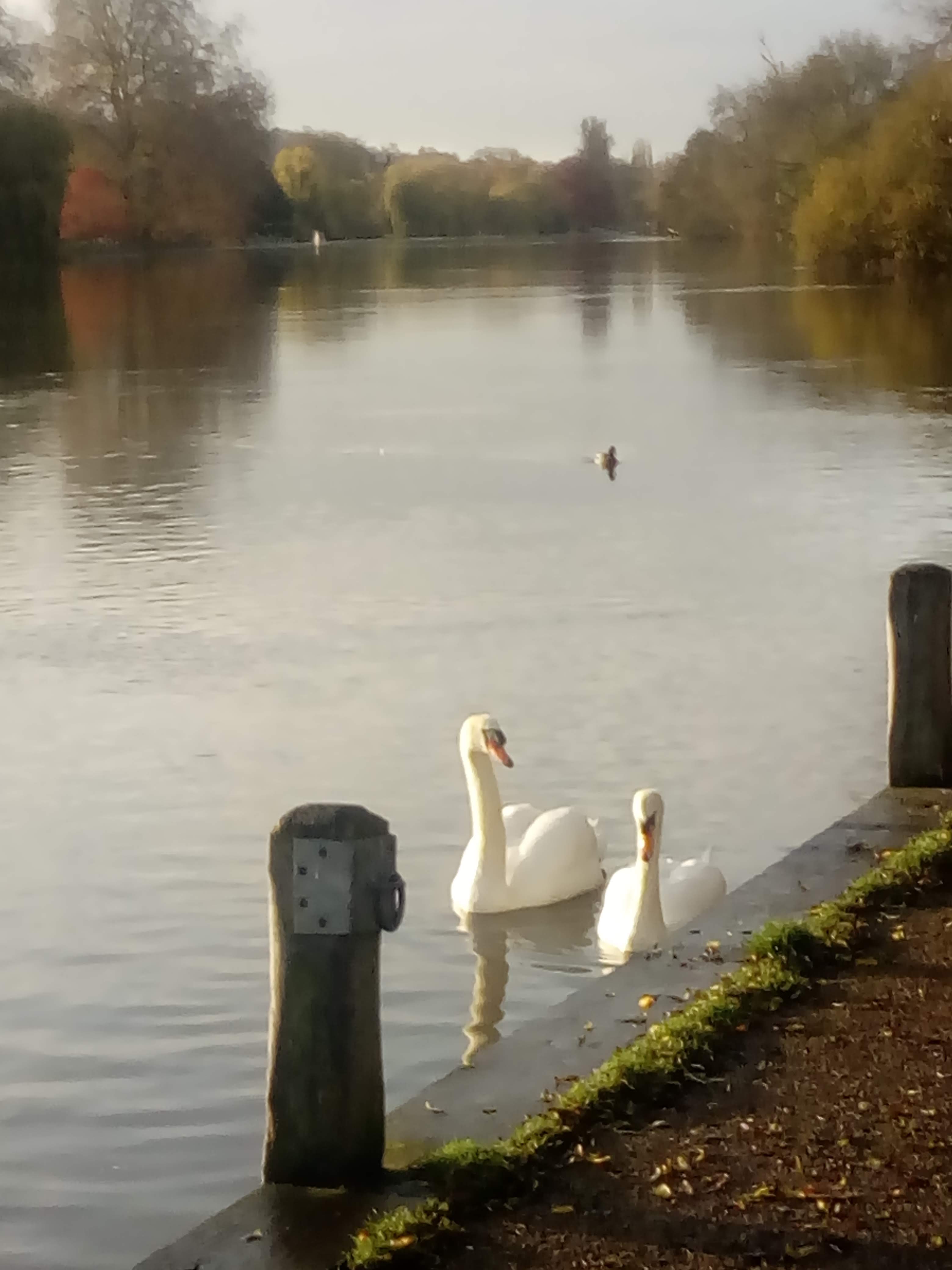
People have always bathed in the Thames, sometimes for necessity, sometimes for pleasure. The trouble for Victorian Marlow residents was quite a lot of them liked to do so in the nude.
If you read reports of those swimming and bathing in the river early on, often in terms unfortunately of their escape or otherwise from the prospect of drowning, it's clear they are swimming naked. Or at least the men were. It was expected and not commented on in a shocked way - it's more that the fact was revealed by statements about where their clothes were found and how the fact that they were wearing none was taken as an indication they had deliberately entered the water to bathe. This wasn't something restricted to youths and it cut across class boundaries. But as the Victorian era progressed, this changed. Mutterings begin about "bathing nuisances" and "public indecency" and it became an issue that got some people very hot under the collar indeed.
A hygienic and life preserving exercise
Back in the late 1850s, swimming was said to be "quite the rage" among the (male) youths of Marlow. A Mr Goggs had taken it upon himself to teach a number of the boys to swim. Some of the private boys schools taught their pupils to swim, for example William Faulkner's Prospect House Academy and later Marlow Place School where swimming lessons cost a "moderate fee" in 1863.
Given that many of the boys would have grown up to work on or near the river, this sounds like a good idea. The boys' minds then turned to competitive swimming. Some unnamed gentleman thought that this craze for swimming was a hygienic and life preserving exercise and to encourage the lads, set up a swimming competition in August. There were also races for men but none for females of any age. This was the start of an annual but long forgotten sporting event that attracted big crowds. About the same time an Amateur Swimming Society was formed and they took on the organisation of the swimming races, as well as matches between two close rivals. There was a cup for the most successful competitor under 16 and other races were swam for prizes like fishing rods. In 1863 the juvenile cup was won by the ever sporty Augustus Creswell. In 1865 the annual swimming race was swam between Bisham Abbey and the suspension bridge with "many hundreds" of people watching from the bridge and along the tow path. Everyone expected Augustus Creswell to win as always but he was pipped at the last by Master Povey. Povey had a very successful day overall, as he also won the diving prize. And where were the boys diving from? Marlow Bridge! The winner succeeded by diving the greatest distance and remaining the longest underwater. Thankfully all the young men resurfaced without any broken limbs. Other names mentioned as competitors include Shaw, White, Rose and Blacksmith. The younger boys had shorter races - winners include Shaw, Gibbs and Honey. These races continued for a number of years, and were revived in the late Victorian period.
In 1873, the Reverend Cree wanted to create a designated safe bathing place. He knew that many used the back waters behind the mill to bathe but this was not always considered very safe. Funds were raised and a committee formed but then they hit a problem. None of the landowners owning the river bank land would give up even a small part to allow the project to be realised. So the plans came to nothing. Later that summer Dr Shone's young assistant surgeon William Henry Anderson, drowned whilst swimming in those fore mentioned mill back waters. He was 23. It was said that his death meant the poorer classes in particular lost a kind, patient and skillful friend. The jury at his inquest publicly made a plea that a proper bathing place should be provided for without delay.
Wash the London dirt away
Visitors to the town were advised to get one of the fisherman (fishing guides) to take them by punt to a suitable spot for a swim. They advised only good swimmers to attempt it, but the rewards would be worth it. Joseph Ashby-Sterry, writing a travel guide for 1874, said bathing at Marlow was a pleasure for which he would "gladly give a good part of my limited earthly possessions." It was just the thing for washing off the dust of London. He recommended bathing at the weir itself, holding on to the paddles, for an exhilarating experience. He may have enjoyed this, but he was obviously unaware of the number of people who have drowned in that vicinity.
A perpetual infestation of nudists
In the late 1870's, the problem of nude bathing was starting to be treated more seriously. In 1877 High Street chemist Charles Miller Footitt went along to the Petty Sessions to plead with the magistrates to do something about the issue. Robert Hayes Smith seconded this and said the river banks were "perpetually infested" with those who not only bathed nude but wouldn't confine themselves to the water but were to be frequently seen running along the bank, sans clothing. The magistrates were sympathetic but could only act on the transgressors if they were bought before them.
Six years later, a meeting was held to consider the issue of a bathing place again. If everyone had somewhere particular to bathe it could be sheltered from sight and limit the spread of our streaking friends. One of the speakers William Shone, made the good point that very many of the poorest in town had no real facilities to wash themselves properly in the summer unless they used the River, with the result the river banks were constantly covered by boys and men bathing. Everyone agreed that providing a spot for comfortable and decent bathing was a good idea, but what they could not decide was where it should be. Around 1900 Colonel Clayton offered the use of Slough Pond "near Gossmore" for conversion into a bathing pool. It would be equipped with an inlet and outlet so a constant supply of Thames Water would keep it fresh. But the work and expense involved made the Council shy away from this proposal.
Beware the young savages of Marlow
Thames Conservancy bye laws to ban bathing without wearing a suitable costume were in force here by 1891. These rules also restricted bathing to before 8am or after 8pm. But the rules were routinely flouted. The police received many complaints, and so decided in 1891 to send a plain clothes constable duo strolling by the river to catch the offenders in action. And this they did. The police said they found a pack of boys dashing about the river banks entirely unclothed like a parcel of "young savages". They managed to round up 5 boys and they duly appeared before the magistrates. They were described as "poorly dressed lads". It is not hard to understand how unrealistic it would probably have been for their families to provide them with bathing costumes, or even a spare set of dry clothes to change into if they bathed in their others. Henry and William Rockell, Joseph Boot, George Thorpe, and William Tubb were fined 2s6d each but they were warned that a second appearance would result in a sharp fine. General Sir George Higginson, as magistrate said it was "monstrous that ladies were deterred from walking by the river in the summer evenings" because of the risk of coming across such a group. The police should have stuck with the plain clothes approach. In 1905 some groups of boys, missing their garments, were reported to be having a riotous time in the water and on the river bank, splashing and running about. A constable in uniform attempted to creep up upon them but his helmet showed him up and the boys scattered. The constable did not catch any young savages this time!
Progress was lacking on any public facility, but a privately owned island near Marlow Lock, the property of A G Lovell and later the High Street builder Young Lovell, was by the 1890's in use as a permitted bathing spot. It was said Mr Lovell seldom refused permission to anyone asking to use it as a base for swimming. It was secluded and regarded as a safe spot. He had generously erected a shelter there for the bathers use but after this was trashed in 1892, he restricted the use of the island for a while and introduced a small charge to use the hut. It was not manned, instead you could get a ticket to use it from the lock keeper at Marlow. It was still possible to use it at the time just before the First World War. The Boys Life Brigade had also secured a piece of land adjoining the backwater of the lock for their swimming base in 1903. Non members could get a ticket to use the facilities by applying to Mr Lunnon. This was also used unofficially by other young bathers who did not want - or could not - pay.
Not for improper purposes
By 1900 the reports of illicit nude swimmers are a little less frequent but there were those worried about the potential for indecency during the dressing and undressing process. The Thames Conservators considered the solution was for local councils to provide wood and canvas screens not less than 4ft 6 high for people to change behind. They advised the council to take steps to make sure these screens were not used for any "improper purposes". The council noted the suggestion but took no action to construct the screening.
I go by violence!
It was this issue of changing on the river bank that seems to have caught out Munday Dean resident William Macdonald in the summer of 1908. He was bought before the magistrates for bathing without proper dress 300 yards from Marlow Bridge. He said in court that he had a bathing suit with him and must have been observed when only briefly nude as he was changing in or out of it. The constable who witnessed William's bathing session said he had been observed standing with nothing on, in the water and splashing himself. He then began lounging on the river bank, still undressed, while reading a newspaper and keeping an eye on his 3 unconcerned young daughters and their three friends. At the time of his arrest William said he had bathed all over the world but had never been told it was indecent and Marlow should put up some warning signs if they thought it was. The magistrates disagreed and fined him £1 plus costs. William protested strongly and shouted "I go by violence" when forcibly removed from the court - something that took several policeman.
But what of the ladies?
The idea that women might also want to bathe was now being considered by some. Mr John Foster wrote to the local paper in 1904 wondering why such a town as Marlow, which prided itself in facilities for visitors wanting to enjoy the river, should have no bathing place for ladies. The swimming race meeting of 1911 had events for women and girls. This was open to those living in or visiting the area between Henley and Maidenhead, and made use of the Marlow Rowing Club lawn. It ended with an "aquatic drama" enacted by members of the rowing club, entitled "Attack on the Settlers Camp". Sounds an interesting entertainment!
A bathing place at last
The arguments about providing any kind of bathing place were still rumbling on and 20 years of council meetings on the subject produced almost identical conclusions. They loved the idea, but not the cost of putting it together. Finally in 1912, Mr Vansittart Neale offered to provide a spot to construct a bathing space in exchange for a yearly fee. This would be accessible from the Bisham side of the river and while access from Marlow was considered best, no one on this side of the river would allow it. Mrs Taylor of Stoneyware, threatened to ban public access to the tow path if bathing was not more tightly controlled. This was in her power to do as technically she only had to allow access to those involved in towing boats. If somewhere for swimming could be properly provided, she would however donate £50 towards the initial cost. This and a promise from the Thames Conservancy that they would ban bathing from the towpath altogether if Marlow provided a free bathing place, prompted the council to action. Tenders were sought to build a 21ft long and 8ft wide dressing hut. The bathing pool itself would be 75ft long, 20ft wide, and 3-6ft deep. The bathing hut would be on the eyot with plank bridge to gain access to it from "the new road leading to Cookham" (Quarry Wood Road). In the end a 7ft diving pool was also provided, with a 16ft long springboard (6ft projection) set 3ft above the summer water line.
Progress on getting things going was slow thanks to bad weather but the bathing place finally opened in 1913. It had a timber and iron changing hut complete with earth closet behind. It would be open all year from 7 or 8am to 7-10pm depending on the season. An attendant was present although only in the evenings and on Sunday mornings. Boys under 12 had to leave by 7 and there was signs up reminding bathers that swimming without proper costumes or drawers was forbidden and you could only get changed within the hut. Anyone hoping to laze around on the island before or after their swim was out of luck. Loitering after coming out of the water was not allowed, nor was entry if you didn't intend to bathe personally. The Thames authorities were good to their word and banned bathing from the tow path between Marlow Bridge and Bisham Grange.
Female only bathing times were introduced in 1914, although none were on Sundays. Later the changing facilities were extended and you could pay to use boxes to store your things securely while you swam. This helped to make the bathing place self supporting as it needed regular dredging and cleaning.
Death at the bathing place
Learning to swim here probably saved many lives. A large number of people especially children have drowned in the Thames at Marlow. Sadly even the bathing place saw a drowning in 1917. The then attendant George Higgins of Dean Street, (see note 1 below) died on entering the water to save two young ladies within the bathing place who had got into difficulties. He jumped in but never resurfaced. He is believed to have suffered a heart attack. Rose Maddox Morse, a young lady of Bourne End, who was bathing there at the time managed to retrieve the unconscious George and performed artificial respiration on him although sadly he could not be saved. Rose also rescued one of the two girls who had initially got into difficulties, with the other saved by a man who nearly drowned himself in the effort. Rose rightly recieved a medal for her bravery. Thank goodness women were allowed in the bathing place!
This spot continued to be used until the 1950's. A proposed bathing lido for Higginson Park in 1933 never took off.
NOTES
1. At George's inquest questions were raised about whether he had rightly been appointed. Although he had been a strong swimmer at one point, he had suffered a paralytic stroke 18/19 years before which had left him with a limp. He had told those responsible for appointing him that he was confident he could swim across the bathing place 4-5 times if necessary. They did not ask him to prove this. It seems his death of a heart attack could not be foreseen though. He was only 59. Some of the witnesses criticised the fact that the life preserver was only half filled with cork and had no rope attached. They said Mr Higgins had complained about it. The council denied he had raised the issue.
Related Posts
Little lives lost in The Thames here
Bellows, bricks and brandy - reviving the drowned here
The Sorry Youth of Today - 1896 style here
Biography Robert Shaw, king of the river here
All mentions of an individual here can be found under the A-Z person index in the top drop down menu. For more posts related The Thames, see the River sub category under the General Marlow History section of the same menu.
SOURCES
Ashby- Sterry, Joseph. Tiny Travels. (Tinesley Bothers, 1874)
Taunt, Henry - A New Map of the River Thames from Oxford to London (Taunt, 1872)
Grace, William G, Outdoor Games and Recreations: An Encyclopaedia for Boys. (Religious Tract Society, 1892)
South Bucks Free Press August 26 1859. Copy from the British Library, and accessed via the BNA.
A Guide To Marlow 1905, anon.
Royal Humane Society - For the Reviving of Persons apparently dead by drowning -( R.H.S - London 1783)
South Bucks Standard August 15 1863, August 21 1891, September 16 1892 April 6 1900, May 29 1903, January 15 1904, August 4 1905, 26 July 1907, June 26 1908, June 17 1910 , July 18 1912 as above
Reading Mercury August 15 1863, June 23 1917, as above
Berks County Paper July 22 1865, as above
Bucks Herald - August 2nd 1873, June 23 1877, August 22 1891, February 10 1933, as above
Maidenhead Advertiser September 6 1911, as above
Researched and written by Kathryn Day
©Marlow Ancestors.